
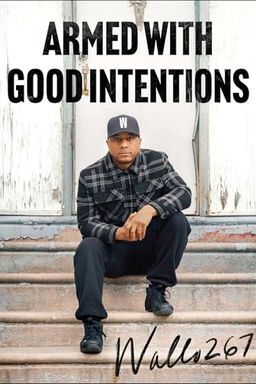
Armed With Good Intentions cover

Armed With Good Intentions

by Wallace “wallo267” Peeples With Raquel De Jesus

The entrepreneur and podcast host describes his time in the prison system and journey to success.

From Intentions to Transformation

Have you ever told yourself your intentions were good—only to watch your actions drag you somewhere you never wanted to go? In Armed With Good Intentions, Wallace “Wallo267” Peeples (with Raquel De Jesus) argues that good intentions don’t protect you from bad outcomes. What protects you—what actually transforms you—is ruthless accountability, a written vision you execute daily, and a commitment to serve people beyond yourself. He contends that you can turn the very energy that once fueled self-destruction into disciplined momentum, provided you face the truth about harm you caused, learn your environment’s rules, and build a new identity through consistent, public acts of value.

This is both a memoir and a manual. Peeples chronicles the arc from fatherless kid in North Philly to stick-up artist, to a teenager tried as an adult, to “the happiest man in prison,” to TEDx speaker, top podcaster, and Chief Marketing Officer of REFORM Alliance. Along the way, he demystifies survival in prison, reframes the hustle as legal marketing, and shows how forgiveness (even of his brother’s killer) can be a strategy for saving your own life. The claim is bold: your past can become a playlist for progress—if you learn to DJ it differently.

Why this matters now

Peeples writes against devastating odds. He cites Pennsylvania’s 64.7 percent three-year recidivism rate and admits he’s on parole until 2048. Yet he insists the odds improve the longer you stay out—and that small compounding wins beat big, flashy risks. For anyone navigating cycles of poverty, the street economy, or a family history of incarceration, this book offers a practical counter-program: document your vision (“The Book of Life”), get educated (GED, law library), transform the hustle into legal marketing (à la Steve Stoute’s The Tanning of America and George Lois’s Damn Good Advice), build a reputation for service, and tell the truth when it counts (even to the parole board).

What you’ll learn in this summary

  • How environments script identity—and how to rewrite your script (from “Front Step University” to Karate Earl to Nanny).
  • How prison really works: the economy, respect, danger, and the game of opposites (echoing Viktor Frankl’s “choose your response” but with raw, day-room realism).
  • Why accountability beats alibis, and how letters, journaling, and anger management unlock self-respect.
  • How to transmute the hustle into brand building, content, and service (from kitchen platters to iPhone research to viral skits to a global podcast).
  • How forgiveness and grief work keep you alive—and free.
  • A reentry playbook: start tiny, build loud, serve daily, and never act entitled.

The core argument

“Armed with good intentions” can be a dangerous lie when it excuses harm. Peeples reframes it: intentions are raw fuel; discipline is the engine; service is the steering; and forgiveness is the brake. He turns the “hustler’s energy” that once ran armed robberies (KFC at 17, Blockbuster at 23) into institutional learning (GED, culinary certificate), entrepreneurial action (selling platters; content marketing), and civic leadership (REFORM Alliance CMO). He shows how a man with no MBA can read George Lois, study ads on a prison TV, journal a life plan, and later run national campaigns that move policy and culture.

Key Idea

Survival without purpose makes you hard; purpose without accountability makes you dangerous. Combine purpose and accountability and you get momentum you can trust.

How this guide is structured

We start with the forces that shaped young “Little Wally”—the pull of father-myth, hood legends, and early praise for the wrong things. Then we enter the prison crucible: a place of danger, respect, and accidental education. From there, we move to the interior work—letters to “Freedom,” anger management, and the math that proves crime pays less than a penny an hour. We’ll explore how Peeples remixed the hustle into a legal marketing engine, how his voice became a vehicle for service (Real Street Talk, TEDx, Million Dollaz Worth of Game), and how grief, mentorship, and forgiveness remapped his compass. We close with the reentry blueprint and systems-level work—proof that one person’s transformation can ripple into policy, platforms, and programs.

If you’ve ever felt trapped by your past, your block, or a bad story about who you are, this book—and the ideas below—gives you a way to narrate and then live a different ending.


Environment Scripts Identity

Peeples shows you how a neighborhood can become a classroom—sometimes a corrupt one. He calls his childhood “Front Step University,” a place where the nine-to-fivers trudged home ignored while Benz-driving hustlers were celebrated to a soundtrack of Cameo’s “Candy.” From Nicetown (“Ain’t Nothing Nice”) to 13th Street, the praise economy taught him what earned respect. When your role models get applause for fast money and heavy jewelry, it’s rational to chase the applause.

The father-void and hood legends

Peeples’ father, Wallace Roundtree—a stylish hustler—disappeared when Peeples was two. That absence created a powerful pull. He longed to be spoken of with the same reverence. Enter the hood legend: people like “Karate Earl,” the ageless neighbor who taught him kung fu, walked on tiptoes in slippers, and embodied defiant individuality. Earl offered an alternate script—disciplined mastery—right when “The Last Dragon” gave Black kids a Bruce Lee they could become. But peer pressure mocked that glow. By nine, Peeples traded dojo drills for “going on route” with brother Steven: boosting, chain snatching, and picking “easy targets” near Broad Street transit.

The lesson: your first teachers are the people your block claps for. Unless a counterexample gives you status for a different definition of “man.” (Compare Bryan Stevenson’s Just Mercy: if systems applaud punishment over healing, you’ll absorb that creed until someone models another.)

Nanny’s love vs. the street syllabus

His grandmother, Nanny (Lois Peeples), ran inventory for 31 years, baked apple pound cake, and called out bottle models by sight (“Cylinder, shorty neck, 30-millimeter cap”). She was thorough and tender, whisk(e)y-sipping and wise. She warned him: “When you stop moving, you stop moving.” She took him to Seaford, Virginia to make sun tea with Great-Grandma Lee. Those trips showed him other skies, slower rhythms, and the quiet love working people give. Yet grief, anger, and a craving to be the man pushed him back. Nine days after his eleventh birthday, a chain snatch ended in public cuffs—and disappointment on Nanny’s face he feared more than court.

Key Idea

You imitate who gets praised in your proximity. If no one applauds patience and craft, the urgent wins. You need living, local examples of a different applause.

Why “imaginary player” matters

At 14, Peeples falls for Veronica (“Ronnie”)—and learns a counter-lesson. Beneath 2 Live Crew posturing and Iceberg Slim fantasies, he just wants to be loved. When she leaves after he plays hard, he cries on the phone like Tre in Boyz n the Hood. He gets her back briefly, then loses her for good. The scene exposes a deeper truth: posturing fills the father-void without healing it. You need mentors who respect your feelings, not just your toughness.

The moment the street meets destiny

By 17, he’s robbing a KFC—lip twitching, no mask, nickel .22 at a clerk’s ribs—because a OG showed “how easy” a $15K morning deposit can be. He tosses the gun, gets grabbed, and Mr. Sammy—an elder—lays him down safely for the cops. Weeks later, a female CO hums him “Happy Birthday” as he turns 18 and is marched into a cell where a form asks, “Where should we send your body in case of death?” That bureaucratic question reframes identity. It also proves the earlier point: the block’s syllabus works, until reality changes the course.

Environment scripts identity. To rewrite it, you need Nanny-level love, Earl-level mastery models, and a Mr. Sammy who grabs your life in urgent moments. Short of that, you’ll default to the syllabus your steps teach.


Prison: A Brutal Classroom

Behind the wall, Peeples learns that prison is paradox. It’s one of the most respectful places he’s ever been—because one small disrespect can spark a war—and also one of the most predatory. He calls it a “game of opposites”: when things look right, they might go left; comfort attracts risk; and the people you fear might be the ones who save you. (This echoes Viktor Frankl’s Man’s Search for Meaning on choosing your stance, but here the curriculum is chow hall, yard, and the hole.)

The economy and respect

He learns the block economy from his bunky Mitch and messenger Ray: smokes, smut mags, commissary, and contraband (Sinequan “quan” from psych)—with margins protected by silence and “knowing your lane.” When Peeples casually tells a Puerto Rican inmate the price points “on our side,” he’s quietly disciplined in-cell to teach him the first law: mind your business, or get worked. In chow, the feared C.O. “Cold Blooded” (Cole) elbows his face for a slip; an intake officer, Ms. Walker, unexpectedly intervenes. The rules are ruthless and weirdly humane, often in the same hour.

He also witnesses savage violence: a ten-pound weight bashing a skull after a drug beef; a redheaded transfer raped to death by a “booty bandit,” a story told in hushed tones that underscores predation and the stakes of every decision. Yet even here, there’s discipline: territories by city and race; unspoken protocols; and the constant calculation of “twenty-three and one.”

Education: from GED to law library

Peeples treats the law library like a gym for his mind. He studies for a GED after psych evaluations labeled him “below average” with attention issues. Passing becomes an identity makeover. He writes “Letters to Freedom,” a series to his future self, and later begins “The Book of Life,” a journal of plans, ethics, and future ventures—naming what he wants before he can act it out. He also practices “sidewalk therapy,” interrogating incoming cellies about restaurants, movies, and life beyond bars to keep his imagination calibrated to the free world. (Compare Jeff Henderson’s Cooked for kitchen-to-career transformation; Peeples even follows Henderson’s path into culinary training.)

Key Idea

If you don’t write your next life while you’re living this one, the next life will write you. Paper is practice for freedom.

“The happiest man in prison”

Over time, Peeples becomes the guy urging others to “do one thing better than yesterday.” He accepts mentor wisdom from an elder named Rick (who admits he started as a follower, then killed a clerk in panic on his first run) and from Shoes, a sick OG who knew his father and let Peeples read to him until he passed away. Peeples learns to absorb loss without lashing out—and to convert anger into service.

There are stumbles. He engages a female C.O. romantically, then ends it to protect her job. He admits to the parole board—plainly—that he used a contraband phone for YouTube tutorials, business ideas, social media… and porn. That radical honesty (“off the record,” a commissioner later says) helps shift them from gridlock to parole. In a world where fronts are frequent, candor is competitive advantage.

If the street made him a student of applause, prison made him a student of cause-and-effect. When respect keeps you alive and reading gets you free, you learn to study what works.


Accountability Beats Alibis

Peeples’ transformation hinges on a hard pivot: stop narrating yourself as a victim of good intentions and face the harm you chose. He documents it in his “Letters to Freedom,” where he calls out the nonsense around him—and in him. He critiques men who play cards all day, then blame the system when denied parole; who confuse breaking the law with knowing it; who phone-bully the women holding them down. Then he flips the mirror: I did robberies pointing guns at people’s ribs. I rationalized it because it was “company money.” I could have killed someone.

Do the math on the myth

His most devastating exercise is financial. The Blockbuster heist netted $859 for three men; Peeples’ share was $286. He served 15 years. Assuming 2,000 work hours a year for 15 years, that’s 30,000 hours. $286/30,000 = $0.009/hour. Less than a penny. He writes, “Crime might pay short-term, but over time it costs way more.” That one spreadsheet crushes a thousand gangster myths (this pairs well with Nassim Taleb’s discussions on ruin; a fat-tail downside makes one “win” catastrophic).

Anger management and the inner pivot

In group programs, Peeples reframes anger using Malcolm X’s line: “When they get angry, they bring about change.” The trick is channeling anger toward reform, not revenge. He practices this in a catalytic moment with a young man named Rico. Mid-session, Peeples stands up and tells him (and also, really, his big brother Steven): stop worshiping your past self; your kids don’t care who you were; who are you today? The room goes still—then laughs in discomfort—because truth lands with a thud before it liberates. That day becomes Peeples’ purpose: move men from rationalization to responsibility.

Key Idea

Accountability isn’t a confession; it’s a capability. When you own the cause, you reclaim the effect.

Redefine “armed with good intentions”

By the end, the title becomes a double-edged warning and a framework. Bad actors often say “my intentions were good” as cover. Peeples flips it: be armed with good intentions organized—backed by papered plans, tiny compounding actions, and public service. He journals what he’ll do his first week out; one week later he records a video with $1,000 cash and his notebook on Nanny’s bed: “I’ll turn this thousand into a hundred grand, then a million.” People laughed. Then watched. Then bought T-shirts out of his minivan trunk. The proof wasn’t in a promise. It was in a pile of repeated, observable work.

If you’re stuck in your own “intentions,” try his sequence: write it; say it; ship it small; serve people; repeat with receipts. Accountability, done daily, compounds into a changed identity.


Rewiring The Hustle

Peeples didn’t stop hustling—he changed what he hustled. In prison, he fell in love with marketing. He’d watch McDonald’s commercials and marvel that the studio burger looked nothing like the cafeteria’s. That gap—between perception and product—sent him down a rabbit hole. He read George Lois’s Damn Good Advice (Big Ideas shape culture) and Steve Stoute’s The Tanning of America (translate hip-hop’s value into corporate language). He clocked Anthony Bourdain’s curiosity as a model for talking to anyone with respect. He realized the street life was one big ad: Benz + chain + pinky ring = conversion. So he’d sell something different: hope with proof.

Implements of escape

When an iPod Touch and a Clear hotspot landed in his hands (via a risky route), the device became an “implement of escape.” He googled himself (panicked when he saw his name), then used YouTube to study business models, copywriting, content cadence, and platform dynamics. He also built a little “telecommunications business” in the joint, flipping phones—a risk that later landed him in the hole. Ironically, that hole helped him grieve his brother Steven’s murder and re-clarify his mission. The tool that got him punished also equipped him to lead when released.

From kitchen platters to brand assets

At Dallas and Graterford, he earned a culinary certificate and cooked for 5,000 men. He sold $10 platters (priced as a pack of cigarettes) and learned unit economics and quality control. Post-release, he reinvested every dollar into inventory, LLCs, trademarks (Wallo267—the 267 nodding to his state ID), websites, and content. He walked Philadelphia alone listening to Springsteen’s “Streets of Philadelphia,” shot viral skits (ketchup on his forehead in a fake coffin: “Don’t wait until it’s too late”), and used humor to interrupt the scroll. He knew social platforms were an attention game, so he met people where they were and snuck lessons into laughs (a content strategy Gary Vaynerchuk would applaud).

Key Idea

What you practiced illegally (finding demand, managing risk, reading people) is a superpower when the product becomes value and the metric becomes trust.

The “Book of Life” as operating system

He didn’t wing any of this. “The Book of Life” hosted daily plans, talking points, and experiments. It reminded him of Shoes’ dying wish: “Live your motherf***ing life—for me.” It captured lines that became mantras (“And it’s just like that”). And it gave him a way to iterate: ship video, watch comments, adjust tone, stay funny, get clearer. Consistency made him legible to strangers. Legibility made him bankable. Bankability let him scale service.

Rewiring the hustle isn’t moralizing—it’s retargeting. If you can sell chaos, you can sell change. The latter sustains longer.


Voice, Service, And Momentum

Your voice becomes valuable when it shortens someone else’s suffering. In prison, Peeples spoke at “Real Street Talk,” a program where older inmates tried to reach new intakes. After one of his talks, an OG named Brother Ali told him his delivery gave him chills—“like when Brother Malcolm was alive.” That blessing—given wisely, not loosely—became a battery. Peeples leaned into his natural speed, humor, and plain talk, and he practiced relentless empathy wrapped in jokes. The blend made hard truths digestible.

The Rico moment: when purpose clicks

In the addiction program, when Rico slumped late into session, Peeples risked intimacy and pushback. He thanked Rico for showing up (respect), then called him to account (truth): no one cares who you were; who are you now for your kids? The silence in that room birthed a calling: help people choose today over nostalgia. From there, he became the guy others called “Pastor Peeples,” sometimes teasingly—but always listening.

Forgiveness as strategy

After Steven was murdered, Peeples woke to 22 missed calls and a new world. Grief roared. The block expected retaliation. Instead, on a TEDx stage in Buckhead, he said the most countercultural sentence a street-certified man could say: “I forgave my brother’s killer.” He wasn’t absolving; he was abstaining—from the cycle that would put him back in a cage. He saw what Jay-Z once described about his own father’s ruin chasing his brother’s killer. Forgiveness, Peeples realized, is a survival tactic. (This resonates with Desmond Tutu’s No Future Without Forgiveness: it frees the future from yesterday’s chains.)

Key Idea

Service flows better through a nervous system not hijacked by revenge. Forgiveness makes the channel clear.

Candor that changes rooms

The parole board scene shows his style. He lists his progress (GED, culinary, groups), then answers a contraband question plainly: he studied business, built @Wallo267, and watched porn. The panel goes silent. After recess, they grant parole—“off the record,” one says, admitting that honesty tipped a gridlocked decision. That’s not performance. It’s the long practice of telling the truth so consistently it becomes your brand.

Put simply: voice + service = momentum. When people believe you mean it, they follow.


A Reentry Playbook

Coming home is a test most fail not because they can’t, but because they expect applause to feed them. Peeples refuses entitlement. He is literally on parole until 2048—any slip could snap him back. He focuses on compounding tiny wins that publicize a bigger plan.

Start smaller than your ego

He starts with $1,000 on Nanny’s bed and a phone. He records a declaration, then sells merch out of a beat-up minivan, reinvesting every dollar into legal structure (LLCs), IP protection (trademarks), sites, and production. He walks the city alone—“the only thing I had was me, my book bag, and earphones”—capturing content and feedback. Cousin Gillie backs him even when others clown the skits. The test: can you endure being misread while staying useful?

Make them laugh to make them listen

He leans on comedy to break the feed, a technique marketers from Seth Godin to Issa Rae use. The point isn’t gags; it’s hooks. With the hook, he slips in principles about patience, paperwork, and resilience. He builds a cadence that makes him predictable in the best way. Predictability earns trust. Trust unlocks doors.

Scale what proves itself

In February 2019, after reading a Variety piece that Spotify would spend up to $500M on podcasts, he and Gillie sprint. Within seven hours of launching Million Dollaz Worth of Game, they hit #2 in comedy and #4 overall. They later ink a deal with Barstool Sports that preserves their voice and funnels $4.5M to support small businesses post-pandemic. The brand remains rooted in the same three beats: tell the truth, serve the people, and keep it funny.

Key Idea

Reentry is not a comeback tour; it’s a startup. Treat your life like an early-stage company: ship, learn, and never mistake likes for livelihood.

Stay out by staying useful

He studies recidivism math the way he studied robbery margins: every year out lowers risk. Use each year to build another moat—contracts, community, content, character. He avoids old beefs (even when Baby D reappears in chains on a transfer), chooses silence over rumor, and keeps his circle aligned to production over provocation. The meter on freedom rewards boring, repeated goodness.

If you’re reentering anything—workforce, health, or a relationship—the same rules apply: begin tiny, declare publicly, stay funny, be useful, reinvest, and track compounding. That’s not show; that’s survival with upside.


Healing, Family, And Forgiveness

The book’s heart is relational. Nanny’s kitchen and Great-Grandma Lee’s porch are sanctuaries; his mother Jackie is complicated—young when she had him, often guarded, sometimes painfully practical (“You’ll be alright,” after his sentence). The healing arc runs through small, brave acts: calling his mother from the prison phone to say “I love you” on purpose; receiving elder Rick’s challenge to tell her first; letting Shoes’ love break his cynicism; and, later, letting grief break him open in the hole after Steven’s death.

A brother’s bond—and a break

Steven puts Peeples on his first “route,” then years later becomes his bunky. They dream up life after prison together. Steven gets an appeal and goes home. Then a rift: Peeples wants $5,000 for a lawyer; Steven declines, believing the case is weak. They go silent for years. When Peeples wakes to news of Steven’s murder, he also carries the weight of words unsaid. In the hole, he works through it: grief, rage, regret, then release. He chooses to forgive his brother’s killer publicly, not to absolve the act but to preserve his own future.

Mentors as medicine

Rick’s confession (“I was a follower”) protects Peeples from throwing his life away trying to prove leadership through violence. Shoes’ request (“Live…for me”) becomes a sacred duty. Ms. Walker’s intervention interrupts state-sanctioned cruelty. Brother Ali’s compliment gives permission to speak boldly. Mr. Sammy’s arms on the sidewalk save a teenager from a hail of bullets. None of them fix everything. Together, they fix enough.

Key Idea

You don’t heal alone—even if you start alone. Find elders, accept small rescues, and return the favor with your life.

Redefining masculinity

From crying over Ronnie at 14, to naming childhood sexual exploitation by Brenda (a near-30 woman who groomed him at 13) as abuse—only years later—Peeples models a masculinity that tells the truth. He holds a paradox: be a protector of women in a culture that exploits them; be a father-uncle who hears his niece MayMay say, “Don’t leave me,” and vows to stay out. He’s still funny and fast and Philly. But the center is soft on purpose.

In short: family, mentors, and forgiveness don’t erase pain; they organize it into meaning you can walk with.


From Personal To Systems Change

Personal reform scales when you plug it into platforms and policy. Peeples’ arc ends with appointments and programs that multiply his message. He becomes Cultural Advisor at YouTube, launching YouTube Avenues to teach creators in Philly, Atlanta, Houston, Oakland, D.C., Baltimore, and New Orleans how to start, scale, and monetize channels—with hard-won lessons about cadence, copyright, and consistency. He speaks to NFL rookies about money and mindset. He and Gillie’s Barstool relationship includes a $4.5M relief fund for small businesses post-COVID.

REFORM Alliance: CMO by lived experience

In 2024, he’s named Chief Marketing Officer of REFORM Alliance (founded by Meek Mill, Jay-Z, Michael Rubin, Michael Novogratz, Clara Wu Tsai, and Dan Loeb) to transform probation and parole. Rubin calls him a “one-man self-marketing agency.” Peeples brings the prison yard’s clarity to boardrooms: talk direct, stay people-first, keep campaigns raw and real. The symbolism matters: a man with no degree who learned marketing from a prison TV and a George Lois paperback now steers national narratives so fewer people suffer what he did.

Represent the forgotten

Peeples insists he represents “the people the world forgot”: poor neighborhoods, returning citizens, people battling addiction. He treats each title—podcaster, advisor, CMO—as a megaphone for them. Systems work, he shows, is just scaled service: the same voice that calmed a chow hall fight can calm a culture war; the same honesty that moved a parole board can move a statehouse.

Key Idea

Your biggest platform is still your daily practice. But when institutions hand you a mic, point it at people who don’t get mics.

Why this ending matters

The story could have ended with a viral feed. Instead, it ends with policy levers. This satisfies a moral arc (like Bryan Stevenson’s call to proximity in Just Mercy): don’t just tell stories; change structures. Peeples frames his CMO role not as “I made it” but as “Look at us now.” The “us” is the block, the bunky, the caregiver, the kid deciding between Karate Earl and a quick lick.

Systems don’t change from sermons alone. They change when a million small acts and a few big platforms amplify each other. That’s how “armed with good intentions” becomes armed with good institutions—and people who know how to use them.

Dig Deeper

Get personalized prompts to apply these lessons to your life and deepen your understanding.

Go Deeper

Get the Full Experience

Download Insight Books for AI-powered reflections, quizzes, and more.