
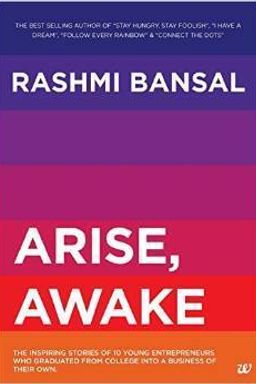
Arise, Awake cover

Arise, Awake

by Rashmi Bansal

Arise, Awake unveils the inspiring journeys of India''s young entrepreneurs who have transformed diverse industries by solving local problems with innovative solutions. These stories of grit and determination encourage readers to pursue their entrepreneurial dreams.

Arise, Awake: The Spirit of Student Entrepreneurship

Have you ever wondered what might happen if you stopped waiting for the 'right time' to start something and simply began today? Rashmi Bansal’s Arise, Awake takes this question head-on. The book argues that college isn’t just a time for studying or job hunting—it’s the perfect incubator for entrepreneurial dreams. Through the inspiring stories of ten young Indian entrepreneurs who launched real businesses while still in college, Bansal challenges readers to shed fear, embrace experimentation, and take their first bold steps toward independence.

Bansal contends that the true spirit of enterprise is not about waiting for funding, fancy degrees, or the right contacts—it’s about vision, resourcefulness, and grit. The heroes of this book prove that passion, perseverance, and self-belief can transform modest ideas into thriving ventures.

A Wake-Up Call for Youth

Bansal opens with Swami Vivekananda’s resounding call—“Arise, awake, and stop not till the goal is reached.” She weaves this spiritual rallying cry into the modern landscape of startups, presenting entrepreneurship not just as a career path but as a way of living with purpose. For today’s students, she argues, the barriers to starting up have never been lower, yet mental barriers—fear of failure, parental pressure, and social conformity—keep many from trying.

Each chapter demolishes one such barrier through a living example: whether it’s Shashank N D and Abhinav Lal turning a final-year project into Practo, a ₹20 crore medical technology company; or Aruj Garg, the law student who turned his college food joint into Bhukkad, a healthy fast food brand. The variety of their backgrounds proves that there is no single formula for entrepreneurial success—only a shared will to experiment and persist.

Three Kinds of Dreamers: Rankers, Repeaters, and Rebels

The book is structured into three categories: Rankers who excel academically and then break into uncharted territory; Repeaters who stumble but rise again with new ideas; and Rebels who defy societal expectations to follow their unique passions. This triptych mirrors the psychological arc of aspiring entrepreneurs: initial enthusiasm, failure or resistance, and eventual independence.

For instance, in the ‘Rankers’ section, IIT and IIM graduates use their analytical skills to build scalable, high-value enterprises. In ‘Repeaters,’ we meet college dropouts and modest performers who rely on street smarts and hustle. The ‘Rebels’ chart paths so unconventional—from fraud detection to dosa-making machines—that they redefine the very idea of what an entrepreneur can be.

The Common Denominator: Action over Approval

What connects these ten stories isn’t luck or privilege but the decision to do something — to act rather than await permission. Bansal’s writing makes it clear that action births clarity. Almost every entrepreneur in the book begins with uncertainty, limited capital, and zero contacts. Yet action is what reveals opportunity. Practo’s founders didn’t know anything about healthcare software until they talked to a doctor who offered their first ₹5000 cheque. Magicrete’s team learned construction materials by visiting factories. Each story shows that your “Plan A” rarely works, but execution creates new possibilities.

Throughout, Bansal reminds readers that entrepreneurship thrives where courage and curiosity intersect. Her own journey mirrors this principle: quitting stable paths to pursue writing, she emphasizes that creativity and business are simply ways to exercise one’s inner calling.

Why This Book Matters Now

Arise, Awake captures a turning point in India’s youth culture: a shift from the dream of high-paying jobs to the dream of meaningful impact. Published in 2015 during the early wave of India’s startup ecosystem, it serves both as documentary and manifesto. For every reader wondering “Can I really start from where I am?”, these stories stand as proof that learning, creativity, and entrepreneurship can—and should—begin now.

“Life is a massive multiplayer game,” Bansal writes. “So put on your avatar, do your thing. Many lives and many adventures await—your time starts now.”

In essence, Arise, Awake isn’t just a collection of success stories—it’s a blueprint for fearless living. It asks you to take your first step, however small, towards the life you want to create. It shows that when you dare to act, even failure becomes your tuition fee for greatness.


Learning by Doing: Practo’s Journey from Idea to Impact

Imagine building a ₹20 crore company before your graduation ceremony. That’s precisely what Shashank N D and Abhinav Lal did at NIT Surathkal when they founded Practo Technologies. Their story embodies one of Rashmi Bansal’s central messages: entrepreneurship is the best education you can get, if you’re willing to learn by doing.

From Classroom Curiosity to Real-World Opportunity

At NIT Surathkal, Shashank stumbled upon the concept of an entrepreneurship cell—an unfamiliar term in 2006. Yet that single spark led him and Abhinav into a whirlwind of exploration: attending talks, meeting founders, and soaking in the energy of India’s early startup ecosystem. Like many innovators, they started with multiple ideas that failed to click. Their tenth attempt—software to help doctors manage appointments—was the one that finally worked.

Bansal portrays their first product pitch not as a triumph but as a disaster. Dressed in ill-fitting suits, the young founders faced a hall full of indifferent doctors. Still, one doctor, Dr. Mohammed Ali, saw potential. His willingness to pay ₹5000 gave the duo their first real assignment—and a reason not to quit. Out of that humble payment was born what would become India’s most prominent healthcare platform.

Building While Learning

The Practo story demonstrates how successful entrepreneurs transform ignorance into expertise through immersion. The founders didn’t know the medical industry, sales, or software-as-a-service models. Yet they harnessed curiosity as a business tool. They built prototypes, tested on real users, adjusted relentlessly, and stayed close to feedback. They also learned the importance of something most engineers neglect—salesmanship. Shashank famously said, “If it’s not magic, the doctor won’t buy it.” He and his team learned to create moments of delight, giving doctors quick wins that closed deals on the spot.

Rashmi Bansal emphasizes that this type of experimentation is the essence of entrepreneurship. It’s education with stakes. The lessons cost time, sleep, and comfort, but teach resourcefulness—how to pitch ideas, convince professionals, and handle rejection. Those soft skills, she argues, can never be learned in a lecture hall.

The Turning Point with Sequoia Capital

After countless rejections from investors who doubted that Indian doctors would buy SaaS products, fate led Shashank to Sequoia Capital. Instead of grilling them about ROI and market size, investor Shailendra Singh asked one question: “Why are you doing this?” That conversation changed everything. It was passion, not profit, that convinced Sequoia to invest. Overnight, the young men went from empty bank accounts to leading one of India’s first health-tech success stories. Within two years, Practo had scaled to 25 employees and offices across multiple cities. Their next funding round of ₹25 crore enabled global expansion.

This story mirrors the startup trajectory of Silicon Valley legends like Airbnb or Dropbox—beginning with an unsolved user problem, bootstrapping in obscurity, and winning through persistence. It also shows one of Bansal’s key beliefs: investors bet on conviction before they bet on numbers.

Key Lessons from Practo’s Growth

  • Start early—student life is the safest time to take risks.
  • Don’t wait for perfect knowledge; learn by solving real problems.
  • Sales skills are as critical as technical talent.
  • Believe in your mission—funding follows passion and persistence.

Practo’s founders exemplify that true entrepreneurs aren’t born with grand ideas—they grow into them. They started by trying to help one doctor and ended up transforming how millions of Indians access healthcare. Bansal uses their story to assure every reader: even the smallest beginnings can lead to movement-making results, provided you don’t stop at the first 'no.'


Turning Waste into Wealth: The Magicrete Story

Sourabh Bansal, Sidharth Bansal, and Puneet Mittal prove that you don’t have to invent a new app to be an entrepreneur—you can reinvent an old industry. Their company, Magicrete, produces environment-friendly AAC blocks and transformed construction materials in India. Through their journey, Rashmi Bansal highlights a vital truth: innovation is not only about technology but also about vision and perseverance.

From IIT Dreams to Real Factories

Sourabh’s story begins in IIT Kharagpur, where ambition sparkled literally on his hostel wall—he wrote “₹5000 crore” beside his bed. That audacious vision became his north star. After considering multiple ideas—from RFID to solar energy—he learned to focus on *one solvable industrial gap*. That gap, surprisingly, was brick-making. Traditional red-brick production was outdated, polluting, and fragmented. Sourabh discovered that AAC blocks were lighter, stronger, and eco-friendly—but rare in India due to high production costs.

Together with his brother Sidharth and CA Puneet Mittal, Sourabh convinced an investor to fund the idea. They learned fundamentals of banking, manufacturing, and supply chain operations on the job. Problems—from protesting villagers to machinery imports gone wrong—tested their discipline but sharpened their entrepreneurship muscles. By 2014, Magicrete’s revenue crossed ₹130 crore, and the team expanded across regions.

The Power of Practical Vision

What makes their story powerful is not just scale but courage to professionalize an unglamorous field. Bansal draws parallels to companies like Cemex or Tata Steel—industries built by persistently upgrading processes. Magicrete became India's symbol of “wealth from waste,” using fly ash (a power industry byproduct) to produce blocks, turning pollution into profit.

Like many entrepreneurs in Arise, Awake, the Bansal brothers learned to dream big without losing thrift. They borrowed wisely, reinvested prudently, and focused on sustainability. Their real value lay not in fantasy but in focus—proof that steady enterprises can be as inspiring as glamorous tech startups.

“Dream big, but build brick by brick.” —Sourabh Bansal’s advice to students captures the mental model of long-term entrepreneurship.

Their trajectory underlines a broader lesson Bansal champions throughout the book: India’s future founders will come not only from the tech sector but from every workshop, factory, and town willing to reimagine how the old economy works. Magicrete’s growth reminds readers that passion becomes power when paired with persistence.


When Failure Becomes a Teacher: The Bewakoof Story

Prabhkiran Singh and Siddharth Munot of IIT Bombay show that business school curricula can’t match the lessons failure can teach. Their first venture—selling lassi outside college—flopped. Their second, Bewakoof, became one of India’s most beloved youth brands. Through their story, Bansal reframes failure as the tuition fee of entrepreneurship.

Selling Lassi, Learning Life

As a third-year student, Prabhkiran started a stall named 'Khadke Glassi'. Friends mocked him for “wasting an IIT seat”, yet he returned every evening to serve lassi for ₹25 a glass. When monsoon hit and sales collapsed, he shut down with no money but newfound resilience. Bansal portrays this not as a failure but a formative success: the stall taught humility, budgeting, customer service, and the hard truth that ideas die easily—but entrepreneurs grow tougher.

Failure Breeds Innovation

Later, Prabhkiran and Siddharth used humor and digital savvy to found Bewakoof.com, converting their irreverent campus humor—and Facebook virality—into business. The casual apparel brand resonated with youth for its funny slogans and relatable attitude (“Ghanta Engineering”, “Aal Izz Well”). Their willingness to start small, sell directly, and use social media before influencers existed gave them exponential reach. Within two years, Bewakoof’s monthly sales crossed ₹1 crore.

Bansal highlights how their entrepreneurial education came not from books but from the streets: cold calls to sponsors, standing at festivals, handling logistics, and balancing egos. She compares their learning curve to that of Richard Branson—each failure feeding the next daring experiment.

The Courage to Look Foolish

Their brand name—‘Bewakoof’ (“foolish”)—is a metaphor for the entire book’s ethos: owning your mistakes, embracing experimentation, and celebrating imperfection. When everyone around you says, “Yeh to hona hi tha,” “this was bound to fail,” you just focus on what’s next. That mindset transformed two so-called ‘idiots’ into millionaires in their twenties.

The moral? Entrepreneurship doesn’t reward perfection—it rewards persistence. Bansal uses Bewakoof’s story to remind young readers: don’t fear being called foolish. The world changes because a few people are mad enough to act.


Second Chances and Smart Pivots: Learning from Innovese and InOpen

Some entrepreneurs learn by winning twice; others learn by falling apart first. In the stories of Ankit Gupta and Dhruv Sogani of Innovese Technologies and Rupesh Shah of InOpen Technologies, Bansal shows that resilience and reinvention are central to entrepreneurial maturity.

When Teams Break, People Grow

Innovese Technologies began at BITS Pilani as a student start-up that created a smart ad-based CAPTCHA system called YoCaptcha. It was clever, popular, and even attracted acquisition offers. But internal rifts—ego, miscommunication, and burnout—tore the company apart. Bansal doesn’t romanticize this collapse. She dissects it: the missing ingredient was emotional intelligence. The founders had brains and product-market fit but lacked alignment as partners. Their subsequent sale to a larger firm taught them that “who you build with” matters as much as “what you build.”

From Failure to Foundation

Rupesh Shah of InOpen Technologies faced a different kind of struggle—academic failure. Rejected from IIT and failing exams, he found redemption in open-source software. His persistence led him to an internship at IIT Bombay, where he co-developed Computer Masti, a computer science curriculum for children. What started as a passion project now educates over 500,000 students across India and abroad.

Bansal contrasts Rupesh’s self-taught success with the institutional collapse of Innovese to show two sides of grit: one recovers after losing direction, the other rebuilds systems after losing people. Both prove that setbacks don’t end dreams—they refine them.

“Every failure has a pattern,” Rupesh says, “and once you decode it, it becomes ordinary.” His insight captures the mental resilience that binds all ‘repeaters.’

The broader takeaway? Don’t fear iteration—whether of your product, partnership, or purpose. These stories remind readers that good entrepreneurs pivot; great ones evolve.


Rebels with a Cause: From Dosas to Fraud Detection

The third group in Bansal’s book, the Rebels, redefine what it means to create impact. Whether it’s making healthier food or tackling financial crime, each rebel shows that profit and purpose can go hand in hand. From Aruj Garg’s natural fast-food chain Bhukkad to Apurva Joshi’s innovation in forensic accounting, these stories explore how unconventional interests become world-class solutions.

Bhukkad: A Law Student Feeds the Hungry

Studying at National Law School in Bangalore, Aruj realized he didn’t want to be a lawyer—he wanted to solve real problems. The biggest one around him? Bad campus food. He started a takeaway joint for hungry students. That small kitchen became Bhukkad, a healthy fast-food brand expanding across Bangalore. Bansal paints him as a new-age entrepreneur—conscious, curious, and committed to well-being—someone who replaced courtroom briefs with recipe sheets and found a deeper form of justice in feeding people good food.

Apurva Joshi: Catching Thieves with Numbers

Meanwhile, Apurva Joshi, a chartered accountancy student, entered the obscure field of forensic accounting. Facing skepticism, she pursued the Certified Fraud Examiner course, learned digital forensics tools, and launched Fraudexpress, a platform for fraud-risk education. At 24, she co-developed India’s first university-recognized diploma in forensic accounting—proving that a young woman from Solapur could influence an entire professional field. Her story resonates with rebels worldwide—people who see gaps not as problems but as opportunities for service.

Different Paths, One Principle

Whether it’s Anurag Arora’s student hostel business or Eshwar Vikas and Sudeep Sabat’s Dosamatic dosa machine, all these ventures share one thread: rebellion against passive living. They teach that ‘rebellion’ in entrepreneurship isn’t about defiance for its own sake—it’s about redefining what’s possible in your own domain.

“Take that leap and be at it—it will work out in some way,” says Aruj, echoing a truth every reader of Arise, Awake should internalize.

Through their unconventional journeys, Bansal’s Rebels redefine success—not in job titles, but in impact, courage, and the joy of doing something they deeply care about.


The Pattern of Every Entrepreneur’s Journey

Across all ten stories, Rashmi Bansal identifies a recurring rhythm—awakening, action, adversity, adaptation, and achievement. It’s not a formula but a lived pattern seen from Practo’s medical software to Bewakoof’s T-shirts. This pattern, she suggests, can guide anyone who aspires to build something meaningful.

Stage 1: Awakening

Every story begins with discontent—an itch to do more than fit in. For Shashank of Practo, it was the desire to solve his father’s health record chaos. For Rupesh of InOpen, it was frustration with meaningless rote learning. In your own life, awakening happens when you stop asking, “Why me?” and start asking, “Why not me?”

Stage 2: Action

Once awakened, these entrepreneurs took immediate action. No perfect plan existed—only motion. They made sales calls, built prototypes, designed boxes, cooked dosas, and spoke to whoever would listen. As Bansal writes, execution creates momentum, and momentum breeds clarity. Even when directions change, the act of doing becomes the seed of discovery.

Stage 3: Adversity and Adaptation

Every journey in this book hits turbulence—failed ventures, delays, lack of funds, or family pressure. Instead of quitting, these founders learn to adapt. Bewakoof pivoted from lassi to T-shirts; InOpen shifted from free content to paid school programs; Magicrete refined pricing models continuously. Entrepreneurship, the book teaches, is not about avoiding problems but mastering flexibility.

Stage 4: Achievement and Continuity

Achievement doesn’t mean the end of struggle—it means the beginning of scale. Once successful, these founders faced new challenges: hiring, leadership, managing growth. Those who sustained their ventures—like Practo or Magicrete—did so by staying learners. They treated success not as a trophy but as a responsibility to build systems and empower teams.

For readers, Bansal’s model offers reassurance: each stage has its pain but also its purpose. You may not start with clarity, but if you stay awake and act decisively, the pattern will eventually lead you to your own definition of success.

Dig Deeper

Get personalized prompts to apply these lessons to your life and deepen your understanding.

Go Deeper

Get the Full Experience

Download Insight Books for AI-powered reflections, quizzes, and more.