
Idea 1
Areté and the Heroic Operating System for Life
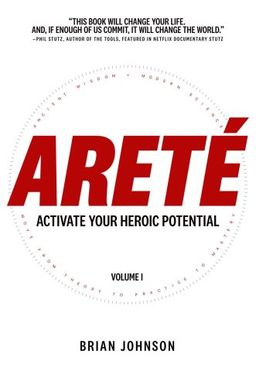
What does it mean to live your best life moment to moment? In Areté, Brian Johnson argues that excellence is not an abstract virtue or distant ideal—it is a practical operating system you can train daily. He revives the ancient Greek idea of areté—expressing your highest potential right now—and fuses it with modern behavioral science to create a manual for becoming what he calls a “Heroic” human being. Aristotle’s pursuit of eudaimonia meets Martin Seligman’s positive psychology, Phil Stutz’s action philosophy, and modern neuroscience in a single framework: flourish by living your virtues in action.
The book teaches you that your best self and your current self are always separated by a small, actionable gap. Closing that gap, one micro-behavior at a time, is the hero’s game. This philosophical compass points you toward becoming the protector, creator, and leader someone else needs you to be—through practical systems, not lofty ideals.
The Good Life as Direction, Not Destination
Carl Rogers once said, “The good life is a direction, not a destination.” Johnson agrees: the heroic journey isn’t about reaching perfection but about aligning your life toward progress. Tal Ben-Shahar calls these “guiding stars”—you never arrive, but you always move closer. Instead of fantasizing about some perfect future, you sculpt your best self daily, Michelangelo-style, by chipping away what’s in the way: bad habits, excuses, and resistance. Over time, those small cuts reveal the marble figure already within you.
(Practical lens: The author often asks readers to name their “telescope” goals—big, long-term visions—and their “microscope” tasks—what they can do in the next 24 hours to close the gap.) This balance between long-horizon purpose and short-horizon execution runs throughout the book’s structure.
The Big 3: Energy, Work, and Love
Brian builds his Heroic structure around what he calls the “Big 3”—Energy, Work, and Love. Freud said life revolves around work and love; Brian adds energy as their enabler. If you want to do great work or build profound love, you must start with physical vitality. Energy arises from mastering fundamentals: sleep, nutrition, movement, and breath. When you sustain that energy, you can channel it into Genius Work (focused, meaningful effort) and Heroic Love (acts of compassion and celebration that lift others).
Each area demands daily behaviors rooted in identity: you don’t “try” to be healthy, creative, or loving—you decide you are that kind of person and prove it with consistent action. That is the Heroic protocol: identity fuels virtue; virtue drives behavior; behavior compounds excellence.
Virtues and Flourishing
The book’s moral backbone comes from four cardinal virtues—Wisdom, Discipline, Love, and Courage—unified into a modern behavioral science. Living your virtues activates the psychological ingredients of flourishing: Positive emotion, Engagement, Relationships, Meaning, and Achievement (Seligman’s PERMA). Empirical studies show gratitude, hope, zest, curiosity, and love predict the highest well-being. Johnson doesn’t treat these as abstractions but as habits—writing weekly gratitude lists, WOOP-ing goals into if–then plans, or designing micro-moments of joyful connection.
(Example: His son Emerson’s chess tournaments become laboratories for virtue—translating losses into practice for resilience, humility, and love of mastery.) Flourishing, then, becomes measurable virtue-in-action, not vague happiness.
Targeted Thinking and the Empowerment Shift
To move from philosophy to practice, Johnson teaches Targeted Thinking: a 3-step reset that turns rumination into focused action. Step 1: Ask “What do I want?” Step 2: Ask “Now, what needs to be done?” Step 3: Do it immediately. It’s small, fast, and works for both kids and CEOs. In the book, when his son’s bike tire goes flat, Targeted Thinking transforms a meltdown into a moment of empowerment: What do you want? To ride. Then what must you do? Pump. Problem solved.
(Rooted in David Emerald’s The Power of TED*, it reframes life from Victim to Creator.) The empowerment shift also appears in emotional mastery: you reduce suffering by reducing resistance (Pain × Resistance = Suffering). Naming emotions, breathing slowly, and taking small corrective actions stop drama before it grows.
Antifragile Confidence and Emotional Resilience
The book’s psychological engine is antifragility—the idea that pressure makes you stronger if handled correctly. Johnson echoes Phil Stutz: “The worse you feel, the more committed you are to your protocol.” Accept that life is supposed to be challenging; you will never be exonerated from adversity. Instead of retreating from discomfort, train with it. Tools like Stutz’s Reversal of Desire (“Bring it on!”), Alison Wood Brooks’ “I’m excited” reframe, and the mantra OMMS (“Obstacles Make Me Stronger”) teach you to transmute fear into focus.
Confidence, etymologically “trust-with,” is built through small wins, social encouragement, and physiological alignment (posture, breathing). The moment you practice your protocol under stress, you earn self-trust. Each repetition compounds courage.
Consistency, Mastery, and Soul Force
Everything culminates in Soul Force—the moral energy that arises when you combine high Energy, sharp Focus, disciplined execution on “What’s Important Now,” and relentless Consistency. Soul Force = (Energy × Focus × WIN)^Consistency. This equation fuses ancient virtue theory with exponential behavior design. You develop Soul Force not through inspiration but through trained consistency: enough sleep, clear priorities, and doing what you said you’d do even when no one watches. Over time, the compounding power becomes visible charisma—the kind Gandhi called satyagraha, truth-force.
The book closes the loop where it began: living with areté, moment to moment, is The Ultimate Game. Master your physiology, focus your mind, lead with love, and practice small disciplines every day. Your flourishing becomes a signal, not self-centered but contagious. That is the Heroic Operating System—ancient wisdom, modern science, one decision at a time.