
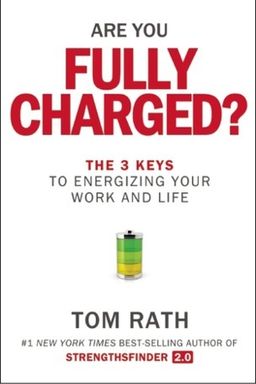
Are You Fully Charged cover

Are You Fully Charged

by Tom Rath

Are You Fully Charged offers a transformative guide to energizing your work and life. Discover practical strategies for finding meaning, building positive relationships, and prioritizing health to eliminate off days and enhance personal and professional success.

Living a Fully Charged Life

When was the last time you ended your day feeling fully alive — not drained, distracted, or running on fumes? In Are You Fully Charged?, author and researcher Tom Rath poses a deceptively simple question: what makes certain days so much more productive, meaningful, and energizing than others? Rath’s answer, grounded in decades of research from psychology, health science, and organizational behavior, is that a fully charged life emerges from meaning, positive interactions, and energy.

For years, Rath studied how people flourish — from employees’ engagement at work to the habits that sustain well-being. But what he discovered personally and professionally is that knowledge alone isn’t enough; real change happens through small, daily behaviors. Rather than waiting for big life overhauls or chasing distant happiness goals, the key is how you live each day. The book’s premise is clear: a great life is built by better days.

The Science of Daily Experience

Rath opens by describing a major shift in research — away from vague notions of long-term happiness toward the science of daily experience. New data tools now allow scientists to measure not just how people think their lives are going, but how they actually feel throughout the day. These findings overturn the old assumption that well-being is tied to wealth or status. He notes that while life satisfaction keeps rising with income, daily well-being stalls after a modest level of financial security, around $75,000 in the U.S. You can earn a fortune and still experience miserable days. Conversely, countries like Paraguay, not known for affluence, often score higher in daily positive emotions than richer nations. The takeaway is profound: daily joy and meaning have little to do with how much you own or where you live.

The Three Keys to a Full Charge

Across more than 2,600 scientific findings and thousands of interviews, Rath distilled what differentiates a thriving day from an average one. The three essential elements are:

  • Meaning — doing something that benefits another person and connects your efforts to a purpose larger than yourself.
  • Interactions — creating many more positive than negative exchanges, because frequent small moments of connection drive well-being more than rare grand experiences.
  • Energy — staying mentally and physically strong by eating, moving, and sleeping in ways that sustain momentum through the day.

Through these three pillars, Are You Fully Charged? reads like a modern manual for thriving in a distracted era. Rath argues that we often mismanage our attention toward money, busyness, and achievements, when what truly keeps us alive is serving others, connecting meaningfully, and maintaining vitality. The book is divided into three parts — Meaning, Interactions, and Energy — each offering stories, studies, and practical steps to live with more engagement.

Why It Matters Today

This message strikes a deep chord in our always-on culture. Rath contrasts the modern norm of reaction — constant emails, notifications, and multitasking — with intentional living. He emphasizes that being busy is not the same as being charged; in fact, chronic distraction erodes both creativity and purpose. To live meaningfully, we must choose fewer, better priorities and reconnect our everyday actions to what benefits others. It’s a countercultural but liberating reminder, one that echoes thinkers from Viktor Frankl to Daniel Pink: we find fulfillment when our work aligns with a sense of purpose, not when we chase external rewards.

Rath’s own story adds weight. Diagnosed with a rare cancer at age sixteen, he has spent decades battling tumors throughout his body. That experience taught him that time is nonrenewable — each day is a lease renewed, not guaranteed. His deeply personal journey led him to explore how small choices compound into big changes. When he asks, “What will you do today that makes a difference?” it’s not rhetorical. It’s a call to focus on what truly sustains life: doing meaningful work, nurturing human connection, and protecting the energy that makes both possible.

A Preview of the Journey Ahead

In the chapters that follow, you’ll learn how meaning is created through small wins and aligning your strengths with what the world needs. You’ll see why interactions shape our emotional climate more than major life events — and how choosing empathy and positivity can ripple through social networks. Finally, you’ll discover how your energy level — guided by diet, movement, sleep, and mindfulness — becomes the invisible engine behind all achievement and joy. Each idea builds a case for replacing the pursuit of happiness with the daily practice of charging yourself and others.

Core Message

You don’t need to overhaul your life or quit your job to feel fully alive. You only need to realign how you use your moments — toward meaning, towards people, and toward energy that lasts.

That’s the essence of being “fully charged.” It’s not about endless enthusiasm or unbroken optimism, but about sustaining the right mix of purpose, connection, and vitality each day so that your positive charge extends into the lives of others — creating a loop of goodness that multiplies beyond your view.


Find Meaning in Small Wins

Meaning, Rath insists, isn’t found in grand missions or abstract life purposes. It thrives in the small wins that make daily progress visible. Drawing from Teresa Amabile and Steven Kramer’s research (The Progress Principle), which analyzed 12,000 workday diaries, he notes that “the single most important factor engaging people at work is making progress in meaningful work.”

These small victories — a productive meeting, a kind word, a task completed — create momentum and joy. When you notice your progress and how it benefits others, your day gains substance. Rath’s life, framed by recurring cancer treatments, reinforces the urgency of making each day count. He writes that “having a renewed lease on life every twelve months” helped him stop chasing happiness and focus on creating meaning instead.

Abandon the Pursuit of Happiness

The book challenges the American ideal of chasing happiness (a theme echoed by Viktor Frankl’s Man’s Search for Meaning). Happiness pursued selfishly — valuing one’s personal joy above all — often backfires, leading to loneliness and even physiological stress. Rath cites studies showing that “happy but meaningless” lives trigger inflammatory gene patterns similar to chronic adversity. Meanwhile, lives rich in meaning — even amid challenges — show healthier gene expression and immune resilience. Meaning, unlike transient pleasure, anchors you against life’s storms.

Creating Meaning Every Day

How do you build meaning daily? Start small. Have deeper interactions. Add value to someone’s day. Recognize that work is an opportunity to contribute, not merely to earn. When Rath asks, “What will you do today that makes a difference?” he reframes meaning as a practice — a verb — not a distant ideal. Meaningful living demands attention to everyday progress, not the pursuit of endless pleasure.

“Small wins generate meaningful progress.” — Tom Rath

When you stop pursuing happiness and start creating meaning, you shift from fleeting highs to enduring fulfillment — one small victory, one kind act, one meaningful moment at a time.


Redefine Work as Purpose, Not Place

Rath’s vision of work departs radically from the “work to live” cliché. He draws on studies by psychologist Amy Wrzesniewski, who found that janitors in hospitals who saw themselves as healers — not cleaners — experienced greater job satisfaction and better patient outcomes. Their key difference? They redefined their roles around purpose and relationships.

Why Meaningful Work Matters

In an era when most organizations still treat employees as replaceable “resources,” only 12% of workers report that their lives are better because of their employer. Rath argues that this must change. Work has evolutionary roots in collective survival — humans joined tribes to achieve what individuals could not. Purposeful work revives that spirit.

Companies that nurture purpose also prosper: research by Towers Watson found that when firms improve employees’ well-being alongside engagement, operating margins nearly triple (27% vs. 10%). A shared mission benefits both the person and the organization.

Work for Meaning, Not Money

Beyond compensation, Rath cautions against “working primarily for cash.” Drawing from his own career, he recounts creating StrengthsQuest — a project aligning his technical skills with student development — and finding it more deeply gratifying than higher-paying endeavors. He aligns with Daniel Pink’s argument in Drive that intrinsic motivation (autonomy, mastery, purpose) outperforms external rewards.

Financial security matters, but beyond basic needs, chasing more money leads to diminishing returns — and even isolation. Studies show that reminders of money literally make people sit farther apart from others. The healthiest workplaces are those that enable people to contribute to something larger — together.

Meaningful work isn’t a luxury. It’s the foundation of sustainable engagement, growth, and collective success.

If your work aligns with a shared mission, you’re three times more likely to stay and almost twice as satisfied. Purpose doesn’t just make your job better; it makes your life stronger.


Make Every Interaction Count

Our lives, Rath explains, are not defined by years but by moments — millions of them. He draws on Nicholas Christakis’s research showing that emotions ripple across social networks up to three degrees of separation; your smile today can affect a stranger’s mood weeks later. Every interaction either adds or drains energy — which he calls “the charge.”

Assume Good Intent

Rath’s story about accidentally bumping into people because of blindness in his left eye illustrates this. Some people cursed him; others laughed and smiled. Their reactions shaped their own mood more than his. That’s why he urges you to “assume good intent.” Indra Nooyi, cited here, said it best: “When you assume negative intent, you’re angry. When you assume positive intent, you can listen.”

Frequency Beats Intensity

Research shows that the number of positive moments matters more than their magnitude. A dozen small positive exchanges create more well-being than one grand event. Proximity also matters: a nearby happy friend boosts your happiness by 40%. Digital connections extend this network, for better or worse — experiments modifying Facebook feeds proved that positivity (or negativity) spreads contagiously online.

Every brief exchange — a greeting, a compliment, a smile — is a tiny investment that compounds over time.

Your charge depends less on perfect relationships and more on the frequency of positive moments you spark each day. Each time you leave someone a bit better than you found them, you’re shaping not just your day but the wider emotional ecosystem around you.


Be 80 Percent Positive

If every conversation is a battery, negativity drains it faster than positivity can recharge it. Drawing from John Gottman’s marriage studies and workplace research, Rath notes that thriving relationships — at home or work — maintain at least a 5:1 ratio of positive to negative interactions. Without this buffer, cortisol-driven stress takes over, shutting down thinking and trust.

Positive Words as Relationship Glue

In language analysis across cultures, four out of five words people use are positive. Yet negativity weighs roughly four times more heavily in memory. So a single cutting remark can undo multiple compliments. Rath urges us to “use positive words as glue” — specific, sincere praise that strengthens connection. Blanket praise (“good job”) doesn’t work; targeted recognition (“Your research made this project succeed because…”) does.

Pay Attention, Even When Negative

Silence, Rath warns, is worse than criticism. Being ignored at work causes more harm than harassment — people feel invisible. Attention, even critical, signals that you care. Therefore, strive for a tone that is mostly positive and always engaged. The simple act of noticing others is one of the most powerful forms of respect.

Be 80% positive in tone and 100% attentive in presence — that’s how influence and trust are built.

In your next interaction, listen deeply, choose specific encouraging words, and balance candor with compassion. The language of positivity is not fluff; it’s the chemistry of connection.


Recharge Your Energy

For Rath, energy is the foundation of a meaningful and connected life. Without physical vitality, intention collapses. He integrates insights from his earlier book Eat Move Sleep to show that small lifestyle choices shape daily energy more than long-term resolutions.

Put Your Own Health First

Service-oriented people — nurses, teachers, caregivers — often sacrifice their own health. Yet studies show that overworked nurses’ care quality declines with exhaustion. To “serve others longer,” Rath says, you must prioritize rest, nutrition, and movement. Energy is not selfish; it’s social responsibility.

Eat, Move, Sleep

He debunks “everything in moderation,” emphasizing food quality over calories. Focus on proteins, natural foods, and minimal sugar. Move consistently — walking and standing throughout the day are as important as workouts. Sitting for long periods cancels exercise benefits. Sleep, often dismissed as weakness, is actually “an investment in tomorrow.” A single lost hour decreases alertness by a third. Think of sleep as cognitive fuel, not luxury.

De-Stress and Respond with Resilience

Chronic stress shortens telomeres — markers of cellular aging — but habits like exercise and sleep protect them. Moreover, stress itself isn’t fatal; your response is. Reframing stress as a challenge instead of a threat converts cortisol into motivation. Even forced smiles regulate breathing and heart rate, reducing negative effects.

Energy multiplies meaning and relationships. Without it, purpose becomes fatigue.

Your choices today — a 15-minute walk, a good night’s sleep, a healthy meal — are not trivial. They’re the foundation of being fully charged tomorrow.


Give to Grow: The Ripple Effect of Generosity

The book closes where it began: with giving. Rath’s final insight is that helping others charges you more than self-focus ever will. The epilogue’s evidence is striking — alcoholics who helped other alcoholics in recovery doubled their odds of staying sober. People who volunteered reduced depression by 94%. This is not moral preaching; it’s neurological fact — altruism triggers the same reward centers as pleasure.

Share Time, Not Just Money

Giving time has greater returns than giving possessions. Yet financial generosity helps too. Economist Arthur Brooks found that families who gave $100 more to charity earned $375 more in subsequent income — and volunteers later made more money as well. Across 136 countries, donating improved happiness even when people struggled to meet basic needs. Giving activates something “deeply wired” in human biology.

A Life Well-Lived

Rath urges you to see your remaining days as finite opportunities to invest in others. Ask: Did I create meaning? Did I strengthen relationships? Did I sustain my energy to serve again tomorrow? Living this way turns every act of kindness — from mentoring a colleague to writing a thank-you note — into legacy.

“Spending time on others yields a greater return than spending time on yourself.” — Tom Rath

Generosity isn’t the final step of being fully charged — it’s the energy source that ensures every charge you pass along keeps flowing long after you’re done for the day.

Dig Deeper

Get personalized prompts to apply these lessons to your life and deepen your understanding.

Go Deeper

Get the Full Experience

Download Insight Books for AI-powered reflections, quizzes, and more.