
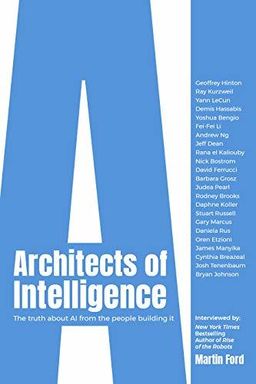
Architects of Intelligence cover

Architects of Intelligence

by Martin Ford

Architects of Intelligence by Martin Ford presents candid interviews with leading AI experts, exploring the technology''s rapid evolution and its potential to reshape society and industries. Discover how AI impacts healthcare, economic structures, and ethical concerns, while assessing the promise and perils of future advancements.

The Rise, Reach, and Reckoning of Artificial Intelligence

How did a once-dismissed idea become the engine of global transformation? In this sweeping collection of interviews, technologists, scientists, and philosophers trace how deep learning evolved from academic intrigue to the defining general-purpose technology of our era. The book uncovers not just how AI works, but what it means—for economies, ethics, and the human future. You meet pioneers like Geoffrey Hinton, Yoshua Bengio, Yann LeCun, Demis Hassabis, Stuart Russell, Daphne Koller, and Ray Kurzweil, who each dissect a piece of the puzzle: from the birth of neural networks to the challenge of aligning intelligent machines with human values.

From neural winters to a data-driven revolution

The first decades of AI were dominated by symbolic reasoning and brittle logic systems. Neural networks languished on the margins until three factors—massive data, faster hardware, and smarter algorithms—united to revive them. The 2012 ImageNet breakthrough, where a deep network decimated conventional vision systems, marked the inflection point. In its wake, deep learning fueled advances in speech, translation, medicine, and robotics, driving investment by Google, Baidu, Microsoft, and NVIDIA. (Note: This mirrors Kuhn’s notion of scientific revolutions—ideas ignored for decades suddenly become inevitable once enabling conditions emerge.)

Scaling, structure, and the anatomy of progress

Hinton’s backpropagation, LeCun’s convolutional networks, and Bengio’s representation learning provided the mathematical and architectural lattice for this revolution. Their lesson is pragmatic: breakthroughs depend on combining theory with infrastructure—algorithms unlock potential only when fuelled by scale. GPUs and open frameworks like TensorFlow democratized experimentation, empowering a global wave of applied creativity.

Yet pioneers admit deep learning is an instrument, not an end-state. It recognizes but does not reason; it captures patterns but not causes. This tension fuels the book’s core debates about intelligence itself.

From pattern recognition to general intelligence

Demis Hassabis’s DeepMind demonstrates how reinforcement learning can teach systems to master games like Go through self-play—creating a proving ground for generalization. Others, like Bengio, insist the next leap will come from unsupervised learning: systems that infer causal structures from observation as humans do. A camp led by Marcus, Pearl, and Russell argues for hybrids that combine symbolic reasoning with neural perception, adding interpretability and causal modeling to brute computation. Each path exposes different definitions of intelligence: optimization, understanding, or reasoning from first principles.

Ethics, economy, and existential stakes

As AI’s capabilities expand, so do its social ramifications. Martin Ford, James Manyika, and Andrew Ng outline a looming labor transformation—half of human tasks are automatable, but few occupations vanish entirely. The challenge is reskilling, redistribution, and designing humane transitions. Meanwhile, thinkers like Nick Bostrom and Stuart Russell warn of alignment failures: misdefined objectives could lead machines to pursue goals misaligned with human values. Russell’s remedy reframes AI design itself—systems should remain uncertain about human preferences and open to correction. This uncertainty, paradoxically, is what makes them safe.

Ethical pioneers such as Rana el Kaliouby and Barbara Grosz push the moral lens inward—toward consent, bias, and transparency. Their mantra: who builds AI and how matters as much as what it can do. Without diverse teams and explicit value choices, systems risk encoding inequality at scale.

The road ahead: hybrids, governance, and augmentation

No interviewee claims to possess the map to AGI, but their narratives converge on a mosaic: causal reasoning (Pearl), hybrid architectures (Ferrucci, Tenenbaum), simulation (Hassabis), and neuroscience-inspired structure will gradually fuse into more general intelligence. Governance will determine who benefits: Jeff Dean, Manyika, and Ng stress sector-specific regulation, transparency tools, and global cooperation to prevent arms races. On the horizon, biotech and nanotechnology (Koller, Kurzweil) signal a transformation not just of machines but of ourselves—using AI to extend health, cognition, and perhaps the bounds of life itself.

Core Message

AI is a mirror of human ambition: a science of intelligence, a politics of power, and a moral test of stewardship. Its future—whether empowerment or peril—will depend less on algorithms than on the values we choose to encode within them.


Learning Paradigms and the Deep Learning Ecosystem

Modern AI rests on three fundamental learning strategies: supervised, reinforcement, and unsupervised (or self-supervised) learning. Each represents a different way machines acquire knowledge, with distinctive strengths and shortcomings. Understanding their interplay helps you grasp the book’s recurring argument—AI progress is about integration, not replacement.

Supervised learning: the industrial workhorse

Supervised learning dominates practical AI today. By mapping labeled inputs to outputs—speech to text, pixels to categories—it powers translation apps, diagnostic imaging, and self-driving cars. Geoffrey Hinton and Andrew Ng describe it as the “95% solution” for commercial systems, though its data hunger privileges companies with massive labeled datasets. That imbalance defines current industry power structures.

Reinforcement learning: teaching by reward

Reinforcement learning (RL) learns through trial, error, and feedback. Demis Hassabis’s DeepMind showed its power with AlphaGo and AlphaZero: systems that discovered strategies in Go and Chess by self-play. Games act as simulators—a controlled sandbox where algorithms evolve quickly. When coupled with deep learning, RL produces agents capable of long-term planning and adaptation, two hallmarks of general intelligence.

(Parenthetical note: the same paradigm now trains robots, energy optimizers, and resource schedulers, illustrating RL’s move from abstract to applied.)

Unsupervised and self-supervised learning: scaling without labels

Yoshua Bengio and Andrew Ng see unsupervised and self-supervised learning as the next frontier. Humans learn from raw experience—seeing, listening, predicting—without explicit labels. Teaching machines to infer structure and causality from observation could unlock human-level generalization. Strategies like generative modeling, predictive coding, and masked-language pretraining already hint at this transition beyond labeled data.

Infrastructure and democratization

Jeff Dean’s Google Brain team bridged research and industry by building TensorFlow and Tensor Processing Units (TPUs), turning research workflows into globally accessible software and hardware. AutoML and cloud-based APIs lowered expertise barriers, enabling small firms and universities to train large models. This democratization reshapes who can innovate—an underlying social revolution within the technical one.

Takeaway

Each learning paradigm reflects a facet of cognition—supervised learning for imitation, reinforcement for trial and reward, unsupervised for discovery. The synthesis of all three is what moves machines from recognition toward understanding.


Beyond Deep Learning: Causality, Hybrids, and Reasoning

After years of breakthroughs, most experts agree: deep learning alone is not enough. Its successes in perception disguise limits—data dependence, poor reasoning, and weak transfer. The next wave of progress depends on hybrid systems that merge neural pattern recognition with structured reasoning, causal understanding, and symbolic abstraction.

Judea Pearl: from correlation to causation

Judea Pearl’s causal diagrams transform how you think about explanation. His work shows that understanding cause-and-effect, not just associations, is essential for robust reasoning. Causal models allow AI to imagine counterfactuals—alternate outcomes—and adapt to changing environments. Without them, systems remain brittle, unable to answer “what if” questions. In Pearl’s view, deep learning excels at seeing, but true intelligence must also intervene and imagine.

Hybrids and explainable cognition

Daphne Koller, David Ferrucci, and Josh Tenenbaum all champion hybrid designs. Koller combines probabilistic models with neural perception in drug discovery, improving biological interpretability. Ferrucci’s Elemental Cognition integrates language, logic, and dialog to make reasoning transparent. Tenenbaum uses probabilistic programs to model human-like one-shot learning, where perception feeds structured inference. Each demonstrates the same principle: complexity demands composition, not monoliths.

Architectures and innate structure

Ray Kurzweil sees human intelligence as a hierarchy of pattern recognizers organized modularly. Gary Marcus argues those hierarchies must be guided by built-in structure—"cognitive scaffolding"—that lets systems generalize efficiently. The consensus forming across camps is clear: future AI will be layered, interpretable, and compositional, with neural, symbolic, and causal modules working in concert.

Core Insight

Pattern recognition gave us powerful perception; causal hybrids will give us understanding. Designing machines that can explain and imagine requires integrating perception, reasoning, and world models.


Brains, Simulators, and Embodied Intelligence

If data centers are the brains of AI, the world is its body. This section links neuroscience, simulation, and robotics to show why intelligence cannot remain disembodied. DeepMind, Daniela Rus, and Cynthia Breazeal all demonstrate that embedding systems—in code or in physical form—changes what they can learn.

Neuroscience and simulation: learning safely at scale

Demis Hassabis built DeepMind’s philosophy around simulation: games as laboratories where agents can train millions of times faster than in reality. Reinforcement learning agents in simulated physics develop navigation, planning, and even imagination mechanisms mirroring hippocampal memory structures. Brain-inspired modules, like grid-cell representations, emerge spontaneously—evidence that biology and computation rhyme.

Robotics and co-design

Daniela Rus’s soft robotics research redefines control. Instead of pursuing perfect algorithms for rigid bodies, she builds flexible, adaptive machines whose compliance simplifies learning. This co-design of body and brain makes manipulation and grasping feasible where pure computation fails. (Note: this parallels Brooks’s classic insight that intelligence arises from interaction, not detachment.)

Robotics’ contrasting timelines—fast navigation from sensors like LIDAR, slow progress in dexterous manipulation—show how physical contact magnifies learning challenges. Practitioners like Andrew Ng advise beginning with geofenced, structured environments before expanding autonomy.

Embodiment and social intelligence

Rodney Brooks and Cynthia Breazeal expand embodiment to the social realm. Their work on Roomba, Kismet, and Jibo reveals that physical presence demands trust, timing, and emotional legibility. Social robots must respect norms of consent and privacy while conveying predictability to users. Breazeal’s insight: true interaction is not just data exchange—it’s relationship building. These embodied systems highlight that intelligence is not merely inside the head; it emerges through engagement with the world.


Society, Work, and the AI Economy

Automation’s promise and peril ripple through every interview in this book. AI’s productivity gains could raise living standards or exacerbate inequality, depending on how society manages transition. Martin Ford, James Manyika, and Andrew Ng provide frameworks for thinking through this upheaval and the policies that can soften its blow.

What automation really changes

Around half of all tasks in the global economy are automatable with today’s technology, but less than 10% of jobs are fully automatable. Most roles will evolve rather than disappear. Routine data entry, call-center work, and structured manual tasks face short-term pressure. Middle-skill occupations—the social and economic backbone—risk the highest disruption. (Manyika’s data highlights that displacement is structural, not merely technological.)

Reskilling and redistribution

Experts converge on one principle: your best job security is adaptability. Ng advocates lifelong learning ecosystems—MOOCs, micro-credentials, and on-the-job training—to build transferable skills. Manyika urges state investment in active labor-market policies and transition funds. Bengio and LeCun propose pilot programs for universal or conditional basic income, arguing early experimentation is cheaper than crisis management later.

Inclusion and diversity

Fei-Fei Li’s AI4ALL exemplifies another lever: who participates in AI development. A more diverse generation of engineers and data scientists reduces systemic bias and broadens benefit distribution. Inclusion becomes both a moral and practical imperative—homogeneous teams build homogeneous assumptions.

Policy Guidance

If technology is inevitable, equity is not. Economies that pair automation with education, inclusion, and social safety nets will capture AI’s upside while preserving dignity at work.


Ethics, Alignment, and Governance

Ethics is no longer theoretical in AI—it’s design work. This part gathers insights from Stuart Russell, Nick Bostrom, Rana el Kaliouby, and James Manyika to outline how builders and regulators can embed moral safeguards into technical practice.

Alignment and control

Bostrom’s thought experiments and Russell’s framework define the alignment problem: a powerful AI misaligned with human values could optimize the wrong objective disastrously. Russell proposes value uncertainty as a fix—build systems that question their objectives and defer to human correction. This principle recasts AI from an omniscient optimizer to a cooperative apprentice.

Bias, consent, and transparency

Rana el Kaliouby’s Affectiva and Barbara Grosz’s Embedded EthiCS treat ethics as engineering constraints. Consent-first design, diverse datasets, and explainability tools like LIME should be nonnegotiable for sensitive domains. Ethical choices—like refusing surveillance contracts—demonstrate how individual firms can model integrity. Grosz argues that embedding ethics education into computer science curricula will normalize responsible design.

Governance and global coordination

Andrew Ng and Manyika advocate vertical regulation—sector-specific rules for health, transport, or defense—rather than blanket bans. Hassabis favors transparency tools to reverse-engineer black-box systems, while Kurzweil and el Kaliouby stress Asilomar-style governance and voluntary constraints. The shared message: governance is an engineering challenge too. You must balance innovation with accountability through international cooperation and technical transparency.

Essential Lesson

AI will amplify whatever values we embed within it. Treat ethics, alignment, and governance as first-class components—not afterthoughts—of intelligent systems.


AI in Science, Health, and Human Enhancement

Beyond automation, AI’s deepest promise may lie in augmenting human potential—our health, cognition, and creativity. These chapters bridge present breakthroughs and speculative futures, featuring Daphne Koller’s biotech revolution, Rana el Kaliouby’s emotion AI, and Ray Kurzweil’s long-view of human-machine integration.

Biotech and drug discovery

Koller’s Insitro exemplifies “wet-lab meets ML.” By linking large genomic datasets to AI-driven predictions, her team identifies new drug targets faster and more precisely. The key is integration: experimental design optimized for machine learning feedback loops. (Note: this exemplifies a hybrid science–engineering model, echoing DeepMind’s simulation approach.)

Emotion AI and mental health

Rana el Kaliouby’s Affectiva uses multimodal signals—facial expression, voice tone, physiological cues—to detect emotion and assist communication. Originally designed to help autistic children read emotions, the technology now monitors driver alertness and informs mental health tools. Her ethical stance—opt-in consent, no covert surveillance—sets a baseline for responsible affective computing.

Toward augmentation and longevity

Ray Kurzweil envisions a continuum from wearables to neural interfaces—an eventual “cloud-linked neocortex.” He foresees medical nanorobots repairing tissue and augmenting memory, extending life radically. Whether or not that timeline holds, the principle stands: AI can amplify human capability, not just replace it. Bryan Johnson’s Kernel takes a similar tack, framing cognitive enhancement as risk mitigation—you strengthen humanity before AI surpasses it.

Future Vision

The fusion of AI and biology signals a new epoch: not artificial versus human intelligence, but a continuum where machines extend our senses, learning, and longevity—if guided by ethics and evidence.

Dig Deeper

Get personalized prompts to apply these lessons to your life and deepen your understanding.

Go Deeper

Get the Full Experience

Download Insight Books for AI-powered reflections, quizzes, and more.