
Idea 1
Reality TV to Political Power
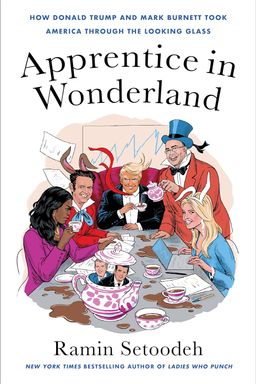
How do you turn a prime-time spectacle into real political power? In Apprentice in Wonderland, Ramin Setoodeh argues that The Apprentice didn’t just entertain America—it engineered a durable public persona for Donald Trump, rewired how audiences read “leadership,” and taught a candidate to campaign like a TV showrunner. The book contends that ratings-driven storytelling, celebrity culture, and reality-TV production techniques fused into a cultural machine that reshaped U.S. politics. To understand that pivot, you have to follow both the content on screen and the systems behind it: casting, editing, ad deals, and a relentless focus on spectacle.
You watch three intertwined forces at work: Mark Burnett’s industrialized playbook for provocation and profit, Trump’s obsession with performance and validation, and NBC’s willingness to bankroll a format that sold authority through ritual humiliation. These parts converge into a feedback loop: bigger stunts and cleaner arcs drive higher ratings; higher ratings validate Trump’s mythic CEO role; that role then exports into politics as a template for attention, leverage, and dominance.
From boardroom theater to household brand
Setoodeh shows how The Apprentice transformed Trump from a New York tabloid character into a national authority figure. The pitch—“the ultimate job interview”—felt relatable in a way Survivor or Fear Factor didn’t; if you’ve ever hustled for a job, you can imagine yourself in that boardroom. Trump crystallized as a television archetype: the decisive CEO with memorable epigrams (“You’re fired!”; “Location, location, location”), a gold-plated set, and ritualized eliminations. Blockbuster ratings from the first-season finale (with Bill Rancic hired) became the shrine he pointed to—a framed Variety Nielsen sheet in Trump Tower as proof that audiences had chosen him.
Burnett’s engine: stress, story, and sponsors
None of that felt inevitable. Burnett designed a behavioral lab: grueling casting, psychological pressure, and isolation produced combustible footage; editing turned chaos into myths of winners and villains. He also modernized the money. Product-placement and integration deals (Mattel, Crest, Levi’s) didn’t just sponsor tasks—they shaped them, with production companies keeping a large slice (a radical move then). The show became both a narrative and an ad factory, and Trump shared in the profits, binding his fortunes to ratings and brand partners.
Celebrity as Trump’s working capital
Setoodeh spotlights how Trump treats fame like cash. Magazine covers, blockbuster episodes, and A-list proximity become bargaining chips with networks and audiences. He boasts (sometimes exaggerating) about the numbers because metrics buy leverage. He insists that big names—from Martha Stewart to Taylor Swift and denizens of Beverly Hills and Bel-Air—secretly like him, reframing criticism as a short-term political pose. The Celebrity Apprentice doubles down on that logic: swap unknowns for familiar faces (Joan Rivers, Piers Morgan, Dennis Rodman) to renew attention and, by extension, Trump’s authority.
The social scripts under the spectacle
Under the shiny surface, the show rehearses thorny scripts about race, gender, and power. Trump praises beauty as an “unfair advantage,” which benefits contestants like Jennifer Murphy while also marking them for jealousy and backlash. The Randal Pinkett finale exposes racial fault lines: a Black candidate with elite credentials faces a live moment where a “shared win” is floated; Pinkett’s refusal triggers debate, boos, and later reflections that race and sexism colored the ask. These on-screen choices sculpt public perceptions of who deserves power and how authority is performed.
From set piece to stump speech
Across years, Trump learns to treat media as the main arena. Boardrooms become dry runs for rallies; catchphrases become stump lines; cliffhangers become campaign “ reveals.” NBC executives—Ben Silverman, Steve Burke, Paul Telegdy—keep tempting him to stay in prime time, even amid the 2007–2008 Writers Guild strike, because he’s a ratings asset. Yet the gravitational pull toward politics grows as he internalizes the formula: control the frame, dominate the conversation, and measure every day in numbers (polls now, Nielsen then). He leaves the fourteenth-floor boardroom set intact; later it morphs into campaign HQ, a literal and symbolic throughline.
Key Idea
The Apprentice didn’t mirror reality—it manufactured it. That manufactured reality then trained a politician to turn attention into power, with production savvy as the hidden muscle behind public persuasion. (Note: This echoes studies of the Kardashians’ attention economy, but here the leap from show to state is unusually direct.)
By the time you reach Mar-a-Lago, now a post-presidential studio for NFTs, merch, and nightly poll talk, the pattern is clear: controversy fuels coverage, coverage feeds relevance, relevance converts to money and votes. Setoodeh gives you a blueprint for reading modern spectacle politics—and a case study in how a TV producer’s toolkit can redraw the map of American power.