
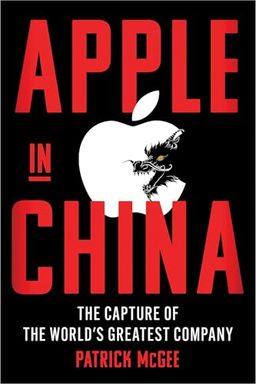
Apple In China cover

Apple In China

by Patrick Mcgee

A journalist depicts the development of Apple’s supply chain and its increasingly precarious relationship with China.

Design, Scale, and Sovereignty

How do you turn beautiful objects into the world’s most profitable hardware business—and why does that success come with geopolitical strings? This book argues that Apple’s rise rests on a design-first philosophy fused to an operations machine built largely in China. Apple embedded its own engineers inside supplier factories, bought and placed specialized tools at massive scale, and forged two defining partnerships—Foxconn to build the body, TSMC to build the brain. The payoff was historic margins and unmatched product quality. The price was concentration risk: a business tethered to Beijing’s political leverage and Taiwan’s semiconductor vulnerability.

You see Apple teach factories how to hit “impossible” tolerances, then use procurement power to squeeze costs, creating what the book calls the Apple Squeeze. You also watch that engine collide with Chinese politics under Xi Jinping, retail gray markets, and corporate responsibility tensions—pushing Apple to adopt a new political playbook (the “Gang of Eight”) and to diversify cautiously to India and Vietnam. Yet the single biggest fault line remains chips: Apple’s dependence on TSMC in geopolitically exposed Taiwan.

The design-first core

From the Bondi Blue iMac to iPhone, Apple refuses to let manufacturing dictate industrial design. Jony Ive’s team sets the aesthetic bar; Product Design (PD) and Manufacturing Design (MD) invent the processes; Operations (Ops) scales the factories. When the first iMac’s translucent shell seemed “unmanufacturable,” Jobs threatened to send files to Acorn; Acorn proved feasibility and Apple’s engineers closed the gap—an early template for design dictating process, not the reverse. Later, unibody aluminum MacBooks required Apple to buy thousands of CNC machines and essentially corner global capacity so the vision could ship at scale.

Turning outsourcing into capability

Apple didn’t just outsource; it embedded. PD and MD lived in supplier plants, from Foxconn to glass makers like Lens Technology, teaching yields and zero-tolerance quality. Apple purchased and “tagged” capital equipment—CNC mills, RF testers (LitePoint; Rohde & Schwarz), anodization lines—then parked those tools in partner factories. That let Apple shift processes among suppliers and drive just-in-time flows that beat industry inventory turns by margins analysts found shocking (O’Marah’s work put Apple roughly 2.5x better than Nokia at the time). The company also secured components and raw materials directly, stripping supplier markup.

The Apple Squeeze

Suppliers got volume, capability, and prestige—while Apple captured the profits. Procurement led by Tony Blevins used cost transparency, psychological leverage, and exacting warranties (the “Blevins special”) to compress margins. Foxconn accepted thin operating margins as revenue exploded, aided by Apple-funded tooling and massive campuses like Longhua and later Zhengzhou. This taught China’s ecosystem world-class practices, which later spilled over to domestic brands (Huawei, Oppo, Vivo, Xiaomi)—a form of tacit technology transfer Apple didn’t intend but made inevitable. (Note: Compare to David Landes on technology diffusion and Horace Dediu’s observation that Apple’s survival is intertwined with Communist China.)

Politics, gray markets, and leverage

By 2013, more than 90% of Apple’s final assembly ran through China and Apple’s annual in-country spend approached $55 billion. Xi Jinping’s consolidation of power reframed foreign-firm rules. A CCTV Consumer Day spectacle accused Apple of service arrogance; Tim Cook issued a Mandarin apology and beefed up warranties. That change, however, supercharged “yellow cow” gray-market scams that manipulated IMEIs and returns to mint new iPhones for resale. Beijing also demanded data localization, content takedowns, and deeper compliance—proof that economic presence alone doesn’t buy political safety.

Apple’s political pivot

In response, Apple formed the “Gang of Eight,” expanded in-country operations to thousands, invested $1 billion in Didi, and privately pledged a five-year, $275 billion China program of supplier development and R&D centers. The message: Apple isn’t just selling phones; it’s building Chinese industrial capacity. Yet corporate responsibility efforts (Jacky Haynes) struggled against ramp-time pressures and a civil society crackdown that weakened independent oversight.

Diversification and the TSMC trap

Apple is adding iPhone FATP lines in India and shifting AirPods/Watch to Vietnam, but the depth of China’s clusters is hard to replicate quickly. Meanwhile, chipmaking remains Apple’s true single-point risk: TSMC’s advanced nodes mostly sit in earthquake-prone, politically contested Taiwan. Even with new Arizona fabs, the near-term substitute is partial. A major Taiwan disruption could halt Apple’s core product lines and jolt the global economy.

Key Idea

Apple turned design ambition into industrial reality by embedding inside China’s factories and owning the tools—achieving record profits while tying its fate to the politics of Beijing and the stability of Taiwan’s chip industry.

If you buy Apple, you’re buying an ecosystem that excels at marrying taste to tooling. If you run operations, you’re seeing a masterclass in capability building—and a warning about concentration. And if you track geopolitics, you’re watching how a private supply chain became entangled with state power, industrial policy, and the “Silicon Shield.”


Design Dictates Manufacturing

This book makes you rethink the old rule that design must bow to manufacturing. At Apple, Industrial Design (ID) sets a high bar and forces Product Design (PD), Manufacturing Design (MD), and Operations (Ops) to invent the processes that make the impossible ship on time. Jony Ive’s mantra—make it pure, make it seamless—became a mandate for tooling innovation, from translucent plastics to unibody aluminum and RF validation gear deployed at unheard-of scale.

From “unmanufacturable” to factory standard

The original iMac (Bondi Blue) and iMac G4 illustrate the pattern. Severe undercuts, recessed handles, and translucent plastics baffled standard injection molding. When internal teams balked, Steve Jobs threatened to send files to Acorn; Acorn said yes; Apple reset expectations and engineered novel tools that preserved ID’s vision. That compromise—never on aesthetics, always on process—became a norm that later powered the iPod’s tight tolerances, the iPhone’s glass-metal fit, and the unibody MacBook Pro.

Stages of the pyramid

  • Industrial Design (Ive): Defines look, feel, and material language (e.g., “lickable” plastics, invisible seams, the sunflower-like G4 arm).
  • Product Design (PD): Translates aesthetics into mechanical solutions: undercuts, fasteners, thermal paths, space claims.
  • Manufacturing Design (MD): Crafts new processes: CNC milling paths, forging die design, PVD coatings, anodization colors, adhesive cure profiles.
  • Operations (Ops): Sources, buys, and deploys machines; trains lines; sets up suppliers for yield and ramp speed.

The point is not that Apple ignores manufacturing. It invests upstream so manufacturing becomes capable of realizing design. (Note: This inverts the classic EMS model where brands toss over CAD files and hope.)

Buying the tools, building the process

Apple’s decision to buy and place capital equipment is the crucial bridge from sketch to shipment. For unibody Macs, it purchased thousands of high-end CNC machines and parked them across suppliers, effectively cornering capacity. For the iPhone, it procured fleets of RF testers (LitePoint; Rohde & Schwarz) so every line could validate radios at speed. In glass, it partnered deeply with suppliers like Lens Technology to shape, polish, and pair displays to logic boards with micrometer precision.

Embedding engineers on the line

Engineers moved to China, lived in factory dorms, and iterated on fixtures and tolerances until yields stuck. This “arms and legs” model—Apple’s teams shoulder-to-shoulder with Foxconn or Pegatron—meant new processes became Apple property more than supplier property. Apple could lift and shift: move a milling recipe, a laser alignment routine, or a cure profile to another site with minimal friction because the machines and the know-how were Apple-tagged.

What you feel in your hand

When you admire a seamless chamfer or a tight antenna line, you are feeling the cost of upstream invention. Tens of thousands of engineering hours, machine buys, and supplier training add up so the edge you touch is perfectly smooth. You pay more, but you also get an object that couldn’t be made in a generic EMS model.

Hidden tradeoffs

These choices add fragility and cost. Specialized tools lengthen lead times and require disciplined supplier orchestration. When a design move (say, a new glass curvature or camera ring tolerance) pushes yields down, the only way out is more embedded Apple engineers, more machine tuning, more capital spend. Competitors who “just outsource” can’t match without a similar investment philosophy.

Key Idea

Apple’s industrial design sets non-negotiable targets; its operations model manufactures the previously “unmanufacturable” by owning the machines, embedding the engineers, and rewriting factory playbooks.

For you as a builder, the lesson is sharp: if design is your moat, process must be your fortress. Budget for capital tools, build in-house manufacturing design skill, and get comfortable living at suppliers. Otherwise, your “vision” stays on the page.


The Apple Squeeze

If you want to understand how Apple captured the lion’s share of smartphone profits while shipping a minority of units, study the Apple Squeeze: a playbook that trades Apple-funded capability for supplier margin. It is part psychology, part engineering, and part balance-sheet strategy. Suppliers get scale and learning; Apple gets quality, speed, and price—plus control over the critical tools and processes.

How the squeeze works

Procurement, led by Tony Blevins, demands cost transparency down to the screw. Apple often buys raw materials and custom machinery itself. It places those machines in Foxconn, Pegatron, or Lens Technology plants with contracts that keep capacity effectively “Apple-only.” Meanwhile, Apple’s PD/MD engineers live at the factory, tuning fixtures and recipes to hit yields. The supplier’s margin compresses, but the order book grows, and the workforce learns world-class skills on Apple’s dime.

Tools, turns, and time pressure

Apple’s balance sheet reflects this strategy: long-lived assets placed in supplier facilities surged from under $2 billion in 2009 to tens of billions mid-decade (the book cites $44.5 billion by 2016). With tools “owned” by Apple, inventory moves at China speed. Analysts like Kevin O’Marah found Apple’s inventory turns outpaced peers dramatically. That speed becomes a negotiation weapon: miss a ramp and the supplier risks losing future Apple work and being stuck with machines they can’t repurpose freely.

Blevins’s negotiation craft

Inside the room, Blevins uses scarcity and theater. Stories include lawyers pressured to sign without full read-through, cramped rooms, temperature games—tactics to frame Apple’s offer as both urgent and inevitable. He binds price to volume curves and insists on “no-quibble” warranties—famously pushing Foxconn to accept 12 months of returns on early iPhone generations, a clause that later proved ruinous as usage soared.

Case studies

  • Foxconn: Terry Gou offers to fund tooling up front, align with local governments for land and subsidies, and build dorm-equipped campuses. Apple places gear, Foxconn scales rapidly; margins thin as revenue explodes.
  • Lens Technology: Apple teaches glass shaping, polishing, and pairing, monitors costs closely, and secures pricing leverage via embedded expertise.
  • RF testing: Apple buys fleets of testers so every iPhone line can validate radios—turning a bottleneck into a throughput edge the competition can’t quickly copy.

Winners, losers, and spillovers

Apple’s customers win on product quality and performance. Apple’s P&L wins on gross margin. Suppliers win on absolute revenue and capabilities, but lose on unit economics and leverage. Over time, the capability transfer empowers China’s broader ecosystem to climb the value chain—helping domestic brands and sub-suppliers master premium-grade processes. (Note: This is tacit rather than contractual tech transfer, but the result rhymes with the industrial diffusion seen in East Asia’s late 20th-century rise.)

Hidden risks in the squeeze

Price pressure plus brutal ramps create perverse incentives: “do the right thing” until it isn’t economically feasible. That tension later undermines Supplier Responsibility efforts and feeds gray-market leakage when stressed suppliers siphon parts. And because the tools are Apple’s, a geopolitical shock can freeze enormous embedded capital behind national borders.

Key Idea

The Apple Squeeze converts Apple’s engineering and capital into supplier dependence, enabling premium products at mass scale—while concentrating capability and risk inside one national ecosystem.

If you manage supply chains, the blueprint is clear: invest in your partners’ process capability, own the bottleneck tools, and negotiate like scale is destiny. But remember: capability you seed can later compete with you—and political borders can turn embedded assets into hostages.


Making China the Factory

Apple’s deep China footprint didn’t appear overnight. The book traces a decades-long path: from early U.S. EMS pioneers like SCI to Taiwanese Taishang who brought know-how to the mainland, and finally to Foxconn’s city-sized campuses that Apple supercharged with tools and engineers. Add explosive Chinese consumer demand—and gray markets eager to arbitrage scarcity—and you get both unmatched scale and a new kind of vulnerability.

From SCI to Foxconn City

SCI (Space Craft Inc.) in Huntsville helped popularize EMS as brands offloaded board stuffing and assembly. Apple’s sale of its Fountain, Colorado plant to SCI in 1996 signaled a shift: brands could focus on design and channel while partners made the goods. Taiwanese manufacturers—Quanta, Inventec, and others—then transplanted management, machines, and methods into Guangdong and beyond, birthing supply clusters near Shenzhen. Terry Gou’s Hon Hai (Foxconn) pushed the model further: vertical integration, upfront tooling, and dorm-equipped megacampuses aligned with local governments for land and subsidies.

Why Foxconn fit Apple

Foxconn could “fix” failures that plagued other regions by co-locating molding, stamping, PCB, and final assembly—the hub model. It could hire and house thousands quickly, then flex to meet Apple’s brutal ramps. When Apple embedded PD/MD/Procurement on site and parked its machines on the floor, iteration cycles collapsed from weeks to days. That speed, plus a government eager to support exports, made China peerless for Apple’s ambitions.

Retail demand meets gray-market ingenuity

On the consumer side, Apple’s Sanlitun store, led by Mandarin-fluent ex-missionary John Ford, revealed a different side of “China speed.” With licenses hard to obtain, Ford gamed bureaucracy (a sewing-machine repair license) to open the store. Launches drew fervent crowds—and “yellow cows” organized human queues to sweep inventory, smuggle devices inland, and profit off scarcity. At peak, they hired buses of buyers and ran cash rooms that stunned Apple staff. When crowd control faltered, violence and headline risk followed.

When operations turns political

This same demand engine became a political stage. In March 2013, CCTV’s Consumer Day attacked Apple for warranty practices, casting the brand as arrogant. Tim Cook’s Mandarin apology and enhanced China warranties aimed to defuse the moment—but inadvertently juiced the yellow cows’ scams. Organized rings used fake IDs, burned out processors on stolen or subsidized U.S. phones, then returned them in China for brand-new devices using Apple’s generous policy. Warranty became supply.

Administrative leverage

Beijing wielded state media, tax investigations, and service rules (data localization, app removals, JV structures) to steer outcomes. Local enforcement levers—like labor dispatch law pressure—nudged Foxconn-style employers to work closely with cadres. The message was unmistakable: to operate at scale in China, corporate power must coexist with Party power.

What you should see

China offered speed, skill, and clusters no other country could match. Apple amplified those advantages with embedded teams and machines. But the same factors spawned parallel markets and gave the state outsized leverage over an iconic Western brand. You get miracle ramps and world-beating products. You also get political “risk premiums” that can surface overnight.

Key Idea

Apple helped build the world’s densest electronics ecosystem in China—an advantage in speed and cost that came with gray-market arbitrage and state leverage baked into the business model.

For operators, the template is powerful: find or build clusters and co-locate steps to compress iteration. For strategists, the warning is equally clear: clustering inside a single political system raises exposure from nuisance risk to existential risk.


Politics and Apple’s Pivot

By the early 2010s, Apple discovered that being China’s biggest private investor didn’t guarantee political insulation. Xi Jinping’s consolidation of power reframed the deal for foreign firms: China wanted not just jobs but core technology, data control, and industrial sovereignty. Apple’s initial instinct—product PR and quiet diplomacy—proved inadequate. The company answered with a strategic pivot that blended narrative, investment, and on-the-ground presence.

Xi changes the context

Xi’s anti-corruption push and rival takedowns (Bo Xilai’s fall) set the tone for reasserting Party control. “Made in China 2025” signaled goals in chips, EVs, and beyond. For Apple, the 2013 CCTV Consumer Day episode was a wake-up call: state media can mobilize public sentiment and regulators in lockstep. Apple’s apology and warranty concessions quieted the moment but exposed a bigger lesson—operational excellence needs political capital.

The Gang of Eight

Apple formed a cross-functional task force: Rory Sexton (ops), Steven Marcher (R&D/suppliers), Jun Ge (government affairs), Doug Guthrie (China scholar via Apple University), Brendan Lawry (procurement), Denny Tuza (retail), Brian Lu (third-party sales), and Chip Hills (ops). Their mission: articulate Apple’s benefits to China and smooth frictions across ministries and provinces.

Three-part strategy

  • Storytelling: Frame Apple as a builder of Chinese capability, not a mere importer. Guthrie helped quantify Apple’s annual in-country “registered capital” effect—an estimated $55 billion in 2015—into a narrative of industrial uplift.
  • Targeted investments and optics: A $1 billion Didi stake (Jean Liu) to signal alignment, plus R&D centers in Beijing, Shanghai, Suzhou, and Shenzhen. A private five-year, $275 billion pledge to fortify supplier bases and ecosystem skills.
  • Local embedding: Build in-country ops teams (thousands of engineers) so Apple operates locally rather than via occasional Cupertino fly-ins. Jun Ge shifted GR from national-only to province-level engagement where factories and cadres hold sway.

Data, apps, and compliance

Apple complied with data localization (Chinese iCloud data stored domestically) and pulled apps under regulatory pressure. Those concessions preserved market access but drew criticism abroad. The calculus was pragmatic: China was where most iPhones were built and sold; service growth and retail expansion depended on sustained detente.

CSR meets ramp reality

Supplier Responsibility under Jacky Haynes expanded audits and working-hours dashboards. But Apple’s own ramp pressures and Xi-era NGO crackdowns undercut enforcement. When push came to shove, shipments took precedence; Apple eventually downplayed public dashboards and relied more on supplier self-reporting—illustrating the contradiction between CSR rhetoric and operational demands.

New fluency, persistent exposure

The Gang of Eight gave Apple political fluency and bureaucratic allies, buying time and stability. Yet the underlying structure—most assembly in China, key partners (Foxconn) dependent on local cadres—kept leverage in Beijing’s hands. Apple learned to speak the language of industrial policy, but the Party still writes the grammar.

Key Idea

Apple’s political pivot—narrative, investment, and local embedding—turned product PR into statecraft. It worked tactically, but did not erase the strategic dependence created by the supply chain’s center of gravity in China.

If you operate globally, the playbook is instructive: pre-negotiate your social license, quantify your local benefits, and build in-country teams who can solve problems at province speed. But design resilience so politics can’t stop your assembly lines with a single televised segment.


Diversify or Double Down?

After tariffs, COVID lockdowns, and worker unrest at Zhengzhou, Apple accelerated production outside China. AirPods and portions of Apple Watch and iPad moved to Vietnam; iPhone FATP (final assembly, test, pack) expanded in India under Priya Balasubramaniam. Yet the book is clear: moving assembly is not the same as moving the ecosystem. China’s clusters—sub-suppliers, machine shops, automation experts, logistics nodes—took decades to build. Replicating them is slow, costly, and politically delicate.

What moved, what didn’t

By 2023, India was shipping ~15 million iPhones (about 7% of global volume), up from near-zero a few years prior. Vietnam hosts a majority of AirPods lines and some Apple Watch/iPad capacity. These are real shifts, enabled by supplier migrations and Apple’s embedded teams. But many parts still fly from China; specialized tooling and expert labor remain anchored to Chinese clusters. Lead times elongate; logistics risk rises.

Why India isn’t China 2.0—yet

Three constraints loom. First, supply depth: decades of spares, jigs, metrology labs, and Tier-2/Tier-3 suppliers don’t appear overnight. Second, logistics: India lines often depend on Chinese components, making schedules hostage to cross-border friction. Third, institutions: China’s cadre incentives and migrant labor systems enabled gigantic seasonal ramps; India’s decentralized governance and norms make hyper-fast labor mobilization harder. (Note: Tesla Shanghai’s rapid permitting illustrates Beijing’s willingness to catfish domestic industries—an advantage India won’t easily match.)

Scale math and optics

China scaled iPhone from zero to 153 million units in 2006–2013. Matching that slope elsewhere likely requires a decade-plus and hundreds of billions of dollars. Politically, Apple must frame diversification as expansion, not retreat, to avoid retaliation in China. The messaging duality—“we’re growing here and there”—is pragmatic but fragile.

The TSMC trap

Even perfect geographic assembly spread won’t fix Apple’s biggest single-point risk: advanced chips fabricated primarily by TSMC in Taiwan. Apple Silicon unified iPhone, iPad, and Mac performance—but concentrated fabrication on an island Beijing pressures militarily and earthquakes threaten physically. Analysts warn that an invasion, blockade, or major quake could halt advanced-node output, triggering a global depression-scale shock. The “Silicon Shield” suggests Taiwan’s fabs deter war by making everyone dependent, but deterrence is not a guarantee.

Mitigation and its limits

TSMC’s Arizona fabs (three sites, >$65 billion) modestly reduce risk. Yet advanced packaging, supplier ecosystems, and hard-to-scale tacit knowledge still cluster in Taiwan. Morris Chang himself cautions about the costs and challenges of onshoring full parity. In other words, for the foreseeable future, Apple’s most critical silicon runs through Hsinchu and Tainan.

Actionable resilience

  • Build dual-sourcing where physics allows (memory, passives, enclosures), and scenario-plan for chip rationing.
  • Invest in packaging, test, and design enablement beyond Taiwan to shorten recovery time if fabs pause.
  • Design products for graceful degradation (modular SKUs, node-mix flexibility) during supply shocks.
  • Pre-commit to government programs (e.g., CHIPS incentives) as optionality, not immediate substitution.

Key Idea

Diversifying final assembly reduces day-to-day friction, but Apple’s existential risk lives at the wafer and package. Until the chip geography diversifies, the company’s fate is tied to Taiwan’s stability.

For you, the practical takeaway is blunt: don’t confuse geographic headcount with supply independence. Map your true single points of failure—the bottleneck tools, materials, or fabs—and invest to bend those risks before the meteor hits.

Dig Deeper

Get personalized prompts to apply these lessons to your life and deepen your understanding.

Go Deeper

Get the Full Experience

Download Insight Books for AI-powered reflections, quizzes, and more.