
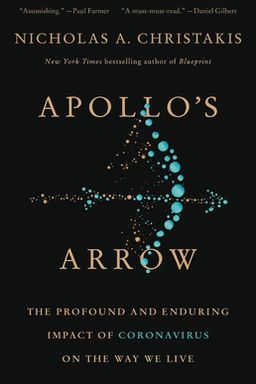
Apollo’s Arrow cover

Apollo’s Arrow

by Nicholas A Christakis

Apollo''s Arrow offers a timely exploration of the COVID-19 pandemic, examining its origins, societal impacts, and the enduring changes it brings. Nicholas A. Christakis provides a scientifically grounded look into the virus''s global influence and our collective response.

Pandemic Origins and Human Response

How do global pandemics begin—and why do our responses so often fail to keep pace? This book traces the story of COVID‑19 from its microscopic origin in a Wuhan market through the vast social transformations that followed. The author’s core argument is that a pandemic is not just a biological event but a social one: tiny genetic mutations meet vast networks of human movement, inequality, fear, and innovation. To understand what happened—and what it means for future outbreaks—you must grasp both the biology of SARS‑2 and the behaviors, institutions, and emotions that shaped its trajectory.

Invisible beginnings and rapid amplification

In late 2019, a coronavirus circulating in bats jumped to a human host. Whether it crossed at the Huanan Seafood Market or earlier, the result was the same: in crowded urban stalls, live animals and humans created the perfect amplifier. Doctors Jixian Zhang and Wenliang Li first sounded the alarm—Zhang reported a cluster of pneumonia cases on December 26; Li warned colleagues days earlier but was punished for “rumor‑mongering” and later died of COVID‑19. That suppression cost valuable time. During January’s massive Lunar‑New‑Year migration, Wuhan’s travelers carried the virus across China and abroad. Within weeks, cases appeared in Seattle, Italy, and Iran.

Genomic fingerprints and early detective work

Genetic sequencing—posted online by Yong‑Zhen Zhang on January 11—became the pandemic’s passport system. Every viral genome carried stamps of its journey, enabling scientists like Trevor Bedford to map transmission chains from Wuhan to nursing homes and cruise ships. This genomic surveillance revealed that the first U.S. case (WA1) was a dead‑end lineage; later arrivals seeded sustained community spread.

Why biology met behavior

The virus’s biology—a spike protein that locks onto ACE2 receptors in lungs and throats—explains both its stealth and its lethality. Because infected people shed virus before symptoms, conventional screening failed. Nursing homes like Kirkland’s Life Care Center became devastating clusters; cruise ships like the Diamond Princess provided tragic natural experiments. These examples show that the pandemic was shaped as much by social structures as by RNA sequences.

The global cascade

From there, the story unfolded with grim predictability: uneven testing, political suppression, and delayed nonpharmaceutical interventions allowed exponential spread. But amid systemic failures came extraordinary ingenuity—clinicians posting genomes, volunteers organizing deliveries, and engineers designing PPE networks. Throughout these events, the book asks you to see pandemics not as alien “acts of God” but as mirrors of society’s strengths and fractures.

Human meaning in biological catastrophe

The pandemic exposed deep moral dimensions: grief, misinformation, inequality, and altruism coexisted with medical innovation and cultural adaptation. Economic shocks reshaped work and schooling, surveillance technologies tested privacy, and vaccination campaigns demonstrated humanity’s capacity for rapid learning. The book closes by reflecting on how plagues end—not simply when infection rates fall, but when societies accept risk and rebuild common life.

Core message

Pandemics unite biology and sociology. A virus travels through cells, but its path is carved by cities, inequalities, and decisions. Understanding that intersection—how nature and culture entwine—is the foundation for preventing, mitigating, and ethically responding to future global crises.


The Biology of Contagion

You can’t manage a pandemic without grasping the biology that drives it. SARS‑2’s behavior, from its invisibility to its deadly potential, arises from its molecular architecture—tiny spikes that unlock the cells that line your airways.

Spike, receptor, and invasion

The coronavirus’s spike protein binds to ACE2 receptors found in lungs, intestines, heart, and kidney tissue. That pairing determines where the virus replicates and why symptoms range from mild loss of smell to fatal pneumonia. Once inside, the virus hijacks cellular machinery to reproduce, sometimes triggering an overblown immune reaction—the notorious “cytokine storm.”

Invisible infectiousness

Unlike past coronaviruses, SARS‑2 is contagious before symptoms. The incubation period averages six days, but people can shed virus two to four days earlier. This mismatch made symptom‑based quarantine futile. Studies estimated that presymptomatic spread accounted for roughly 12 percent of transmissions—and that infectiousness peaks right before illness begins. Hence, quite literally, you can be most contagious when you feel fine.

Why small numbers mean large tolls

With a reproductive number near 3.0 and infection fatality rates around 0.3 to 0.6 percent, SARS‑2 might seem modest compared with Ebola. Yet its combination of high transmissibility and moderate lethality makes it catastrophic at scale: given billions at risk, small percentages translate into millions dead. That’s why epidemiology—understanding R0, CFR, dispersion—is inseparable from biology.

The practical takeaway

Biology teaches humility. You must act as though you’re infectious even without symptoms. Masks, ventilation, rapid testing, and honest communication derive directly from viral anatomy: a microorganism that occupies both upper airways (easy transmission) and lower lungs (severe disease) can only be checked by behavior that acknowledges its stealth.


Epidemic Patterns and Spread

Epidemics grow not linearly but exponentially, shaped by tiny biological differences and large social structures. To see why SARS‑2 spread so widely, compare it with its relatives and consider the environments that amplify infection.

Comparing relatives

SARS‑1 (2003) and MERS (2012) were deadly but containable. They struck hospital workers, became contagious only after symptoms, and so isolation worked. SARS‑2, by contrast, paired invisibility with endurance: it spread early, lingered long, and killed selectively—enough to devastate but not enough to burn itself out quickly.

Dispersion and super‑spreading

Not everyone spreads disease equally. SARS‑2’s lower dispersion meant that most infected people transmitted to several others, making containment harder. Early outbreaks in choirs, prisons, and meatpacking plants show how confined, noisy, and poorly ventilated settings become engines of contagion. They turn modest transmission rates into local explosions.

Herd immunity arithmetic

To halt spread, a population must reach a critical immune fraction: roughly (R0‑1)/R0. At R0 ≈3, about two‑thirds immunity is needed. In reality, network heterogeneity lowers that threshold—those with many contacts get infected earlier, reducing routes of transmission. Still, without vaccines, natural herd immunity implied enormous suffering, which illustrates why behavioral measures were essential before pharmaceutical tools arrived.


Nonpharmaceutical Interventions and Testing Failures

Before vaccines existed, societies relied on human behavior and measurement to control transmission. The book gives equal weight to what worked and what failed—especially the early U.S. testing fiasco that let invisible spread continue.

Layered defenses

Nonpharmaceutical interventions (NPIs) combine two strategies: reducing the likelihood any meeting spreads infection (masks, hygiene) and reducing the number of meetings (lockdowns, school closures). China’s unprecedented restrictions—affecting hundreds of millions—showed NPIs can halt exponential growth, though at immense social cost. The principle remains: timing is everything. Early, sustained measures save far more lives than late, intermittent ones.

Testing and tracing breakdown

In the U.S., flawed CDC test kits and red tape crippled early detection. Researchers like Helen Chu’s Seattle Flu Study discovered local transmission only by defying bureaucratic prohibitions. By the time testing expanded, chains were untraceable. The book compares this to Singapore’s well‑resourced contact‑tracing army and South Korea’s tech‑enabled response—models of speed at the cost of privacy.

Political and economic trade‑offs

Flattening the curve prevented hospital collapse but spiked unemployment to Depression levels. Policymakers faced tragic arithmetic between health and livelihoods. The author urges transparent public communication and rapid data use so societies can target interventions without blunt lockdowns.


Fear, Inequality, and Social Fractures

The pandemic’s human landscape reveals deep social fissures. Its emotional contagion—grief and misinformation—paralleled its biological one, and its burden fell unevenly by class, race, and occupation.

Grief and moral injury

Families mourned alone. Funerals shrank to drive‑by burials, bedside goodbyes turned into video calls, and caregivers suffered moral injury from watching avoidable deaths. Fear metastasized into stigma—health workers were evicted for perceived risk.

Misinformation and suppression

Rumors and quack cures spread faster than the virus: bleach ingestion deaths, conspiracy videos, and politicized falsehoods about hydroxychloroquine. Scientists who spoke candidly, from Li Wenliang to Nancy Messonnier, faced backlash. Suppressing truth endangered everyone. In this sense, the book echoes Henri Poincaré’s warning: fear of the plague may be more formidable than the plague itself.

Unequal suffering

Low‑income essential workers—cashiers, custodians, meatpackers—could not shelter in place. Racial disparities sharpened: Black and Hispanic Americans were several times likelier to die. Structural inequities—crowded housing, limited health access, multigenerational households—made biology bend to sociology. The book insists that ethical pandemic policy must protect those who cannot choose safety, not scapegoat those who appear different.


Social Structure and Ethical Policy

The virus’s social path reflects residential segregation, network patterns, and historical injustice. You learn how “homophily”—the tendency to interact with similar others—produced varied outcomes and how policy must recognize structural roots, not merely individual choices.

Patterns of contact

Communities differ in exposure due to how daily life is organized. A quarter of Black and Hispanic families live in multigenerational homes, compared with fewer white families, raising cross‑age infection risk. Segregated networks limit spread temporarily within groups but magnify disparities. Epidemics concentrate where they start—just as HIV did in specific social networks.

Policy lessons

Targeted outreach—testing, PPE, paid leave—must supplement broad interventions. Adjusting away socioeconomic mediators in analysis can mask causal racism; ignoring structure blinds decision‑makers. The author’s vivid analogy: saying race no longer matters after controlling for income and housing is like saying McDonald’s equals a fine restaurant once you ignore ingredients and ambience. The context is the cause.


Innovation, Altruism, and Cultural Learning

Amid darkness, the pandemic revealed humanity’s capacity for cooperation and rapid innovation. The author celebrates both grassroots aid and biomedical breakthroughs grounded in centuries of cultural accumulation.

Mutual aid and worker sacrifice

Groups like Invisible Hands delivered groceries to the elderly, scaling thousands of volunteers within weeks. Health workers risked—and often lost—their lives, improvising gowns from garbage bags. GetUsPPE.org cataloged thousands of urgent requests while hundreds of clinicians died. Moral injury and trauma became endemic among caregivers. Yet volunteerism reduced depression and fostered meaning even amid chaos.

Rapid medical learning

Cultural knowledge made fast vaccines possible. Moderna’s RNA candidate advanced from genome to human dosing in 42 days—an achievement built on decades of prior science. Classic adjuvants like aluminum salts, first used by Gaston Ramon, enhanced immune responses. Parallel trials tested repurposed drugs—remdesivir, dexamethasone, hydroxychloroquine—teaching pragmatism: what works must be proven, not hoped.

Ethical experimentation

Volunteers like Josh Morrison proposed human challenge trials, offering self‑risk for collective speed. The author invites debate but recalls historical cautions like the 1955 Cutter incident, underscoring safety and transparency.

Immunity certification dilemma

Ideas of “immunity passports” promised reopening but risked deepening inequality. If immunity arose only through infection, the incentive structure could perversely reward getting sick. Ethical design requires free testing, anti‑discrimination safeguards, and temporary scope. Knowledge of immunity itself, not privilege based on it, is the collective good.


Privacy, Work, and Institutional Transformation

Pandemics accelerate social change. Under COVID‑19, technological surveillance and digital adaptation reshaped work, education, and health care, often trading convenience for privacy and rethinking what institutions exist to do.

Surveillance and liberty

Remote proctoring turned homes into monitored spaces; governments used phones and cameras for tracing. The author cautions that GPS and Bluetooth yield many false positives and erode privacy. His own Hunala app offers a privacy‑preserving alternative: a network‑based risk forecast that shares anonymized warnings rather than identities. It exemplifies how technology can inform without controlling.

Work and medicine transformed

Telemedicine proved that much care—up to 95 percent of outpatient visits—can occur remotely. Cross‑state licensure relaxed, remote monitoring spread, and digital platforms expanded healthcare access. Work followed suit: firms like Twitter and Tata announced permanent remote models, changing commuting, housing, and city life. Schools exposed inequities, revealing childcare as critical infrastructure. The crisis invited re‑examination: perhaps less medicine and more prevention yield better health.


How Plagues End

Every pandemic ends—but not in a single way. Biological closure and social closure unfold differently. The book’s finale weaves epidemiology with sociology to show how societies transition from emergency to acceptance.

Biological endings

Herd immunity, whether natural or vaccine‑induced, reduces transmission. As immunity builds, viruses often evolve toward mildness—OC43’s transformation from a pandemic pathogen circa 1890 to a common cold virus exemplifies this trajectory. Because SARS‑2 harms mainly older adults, long‑term genetic shifts in humans will be negligible. Evolution favors the virus’s survival, not its extinction.

Social endings

A plague is socially “over” when people stop behaving as if it’s extraordinary. Visibility shapes closure: early deaths in nursing homes were hidden, delaying collective awareness. Later reopenings—often politically driven—revealed tension between biological risk and social impatience. Thomas Frieden warned that ending lockdowns too early was a triumph of politics over epidemiology.

Measuring what was lost

Demographers evaluate pandemics in years of life lost—an economic and moral index marrying numbers to meaning. The author concludes that plagues end through adaptation: vaccination, viral attenuation, and emotional recalibration. How—and when—they end depends on empathy, science, and honest leadership.

Dig Deeper

Get personalized prompts to apply these lessons to your life and deepen your understanding.

Go Deeper

Get the Full Experience

Download Insight Books for AI-powered reflections, quizzes, and more.