
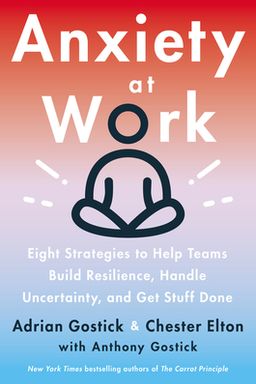
Anxiety at Work cover

Anxiety at Work

by Adrian Gostick and Chester Elton with Anthony Gostick

Anxiety at Work offers transformative strategies for leaders to identify and mitigate anxiety triggers in the workplace. By fostering empathy, open communication, and inclusivity, organizations can improve employee well-being, resilience, and productivity in today’s uncertain job market.

Creating Calm and Resilience in the Age of Workplace Anxiety

Have you ever felt like that duck on a pond—calm and composed on the surface, but desperately paddling underneath just to stay afloat? In Anxiety at Work, Adrian Gostick and Chester Elton argue that this image captures what millions of professionals experience daily. Their central claim is simple yet profound: anxiety has quietly become one of the biggest productivity killers of our time, and the way leaders respond to it can either empower or devastate their people. By ignoring anxiety, organizations risk burnout, disengagement, and even health crises; by addressing it, they unleash confidence, creativity, and deep loyalty.

Gostick and Elton—known for their research on leadership and workplace culture—contend that anxiety must be seen not as an individual weakness but as a cultural signal. When anxious employees feel unseen or unsupported, entire teams suffer. In contrast, when leaders cultivate psychological safety, clarity, and compassion, those same employees often become the most resilient and productive. Anxiety isn’t always bad, they note; it signals people who care deeply about their work. The challenge is transforming that energy from fear-driven chaos into constructive motivation.

Why Anxiety Has Become a Universal Workplace Crisis

The authors began their research before the COVID-19 pandemic, but its arrival magnified everything. Surveys already showed that 34% of workers experienced anxiety regularly, with younger employees—millennials and Gen Z—quitting jobs for mental health reasons at alarming rates. Then came global upheaval, economic unpredictability, and social isolation. According to Gostick and Elton, we entered an age where everyone feels the ripple effects of pressure, uncertainty, performance metrics, and virtual disconnection. The U.S. Census Bureau found that during 2020, over 30% of Americans reported symptoms of an anxiety disorder, including nearly half of people in their twenties.

The book’s first chapters introduce “the duck syndrome,” originally coined at Stanford University to depict how students project success while hiding emotional struggle. In workplaces, leaders see calm employees who quietly endure mounting panic underneath. Like Chloe—the investment analyst who unexpectedly ghosted her job—many workers appear composed while they’re on the brink of burnout. When anxiety remains invisible, even a small miscommunication or perceived indifference from a manager can push someone over the edge. The authors argue this epidemic demands proactive leadership: awareness, care, and systems that make mental health safe to discuss.

The New Role of Leaders: From Pressure to Empathy

Gostick and Elton insist leaders can no longer rely on old-school toughness, where pressure is wielded as motivation. That approach amplifies fear, erodes retention, and costs organizations billions through absenteeism and burnout. Instead, the modern manager must pivot toward compassion and clarity. Leadership today means helping people navigate volatility while maintaining trust, transparency, and psychological safety. Gareth Southgate’s transformation of England’s national football team offers a striking metaphor: by vulnerably discussing his own missed penalty and releasing athletes from fear of failure, Southgate turned a culture of anxiety into open, confident performance and led his team to its best finish in half a century.

The key, argue Gostick and Elton, is not to eliminate anxiety entirely but to help employees regulate it. Like resilience training in the U.S. Army, teams can learn mastery (control in chaos) and cultivate social support so people recover faster from setbacks. Leaders who listen, normalize emotional discussions, and take meaningful action—such as adjusting workloads or offering flexibility—become catalysts for mental well-being. They’re not therapists, but advocates. Companies that do this, the authors show, experience higher engagement, stronger culture, and even lower healthcare costs.

Eight Paths to Reducing Workplace Anxiety

The book is organized around eight sources of workplace anxiety and provides concrete methods for each. These include uncertainty about job security, overload and burnout, lack of career clarity, perfectionism, fear of conflict, marginalization and bias, social exclusion, and low confidence or under-recognition. Every chapter distills stories from leaders who tackled these issues with skill and empathy—whether helping anxious employees prioritize workloads, encouraging healthy debates, or making marginalized team members feel safe and valued.

Through examples like FYidoctors president Darcy Verhun, who practiced transparent communication through daily Zoom briefings during the pandemic, or American Express executive Doria Camaraza, who cultivated psychological safety while delivering tough news, Gostick and Elton illustrate the power of authentic connection. Leaders who practice humanity instead of hierarchy transform fear into loyalty. Anxiety becomes not a liability—but a message that something within the culture is asking to be healed.

Why This Book Matters Now

What makes Anxiety at Work uniquely urgent is its invitation to reimagine leadership around empathy and mental health. In a world of automation, pandemics, and relentless change, anxiety may never disappear—but it can be harnessed. Leaders who embrace emotional intelligence, build open dialogue, and recognize their people’s humanity will not only reduce worry and burnout but also inspire deep resilience. The book closes on a hopeful note: the semicolon tattoo as a symbol of continuing the sentence instead of ending it. In workplaces crippled by stress, leaders can become that punctuation mark—a pause of compassion before moving forward with purpose. This is not just a management guide; it’s a manifesto for building workplaces that feel safe, human, and whole.


Lead Through Uncertainty

Uncertainty is one of the most potent anxiety triggers at work. Gostick and Elton explain that few things unsettle people more than not knowing what’s coming—whether it’s about job security, company direction, or personal performance. When employees don’t clearly understand where their organization or role is heading, their brains flip into threat mode. They imagine worst-case scenarios and struggle to focus. The antidote? Relentless transparency and communication.

Make It Okay Not to Have All the Answers

Leaders often fear admitting uncertainty. Yet the most effective managers, like Microsoft’s Lutz Ziob and Oracle’s Liz Wiseman (author of Multipliers), invite their teams into the unknown. Ziob encouraged debates where people defended opposing viewpoints and then swapped sides, teaching that collaboration thrives when ambiguity is embraced openly. This normalization of not knowing reduces paralysis and lets teams think creatively instead of fearfully.

Loosen Your Grip in Tough Times

Nicole Malachowski, the first female pilot of the Thunderbirds, offers a metaphor: when flying in turbulence, gripping the flight stick tighter only amplifies instability. In uncertain conditions, leaders must “loosen their grip”—stop micromanaging, stay curious, and display calmness. When bosses overcontrol under pressure, employees' anxiety skyrockets. Instead, showing vulnerability (“I’m overwhelmed too”) can encourage shared humanity and build team trust.

Ensure Everyone Knows What’s Expected

Unclear expectations are gasoline for anxiety. Even small ambiguities—how detailed a report should be or who owns a task—can spiral into panic. Gostick tells of Lisa, a register attendant who slowed down sales while being friendly. Her boss clarified priorities: speed over conversation that day. Anxiety fell immediately. The lesson is that clarity beats charisma; make sure every team member knows what “good” looks like today.

Keep People Focused on What They Can Control

A customer service leader reduced burnout by helping her team accept what they couldn’t fix—slow systems—and focus on quality instead. This emotional reframing, called emotional acceptance, helped the team celebrate weekly wins rather than obsess over inefficiencies. By shifting focus from helplessness to agency, you replace rumination with mastery—the psychological sense that “I can influence my world.”

Cultivate a Bias to Action

At WD-40 Company, CEO Garry Ridge calls mistakes “learning moments.” With “bias for action,” employees move forward despite uncertainty, knowing errors are data, not evidence of failure. Amazon embodies this principle too—they value reversible decisions and calculated risk-taking. Action reduces fear paralysis because movement sends a signal of self-efficacy. Stagnation, by contrast, reinforces anxiety.

Offer Frequent Constructive Feedback

The final ingredient for calming uncertainty is continuous, compassionate feedback. Instead of annual reviews, leaders should hold regular check-ins where employees hear both affirmation and direction. A culture of ongoing dialogue dissolves ambiguity: people know where they stand. Doria Camaraza at American Express exemplifies this—she shared hard truths early but combined them with hope and clarity. When employees believe that leaders will level with them, uncertainty becomes manageable rather than menacing.


Help with Overload and Burnout

Workload anxiety—the feeling that you’ll never catch up—is one of the most pervasive stressors today. Gostick and Elton reveal that over 90% of employees report feeling burned out, not because they’re inefficient, but because modern work systems demand more in less time with fewer people. The authors urge leaders to shift focus from fixing individuals to fixing the environment that overloads them.

Break Work into Manageable Chunks

Using Navy SEAL training as metaphor, Columbia professor Rita McGrath contrasts “Taskers,” who take things one step at a time, with “Optimizers,” who think about the entire mission and burn out. Managers can help employees emulate Taskers—taking large projects and breaking them into clear, achievable milestones. This creates mental rest stops that prevent overwhelm and restore focus.

Create Clear Roadmaps

Mary Beth DeNooyer of Keurig Dr Pepper uses personalized frameworks that map each employee’s goals, values, and competencies on one sheet. When everything feels chaotic, employees look up at the roadmap and re-anchor their priorities. Co-creating such plans cultivates ownership and reduces anxiety because people see cause-and-effect between effort and outcomes.

Balance and Rotate Loads

DeNooyer also keeps weekly “load balancing” check-ins. She looks at each employee’s bandwidth and redistributes tasks. Managers must avoid consistently overloading star performers—hours aren’t productivity. Assign work fairly, celebrate efficient completion, and use transparency. Harvard psychologist Harry Levinson adds rotation into lower-stress roles: temporary reprieve replenishes energy and builds resilience. Rotation made nurses, for example, less likely to burn out and improved patient care.

Prioritize and Minimize Distraction

Employees often drown not in work, but in interruptions. Studies show multitasking reduces productivity by 40%. Manager Kim Cochran reduced distraction by triaging company emails, only forwarding essentials. This “filtering leadership” helped her retain her entire remote sales team. Teach employees to focus deeply on one priority—like Abraham Lincoln pondering law cases on his log until clarity emerges. Concentrated calm replaces noisy anxiety.

Encourage Rest and Renewal

Finally, burnout recovery isn’t about grinding less—it’s about recovering better. Dr. David Ballard of the American Psychological Association insists downtime must also be mental, not just physical. Stop sending weekend emails, use vacation time publicly, and talk about what you do outside work. When you say, “I’m taking a walk at lunch,” you normalize rest. This simple habit models balance and signals safety to anxious employees craving permission to breathe.


Chart Career Growth and Direction

Career uncertainty is the modern generation’s existential anxiety. Gostick and Elton show that young professionals today face a “quarter-life crisis” fueled by stagnant wages, delayed milestones, and unclear advancement paths. While 87% of millennials say growth is vital to job satisfaction, fewer than 40% feel they’re learning anything new. Leaders can greatly reduce this tension by helping employees visualize growth, even if upward mobility seems limited.

Create More Steps to Grow

At job site Ladders, CEO Marc Cenedella resolved promotion anxiety among millennials by introducing six mini-promotions over two years. Each had tangible milestones and visible celebration. These incremental steps created psychological momentum and reduced impatience. Frequent progress cues signal value; stagnation signals neglect.

Coach About How to Get Ahead

Former Google executive coach David B. Peterson teaches leaders to help employees balance current excellence with future preparation. By reviewing calendars weekly, teams can check how much time is invested in next-level learning. Allocating even two hours to develop future skills lowers anxiety—it transforms career growth from wishful thinking into structured reality.

Help Assess Skills and Motivations

Using the authors’ “Motivators Assessment,” managers learn what truly drives each team member—creativity, autonomy, teamwork, learning, or recognition. For Greg, a brilliant consultant but poor mentor, moving into team leadership made him miserable. Job sculpting helped him refocus on consulting instead of managing. A good leader helps employees find the work that fits their motivators; forcing the wrong fit breeds anxiety for everyone.

Promote Skill Development and Peer Learning

Employees grow best through real-time challenge, not abstract classes. Keurig Dr Pepper reframes careers as “rock walls” instead of ladders—people can move up, sideways, or diagonally. Leaders support this through short, personalized projects or peer learning sessions, like Housecall Pro founder Roland Ligtenberg who tells staff, “Perfection is the enemy of done.” Such cultures reward experimentation and growth over perfection, diminishing fear and building momentum.


Manage Perfectionism and Fear of Failure

While excellence drives achievement, perfectionism cripples it. Gostick and Elton argue that perfectionism isn’t the pursuit of quality—it’s the fear of imperfection. It manifests as endless overworking, self-criticism, and avoidance of risk. Perfectionists focus more on being seen as flawless than being effective, creating anxiety loops that drain confidence and stunt performance.

Clarify What “Good Enough” Is

Perfectionism thrives in ambiguity. When leaders clearly define acceptable standards, employees can let go of unnecessary self-punishment. Anthony Gostick learned this firsthand when his biotech lab mentor explained that micro-measuring agar jelly wasn’t vital. Clear practical boundaries teach that excellence lives within limits, not compulsive extremes.

Normalize Imperfection and Learning

Columbia’s Rita McGrath teaches “minimum viable progress”—a growth mindset emphasizing experimentation over flawlessness. FYidoctors president Darcy Verhun learned to reframe missed goals as signs they’d dreamed big enough. His team’s 60% success rate became proof of ambition, not failure. This shift transforms anxiety into creative curiosity.

Treat Failures as Learning Opportunities

Leaders like Alan Mulally at Ford redefined mistakes as signals for collaboration. When a manager admitted a launch delay, Mulally applauded rather than punished him—reacting with “Mark, thank you for visibility.” Anxiety decreases when confession brings support, not shame. Cultures that assume positive intent teach employees to surface problems early.

Check Progress and Talk Openly

Regular feedback normalizes improvement and removes fear’s guesswork. Managers should check progress collaboratively, not inspectively. When Liz paired her detail-obsessed employee Sara with an efficiency-focused colleague, Sara learned that sharing control sped up outcomes. Coaching conversations framed around shared wisdom (“Here’s something I had to learn”) shift perfectionist defensiveness into growth openness. Over time, “It’s not perfect” becomes “It’s good—I’ll move on.”


From Conflict Avoidance to Healthy Debate

Many workplaces suffer not from too much arguing, but too little. Gostick and Elton reveal that fear of conflict is a major anxiety trigger—employees stay silent to avoid tension, sacrificing innovation and honesty. Healthy debate, when built on trust and respect, actually reduces anxiety by replacing unspoken worry with open communication.

Define Candor and Psychological Safety

Emmy-winning journalist Connie Dieken highlights that leaders must model “thoughtful candor”—open honesty without hostility. Teams that practice this thrive; silence, by contrast, breeds defensiveness and anxiety. When FYidoctors’ Darcy Verhun asked everyone on Zoom, “What are you thinking but haven’t said?”, his team’s decisions instantly improved. Psychological safety starts with direct questions and genuine curiosity.

Coach the Conflict-Averse

Avoiders often equate disagreement with personal rejection. Gostick suggests coaching around this belief, teaching that candor is a gift—not a betrayal. Leaders should role-play tough conversations focusing on facts over emotions (Issue-Value-Solution framework). This provides a safe scaffold for uncomfortable dialogue. Harvard’s Amy Edmondson adds that “using your words” with vulnerability signals fallibility, inviting others to speak freely too.

Assume Positive Intent and Plan Resolution

Debate degenerates when people question motives instead of ideas. Like Joe Biden’s eulogy for John McCain, attacking arguments, not character, restores respect. Managers must help teams debrief after conflict: what was learned, what remains unresolved, and how to track follow-ups. Without aftercare, even well-meaning debates can decay into resentment.

Encourage All Voices

Author Liz Wiseman learned her best debating lessons from third graders—ask questions, require evidence, and keep participation balanced. She literally tallied who spoke and invited quieter members next. This simple inclusion technique lets teams argue vigorously yet safely, converting fear of conflict into confidence through structure and mutual respect.


Becoming an Ally for Marginalized Employees

Marginalized employees bear anxiety that others rarely see. Gostick and Elton detail how bias, microaggressions, and exclusion make daily work emotionally dangerous for people of color, women, LGBTQ+ individuals, and those with disabilities. Allyship—intentional, consistent advocacy—becomes essential leadership.

Understand Unequal Anxiety

Psychologist Thomas Vance shows that social inequality increases minority mental health risks—yet treatment access lags behind. “Minority stress” builds when people hide true identities at work. Dorie Clark calls it “the stress of hiding.” Managers reduce this by proactively protecting everyone’s authenticity—writing inclusive policies, using respectful language, and sharing vulnerability through their own identity stories.

See Color—and Bias

Colorblind statements (“I don’t see race”) invalidate lived experience. Activists Franchesca Ramsey and Janice Gassam emphasize that empathy starts with acknowledging differences, not pretending they don’t exist. Bias isn’t moral failure; it’s neurological shorthand, says scholars Mahzarin Banaji and Anthony Greenwald (Blindspot). The best leaders seek out implicit bias training and practice curiosity rather than denial.

Recognize Microaggressions and Listen Up

Subtle insults—“You’re so articulate” or “pretty face” introductions—cause real anxiety. Research at Marquette University links these micro-cuts to depression and even thoughts of suicide. HubSpot’s Katie Burke teaches allyship as an active verb: listen vulnerably, amplify marginalized voices, and respond with empathy instead of shock. Leaders like Cummins HR head Evelyn Walter handwritten notes to Black employees during BLM protests—small gestures with immense impact.

Sponsor, Stand Up, and Advocate

Karen Catlin’s story illustrates sponsorship—using privilege to publicly endorse underrepresented colleagues. Allies also confront bad behavior directly, as Isaac Sabat notes, because advocacy from insiders weighs more heavily. YouTube CEO Susan Wojcicki’s mentor secured her invitation to an elite conference, a vivid reminder: powerful allies open closed rooms. These daily acts of courage make workplaces psychologically safe for everyone and transform the anxiety of exclusion into confidence born of connection.


Build Gratitude and Confidence

As the authors close the circle on anxiety, they highlight gratitude as one of the most potent antidotes. Appreciation grounds people in belonging and worth—counteracting self-doubt and imposter syndrome. Gostick and Elton call gratitude the “Bank of Engagement”: regular deposits in trust that buffer constructive criticism and adversity.

Make Gratitude Specific and Sincere

Empty praise (“Good job”) flatters no one. Leaders should express specific gratitude tied to concrete actions and company values. Carlos Aguilera at Avis Budget Group asked his team to publicly share examples—like Delana noticing a customer’s knee brace and arranging faster service. This ordinary thank-you turned anxiety into confidence by saying: We see you.

Match Praise to Magnitude

Small words for big wins breed resentment. Shari Rife at Rich Products discovered equal gift cards for trivial and major efforts demotivated everyone. Recognition must scale with impact—written notes for small wins, personal calls or tangible rewards for major ones. When praise fits achievement, it feels authentic, not perfunctory.

Preserve Significance and Consistency

Never dilute recognition by mixing it with routine business. Gratitude deserves its moment. One worker's one-year award felt humiliating when wedged between twenty-year tributes. Make recognition personal, timely, and contextual. Harvard’s Rosabeth Moss Kanter found innovative companies flood their cultures with “thank-yous” even for small contributions—creating emotional oxygen for anxious minds.

Include Everyone—Especially High Flyers

Managers often overlook their top performers, assuming confidence protects them. It doesn’t. In one case, Jennifer—an outstanding designer—left after being under-recognized, while mediocre peers stayed. Gratitude shouldn’t be rationed for fairness; it’s fuel for excellence. Frequent, genuine appreciation quiets doubt, improves relationships, and turns anxious striving into assured engagement.

Dig Deeper

Get personalized prompts to apply these lessons to your life and deepen your understanding.

Go Deeper

Get the Full Experience

Download Insight Books for AI-powered reflections, quizzes, and more.