
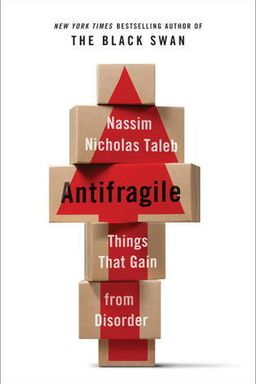
Antifragile cover

Antifragile

by Nassim Nicholas Taleb

Antifragile by Nassim Nicholas Taleb explores the concept of thriving in chaos. Discover how systems benefit from disorder and why modern efforts to create stability may actually be making us more vulnerable. Taleb challenges conventional wisdom, offering a fresh perspective on resilience, risk management, and the role of uncertainty in progress.

Antifragility: Thriving on Disorder

How can you live and design systems that improve under stress, uncertainty, and shock rather than collapse? In Antifragile: Things That Gain from Disorder, Nassim Nicholas Taleb argues that fragility—being harmed by volatility—is a sign of misunderstanding how the world really works. Beyond “robustness,” which merely resists shocks, Taleb introduces antifragility: the property of gaining from variability, randomness, and time. This concept redefines how you should think about life, economics, medicine, and decision-making under uncertainty.

Three categories of response to stress

Taleb begins by distinguishing between fragile, robust, and antifragile systems. Fragile entities break under pressure (a glass or leveraged bank). Robust entities resist change but gain nothing from it (a stone bench or bureaucracy). Antifragile entities, by contrast, grow stronger through volatility (your muscles after exercise, evolution through mutation, city-states through local experimentation). He evokes vivid metaphors: Damocles (fragile, destroyed by a single event), Phoenix (robust, returns unchanged), and Hydra (antifragile, grows more heads when attacked).

From prediction to exposure

You cannot reliably predict rare, high-impact events—“Black Swans.” Taleb’s prescription is practical: stop forecasting and measure fragility instead. Ask how sensitive a system is to mistakes or stress. If small errors escalate nonlinearly into catastrophic harm, it’s fragile. This flips traditional risk management on its head: rather than guess when the next crash will occur, you control what the crash can do to you. A decentralized city-state can endure shocks better than a centralized empire, just as a diversified individual tolerates bad luck better than someone leveraged to perfection.

Convexity and asymmetry

Mathematically, antifragility means convex payoffs: you benefit more from upside volatility than you lose from downside volatility. Jensen’s inequality formalizes this—if your payoff curve bends outward, randomness helps you. The “barbell strategy” embodies this insight: hold most resources in extreme safety and a small portion in speculative, high-upside options. You protect against ruin while keeping open the possibility of extraordinary gain. This applies to life as much as finance—stable income plus bold side projects, redundancy plus opportunistic tinkering.

Modernity’s fragility and ethical balance

Taleb warns that modernity—central planning, over-optimization, suppression of small failures—creates large fragilities. We “smooth” volatility out of economies and humans, losing natural mechanisms of adaptation. Redundancy (like two kidneys or extra slack in schedules) is not waste—it’s the biological way to insure against ruin. He also insists on moral symmetry: never build your antifragility at the expense of others’ fragility. When bankers take hidden risks for personal upside and pass losses to taxpayers, society becomes systemically fragile.

Applied antifragility

Across medicine, policy, and life, the lesson is simple: welcome small stressors, avoid ruinous ones, and design systems that self-correct. Exercise and fasting make the body stronger (hormesis); decentralized experimentation makes civilizations resilient. Education should blend minimal credentials with broad autodidactic curiosity—a “barbell” learning approach. Optionality, tinkering, and ethical skin in the game replace prediction and control. The world’s uncertainty is not a curse; it is the fuel that drives improvement when systems are built to learn from it.

Core message

Don’t try to forecast or stabilize life’s volatility. Design for asymmetric exposure—limit catastrophic downside and embrace beneficial randomness. You gain not by predicting the future but by structuring your decisions so the future’s surprises help you.

In sum, Taleb’s argument unfolds from epistemological humility to practical wisdom: measure fragility, seek convexity, harness randomness, and live with skin in the game. Antifragility becomes not just a property of systems but a philosophy of life—one that honors uncertainty as an ally rather than an enemy.


Fragility, Asymmetry, and Measurement

Taleb’s first actionable rule is measurable: fragility is how harm accelerates with stress. Instead of chasing quantitative forecasts, he urges you to measure sensitivity to shocks—an asymmetry test. A system is fragile if a small increase in volatility multiplies damage. Robust systems remain flat; antifragile ones improve. You can probe fragility with convexity diagnostics rather than full models.

Detecting fragility

You test fragility like a scientist: perturb an input slightly and watch if losses grow faster than linearly. Fragility is concavity—damage accelerates disproportionately with stress size. The “tail vega” idea, developed with Raphael Douady, defines fragility as sensitivity of left-tail losses to volatility. Fannie Mae’s secret 2003 risk reports showed huge negative convexity—tiny shocks produced tiny gains but large losses under stress. That mathematics foresaw collapse without calendar prediction.

Parameter uncertainty and epistemic humility

Taleb’s collaboration with Avital Pilpel and Douady exposes another layer: small probabilities are convex to errors. A tiny uncertainty in parameters like standard deviation magnifies rare-event risks massively. That means engineers or bankers who rely on “one-in-a-million” probabilities, while admitting they don’t know exact parameters, are inconsistent by design. Fukushima’s nuclear estimates illustrate layered ignorance—each level of uncertainty fattens tails. The rarer the event, the less you can know it reliably.

Why measuring exposure beats prediction

You can’t estimate rare-event probabilities precisely—but you can measure how you’ll fare if they occur. Focus on exposure: how steeply harm increases and whether the system can recover. Taleb’s practical motto is “perturb to reveal”—if small changes generate accelerating harm, redesign the system. Banks before 2008 were leveraged to concavity; small liquidity shifts cascaded into ruin. Compare a flexible small trader (antifragile) to a highly optimized conglomerate (fragile). Size magnifies nonlinear damage.

Practical takeaway

Redesign your decisions to reduce exposure to irreversible harm and expand exposure to possible benefit. Control fragility rather than chase precise forecasts—the latter are epistemically undecidable.

Once you shift from prediction to exposure, you free yourself from false precision. Every stress test should ask not “what is the odds of X?” but “will X kill us if it happens?” That epistemic humility becomes mathematical rigor turned into survival strategy.


Optionality and the Barbell Mindset

To transform uncertainty into opportunity, Taleb introduces optionality—the right but not obligation to act when conditions become favorable. Optionality yields convex payoffs: limited losses, potential extreme gains. From Thales’ olive-press gambit to modern start-up investing, this concept operationalizes antifragility in business and life.

The essence of optionality

Thales reserved olive presses cheaply and profited hugely when the harvest boomed. He didn’t predict outcomes; he structured exposure. Seneca’s Stoic attitude complements this—mentally writing off possessions to limit emotional downside while preserving material upside. Optionality lets you exploit good volatility while surviving bad luck. It rewards tinkering and exploration.

The barbell principle

In uncertainty you should hold extreme safety for most of your capital and take multiple small speculative bets with the rest. That’s the barbell strategy: 90% safe assets, 10% risky ventures. You can’t know which bet will win, but you know losses are capped. Venture capital, scientific discovery, and personal careers mirror this shape. The world’s most scalable domains—biotech, publishing—operate on rare positive Black Swans. Optionality across many small bets beats prediction-centered planning.

Convexity in action

Mathematically, optionality equals convexity. When your payoff curve bends outward, volatility increases expected value. Jensen’s inequality proves E[f(x)] > f(E[x)] for convex functions—uncertainty adds potential gains. In policy, this means funding many small independent projects rather than one grand program. In personal life, keep redundancy and curiosity alive—safe income on one side, experimental passion projects on the other.

Guideline

Prefer optionality over prediction: you don’t need to know which Black Swan will win—you need to survive all and capture the rare positive one.

Whether deciding investments, career steps, or creative ventures, think in barbell form. Keep your downside clipped and your upside open. Optionality is the architecture of antifragility—it lets you exploit randomness instead of suffer from it.


Stress, Hormesis, and Redundancy

Taleb defends the paradox that small stressors strengthen systems. The body, like society, improves when challenged but deteriorates when overprotected. This biological insight—hormesis—extends to economics and psychology: short-term discomfort builds long-term resilience.

Hormesis and Mithridatization

Hormesis is beneficial response to low-level harm—your muscles strengthen when stressed, bones densify under load. Mithridates learned tolerance to poison through gradual exposure. Intermittent fasting and episodic stress follow the same principle. (Note: Taleb distinguishes hormesis from homeopathy—a scientifically unproven idea.)

Redundancy and overcompensation

Nature compensates aggressively: two lungs, spare neural circuits, excess strength beyond daily need. Redundancy isn’t waste—it’s built-in insurance. A firm with cash reserves is antifragile; one optimized for thin margins is fragile. Nature doesn’t seek efficiency—it seeks survival. The Greenspan era’s financial smoothing replaced redundancy with leverage, trading apparent stability for concealed ruin.

Practical design lessons

  • Invite small, nonlethal stress—exercise, debate, exposure—to keep systems learning.
  • Build redundancy—cash reserves, multiple suppliers, extra time—rather than chase optimization.
  • Let small failures occur; they cleanse fragility before catastrophe.

Ethical corollary

Never remove small risks to look heroic in the short run—you merely accumulate larger, unseen dangers for later generations.

Redundancy and stress together create learning loops. The antifragile body, organization, and civilization grow stronger from minor chaos and redundancy. The fragile one, insulated from pain, grows brittle until the next shock destroys it.


Modernity, Intervention, and Ethical Fragility

Taleb attacks the dream of control—modern institutions that suppress volatility through planning and intervention. He uses medicine’s term iatrogenics (harm by the healer) for any expert fix that worsens systemic fragility. Overstabilization in finance or policy converts small manageable errors into catastrophic ones.

The iatrogenic trap

Doctors once prescribed mass tonsillectomies—intervention bias disguised as progress. Central bankers do the same with markets: suppress recessions, accumulate risk. Semmelweis’s forgotten handwashing illustrates institutional blindness—truth resisted by arrogance. (Note: Taleb’s anger is moral as much as technical—he sees interventionism as ethical failure.)

Via negativa and subtraction

Taleb revives the apophatic tradition—knowledge by removal. You know fragility by what fails. Instead of adding fixes, subtract harmful components. Medicine should stop unnecessary procedures; policy should remove distortionary subsidies; technology should eliminate risky complexity. You cannot prove what helps, but you can often prove what harms. This “via negativa” is safer under opacity.

Ethical symmetry: Skin in the game

No advice should come from someone unexposed to its consequences. Hammurabi’s builder law—death penalty if a house kills its owner—creates moral alignment. Modern finance reversed it: gains privatized, losses socialized. Taleb demands skin in the game—regulators, CEOs, and academics must bear downside. It’s the ethical backbone of antifragility.

Guiding rule

First, do no harm. Second, ensure symmetric incentives. The healer, policymaker, or banker must suffer if his advice backfires.

Modernity’s fragilization—its overconfidence in experts, suppression of variability, and moral hazard—shows why ethics and structure intertwine. To be antifragile ethically, tie words to personal risk; act less, remove more.


Knowledge, Tinkering, and Time

Taleb blends philosophy, epistemology, and history to redefine how knowledge survives. Real progress emerges from evolution, amateurs, and trial—not from predictive experts. He calls this the triumph of tinkering over theory and connects it to the Lindy effect: the longer something survives, the longer it’s expected to endure.

Tinkering precedes theory

Airplanes, wheels, and engines came from craftsmen, not academic formulas. The “Soviet–Harvard illusion” credits universities for innovations born from workshops. The “green lumber fallacy”—Joe Siegel’s trading success despite misunderstanding his commodity—shows that conceptual knowledge isn’t always what produces practical success. History is rewritten to glorify theory while practice quietly builds the world.

Lindy knowledge and subtractive wisdom

In Lindy domains (nonperishables like books or ideas), time acts as a filter: what survived 100 years will likely survive another 100. This heuristic beats futurism—ignore shiny new narratives and trust tested practices. Time itself is the ultimate stress test. Epistemologically, via negativa complements Lindy—remove what fails, respect what endures. Nietzsche’s Dionysian wisdom—embracing multiplicity over rational design—fits this evolutionary chaos.

Autodidact barbell education

Taleb’s own learning model mirrors antifragility: minimal formal education for access, wide autodidact curiosity for resilience. He reads broadly across disciplines, creating a “barbell” of credentials and exploration. Institutional schooling produces fragile minds optimized to pass tests; curiosity-driven tinkering builds flexible mastery. The Lindy rule applies here too: classic texts and ancient ideas outlast trends.

Takeaway

Trust age and trial, not academic fashion. Project robustness through time, not through credentials. The test of survival beats the test of elegance.

Knowledge grows through antifragile means—messy iteration, survival, and moral exposure. You can be more Lindy by practicing skepticism, tinkering, and timeless learning rather than predicting the next trend.


Design for Scale and Complexity

Complexity often hides fragility. Taleb reveals how size, interdependence, and optimization create convex downside responses: small errors lead to huge failures. From traffic jams to megabanks, nonlinearities make big systems fragile even when they look efficient.

Why size magnifies harm

Large entities—airports, corporations, nations—aggregate dependencies that amplify single shocks. A minor delay cascades into thousands of missed flights; a rogue trader (Kerviel) wrecks a global bank. Ten smaller banks would absorb hits separately. Taleb calls it the “stone versus pebbles” argument—distributed pain beats concentration.

Project failure and the planning fallacy

Bent Flyvbjerg’s data on mega-project overruns confirm Taleb’s intuition: bigger projects have exponentially higher failure rates. Complexity hides interactions, generating preasymptotic disasters long before theoretical safety settles. Centralization shifts domains from Mediocristan to Extremistan, where tails dominate outcomes.

Decentralization and modularity

Antifragility loves modular designs—small units, slack, and autonomy. Switzerland’s canton system or the ancient souk economy illustrate bottom-up noise producing top-level stability. Redundancy cushions errors. Overoptimized, coupled systems are doomed to collapse. Regulators and planners should prefer distributed experiments over grand plans.

Design principle

Favor small, independent units with buffers and loose coupling. Efficiency increases fragility; redundancy builds life.

Complexity without decentralization multiplies fragility. By designing for modularity and slack, you let systems wobble safely rather than shatter catastrophically.


Black Swan Ethics and Societal Resilience

In the final synthesis, Taleb turns philosophy into civic design. How should societies live with Black Swans—rare events of huge impact? His answer combines moral symmetry, decentralization, and phronesis—practical wisdom guided by ethics. Fragility is not just mechanical; it’s moral.

The Fourth Quadrant

Taleb organizes decisions by payoff shape and domain type. The worst quadrant—complex payoffs in Extremistan—is where prediction fails. Most of modern finance and politics lives there. You don’t fix such systems with better models; you fix exposures. That’s where barbell principles, redundancy, and local autonomy function as shields. In opaque domains, humility replaces calculation.

Phronetic rules for individuals

  • Love redundancy and slack over optimization.
  • Avoid hidden tail dependencies: leverage, debt, large centralized bets.
  • Respect the aged, tested, and survived (Lindy heuristic).
  • Expose yourself to variability in small safe doses—physical, intellectual, social.

Ethical reform and institutions

Taleb’s post-2008 manifesto—ten principles for a robust society—demands that fragile things fail small, not be propped up. Systems should localize risk, ban complexity no one understands, and penalize experts for mistakes. Skin in the game transforms governance from fragile technocracy to moral ecosystems. Regret and accountability forge antifragility.

Core ethic

You can’t make uncertainty disappear. You can make systems less destructible. Ethics and structure must align: those who take risk must also bear its cost.

When citizens and institutions embed skin in the game, practice via negativa, and respect local trial and error, society learns from shocks rather than breaks under them. Civilization endures by being antifragile together.

Dig Deeper

Get personalized prompts to apply these lessons to your life and deepen your understanding.

Go Deeper

Get the Full Experience

Download Insight Books for AI-powered reflections, quizzes, and more.