
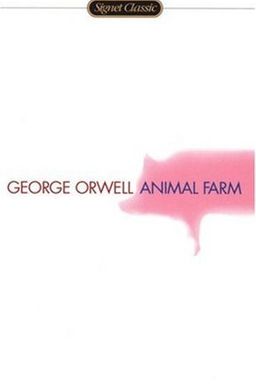
Animal Farm cover

Animal Farm

by George Orwell

George Orwell''s Animal Farm is a timeless allegory about revolution gone awry. Set on a farm, the animals overthrow their human owner, only to discover their new leaders recreate the tyranny they sought to escape. Through a satirical lens, Orwell explores themes of power, propaganda, and corruption, offering a poignant reflection on human society.

Power, Corruption, and the Fragile Hope of Revolution

What happens when a dream of equality turns into a nightmare of tyranny? George Orwell’s Animal Farm asks this unsettling question and dares you to see the echoes in your own world. Beneath its simple surface—a farmyard fable about pigs and horses—is a razor-sharp political allegory of how revolutions can betray themselves, how language becomes a weapon, and how those who seek liberation can easily become new oppressors. It’s less a story about animals than a mirror held up to all of us, showing the cycles of power that repeat whenever vigilance fades.

The Central Argument

Orwell contends that revolutions often devour their own ideals. He builds the narrative as a thinly veiled retelling of the Russian Revolution and its aftermath, where the liberation of the oppressed gives way to dictatorship. The animals rise up against Mr. Jones, their neglectful human master, to establish a society of equals. But as power consolidates among the pigs—particularly Napoleon, Orwell’s stand-in for Joseph Stalin—the promise of freedom decays into repression, propaganda, and betrayal. In Orwell’s view, no system is immune to corruption when accountability is lost and language becomes a tool for control.

Initially, the animals’ revolution feels pure and hopeful. They create commandments based on equality (“All animals are equal”) and chant mantras of solidarity (“Four legs good, two legs bad”). Yet each ideal they proclaim becomes distorted. Slowly, commandments change—quietly, cynically. By the end, the pigs walk upright, carry whips, and dine with humans, indistinguishable from those they overthrew. Orwell’s chilling conclusion resounds: history does not always march forward; sometimes it circles back in disguise.

Why It Matters

Readers often think Animal Farm is a satire of Stalin’s USSR (and it is), yet Orwell’s deeper warning goes beyond a specific regime. It speaks to leadership, manipulation, and human nature. You can see his insight in modern governments, corporations, and even social movements. Whenever ideals become unquestioned dogma, whenever dissent is treated as treason, Orwell’s pigs are alive and well. His fable endures because it captures not only politics but psychology: how fear keeps power intact, how propaganda reshapes truth, and how comfort with small lies leads to grand betrayal.

(In modern contexts, thinkers like Hannah Arendt and Václav Havel explored similar patterns—the banality of evil, the quiet complicity of ordinary people under totalitarian systems. Orwell’s contribution lies in how he made these abstractions vivid, hilarious, and terrifying through farmyard imagery.)

Major Themes to Explore

Throughout this summary, we’ll unpack a series of intertwining ideas that Orwell dramatizes:

  • The Corrupting Nature of Power: Napoleon’s slow transformation from revolutionary pig to totalitarian ruler mirrors how political movements curdle when power is unchecked.
  • The Role of Propaganda: Squealer, with his slippery tongue, demonstrates how language and false statistics can mask oppression as progress.
  • The Betrayal of the Working Class: Boxer the horse, loyal and naïve, stands for the exploited laborer who believes hard work alone can fix a broken system.
  • Language and Memory: Orwell shows how rewriting words—and history—erases resistance. The animals forget, and forgetting becomes fatal.
  • Cyclical Oppression: As the final line reveals, the exploiters of yesterday and today are reflections of one another—the line between man and pig vanishes.

Each of these themes intertwines to form Orwell’s grand design: a closed loop of revolution and repression. When ideals are unprotected by truth and collective memory, freedom becomes illusion.

Why Orwell’s Voice Still Resonates

Written in the last years of WWII and published in 1945, Animal Farm was Orwell’s response to how utopian movements lose moral ground when they pursue power rather than justice. His background as a democratic socialist and his disillusionment with Stalinism—after fighting in Spain—gave his critique moral authority. He loved the idea of socialism but despised its totalitarian mutations. “There could be no socialism without liberty,” he insisted. This paradox—idealism corrupted by control—remains relevant whether you’re examining political parties or corporate systems today.

Ultimately, this book is Orwell’s call to stay awake—to question slogans, to doubt holy leaders, to remember history. While he wraps these lessons in the innocence of talking animals, his vision pierces much deeper: freedom is not a state you achieve but a discipline you sustain. Each generation must guard it anew, or else some new Napoleon will rise to write fresh commandments on the barn wall.


The Birth of a Revolution

Every revolution begins with dissatisfaction—and a dream. On Manor Farm, it starts with Old Major, a wise old boar who gathers the animals in the barn and speaks of a golden age without humans. His speech, filled with passion and prophetic rhetoric, plants the seed of revolt. It resembles Marx’s call to arms in The Communist Manifesto, but Orwell frames it as part sermon, part bedtime story. He makes you feel the animals’ misery and yearning for justice, capturing the intoxicating early moment when hope surges against oppression.

The Promise of Equality

Old Major’s dream crystallizes into six words: “All animals are equal.” It becomes a sacred tenet the pigs codify into seven commandments. The unity feels pure, even beautiful. The animals overthrow Mr. Jones and rename their world “Animal Farm.” For a moment, equality seems achievable—there are no masters, no slaves, only comrades. Orwell captures the euphoria of revolution with striking simplicity: singing, feasting, and freedom under the dawn’s light. Yet you sense from the first how fragile such moments are. Revolution clears the stage but does not determine what follows.

The Clever Pigs Rise

The intellectuals—Snowball and Napoleon—step forward as natural leaders. Snowball is idealistic and articulate, the visionary; Napoleon is calculating, authoritarian, and silent. They, along with the smooth-talking Squealer, guide the animals through their new order of work and governance. Orwell grants the pigs intelligence, but also ambition. What begins as stewardship slowly mutates into control. Their literacy and habit of seizing the “brainwork” quickly separate them from the rest. Boxer’s heroic strength is admired, but it’s their intellect that becomes the key currency of domination. (Compare this to Plato’s philosopher-kings—where knowledge should enable wisdom, Orwell shows how knowledge, unbalanced by morality, becomes tyranny.)

Faith, Fear, and Forgetting

Despite their victory, most animals remain naive. They accept the pigs’ leadership because it’s easier to obey than to learn. When the milk and apples disappear, Squealer’s reasoning—“We need them for your sake”—works because the alternative, the return of Jones, terrifies them. Orwell uses this to show how revolutions are maintained less by faith than by fear. Each moral compromise is explained away “for your benefit,” and every lie smooths the next betrayal. Power doesn’t seize itself overnight—it asks politely first, speaking the language of safety and belonging. And soon, the revolution belongs not to the dreamers, but to those fluent in its slogans.


The Machinery of Propaganda

If truth is the lifeblood of freedom, propaganda is the infection that drains it. Through the silver-tongued pig Squealer, Orwell shows how words can rewire minds. Squealer’s role is to justify every pig decision, to drown logic with fear and clever phrasing: the pigs “don’t enjoy” privileges; they “sacrifice themselves” for others. By appealing to fear and loyalty, he transforms exploitation into patriotism. This manipulation of language becomes the novel’s central horror—the corruption of thought itself.

Language as Control

The commandments on the barn, initially clear and virtuous, begin to shift. “No animal shall sleep in a bed” quietly becomes “No animal shall sleep in a bed with sheets.” Each change erases memory; each justification molds a new reality. Orwell, who later expanded this idea in 1984, understood that tyranny doesn’t survive by censorship alone—it survives when language itself is redesigned so people forget alternative meanings. The farm’s chant, “Four legs good, two legs bad,” simplifies thinking until dissent becomes literally unspeakable.

The Role of Fear and Pride

Whenever doubt creeps in, Squealer invokes fear: “Do you want Jones to come back?” Against that terror, reason collapses. Then comes flattery: the animals are told they are heroes, that production has increased, that they’re freer than ever—even as rations shrink. Orwell’s satire here feels eerily modern. The manipulation of fear and pride is the template for all political messaging. Through Squealer, he demonstrates how storytelling replaces reality, how numbers are twisted into proof, and how lies repeated become gospel.

Silencing the Mind

Benjamin the donkey, who sees through every deceit, chooses silence. Orwell portrays his quiet cynicism as both virtue and flaw—the wisdom to discern truth but the apathy to act. In this way, the oppressed become complicit. Their silence, combined with Boxer’s blind faith and the sheep’s mindless chants, allows the new regime to thrive. It’s a tragic paradox: intelligence without courage and loyalty without discernment each lead to bondage. A free society, Orwell implies, requires both truth-tellers and listeners willing to hear them.


The Cult of the Leader

Napoleon’s transformation from liberator to despot is the novel’s dark heart. Orwell charts his ascent with clinical precision: first among equals becomes ruler above all. His leadership model is domination wrapped in the rhetoric of necessity. Every cruelty is framed as protection, every privilege as burden. By the time statues rise and songs like “Comrade Napoleon” appear, the revolution has become a cult. Napoleon’s image replaces the collective spirit—the symbol of equality becomes the instrument of obedience.

The Psychology of Power

Napoleon relies not just on dogs and guns but on belief. Orwell shows how totalitarian systems blend myth, intimidation, and ritual. The farm’s ceremonies—flag-raisings, parades, and endless slogans—serve the same purpose as real-world national cults: to make servitude feel sacred. When Napoleon revises history, casting himself as the hero of the Battle of the Cowshed and painting Snowball as a traitor, he uses collective amnesia as political cement. The more unrealistic the myth, the more loyal the followers become.

Idolatry and Isolation

By the late chapters, Napoleon lives apart, guarded by dogs, referred to only as “Leader.” He controls food, information, and punishment. Orwell’s satire of Stalin is unmistakable—purges, executions, falsified history—but the point extends beyond communism. It’s how any closed hierarchy breeds gods out of mortals. The tragedy of Animal Farm is not just that Napoleon lies; it’s that the animals need to believe in him. Orwell suggests that the craving for certainty and order makes tyranny seductive. When people surrender skepticism, they gain comfort and lose their souls.


The Betrayal of the Working Class

Boxer, the loyal workhorse, embodies the heart of the revolution—and its greatest victim. He believes in the slogans “I will work harder” and “Napoleon is always right.” Through him, Orwell pays tribute to the honest laborers whose sweat sustains every system yet who reap none of its rewards. Boxer's tragic loyalty demonstrates how good faith, when blind, becomes a tool of oppression. His strength rebuilds the windmill after each disaster; his faith rebuilds the lie each time it collapses.

Faith Turned Against the Faithful

Even when faced with starvation and obvious deceit, Boxer’s answer is always to work harder. When he falls sick after years of service, Napoleon sells him to a glue factory and tells the animals he died in a hospital. The deception devastates Clover and Benjamin but barely stirs revolt. Orwell’s point is brutal: exploitation persists not only because of cruelty from above but because of passivity below. Compassion without resistance, like strength without reason, cannot free anyone.

A Mirror of Every Revolution

Boxer’s fate echoes the proletarian tragedies of the early Soviet Union and beyond—workers sacrificed for utopia that never arrives. But his story also reaches into any workplace or movement where power rewards loyalty only until it is inconvenient. Orwell reminds you that idealism untempered by critical thought becomes servitude. The image of Boxer’s cart rolling away, his friends crying too late, is among the most heartbreaking allegories ever written about betrayed loyalty.


The Collapse of Truth and Memory

Memory is the anchor of freedom, and Orwell shows what happens when it’s slowly cut away. As years pass, the animals forget their original purpose. The Seven Commandments erode until only one remains: “All animals are equal, but some animals are more equal than others.” Through subtle revisions and collective forgetfulness, the revolution’s ideals dissolve into absurdity. The past becomes whatever the rulers say it was.

Rewriting History

Each time the pigs shift a rule, the animals doubt their own memory before doubting the written words. Orwell exposes how propaganda thrives not only by lying but by erasing evidence that truth ever existed. This is the moral precursor to his later invention of the “Ministry of Truth” in 1984. Control the past, and you control identity itself. By the novel’s end, even language—the last refuge of dissent—has been weaponized into nonsense slogans. “Four legs good, two legs better” becomes the epitaph of the revolution.

Full Circle to Slavery

In the final chapter, the pigs walk on two legs, carry whips, and host human farmers in the farmhouse. The animals peering through the window cannot tell pig from man. Equality, having lost its meaning, becomes inequality’s disguise. Orwell ends not with explosions but with laughter—the gut-deep horror of recognizing that the liberators have become indistinguishable from their oppressors. Every revolution that forgets its principles ends not in progress but parody.

For readers, it is a warning both sobering and timeless: freedom dies not with a bang but with an edit—one small revision at a time.

Dig Deeper

Get personalized prompts to apply these lessons to your life and deepen your understanding.

Go Deeper

Get the Full Experience

Download Insight Books for AI-powered reflections, quizzes, and more.