
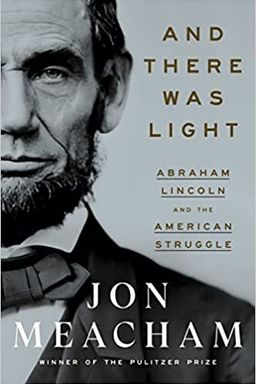
And There Was Light cover

And There Was Light

by Jon Meacham

And There Was Light by Jon Meacham offers a captivating biography of Abraham Lincoln, exploring his moral and political evolution. Delve into Lincoln''s complex leadership during America''s defining struggle over slavery, and discover how his legacy continues to influence today''s quest for justice and unity.

Lincoln’s Moral and Political Evolution

How do moral conviction and political prudence unite to change a nation? In the sweeping narrative of Lincoln’s life, you see a transformation from backwoods autodidact to statesman-philosopher who steers the country through slavery’s end and a rebirth of freedom. The book argues that Lincoln’s greatness lies not in sudden inspiration but in a disciplined marriage of conscience and governance. His story binds personal grief, theological reflection, and political strategy into one evolution of leadership under moral trial.

Formative Years and the Making of a Mind

You begin with the boy on the frontier, hungry for books, forging education from borrowed volumes and charcoal on a plank. His reading of the Bible, Aesop, Murray’s The English Reader, and historical texts implants moral reasoning alongside rhetoric. This frontier autodidact develops habits of reflection that later guide his political style—measured language, slow deliberation, and a belief that reasoned persuasion can move a democracy. Early exposure to frontier preaching against slavery and to the egalitarian ethos of labor nurtures what he later calls his “natural antislavery” sentiment.

(Parenthetical note: Lincoln’s early intellectual solitude contrasts with elite schooling. His education is self-directed and moral in spirit, a lesson in how disciplined curiosity can create civic competence.)

Law, Oratory, and Political Ascent

As Lincoln moves from circuit lawyer to national figure, his legal method becomes a model for political argument. He learns to sequence facts like a case: constitution first, morality second, persuasion third. From his Peoria address through the “House Divided” speech, and culminating at Cooper Union, he refines a style that blends moral law with pragmatic appeal. His debates with Stephen Douglas force him to clarify his stance: slavery must not expand, not merely because of economics but because the republic’s moral fabric depends upon that limitation.

By 1860, this combination of logic and humility—anchored by legal precision—earns him the Republican nomination. His rhetorical method teaches you how moral reasoning can be rendered politically palatable through evidence and restraint.

Faith, Conscience, and Tragedy

Private sorrow deepens public empathy. Death haunts Lincoln—from his mother Nancy Hanks to his sons Eddie and Willie. Pastoral counsel from Phineas Gurley and readings in Scripture move him toward a personal theology of providence: human duty under divine mystery. This moral reserve surfaces in speeches that read like sermons wrapped in political clothing. Unlike ideological dogmatists, Lincoln treats conscience as both compass and corrector; God does not dictate policy but invites humility in its pursuit. Thus, moral language becomes a bridge, not a bludgeon.

From Compromise to War

You watch Lincoln’s principles tested as secession looms. During the Secession Winter of 1860–61, he refuses to sacrifice the party’s promise of restricting slavery’s spread, even at the cost of peace. When Fort Sumter becomes the final test, his choice—to supply the fort without firing first—balances moral resolve and political prudence. The bombardment ends equivocation: democracy’s survival must now be defended by arms. For Lincoln, the Union is sacred not as geography but as the vessel through which freedom’s meaning can mature.

Emancipation and the Moral Turn

War gives Lincoln moral leverage. He issues the Emancipation Proclamation as a military act but anchors it in justice and divine purpose. He accepts that war may be God’s punishment for slavery and that policy must align with conscience. This synthesis—of necessity and faith—produces a moral transformation of the conflict itself: from saving the Union to redeeming it. Emancipation becomes not mere strategy but covenant, a step toward realizing the Declaration’s universal promise.

Legacy and Moral Vision

From his humble start to his Second Inaugural, Lincoln grows from cautious politician to moral philosopher in power. His addresses—Gettysburg’s “new birth of freedom” and the Second Inaugural’s prayer for mercy—bind the moral and the political. Even death cannot still his influence: later critics and activists, from Douglass to King, use his imagery to press justice further. In Lincoln’s evolution you grasp the book’s thesis: that leadership at its highest is moral education enacted through politics, and that conscience tempered by prudence can carry a republic through its darkest trial.


Moral Politics and the Slavery Crisis

You confront a nation divided not only by territory but by moral cosmology. The book immerses you in the intellectual battle between antislavery pragmatists and a proslavery worldview that cloaked domination in theology, pseudo‑science, and nationalism. Lincoln’s challenge is to answer a moral evil with constitutional action rather than moral panic.

The Southern Defense

Proslavery theorists—from Calhoun to Bishop Polk—assert divine sanction for bondage. Ministers wield Genesis and Leviticus; scientists like Agassiz and Morton measure skulls to prove hierarchy. The South’s ideology becomes a self-reinforcing triad of religion, race, and economics. Expansionist dreams—Cuba, Mexico, Central America—turn slavery into imperial ambition. (Note: such ideological infrastructure makes moderation impossible; for Lincoln, this is not mere politics but a collision of moral universes.)

Lincoln’s Antislavery Strategy

Against this edifice Lincoln develops a layered strategy. He begins with containment: slavery must not expand into new territories. He supports the Wilmot Proviso, opposes Kansas‑Nebraska, and articulates his “cordon of freedom.” Gradual emancipation and compensation follow as pragmatic bridges. Only when war renders moderation obsolete does he move toward immediate, enforced liberation. Through this sequence you learn how moral ends require patient use of legal means.

Conscience and Calculation

Lincoln’s moral politics teach you dual lessons: ethical conviction must survive political reality, and politics must serve an ethical horizon. His containment succeeded precisely because it was feasible; his proclamation worked because it followed military leverage. The book underscores this point by comparing Lincoln with the British abolitionists who bought freedom through compensation—a parallel showing Lincoln’s greater political risk and moral reach.

By fusing policy to principle, Lincoln refuses both moral absolutism and cynical compromise. He proves that governance can pursue justice without abandoning order—a lesson for any reformer facing entrenched wrongs.


Faith, Grief, and Conscience in Leadership

Behind Lincoln’s public restraint lies a private theology shaped by loss. This part shows you how personal grief, philosophical reading, and pastoral counsel turn pain into moral energy. His faith is not doctrinal orthodoxy but what he calls “inward religion”: a continual listening for the voice of conscience when logic fails.

Private Suffering, Public Empathy

From his mother’s death in childhood to the loss of his sons Eddie and Willie, Lincoln experiences grief as education. Mary Todd’s volatility and his bouts of depression force him inward. The counsel of Pastor Phineas Gurley—“Let us hear His voice”—turns mourning into contemplation about collective suffering. You learn that his empathy for a wounded nation arises from lived pain, not sentimentality.

Faith Without Dogma

Lincoln reads Joseph Butler’s Analogy, the King James Bible, and Volney’s skeptical treatises; from this mix he forms a belief in moral order without sectarian rigidity. His God is the author of reality but not a partisan. When he calls for “malice toward none,” he is translating private theology into civic forgiveness. (Compare Tolstoy’s later vision of moral power through humility; both treat suffering as the origin of authority.)

Conscience as Compass

In the presidency, this conscience becomes operational. His delay of emancipation until after Antietam shows moral patience; his pardons of deserters reveal compassion under law. The book teaches you that integrity in leadership arises not from certainty but from disciplined moral listening—the willingness to act only when principle and possibility align.


From Secession to War

In the tense winters of 1860–61, Lincoln confronts the existential crisis of the Union. You stand among telegrams, militia drills, and last-minute bargains as he weighs clay-footed compromise against constitutional survival. The story becomes a case study in statesmanship under threat.

The Pressure to Compromise

Crittenden’s constitutional amendments and Thurlow Weed’s entreaties tempt Lincoln to yield on the Republican core promise: stopping slavery’s expansion. He refuses. He believes surrendering that plank would make slavery permanent and make democracy fraudulent. In private letters he warns that “our work is lost” if we trade principle for peace. This moral insistence—tempered by political calm—defines his leadership.

Securing the Capital

The book paints Washington in rumor and treason. Winfield Scott stations artillery along Pennsylvania Avenue; John Breckinridge counts electoral votes with “Roman fidelity.” Edwin Stanton, then in Buchanan’s cabinet, leaks warnings to Congress and will later serve Lincoln loyally. Through vigilance and institutional ritual, the republic secures its lawful transfer of power. You see democracy’s survival hinging not only on ideas but on disciplined individuals honoring oath over faction.

Fort Sumter and the Choice of War

When Major Anderson’s garrison faces starvation, Lincoln’s order to send “bread to Anderson” embodies moral restraint. The Confederates fire first, ending the hope of negotiation. In response he calls 75,000 troops—his first great test of executive power. By defining the war as both constitutional defense and moral contest, he transforms rebellion into national trial. The lesson for you: principle, patiently defended, may bring conflict, but without principle conflict is only decay.


Emancipation and the Transformation of War

You watch the pivot from conservative war aims to revolutionary purpose. Emancipation emerges not as impulsive idealism but as planned progression grounded in law and necessity. Each measure—from the Confiscation Acts to the Militia Act of 1862—lays the scaffolding for Lincoln’s boldest decree.

Legal and Strategic Steps

Congress authorizes seizure of enslaved labor aiding rebellion; Lincoln experiments with compensated emancipation in D.C. while exploring colonization to mollify racial anxieties. When Antietam provides military momentum, he issues the Preliminary Proclamation. By January 1, 1863, emancipation becomes federal policy binding freedom to Union victory. Each act is framed as military necessity but infused with moral vision.

Faith, Timing, and Vow

Lincoln tells cabinet members he made a vow to God: if victory follows Antietam, he will free the slaves. Secretary Seward advises delay lest it seem desperate—Lincoln agrees and waits. The decision marries prudence and faith. You see a leader translating private promise into public decree, merging political craft and personal piety.

Black Soldiers and Citizenship

Following proclamation, recruitment of Black men transforms the army and the moral meaning of the war. The Massachusetts 54th and thousands of others fight for a republic that denies them equal pay yet proves through sacrifice their claim to citizenship. Douglass’s assertion—“no power on earth can deny that right”—summarizes the revolution from within. Lincoln’s retaliatory order for protection of Black troops (General Order 252) establishes equality under arms if not yet in law.

Emancipation thus becomes dual: policy and prophecy. It converts the Union cause into a fight for human dignity, ensuring that victory’s meaning extends beyond the battlefield.


Gettysburg and the Moral Reframing of Union

At Gettysburg in November 1863, amid graves and grief, Lincoln distills the war’s essence in under three minutes. His address compresses philosophy, theology, and history into an ethic fit for a democracy at war with itself. You see rhetoric as reconstruction.

Redefining the Nation

By invoking “four score and seven years ago,” Lincoln resets the nation’s birth to 1776—the Declaration’s creed, not the Constitution’s compromise. He consecrates not the battlefield but the ideal that the dead embodied: equality affirmed through sacrifice. The phrase “new birth of freedom” turns emancipation from war measure into national rebirth. (Compare Garry Wills’s reading: Lincoln remakes the American mind by grammatical revision of its founding.)

Democratic Faith Under Fire

Where Edward Everett gave history, Lincoln gives redemption. He transforms tragedy into covenant, calling the living to finish “the unfinished work.” This moral reframing binds citizenship to responsibility: freedom must perpetually justify itself through devotion and sacrifice. Through brevity, Lincoln achieves permanence—the speech becomes scripture of democracy.

At Gettysburg you learn that moral clarity need not be verbose; it must be precise, humane, and generative. Here Lincoln renews the republic’s purpose by wedding equality to endurance.


Victory, Theology, and Tragedy

As war nears its end, Lincoln’s thought reaches its spiritual apex. The Second Inaugural, Appomattox, and the assassination together form a triptych of triumph, humility, and loss. The book treats these not as separate episodes but as the climactic moral argument of a presidency.

Second Inaugural: A Sermon to a Nation

Delivered in March 1865, the Second Inaugural speaks less of victory than of judgment. Quoting Scripture—“Judge not”—Lincoln invites both North and South to see the war as divine correction for slavery. He refuses triumphalism and calls for mercy: “to bind up the nation’s wounds... with charity for all.” It is civic theology: justice tempered by grace. Clergy and freedpeople alike perceive it as revelation; even skeptics sense its sanctity.

Peace and the Unfinished Work

At Hampton Roads, Lincoln insists on three nonnegotiables—Union restoration, abolition intact, and cessation of arms. Weeks later, Lee surrenders at Appomattox. Lincoln enters Richmond hailed by freedpeople who kneel; he tells them to “kneel only to God.” These scenes crystallize his theology of equality in action. Special Field Order 15 and the Freedmen’s Bureau sketch a blueprint for moral Reconstruction—one fate denies him time to shape.

Assassination and Afterlife

Booth’s shot on Good Friday turns mortal politics into martyrdom. The nation’s mourning turns Lincoln into moral symbol. Yet postwar sections trace decay: Johnson’s racism, the Lost Cause, and Jim Crow erode gains. Later voices—Douglass, Du Bois, and King—rescue Lincoln’s promise, turning his words into fuel for civil rights. From his death arises the larger lesson: moral progress depends on continual reinterpretation. Every generation must reconsecrate the “new birth of freedom” he proclaimed.

Dig Deeper

Get personalized prompts to apply these lessons to your life and deepen your understanding.

Go Deeper

Get the Full Experience

Download Insight Books for AI-powered reflections, quizzes, and more.