
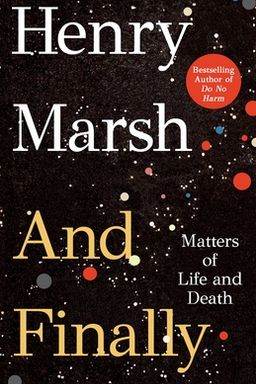
And Finally cover

And Finally

by Henry Marsh

In ''And Finally,'' Dr. Henry Marsh shares his transformative journey from a renowned neurosurgeon to a patient facing his own mortality. Through candid revelations, Marsh explores the challenges of aging, the emotional landscape of illness, and ultimately, the beauty of acceptance and empathy.

Facing Mortality: A Neurosurgeon’s Final Lesson

What happens when the healer becomes the patient? Few questions are as unsettling—or as illuminating—as the confrontation with one’s own mortality. In And Finally, the renowned neurosurgeon Henry Marsh turns his surgical gaze inward. Having spent forty years saving and losing lives in the operating theatre, he finds himself on the receiving end of medicine’s limitations, diagnosed with advanced prostate cancer and staring at his own brain’s slow degeneration. The book is both a memoir and a meditation—a profoundly human investigation into aging, death, consciousness, and the meaning of a good life and a good death.

Marsh argues that coming to terms with death is the ultimate act of self-knowledge. His lifelong desire to understand the brain—‘the seat of the self’—meets an existential reckoning: what happens when that same organ begins to decay? The surgeon who once wielded the knife must now accept frailty, treatment, and dependence. Yet this reversal grants him what decades in medicine obscured—the intimate vulnerability of being human.

From Expert Detachment to Personal Vulnerability

As a doctor, Marsh was trained to suppress emotion. He learned that too much empathy made the scalpel tremble. Yet once he is diagnosed with cancer, every clinical phrase—PSA scores, scans, radiotherapy—is charged with new terror. The book charts this psychic shift from detachment to dependence, from power to humility. Marsh admits that while he prided himself on compassion, he had not truly understood what it meant to sit in the waiting room, clinging to words of hope. Now, he writes, he can finally see how patients “cling to every word, every nuance.” Illness teaches, brutally but indelibly, what medical school cannot.

The irony isn’t lost on him. Having spent years assuring others that “hope is vital medicine,” he now experiences how fragile that medicine can be—and how often doctors themselves fumble its dosage. Each moment of care, each delay, each silent clinician now carries emotional weight he once overlooked.

The Brain as Mirror: Science, Consciousness, and Awe

A lifelong fascination drives Marsh beyond memoir into science. What, he asks, is consciousness, this ghostly flicker generated by 86 billion neurons? Chapters turn philosophical as he moves from the clinical to the cosmic—pondering sleep, anesthesia, free will, and quantum physics. He dismantles romantic notions of the soul, insisting that mind is matter in motion. Consciousness, he contends, is a fragile, emergent property of brain processes—beautiful yet impermanent. The same scientific detachment that once aided his surgeries becomes a source of existential unease: “If we are nothing more than our brains, what is lost when they decay?”

In a striking juxtaposition, he recalls viewing his own MRI scan: his aging brain shriveled, marked by white lesions—proof of degeneration. The neurosurgeon who had interpreted thousands of scans now faces his own mortality in grayscale pixels. The image becomes his memento mori, a scientific skull on the desk, Dürer’s St. Jerome brought to life.

War, Work, and the Moral Weight of Failure

Marsh’s reflections stretch beyond the personal. Through his experiences working in Ukraine and Nepal, he wrestles with the limits of medicine and the ethics of responsibility. He recalls operating in bleak conditions, facing corruption, nationalism, and the chaos of human suffering. These stories illuminate his lifelong theme: the interplay between compassion and detachment. In one vivid encounter, a Ukrainian sniper describes killing without hatred, “no emotion involved in the work whatsoever.” The parallel to surgery—cold skill, violence justified by necessity—is haunting. Marsh recognizes himself in that same need for control amid destruction.

He confronts his own fallibility too. From a wrong-side neck operation to failed tumour resections, Marsh examines medical error without evasion. Surgeons, he writes, must learn to live among their ghosts—patients who died under their hands, haunting them forever. Now, as illness slows him, those ghosts return, not as guilt alone but as teachers. “We bury our mistakes,” he quotes architect Frank Lloyd Wright, “but vines will not cover all the graves.”

Becoming Mortal—And Staying Human

But this isn’t a book of despair. Marsh’s reflections are anchored in craftsmanship, love, and beauty. As radiotherapy weakens him, he turns to woodworking, making a dolls’ house for his granddaughter—a metaphor for creation amid decay. Building, like surgery, gives structure to chaos. His domestic humor, often self-deprecating, grounds the philosophy in tactile life: clogged gutters, collapsing roofs, and kitchen disasters. These moments remind him (and us) that imperfection is simply the texture of being alive.

At its heart, Marsh’s final book argues that accepting mortality need not mean surrendering meaning. The neurological self may perish, but dignity and kindness remain choices. By fusing science, philosophy, and storytelling, And Finally invites you to see death not as an interruption of life, but as its completion. As Marsh writes, “Long life is not necessarily a good thing. Perhaps we should not seek it too desperately.”

In the end, this is not a guide to dying, but to living with intelligence, humility, and courage—a final lesson from a man who has watched countless brains fall silent, and now listens for the fading music of his own.


The Neuroscientist Confronts His Own Brain

When Henry Marsh volunteered for a brain scan, he expected reassurance. After all, he was fit, active, and intellectually sharp. Instead, his own MRI revealed a shrunken brain speckled with white-matter lesions—radiological signs of aging and vascular damage. For a man who had spent a lifetime operating on brains, the shock was existential. “Not to put too fine a point on it,” he writes, “my brain is starting to rot.”

Seeing the Self from the Inside Out

Marsh likens the moment to reading his own obituary. Those grayscale pixels were a scientific memento mori—proof that his identity, intellect, and memories were housed in a decaying organ. For decades, he had told patients not to worry about such findings, often reassuring them that their scans looked “very good for their age.” Now he saw those well-meant lies for what they were: necessary acts of kindness, small shields against panic. The realization forces him to confront a lifelong paradox—how medicine trades honesty for hope.

Brains, Hope, and the Physics of Being

The opening chapters also set the tone for his recurring question: if the self is nothing more than neural activity, what does that say about memory, identity, or the soul? Marsh compares the brain’s function to emergent properties in physics—heat arising from the motion of atoms, consciousness from the synchronized hum of neurons. Like Daniel Dennett’s or Oliver Sacks’s essays, Marsh moves between clinical fact and metaphysical speculation, admitting that neuroscience explains “almost everything and nothing.” The mystery of consciousness, he notes, persists like a shadow behind every scan.

Hope as a Drug

Through this self-investigation, Marsh concludes that hope is the most potent medicine—and the most ethically complex. He cites cardiologist Bernard Lown, who believed that doctors must sometimes “lie out of kindness.” Hope, in Marsh’s experience, is less about probability and more about emotional survival. His own denial before facing cancer proves this power: even doctors fear what they clinically understand. Seeing his own scan, Marsh finally grasps that medicine’s first duty isn’t always truth—it’s compassion amid uncertainty. Science, he implies, can map the brain but not the heart’s need for hope.


Denial, Disease, and Becoming a Patient

Marsh’s transition from doctor to patient unfolds through the quiet humiliation of diagnosis. For years he dismissed urinary symptoms, convincing himself they were benign. When tests finally revealed advanced prostate cancer—with a PSA level of 127, far beyond normal—he could no longer hide behind rationalization. He calls his avoidance not stoicism, but cowardice. The man who once commanded operating theatres now stands as another old man in a hospital gown, shuffling between scans and reception desks.

The Doctor as Patient

This reversal exposes the asymmetry of power in medicine. While doctors often speak of empathy, few grasp what it is to wait for results, overhear hurried specialists, or be treated like a case file. Marsh admits he once brushed over details for anxious patients, thinking reassurance was enough. Now, subjected to the same institutional coldness, he sees how communication falters in the machinery of modern healthcare. Even as colleagues treat him kindly, bureaucracy—printouts, guidelines, impersonal protocols—strips away dignity. His insight is simple but profound: care has become systematized, but not necessarily humanized.

Hospitals, Architecture, and the Loss of Vision

Marsh, ever the craftsman, views hospitals as moral spaces. In one thread, he contrasts his beloved old hospital—Atkinson Morley’s—with the new PFI-constructed complex he came to despise. The old hospital was human-scaled: bright windows, gardens, and camaraderie. The new one, with narrow corridors and hidden management, symbolizes modern alienation. He helped design a “healing garden” for neurosurgery patients, arguing that beauty and dignity are as therapeutic as drugs (echoing Roger Ulrich’s research on hospital environments). His reflections blend sociology with craftsmanship: by saving hospitals from ugliness, we might save something of our humanity, too.

Facing Mortality and Responsibility

Marsh’s encounters with his oncologists underline the uneasy choreography of truth and hope. When told he had a 30% five-year survival rate, he received the euphemistic assurance, “You needn’t write your will for five years.” He recognizes the same patterns he once practiced—balancing candor with comfort. Yet beneath irony lies gratitude: for science, for nurses’ kindness, even for the moments of absurdity, like learning to manage incontinence. Illness becomes its own moral education, forcing him to face fear, surrender control, and rediscover what it means to trust.


On Sleep, Dreams, and the Unconscious

During a trek in Nepal before his diagnosis, Marsh experiences altitude sickness: sleepless nights followed by involuntary hallucinations of images and faces. The episode opens into one of the book’s most fascinating chapters—a neuroscientific and philosophical exploration of sleep and dreaming. Drawing on EEG research, REM studies, and Freud’s legacy, he dissects what our night visions say about consciousness itself.

The Science of Sleep

Marsh recounts how modern sleep science—unknown until the 1950s—revealed the brain’s intricate choreography between NREM (deep, slow-wave sleep) and REM (rapid eye movement). REM, paradoxically, resembles wakefulness on EEG. We are deeply asleep, yet our brains narrate elaborate internal dramas. These cycles, he notes, underpin memory consolidation and even emotional healing. Deprivation, conversely, leads to madness. He marvels that all mammals—and many birds—share this universal biological rhythm, suggesting that sleep is as fundamental as consciousness itself.

The Meaning (or Meaninglessness) of Dreams

But are dreams meaningful? Freud’s theory of disguised wish fulfilment, Marsh notes, is elegant but unsupported. Modern neuroscience points instead to REM-driven “memory decluttering” — the brain reorganizing synaptic patterns. Dreaming may not predict our futures but helps rewrite our pasts. Marsh uses his own “slide show” of faces and colors as evidence that the brain, deprived of oxygen or sleep, spins aimless narratives simply to stay active. Still, he concedes, the emotional resonance of dreams—those numinous moments that feel true—resists reductionism. Science explains the mechanism, but not the meaning.

Reason and Emotion Entwined

Ultimately, his night in the Himalayas becomes metaphoric: a doctor half-awake between rational thought and primal fear. From patients with amygdala damage, Marsh knows that those who lack emotion cannot make decisions. The classical division between reason and feeling, he concludes, is false. The mind is not a courtroom where logic judges emotion—it’s a parliament of impulses negotiating meaning. Sleep, in stripping away ego, reveals this truth: we are creatures of waves, not walls. Dreaming, he writes, is the nightly rehearsal for death’s surrender.


Deceit, Self-Deception, and the Surgeon’s Mind

Marsh asserts that medicine—and perhaps all human endeavor—runs on a paradox: every surgeon must deceive themselves to function effectively. Confidence in the face of uncertainty requires selective blindness. Borrowing from biologist Robert Trivers’s Deceit and Self-Deception, Marsh argues that humans evolved self-deception as a survival advantage: by believing our own lies, we hide them better. Surgery, with its constant risks, depends on this evolutionary trick.

Why Self-Deception Is a Clinical Skill

Early in his career, Marsh had to “inflate” his confidence to cut into living brains. A frightened doctor terrifies patients. So young surgeons must act calm even when trembling. This mask protects both parties. But overconfidence, he admits, can turn deadly. He recounts operating on the wrong side of a patient’s neck—a mistake he could have hidden. Instead, he confessed, fearing dismissal but finding forgiveness from the patient, who likened it to fitting a kitchen backwards. The story illustrates that self-deception can be tempered by honesty. Pretending competence may enable action, but denial of error destroys integrity.

The Soviet Legacy and Moral Blindness

His reflections extend to Ukraine, where he taught neurosurgery for decades. There, he clashed with a colleague who hid surgical complications—a “Soviet reflex of burying bad news.” Marsh saw this secrecy as both cultural and universal: bad outcomes threaten identity. When he realized his protege’s concealment cost lives, he ended their partnership. “Neither of us were heroes,” he concludes, recognizing how ego and ideology distort reality. Like societies, doctors lie to preserve stories about themselves.

Knowing When to Stop

The chapter reaches its emotional climax when Marsh faces his last chance to operate—a young Ukrainian doctor, Olena, with a massive brain tumour. Torn between vanity and prudence, he chooses to let a younger colleague perform the surgery. The operation succeeds brilliantly, but Marsh feels both pride and loss. It marks, as he says, “the end of my career as an operating surgeon.” Self-deception built his confidence; self-awareness grants him peace. True mastery, he realizes, isn’t the ability to cut—but to stop cutting when the time has come.


Illness as Enlightenment

Diagnosis forces Marsh into existential territory he once avoided. As a scientist, he dismissed metaphysical speculation; now, he cannot escape it. Facing his own body’s betrayal leads him to insights about consciousness, mortality, and compassion—what he calls “the moral education of illness.”

From Control to Surrender

He likens radiotherapy’s monotonous routines—lying alone as machines circle him—to religious ritual. In those impersonal moments, he feels both absurd and awed. The treatment becomes an act of surrender to science and chance. The details are vivid: gold fiducials inserted into his prostate, the whirring of photon emitters, bladder protocols that lead to comic disasters. Yet amid humiliation, Marsh finds meaning in acceptance. “It’s very interesting,” he jokes, “to be at the receiving end.”

Science and Mystery

While explaining the physics of radiotherapy with precision—photons, free radicals, DNA damage—he refuses reductionism. Science describes how, not why. Even as his life depends on quantum mechanics, he mocks “quantum healing” quackery. His trust lies not in miracles but in fellow humans: radiographers, engineers, and nurses whose kindness restores his sense of gratitude. Illness reveals both the fragility and solidarity of human life.

The Lessons of Vulnerability

The chapter’s deeper revelation is moral. Marsh recognizes the patient’s dependence not as degradation but as grace. Every act of care—whether inserting a catheter or offering a kind word—reflects the empathy he once rationed. At the edge of mortality, he writes, “we discover that dignity is not self-sufficiency but mutual recognition.” Illness, paradoxically, enlarges him. The healer becomes whole only by being broken.


Assisted Dying and the Ethics of a 'Good Death'

If illness humbled Marsh, the prospect of dying clarifies his beliefs. A lifelong atheist, he dismantles the taboo surrounding assisted dying with surgeon’s logic and philosopher’s clarity. Having seen countless patients die badly—prolonged, paralyzed, in pain—he advocates for legalizing physician-assisted death as an act of compassion, not despair.

Why Dying Well Matters

Marsh recalls old patients with spinal metastases—men “sawn off below the waist,” living in agony until death. These memories make his argument visceral: prolongation without dignity helps no one. He distinguishes assisted dying (by consent) from euthanasia (without). Autonomy, he argues, is the ethical cornerstone: if you may refuse treatment and die, why can’t you choose the time and means of that death?

Law, Faith, and Fear

Engaging current debates, he critiques opponents—religious politicians and some palliative-care doctors—who invoke a “slippery slope.” He rebuts them with data from the Netherlands and Canada: legalization has not led to abuse or moral decay. The greater cruelty, he says, is forcing the dying to suffer for others’ comfort. “No right to die,” he reminds readers, “imposes a duty to suffer.” The argument is not ideological but deeply personal; he acknowledges keeping his own suicide kit, comforted by a fellow doctor’s promise to help if the end grows unbearable.

Autonomy and Love

Perhaps the most striking nuance is his rejection of both defiance and despair. Assisted dying, he insists, is neither suicide out of loneliness nor protest against nature—it is the continuation of love, the wish not to burden one’s family with misery. In this, Marsh joins writers like Atul Gawande (Being Mortal) in urging society to see death not as medical failure but moral responsibility. The good death, he concludes, is one where compassion outranks ideology, where freedom and care meet at the bedside, not the pulpit.


Teaching, Storytelling, and Legacy

After his treatment, Marsh returns to his hospital—not to operate, but to teach. In candid lectures to young doctors, he passes on the hard-won wisdom of a lifetime: that medicine is not about perfection, but managing failure with honesty. His teaching sessions, he says, are now more humane precisely because he embraces his own vulnerability.

The Art of Talking to Patients

Marsh reenacts case discussions where trainees present patients as data, forgetting the human behind the scan. He interrupts them—sometimes with theatrical profanity—to remind them, “What the fuck does that mean to the family?” He insists they sit down, not rush, and speak plainly. Silence, he tells them, is better than jargon. This teaching—equal parts empathy and theatre—reflects his belief that good medicine is moral language, not mechanical procedure.

A Legacy Beyond Skill

Marsh takes greater pride in his students than his surgical triumphs. Skills die with the hands; values endure through words. He recalls reviving the neurosurgical department’s gardens, finding poetry in small acts of repair. Even his fairy tales for grandchildren—featuring the Ukrainian girl Olesya and her dragon friends—become parables of creativity, cooperation, and wonder. Storytelling, like teaching, reclaims meaning from decay.

Acceptance and Continuity

In his later reflections, Marsh draws comfort from legacy—not fame, but continuity. Lives, like medical knowledge, persist through others. He recalls his mother’s survival of Nazi Germany and her quiet strength under loss. Reading her memoir in old age, he finally grasps the generational truth: we return, not as souls, but as influence. His final image—pulling a cart with his granddaughters under the stars—captures the book’s essence: that love and curiosity endure even as the brain’s spark fades. For Marsh, death does not erase meaning; it completes it.

Dig Deeper

Get personalized prompts to apply these lessons to your life and deepen your understanding.

Go Deeper

Get the Full Experience

Download Insight Books for AI-powered reflections, quizzes, and more.