
Idea 1
Character, Crisis, and the Making of Gerald R. Ford
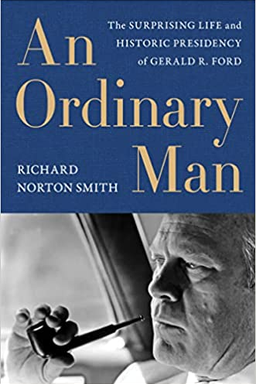
How does a man known as calm, decent, and unassuming become the accidental president who stabilized a shattered nation? In this biography of Gerald R. Ford, the author argues that steadiness itself—so often mistaken for mediocrity—was Ford’s defining virtue and the force that guided him through obscurity, reform, crisis, and reluctant power. Ford’s life becomes a prism through which you can study mid‑twentieth‑century America: from small‑town Protestant ethics to the Cold War’s high diplomacy, from citizen republicanism to executive morality.
Born Leslie Lynch King Jr. in 1913, Ford’s first great act is a conversion of identity. His mother’s flight from an abusive marriage and relocation to Grand Rapids begins the reconstruction of a reliable, respectable name—a secret so well maintained that he admits years later, “I was not Jerry Ford’s son in Grand Rapids.” That hidden rupture explains his lifelong obsession with self‑control and propriety. From that early trauma flows the discipline evident in his athletic regimen, his loyalty to teammates, and his stoic political pragmatism. It also teaches you that emotional stability is often forged in circumstances of shame and concealment.
The Grand Rapids crucible
Grand Rapids supplies Ford the social architecture of his character: Dutch‑Calvinist thrift, civic participation, and visible decency. The city’s mixture of industrious immigrants and moral severity generates the political style he later embodies—practical, service‑based, and allergic to ideological flamboyance. You see him there absorbing the rhythms of constituent service under the shadow of Frank McKay’s political machine. Defying McKay’s corruption, Ford aligns with reformers like Paul Goebel and learns that reputation and integrity, not radical ideology, win elections. That early struggle between machine politics and civic virtue foreshadows his career‑long confrontation between expediency and conscience.
Discipline by sport and service
On football fields and in Boy Scout troops Ford honed the qualities that define his management style: preparation, cooperation, humility before collective goals. As an Eagle Scout and Michigan lineman, he learns to block for others to shine. These experiences later become templates for his congressional and presidential methods—team coordination over demagoguery, problem‑solving over publicity. That athletic ethos matures at the University of Michigan and Yale Law School, where he juggles coaching and coursework to finance his education, forging a realist’s blend of duty and ambition. At Yale he connects with future policy figures like Cyrus Vance and Byron White, extending his civic loyalty network from Midwest to national scale.
War and civic return
World War II functions as both test and certification. On the USS Monterey Ford survives brutal typhoons and deck fires, responding with composed courage. Surviving catastrophe without dramatics becomes his signature form of bravery. Returning home, he channels that steadiness into public reform—collapsing McKay’s machine, organizing veterans, and running an upset campaign in 1948 against entrenched Congressman Bartel Jonkman. His victory comes from relentless personal outreach and moral clarity: he answers letters, shakes every hand, and runs as the antidote to cynicism. His methodical grassroots approach prefigures a congressional career based on trust rather than charisma.
From competence to crisis
In Washington, Ford’s mastery of appropriations and defense budgets transforms him into a bipartisan craftsman. His precision earns him credibility with both hawks and moderates, leading important Cold War task forces and ultimately the Ford Report on American strength. Yet that same competence draws him into the ambiguities of secrecy: his role on the Warren Commission and relations with the FBI entangle him in conspiracy narratives he cannot fully escape. The tension between transparency and institutional loyalty—first rehearsed in his family's hidden past—reappears on a national stage. By the mid‑1960s he rises to House Minority Leader, where he modernizes the Republican apparatus while protecting its pragmatic center. His balancing act between Goldwater zealots and Rockefeller moderates trains him to mediate conflict inside systems that barely hold.
Accidental power and ethical tests
The heart of the narrative is Ford’s climactic sequence: Agnew’s resignation, Nixon’s fall, and Ford’s ascension—first to the vice presidency, then to the Oval Office. He does not seek the position but inherits it under constitutional duress. In office, he faces the country’s moral exhaustion. His pardon of Nixon, widely condemned, becomes the clearest expression of his governing philosophy: mercy and closure over vengeance and spectacle. At political cost, he believes healing matters more than retribution. Subsequent chapters trace economic turbulence—WIN buttons, stagflation management, regulatory reform—and the perils of crisis leadership from Saigon to Mayaguez. You watch a president navigating between domestic skepticism and Cold War responsibilities, demonstrating that moral steadiness can be a strategic form of leadership, even when unpopular.
Legacy of decency and realism
Ford’s presidency closes at the intersection of humility and endurance: assassinations survived, crises contained, dignity preserved. His wife Betty redefines authenticity by exposing personal illness and championing women’s rights and addiction treatment. In retirement, the couple’s openness reshapes how former first families can serve the public. The book insists that Ford’s modest approach—service, decency, and pragmatic humility—offered an alternative model of leadership: one where integrity substitutes for charisma and normalization replaces revolution. His life shows that in democratic systems, stability itself can be a moral achievement.
(Parenthetical note: read against contemporaries like Lyndon Johnson or Richard Nixon, Ford represents civic restoration—much as Churchill’s stability after Chamberlain’s collapse symbolized constitutional resilience. His story, though quiet, demonstrates that reform and reconciliation can coexist with realism.)