
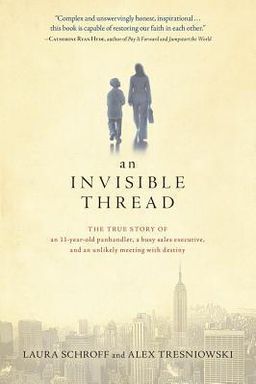
An Invisible Thread cover

An Invisible Thread

by Laura Schroff and Alex Tresniowski

An Invisible Thread tells the inspiring true story of an unexpected friendship between a successful executive and a young panhandler. Their bond, formed by chance, reshapes their lives, offering compelling insights into the power of compassion and the unseen forces that connect us all.

The Invisible Power of Human Connection

What if a single moment of compassion could alter the course of your life? In An Invisible Thread, Laura Schroff—alongside journalist Alex Tresniowski—reveals how one seemingly random act of kindness between a busy advertising executive and an impoverished boy living on the streets of Manhattan transformed both their destinies. Schroff argues that there are unseen forces—'invisible threads'—that connect people who are destined to meet, and that when we act upon those connections, even in small ways, we set in motion extraordinary change.

A Meeting That Changed Everything

On a September day in 1986, Laura walked past Maurice, an eleven-year-old boy begging for spare change on 56th Street, but then turned back—an impulse that defied her corporate-driven routine and the indifference of the city around her. What followed was a lunch at McDonald's, the beginning of a friendship that would span decades. Through their relationship, Schroff uncovers the essential truth that compassion need not be grand or institutional; it can live in the simple tenderness of shared meals, conversation, and trust built week after week.

Threads of Fate and Reciprocal Healing

Schroff suggests that invisible threads connect souls who need each other in ways they may never fully understand. Maurice’s chaotic world—marked by drug addiction, poverty, and trauma—contrasted sharply with Laura’s structured, middle-class life scarred by her father’s alcoholism and violence. Their friendship becomes a mirror for mutual healing: Maurice learns about trust, routine, and hope, while Laura reclaims the nurturing spirit she’d lost in her own painful childhood. This reciprocal transformation echoes themes found in Viktor Frankl’s Man’s Search for Meaning—how purpose emerges when we reach beyond ourselves.

Why This Story Matters to You

Through the unfolding of Maurice's upbringing—from a violent father and addicted mother in Brooklyn to his eventual success as a father and businessman—Laura explores how ordinary compassion can rewire generational cycles. The book invites you to reconsider what kind of threads you are weaving in your own life: who might you be passing by that you are meant to go back for? It reminds you that each act of kindness carries a ripple effect, reshaping both giver and receiver.

Across its chapters, An Invisible Thread moves through themes of childhood trauma, mentorship, redemption, gratitude, and destiny. Schroff’s story is also a quiet challenge to modern cynicism—an assertion that even in a fractured, fast-paced world, empathy can bridge the widest divides. You’ll see how Laura learns to trust her instinct to care, how Maurice breaks free from despair, and how their relationship becomes a lived testament to resilience and hope. This is not just a story of charity—it is a story of connection that redefines what family can mean.

Core message: Sometimes the smallest act of reaching out can pull unseen threads that tie you to your purpose—and to others who help you find it.


Building Trust in a Broken World

Laura’s first encounters with Maurice weren't effortless. When she took him to McDonald’s, his family warned him that she wanted to 'snatch' him. This mistrust speaks to a larger societal wound: how poverty, race, and broken systems erode confidence in goodwill. Laura’s choice to return anyway illuminates how trust begins not with grand gestures but consistent presence. Schroff didn’t just feed Maurice once—she showed up every Monday without fail.

Consistency Over Charity

Unlike fleeting charity, consistency built a bridge. Maurice saw that Laura’s kindness wasn’t transactional. She asked about his life, told him about her job, and explained concepts he had never encountered—like having steady work or planning each day. Through simple acts like teaching him to set a table or pack lunch in a brown paper bag, Laura gave Maurice something deeper: routine. As psychologist Brené Brown notes in Daring Greatly, trust is earned in the small, ordinary moments—not dramatic promises.

Trust as a Two-Way Thread

Maurice, too, demonstrated trust by showing vulnerability. He admitted he wanted to save part of his meal for his mother. Later, when Laura visited his home in the Bryant Hotel—a place saturated with addiction and decay—Maurice begged her never to come back for her own safety. His protection of Laura mirrored her protection of him, revealing how empathy eventually makes mistrust mutual care.

Lessons for Your Own Life

From their relationship, you’re reminded that trust can only grow from patience and reliability. People who’ve been wounded by neglect don’t need speeches; they need someone who shows up. Whether you’re mentoring a colleague or comforting a friend, consistency and listening may be more powerful than any advice. Laura’s steady Mondays became Maurice’s anchor—proof that one dependable person can offer strength amid chaos.


The Generational Shadow of Violence

A hidden current running beneath the book is generational trauma. Schroff exposes how cycles of violence ripple through family legacies—from the brutality of Maurice’s father in Brooklyn to the alcoholism and rage of her own father in Long Island. Both families lived under fear; both children learned survival before tenderness. By paralleling these stories, Schroff reveals how compassion can rewrite inherited pain.

Maurice’s World of Chaos

Maurice’s father, Morris, terrorized his family under addiction and violence until his wife defended herself with a knife. His mother, trapped in cycles of poverty and drugs, oscillated between brief sobriety and relapse. Maurice’s childhood merged danger and love in confusing proportions—he saw care through fear, protection through aggression. His grandmother’s razor blade, Betsy, symbolized that twisted mingling of care and peril.

Laura’s Own Echoes of Abuse

Parallel to Maurice’s chaos was Laura’s upbringing in a 'normal' suburban house where her father’s alcoholism turned domestic tranquility into terror. She recounts nights of screams, broken bottles, and threats. In one striking scene, she confronts him as a teenager, demanding the cycle stop. Both Laura and Maurice survived environments that taught them distrust first—and love as an afterthought.

Breaking the Cycle

By offering gentleness to Maurice, Laura was unconsciously healing her younger self. Likewise, Maurice’s gratitude and openness showed how empathy can sever generational chains. This interplay illustrates trauma’s paradox: the wounded often possess the deepest capacity to heal others. As researcher Judith Herman noted in Trauma and Recovery, recovery always involves reconnecting to human bonds. Through friendship, Laura and Maurice became each other’s reparation.


Mentorship as Everyday Magic

What makes mentorship transformative isn’t advice—it’s involvement. Schroff’s mentorship of Maurice wasn’t formal or intellectual. It began with teaching life’s basics: how to set a table, blow his nose, save money, and use an alarm clock. Each small skill became an act of dignity. Maurice, who grew up thinking he was illiterate, learned to trust his mind through Laura’s belief in him.

Teaching Normalcy

Simple domestic rituals—baking cookies, packing sandwiches—taught structure. Maurice asked for his lunch in a 'brown paper bag' because he associated it with love; it was proof someone cared enough to prepare it. That detail becomes one of the book’s most tender metaphors for mentorship: caring is not only giving resources but giving order to chaos.

Empowerment Through Routine

Laura’s teacher instincts mirrored those of Miss House, Maurice’s real-life special education teacher, who once told her, 'You cannot just wake up one day and abandon this boy.' Both women understood that consistency—the quiet teaching of ordinary life—can reshape identity. Over time, Maurice internalized discipline, applying it later when he earned his GED and mentored other children himself.

The Ripple of Mentorship

By the end of the book, Maurice becomes both student and teacher. He raises his own children with patience rather than punishment and helps youth in his community avoid the pitfalls he faced. Schroff portrays mentorship not as saving someone, but as sharing humanity. For you, this lesson offers a reminder: show up, teach what you know, and believe that your life skills—however ordinary—could be someone’s survival kit.


Love Beyond Biology

Schroff’s central revelation is that family isn’t defined by blood but by connection. The mother who gave Maurice life could not protect him; the woman who met him on Broadway became the nurturing figure he needed. At the same time, Laura—childless after divorce and infertility—found in Maurice the son her heart had awaited. Their bond blurs boundaries of race, age, and class, but above all, it affirms love’s universality.

Reimagining Family

When Maurice tells Laura, 'You’re my mother now,' it distills the entire moral core of the story. Their relationship embodies chosen kinship—the same idea explored in Mitch Albom’s Tuesdays with Morrie, where mentorship becomes surrogate fatherhood. For Laura, nurturing Maurice fills the void left by her unfulfilled dream of motherhood; for Maurice, it redeems broken love.

Love as Mutual Gift

Decades later, at Laura’s fiftieth birthday, Maurice’s toast—'You saved my life'—echoes the circular depth of their bond. Laura replies that he saved hers. Through reciprocal gratitude, each sees the other as grace incarnate—a reminder that the truest family may be the one you build through kindness, not inheritance.

For You

You may find in this story a reflection of your own relationships that stretch beyond biological ties: mentors, friends, or strangers who became family through compassion. Schroff invites you to redefine what belonging means—to see love as a choice we make, not a condition we’re born into.


The Long Arc of Redemption

Maurice’s adult life completes the redemptive arc initiated by that first McDonald’s meal. Against statistical odds, he survives the streets, earns his GED, studies in college, and ultimately becomes both a business owner and a father to six children. His choice to teach them patience and to provide a 'big dining room table' fulfills his childhood vow—to build a life defined by love rather than hardship.

Rebuilding After Loss

Maurice’s resilience surfaces after unbearable moments: his father’s death from AIDS and his mother’s collapse into addiction and eventual passing. Yet each tragedy reinforces his determination 'not to be that man.' Laura’s influence—her insistence on education, punctuality, and hope—becomes his moral compass. Redemption, Schroff shows, is cumulative: every good choice becomes scaffolding for generational change.

The Symbol of the Big Table

Toward the end, Maurice proudly shows Laura his large dining table surrounded by his children—the literal realization of his childhood dream. It represents stability, joy, and shared conversation—the opposite of his chaotic upbringing. That image encapsulates the book’s message: healing doesn’t erase pain; it replaces it with meaning.

Hope as Continuum

Maurice’s children embody what compassion can yield across generations. His daughter Princess dreams of fashion; his son Jahleel plays chess; each carries the thread forward. Through their success, Schroff underscores that kindness is never wasted. For every reader, this is an invitation to trust that small acts today may echo decades later as miracles.


Gratitude and the Art of Seeing

By the book’s end, Schroff concludes that the greatest lesson Maurice taught her wasn’t about giving—it was about gratitude. She came to see ordinary blessings—the security of a home, a dependable job, even a shared meal—as luxuries. Maurice reminded her that 'lack' sharpens appreciation. Through him, she rediscovered the art of noticing what society often overlooks.

Learning to See Again

Maurice’s wonder in simple joys—a park breeze, ice cream, baked cookies—contrasts with the numbness of adults who stop seeing beauty. Laura’s corporate identity had dulled her empathy, but Maurice’s presence reawakened it. This idea resonates with the philosophy of mindfulness: awareness restores connection. In noticing Maurice’s hunger, Laura learned to notice life itself.

Gratitude as Transformation

Gratitude transforms not by adding abundance but by expanding perception. Laura realizes she is the lucky one—not because she gave, but because she received insight. Maurice’s appreciation for every kindness reminded her to dwell on sufficiency rather than deficiency. For you, the lesson is clear: joy doesn’t come from having more—it comes from seeing enough.

In summary: Compassion wakes you up. Gratitude keeps you awake.

Dig Deeper

Get personalized prompts to apply these lessons to your life and deepen your understanding.

Go Deeper

Get the Full Experience

Download Insight Books for AI-powered reflections, quizzes, and more.