
Idea 1
The Shared Planet of Different Worlds
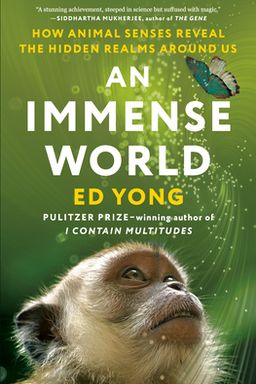
When you walk through a forest or sit by the sea, you experience your surroundings through human senses—sight, sound, touch, taste, and smell. But the same space is inhabited by other perceivers whose experience of reality is completely different. In An Immense World, Ed Yong argues that every creature lives inside its own Umwelt—a sensory bubble that reveals only a sliver of the physical world, filtered through its unique biological hardware and ecological needs. Recognizing this diversity of perception is not just scientifically illuminating; it is ethically transformative.
Umwelt and the illusion of completeness
Jakob von Uexküll coined Umwelt to describe the subjective world of an organism—the part of reality it can detect and use. Humans assume their senses show the world as it truly is, but what we call reality is a filtered version built by our eyes, ears, nose, and nervous system. A bat interprets air pressure waves as mental maps; a tick reduces existence to heat and butyric acid; an elephant lives by scent and vibration. Each creature occupies an overlapping but uniquely structured world.
Sensation as information
All sensing converts physics into meaning. Molecules, light, vibrations, magnetic fields—they are inert until receptors transmute them into neural signals. Evolution fine‑tunes those receptors into matched filters, specialized channels that prioritize what matters: predators, mates, food, or orientation. Maintaining these systems costs energy, so every animal carries senses that are powerful yet economical. An eagle’s eye sacrifices low‑light sensitivity for acuity, while a mole trades visual resolution for ultra‑fast tactile precision.
Why diversity matters
Understanding Umwelten prevents anthropocentrism. No animal is “better” or “worse” equipped—only differently attuned. Perceptual diversity is what sustains biodiversity; it explains everything from bat sonar to ant chemical communication. Yong encourages an “informed imaginative leap”: grounded in data yet open‑minded enough to imagine what other beings perceive. Doing so fosters empathy, better science, and wiser stewardship.
From concept to moral duty
Seeing through other sensory worlds is both exhilarating and sobering. It reveals humans as sensory polluters—flooding earth with light, noise, and chemicals that obscure or overwhelm other creatures’ cues. Recognizing that the planet is a mosaic of Umwelten makes care for darkness and quiet not just aesthetic but ethical. As Yong writes, stepping between Umwelten is like visiting alien planets right here on Earth—a scientific adventure that demands responsibility.
Ed Yong’s main claim is clear: to grasp life’s complexity, you must abandon the illusion of one shared sensory world and enter a multitude of other ones. Only then can you truly see the immense world we live in.