
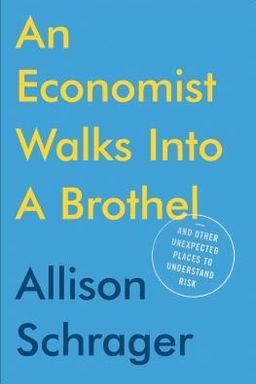
An Economist Walks into a Brothel cover

An Economist Walks into a Brothel

by Allison Schrager

An Economist Walks Into A Brothel offers a fascinating exploration into the nature of risk. Through engaging anecdotes from high-risk professions, it teaches us how to assess and embrace risk to make better decisions in life, career, and finance.

The Science of Risk and How It Shapes Every Decision

How can you make better decisions in an uncertain world? In An Economist Walks Into a Brothel, Allison Schrager argues that mastering risk—the same way economists and financiers do—can help you live a smarter, more confident life. Schrager contends that risk isn’t something to fear but something to understand, manage, and even use to your advantage. She takes ideas from financial economics—like diversification, hedging, insurance, and the trade-off between risk and reward—and applies them to real-world stories about brothels, poker champions, paparazzi, horse breeders, and big wave surfers.

In this engaging investigation, Schrager defines risk as everything that might happen and the probability of each outcome. It’s not just the bad stuff—it’s the whole range of possibilities that come with every choice. We live in a world that feels riskier than ever, with unstable economies, job insecurity, and constant technological change. Yet Schrager shows that when you think like an economist, you realize risk is measurable, often containable, and, most importantly, tradeable. In finance, risk can be priced and sometimes even sold. In everyday life, you can learn to do the same.

From the Brothel to Wall Street: A Framework for Thinking About Risk

Schrager opens the book in one of the least likely places for an economic lesson: a Nevada brothel. Here, both sex workers and clients literally buy and sell risk. A woman trading half her earnings for the security of legal, safe sex work has effectively purchased a hedge—she’s reducing her downside for a price. Meanwhile, customers pay a 300 percent markup for a risk-free experience, avoiding legal, health, and social consequences. By studying these transactions, Schrager illustrates that risk always has a price. Transparency about that price—knowing what risk costs and how much it’s worth—is the first step toward controlling it.

This approach defines the entire book: unusual places reveal universal financial truths. A brothel shows how risk is priced. Hollywood shows how it’s measured. Poker tables and paparazzi alleys show how our psychology distorts it. Big wave surfers and military commanders demonstrate how to face uncertainty head-on when data fail us. The message is clear—risk is everywhere, but so are the tools to master it.

Why Understanding Risk Matters Today

In the premodern world, risk was fate—a whim of the gods. But since the Enlightenment, humans have learned to calculate odds, model probabilities, and make informed gambles. Schrager builds on this intellectual heritage, arguing that understanding risk is one of the greatest achievements of civilization. We’ve gone from fearing uncertainty to quantifying it, from relying on religion to constructing insurance markets.

Today, however, risk feels more complicated. Jobs are less stable, technology evolves faster, and many comforts—like pensions or guaranteed career paths—are gone. According to Schrager, rather than longing for certainty, we need to get better at pricing and managing the trade-offs that come with risk. The book’s five rules for smarter risk-taking unpack exactly how to do that: define your goals, understand your irrational tendencies, maximize reward per risk, manage through hedging and insurance, and embrace uncertainty.

Risk as a Living Equation

Each of Schrager’s case studies becomes an equation in motion. A racehorse breeder diversifies bloodlines just like an investor balances a portfolio. A poker pro learns to override loss aversion—the psychological bias that makes us fearful of losing even small sums. A surfer calibrates when to chase a 60-foot wave based on experience and backup plans, balancing reward against catastrophic failure.

The goal, Schrager says, is not to eliminate risk but to measure it properly, to take just enough to get what you want, and to insure against the rest. Once you realize that, uncertainty stops being terrifying and starts feeling empowering. You can’t know the future, but you can create conditions that make success more likely—and failure manageable.

“Risk is the cost we pay to get more,” Schrager writes. “Once we understand that cost, we can take risks smarter—and more often.”

By blending colorful storytelling with financial logic, An Economist Walks Into a Brothel reframes risk as a science—and a life skill. The question isn’t whether to take risks, but how to structure them so you can live bolder, safer, and freer. This is modern risk literacy: learning to think like an economist, even when your decisions have nothing to do with money.


Defining Risk and the Rules of Reward

Schrager begins with a fundamental question: what do we actually mean by “risk”? Most people equate it with danger or potential failure. But to economists, risk is the full spectrum of possible outcomes—good and bad—and their likelihood. Understanding that nuance changes how you see the world: risk isn’t just a threat; it’s the price of opportunity.

No Risk, No Reward

The first rule of Schrager’s framework is simple but transformative: No risk, no reward. To grow in wealth, career, or relationships, you must accept exposure to uncertainty. Avoiding risk may keep you safe, but it also caps your potential rewards. From entrepreneurs to investors to sex workers, the same principle applies—big payoffs require bearing calculated risks. The key is calculated.

The Economics of the Brothel

In the Moonlite BunnyRanch, prostitutes and clients trade risk as openly as investors trade stocks. Workers give half their earnings to the house to reduce violence and legal exposure; clients pay triple the going rate for psychological peace and safety. This tiny economy captures what finance calls risk pricing: how markets determine the cost of danger and the value of protection. Schrager argues that every market—from airline tickets to housing—works the same way. If you buy the cheapest ticket, you’re implicitly accepting the “option” that you may be bumped. Pay more, and you’re buying down that risk.

The Five Rules of Smarter Risk

  • Rule 1: No risk, no reward. Taking risk is necessary for gain—but know what risk and reward mean to you.
  • Rule 2: I am irrational, and I know it. Emotions cloud judgment, but self-awareness makes risk-taking better.
  • Rule 3: Get the biggest bang for your risk buck. Use diversification to lower unneeded risk without sacrificing return.
  • Rule 4: Be the master of your domain. Manage risk actively through hedging and insurance.
  • Rule 5: Uncertainty happens. Some risks can’t be planned for—prepare with flexibility, not prediction.

The genius of Schrager’s framework lies in applying market logic to life. Every decision—whether it’s switching jobs, marrying a partner, or taking out a mortgage—has a risk price. Once you can see it, you can start managing it instead of fearing it.


Defining What You Really Want

Before you can take a smart risk, you have to know your goal. Schrager warns that most failures aren’t due to bad luck but to unclear objectives. Taking a risk without a defined reward is like getting in a car and driving without knowing the destination—you might end up somewhere amazing, but odds are you won’t.

Kat Cole and the Minibon Moment

Cinnabon's president Kat Cole became a case study in precise risk-taking. When sales slumped in the 2000s, her team wanted to launch a lower-calorie product. But Cole realized that Cinnabon’s brand wasn’t health—it was indulgence. She reframed the goal: increase sales, not reduce calories. Her solution was simple and brilliant—the smaller Minibon. It delivered the same taste at fewer calories and a lower price, attracting new customers without alienating core fans. Within years, revenues doubled. Her decision worked because she defined the right goal and calculated which risks aligned with that objective. (Simon Sinek’s “Start With Why” has a similar message: clarity before action.)

Pricing What’s Risk-Free

Finance defines “risk-free” as a guaranteed outcome—like earning interest from a U.S. Treasury bond. In life, your risk-free path depends on what you want. For Cole, staying in college looked safe, but for her ambition to build a career fast, dropping out to join corporate Hooters was her actual risk-free route. Understanding what’s truly risk-free for you may overturn social expectations. Schrager encourages readers to run every life choice through one question: What is the price of the no-risk option?

Risk-Free Retirement and Beyond

The same principle applies to money. Most people think a retirement plan’s success is measured by total savings. Schrager, drawing on work with Nobel laureate Robert C. Merton, reframes it: what matters isn’t how much you save, but how much risk-free income those savings can buy—like a guaranteed annuity payment for life. When you see your savings as income streams, not balances, you can gauge how much risk you need to take to meet your goals. The insight is disarmingly simple: measure your future in predictable dollars, not abstract wealth.

“Defining what’s risk-free for you,” Schrager says, “is the foundation of any good risk strategy.”

Whether planning a career, investment, or life decision, the key isn’t being fearless—it’s knowing what you want so you can measure whether a risk brings you closer or further away from it.


How We Misread Risk and Probability

Humans are terrible at calculating odds. We fear plane crashes but ignore the greater risk of car accidents. We buy lottery tickets with one-in-a-billion chances while dismissing savings accounts that offer guaranteed growth. Schrager explores how cognitive biases distort our judgment, making rational risk-taking incredibly difficult.

The Crazy Eddie Illusion

Through the wild story of Sam Antar and the Crazy Eddie electronics scam, Schrager illustrates how success breeds overconfidence. The Antars ran a tax-evading empire, then took it public—believing their track record meant they’d never get caught. Like gamblers on a winning streak, they confused luck with skill and underestimated probabilities. Such misperceptions are not just criminal—they’re universal. When past success blinds us, we take bigger and riskier bets assuming fortune will repeat itself. (Nassim Taleb calls this the “narrative fallacy” in The Black Swan.)

Our Cognitive Errors

  • We overestimate certainty—believing events are guaranteed when they’re not (“My career is safe; I won’t get caught”).
  • We overweight rare events, such as fearing terrorism more than heart disease.
  • We assume patterns where none exist—after several wins or losses, we see streaks that statistically mean nothing.
  • We ignore the middle probabilities—a five percent or fifty-five percent chance feels psychologically similar even though it’s not.

Schrager shows how policymakers, marketers, and even tech companies exploit these biases. A lottery slogan like “You can’t win if you don’t play” reframes infinitesimal odds as possibility. Similarly, consumers overbuy extended warranties because sellers highlight improbable disasters. Understanding these distortions helps you question your instincts and evaluate risks more objectively.

Thinking in Frequencies

Drawing on psychologist Gerd Gigerenzer’s research, Schrager advises you to translate abstract probabilities into concrete frequencies. “A 1% chance of failure” sounds trivial, but “one in a hundred airplanes crashes” doesn’t. When information is reframed this way, people make better decisions. Gigerenzer’s birth control study, for example, showed that telling women “two in seven thousand develop blood clots” was far clearer—and less frightening—than “a 100% increase in clot risk.” Reframing probabilities into plain counts makes risk reasoning accessible again.

Schrager’s lesson is both empowering and humbling: understanding risk requires fighting the lazy shortcuts of your brain. Thinking probabilistically isn’t natural—but it’s a superpower you can train.


Managing Risk Through Diversification

Diversification, Schrager explains, is the closest thing to a free lunch in economics: you can reduce risk without giving up expected reward. Investing in a mix of assets—or options in life—lessens the damage when one fails. But diversification isn’t confined to Wall Street. Schrager travels to Kentucky horse farms to show how genetic diversification works in the billion-dollar stud industry, with surprising parallels to portfolio management.

Breeding as Portfolio Theory

In Thoroughbred racing, stallions like Gun Runner and War Front command colossal fees, often breeding hundreds of mares. Yet the resulting offspring’s success rate is abysmal—only eight percent ever make serious money. The market’s obsession with a few glamorous studs creates inbreeding, reducing the genetic variety that makes great horses possible. Economic incentives skew toward short-term gains instead of long-term performance.

Enter Harry Markowitz, the 1952 economist who invented modern portfolio theory. He showed that owning varied assets—stocks that don’t move together—reduces overall risk. Schrager’s insight: horse breeding could adopt the same principle. By spreading bets across diverse sires with complementary traits, breeders could lower the risk of failure and increase the odds of consistently good horses, even if they forgo the chance of one superstar. “Inbreeding is like buying only Apple stock,” she quips.

The Broader Lesson of Variety

Diversification extends to your career, relationships, and daily life. Having multiple income streams—what Schrager calls “side hustles”—spreads job risk in the gig economy. Diversifying friendships avoids overdependence on one social circle. Even dating multiple people initially helps clarify what you value before committing. Just as index funds outperform most managed funds, a broad “life index fund” of experiences yields more stable happiness than doubling down on one volatile bet.

Diversification doesn’t eliminate all risk—it can’t protect against systemic collapse—but it reduces avoidable idiosyncratic pain. The question isn’t how to avoid loss entirely, but how to structure your world so one misfortune never wipes you out.


De-Risking with Hedging and Insurance

When you’ve taken the right amount of risk, the next challenge is managing it. Schrager introduces two key tools from finance—hedging and insurance—and shows how they appear in everyday life, from business decisions to personal safety nets.

Hedging: The Art of Balance

Hedging is giving up some upside to protect yourself from catastrophic loss. Carnival CEO Arnold Donald perfected this strategy. Growing up poor in New Orleans, he built a career by maximizing the probability of success, not chasing the biggest payoffs. When he took over Carnival after its disastrous “poop cruise,” he hedged by introducing the Ocean Medallion: a digital cruise experience rolled out slowly, one ship at a time. The result was low downside with strong eventual upside—a textbook hedge. (Richard Branson once said something similar: “Protect the downside.”)

Insurance: Magic with Contracts

Insurance differs from hedging in one major way—you pay someone else to bear your downside risk but keep all your upside. Schrager likens insurance to magic: it reduces losses while letting you still profit if things go right. Magician Belinda Sinclair’s career exemplifies this perfectly. Every trick is insured by countless hours of preparation, backup plans, and audience control. Like her, a smart risk taker invests in hidden protection.

In markets, this magic manifests as options—contracts that insure against prices falling (put options) or grant the right to buy later (calls). The Black-Scholes model, developed by Fischer Black and Myron Scholes, mathematically priced this risk. Understanding it means understanding the four “Greeks”—vega (volatility), delta (odds of being profitable), theta (time), and rho (risk-free rate). Together they describe how time and uncertainty affect any gamble, financial or personal.

“Insurance seems like magic because it lets you enjoy unlimited upside without paying the full cost of the downside,” Schrager notes.

The key lesson: hedge what you can, insure what you must. That might mean diversifying your investments, insuring your income, or simply always carrying a contingency plan—your personal policy against disaster.


Moral Hazard and the Double-Edged Sword of Safety

Every safety measure can backfire—because feeling protected can encourage recklessness. Economists call this the moral hazard problem, and big wave surfing captures it vividly.

Surfing with Jet Skis and Leverage

Surfer Greg Long nearly died when his flotation vest failed under 80-foot waves. The risk tools designed to save him—jet skis, inflatable vests, weather forecasts—also enabled him to surf waves beyond previous human limits. Equipment makes us braver, and to Schrager, this mirrors financial risk-taking: safety nets like derivatives and bailout expectations tempt investors to push boundaries.

Hawaiian surf innovator Brian Keaulana compares his jet ski rescues to financial hedges—they reduce immediate risk but entice surfers to attempt bigger feats. The result? Fewer small harms but occasional catastrophes—just like Wall Street before the 2008 crisis. The richer the safety net, the bolder the behavior.

Long-Term Capital Management: Finance’s Wipeout

Schrager links the moral hazard of surfing to the fall of Long-Term Capital Management (LTCM), the hedge fund founded by Nobel laureates Robert Merton and Myron Scholes. Their elegant risk models promised safety through perfect hedges—but massive leverage (25-to-1 debt) magnified small errors into near collapse when global markets wobbled in 1998. Like surfers on 80-foot waves, they misused safety to chase impossible perfection.

The moral: risk tools don’t remove risk—they redistribute it. True mastery lies in humility and discipline, ensuring that protection doesn’t tempt you into greater danger.


Uncertainty and the Fog of War

Even perfect risk models fail when the unforeseeable strikes. Schrager ends her exploration with the U.S. military’s battlefield experience. Through General H.R. McMaster’s account of the 1991 Battle of 73 Easting, she examines how planning can’t eliminate uncertainty—only prepare soldiers to adapt when plans collapse.

The Battle That Changed Military Thinking

McMaster’s outnumbered tank troop unexpectedly crushed the Iraqi Republican Guard by breaking orders and seizing opportunity in a sandstorm. His decision was risky but intuitive, guided by preparedness and flexibility. Yet after his victory, the military drew the wrong lesson—believing technology could “lift the fog of war.” Schrager calls this the vampire fallacy: the illusion that tools can kill uncertainty. Like financial risk models before 2008, this faith in precision made future disasters inevitable.

Flexibility as the Ultimate Hedge

Schrager draws on historian Meir Finkel’s work showing that flexibility—not forecasting—is the secret to managing the unknown. Military systems that empower field officers to improvise handle shocks better than rigid hierarchies. In business and life, the same holds true. You can’t plan for every contingency, but you can build resilience—through training, diversification, and humility—to recover when surprises strike.

“Plans are worthless,” Dwight Eisenhower once said, “but planning is everything.” Schrager echoes this: the process of planning sharpens awareness—even when the plan fails.

Uncertainty is inevitable, but paralysis isn’t. The best risk-takers—from generals to entrepreneurs—use strategy as a compass, not a cage. Their goal isn’t certainty; it’s readiness to adapt when the unpredictable arrives.

Dig Deeper

Get personalized prompts to apply these lessons to your life and deepen your understanding.

Go Deeper

Get the Full Experience

Download Insight Books for AI-powered reflections, quizzes, and more.