
Idea 1
Life as an Experiment with Truth
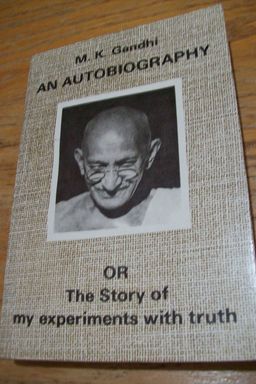
What does it mean to live truth as a continuous experiment rather than a fixed creed? In The Story of My Experiments with Truth, Gandhi narrates his entire life as a moral laboratory. For him, truth is not a dogma but a hypothesis you test through action, self-correction, and renewed vows. Across childhood, marriage, law, religion, politics, and social reform, he treats every arena—private and public—as a site for disciplined inquiry.
The Framework of Experiment
Gandhi’s central method combines three activities: observation, confession, and corrective action. From stealing a piece of gold as a boy and confessing it to his father, to later confessing moral and intellectual mistakes in his public career, each experiment seeks the same end—purification through truth. Where science observes data, Gandhi observes conscience. Each pledge—vegetarianism, celibacy, nonviolence—undergoes trial and revision until it matches both his reason and his heart.
Moral Growth through Everyday Life
Every stage of Gandhi’s narrative offers new experiments. His child marriage to Kasturbai teaches the pain of jealousy and control; his father’s death exposes lust’s moral cost and initiates lifelong experiments in self-restraint. Shyness becomes a discipline of careful speech and listening. Vegetarian practice moves from secrecy to scientific and ethical reasoning, merging body and spirit. A shy student keeping expense ledgers in London evolves into a public man auditing the accounts of an entire movement. Gandhi’s moral education thus operates through the ordinary routines of home, diet, and study.
From Inner Reform to Public Action
You can trace the gradual shift from personal discipline to collective organization. In South Africa, racial insults—the railway ejection, the turban incident—transform private testing into social experiments. He organizes petitions, founds the Natal Indian Congress, and builds Phoenix Settlement and Indian Opinion to make truth a shared institution. Nonviolence, born from confession and forgiveness, becomes a method of public organization. This scaling from conscience to community defines the book’s arc.
Truth in Systems: Law, Religion, and Politics
Gandhi’s experiments cross domains. As a lawyer, he refuses dishonesty even when it costs his clients advantage—transforming law into ethical service rather than manipulation. In religion, he studies Hindu, Christian, and Theosophical texts to enlarge moral sympathy without abandoning critical judgment. In politics, he tests loyalty to empire against conscience, gradually shifting from faith in British justice to faith in universal truth. He insists that truth must guide all human systems—law, faith, or state—or else they fail their moral purpose.
The Evolution of Discipline: Simplicity, Celibacy, and Service
As Gandhi matures, his experiments demand commitment. Simplicity—washing his own clothes, cutting his own hair—becomes tool for independence. Celibacy (brahmacharya) emerges as inner fuel for service and nonviolent endurance. Religious reading meets mechanical chores; philosophy meets the spinning wheel. By Phoenix and Tolstoy Farm, community life itself becomes an institutionalized experiment where truth and labour join. Teaching children by example, welcoming outcasts to the Ashram, fasting for moral repair—all extend the private vow into public pedagogy.
Truth Force and Its Political Flowering
The culmination comes with Satyagraha (“truth-force”). Discipline of body and soul, achieved through years of dietary trials, fasting, silence, and service, now arms Gandhi for political struggle. Champaran proves the concept: impartial nonviolent inquiry yields concrete justice. Rowlatt agitation and later national movements test scale and timing—he learns that mass action requires preparation equal to inner discipline. Gandhi transforms spirituality into a technology of reform where suffering, patience, and truthful speech destabilize injustice.
Reading the Book as Method
For you, the book invites not admiration but imitation of method. Its unity lies not in events but in approach: treat life as an evolving research project in morality. Establish hypotheses of conduct; live them; review results; and correct course. Gandhi’s experiment is endless, not conclusive. His story models how disciplined humility, public transparency, and love can turn self-reform into world reform.
Core insight
To live truthfully means to test every belief through lived experience, to correct error through confession, and to merge private integrity with collective compassion—the essence of Gandhi’s lifelong experiment.
This opening key idea frames the entire autobiography as one unified inquiry: how truth, when practiced experimentally, transforms character, profession, religion, and nation from within.