
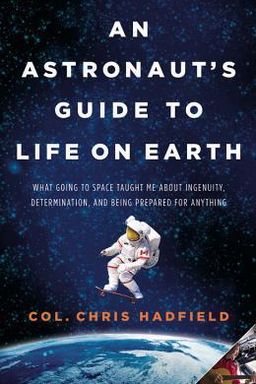
An Astronaut’s Guide to Life on Earth cover

An Astronaut’s Guide to Life on Earth

by Chris Hadfield

Join Chris Hadfield, the first Canadian to spacewalk, as he shares invaluable insights from his astronaut experiences. Discover the unforeseen challenges of space missions and how they translate into life lessons about preparation, problem-solving, and maintaining relationships, applicable to everyday life on Earth.

Preparing for the Worst to Live at Your Best

What if the secret to success wasn’t thinking positive, but preparing for everything that could possibly go wrong? In An Astronaut’s Guide to Life on Earth, Colonel Chris Hadfield argues that the best way to thrive—whether in space or on Earth—is to adopt an astronaut’s mindset: plan meticulously, practice relentlessly, and embrace humility. Drawing lessons from his 35-year career as a test pilot and astronaut, Hadfield contends that transforming anxiety into preparation and ego into teamwork can make life not only more successful but also more meaningful.

Hadfield’s philosophy grew out of his time training for missions that were largely about preventing disaster. Astronauts live in an environment where mistakes can mean death, and yet their calm, methodical responses are what save lives. He extends this discipline to ordinary life: success on Earth, he insists, requires the same readiness for catastrophe and the same gratitude for small, quiet victories. In doing so, he challenges common self-help axioms, replacing “think positive” with “prepare negative,” and “ignore what others think” with “care what others think—but in the right way.”

From Dreaming Big to Living Small

Hadfield begins with his childhood inspiration—the 1969 Moon landing broadcast he watched from his parents' Ontario farmhouse. Nine years old, he decided then and there to become an astronaut. But instead of waiting for grand opportunities, he started acting like one every day. As a teenager, that meant learning to fly gliders, excelling in math and science, and practicing responsibility even in small chores. This relentless orientation toward a distant goal—guided by practical daily steps—provides the foundation for his philosophy: you can’t control the outcome, but you can control your preparation.

Each milestone—from joining the Royal Canadian Air Force to earning a master’s degree in aviation systems, to his eventual acceptance into the Canadian Space Agency in 1992—reflects a pattern of disciplined focus. For Hadfield, life isn’t about waiting for luck; it’s about building competence so that when luck arrives, you’re ready to seize it. This mindset contrasts with advice from traditional motivational speakers like Napoleon Hill or Rhonda Byrne, whose works emphasize visualization and belief. Hadfield’s counterpoint is pragmatic: “visualize disaster and then prepare for it.”

A Philosophy Forged in Orbit

Hadfield’s career provided extreme testing grounds for his ideas. During his missions aboard the Space Shuttle and later as commander of the International Space Station (ISS), he experienced both breathtaking wonders and terrifying crises: being temporarily blinded during a spacewalk, fixing broken systems with nothing but a Swiss Army knife, and maintaining steady communication while floating hundreds of miles above Earth. These moments, he explains, are not about being fearless—they’re about being ready. Fear, once converted into preparedness, becomes an ally rather than a liability.

Interestingly, Hadfield’s philosophy mirrors stoic teachings from thinkers like Marcus Aurelius and Seneca, who taught that control lies only in our responses, not external events. In both stoicism and astronaut training, resilience is born from mental rehearsal. Hadfield insists that when you internalize this habit—constantly asking “What’s the next thing that could go wrong, and how can I respond?”—you not only avoid panic under stress but also discover a deeper sense of calm in everyday life.

Redefining Success and Failure

A key argument threaded through the book is that success should not depend on reaching the top position or the public spotlight. When Hadfield trained thousands of hours for missions he might never fly, he realized that satisfaction had to come from the process itself. Success, he writes, means feeling you contributed usefully, even if no one notices. On the ISS, every small task—from filtering air to inspecting seals—mattered because the crew’s survival depended on collective success, not individual heroics.

That same principle applies on Earth. Hadfield invites readers to find pride in doing their own equivalent of changing air filters: unnoticed, essential, steady work. He critiques the “Hollywood hero myth” that glorifies the climactic moment but ignores the endless preparation before it. Like athletes who train for years for one Olympic event, astronauts embody the idea that excellence is built through invisible repetition. As he puts it, “you can’t reach for the stars if you’re not willing to scrub the floor.”

Connecting Space Lessons to Earthly Living

Throughout the book, Hadfield uses humor, humility, and vivid storytelling to show how space-tested thinking enriches life down here. The discipline that fixes a broken airlock also strengthens a marriage; the awareness developed from EVA (extravehicular activity) checklists enhances how you prepare presentations or parent children. His contagious curiosity about everyday phenomena—the air currents causing a floating pen to drift, the sound of Velcro in zero-G—reminds readers that wonder and responsibility can coexist. What emerges is not a manual about spaceflight but a manifesto for life lived with attentiveness, composure, and joy. In a world that prizes instant results and visible success, Hadfield’s message stands out: real mastery means being prepared to stay calm when everything goes wrong—and grateful when everything goes right.


Sweat the Small Stuff

Hadfield flips a common motivational slogan on its head: instead of “Don’t sweat the small stuff,” he insists that sweating the small stuff is exactly what saves lives—in orbit and on Earth. In space, one loose screw or unchecked gauge can mean catastrophe. This meticulous care, he argues, isn’t about paranoia; it’s about professionalism. Every small act of diligence protects the system as a whole.

Attention to Detail Builds Confidence

On the International Space Station, astronauts must know the exact function of thousands of buttons, levers, and panels. They practice procedures repeatedly until those actions become automatic, a process Hadfield compares to musicians rehearsing scales. You can’t improvise when you’re 250 miles above Earth—you prepare until even mistakes are manageable. The same mindset applies to daily life: when you prepare carefully, you don’t depend on luck to stay calm in crisis.

Small Steps, Big Payoffs

Hadfield’s idea echoes James Clear’s concept in Atomic Habits: consistency in small behaviors leads to large transformation. For example, Hadfield spent years simulating space emergencies he might never encounter, running endless drills. Doing so built instinctive readiness and reduced fear. He encourages readers to apply the same logic—overprepare for a presentation, practice conversations, anticipate potential problems. This attention to detail is what distinguishes amateurs from professionals, and dreamers from doers.

Respecting the Chain Reaction

Hadfield reminds us that details connect: every task influences others. A dirty tool can contaminate experiments, and a missed checklist can endanger an EVA. On Earth, your equivalent might be sending a hurried email or skipping a review meeting. One small lapse can cascade into major setbacks. His broader point is philosophical: excellence is a habit rooted in caring deeply about the smallest things, especially when no one is watching.


The Power of Negative Thinking

Hadfield introduces a paradoxical concept: success comes from thinking negatively. Traditional self-help books promote visualization of perfect outcomes. Astronauts, meanwhile, visualize failure—in exhaustive detail. They imagine the oxygen leak, the failed equipment, the missed maneuver—and plan exactly how to respond. This mindset replaces anxiety with readiness.

Managing Fear Rationally

When Hadfield was temporarily blinded during a spacewalk in 2001, his training enabled him to stay calm. He couldn’t see, but he remembered each movement by touch and procedure. That calm saved him and his team. The takeaway: you reduce fear not by ignoring danger but by naming and preparing for it. This approach aligns with stoic and cognitive-behavioral techniques (as explored by Marcus Aurelius and modern therapists alike): preparation neutralizes panic.

Anticipation Breeds Composure

Negative thinking, in Hadfield’s sense, doesn’t mean pessimism—it means disciplined foresight. By rehearsing every way things could fail, astronauts gain confidence in their ability to adapt. This idea is valuable for anyone who faces stress: a doctor anticipating complications, a teacher planning lessons, a parent preparing for emergencies. It transforms dread into skill.

The Calm Before—and During—the Storm

Hadfield’s broader lesson: calm isn’t a personality trait; it’s a byproduct of preparation. When you’ve already lived through every worst-case scenario in your mind, reality rarely surprises you. True courage, he suggests, is the quiet composure that comes from expecting things to go wrong—and being ready to make them right.


Care What Others Think, Wisely

Most advice says, “Don’t care what others think.” Hadfield advises the opposite—with nuance. In an environment like NASA, teamwork is survival. Caring about others’ perspectives isn’t weakness; it’s strategic awareness. Astronauts constantly depend on technicians, mission control, and crewmates. You can’t succeed—or stay alive—without earning others’ trust.

The Importance of “Being a Zero”

Hadfield uses an internal NASA metaphor: people can be “-1” (detrimental), “0” (neutral), or “+1” (helpful). New astronauts should aim to be zeros first. That means observing, learning, and integrating smoothly rather than trying to prove brilliance immediately. Over-eagerness can disrupt harmony just as much as incompetence. Once you fully understand the system, you naturally shift from zero to +1—adding calm competence without demanding attention.

Humility as a Survival Skill

Hadfield's respect for hierarchy and feedback comes from decades in aviation and spaceflight, where the ability to listen and adapt determines success. He believes humility isn’t self-deprecation—it’s situational intelligence. By caring about others’ perceptions, you calibrate your actions to strengthen trust. On Earth, that means practicing awareness in teams, families, and workplaces: your reputation isn’t what others owe you; it’s what you collaboratively create.


Redefining Success on Earth

Hadfield’s stories remind us that success isn’t always visible. Before commanding the International Space Station, he spent decades doing unseen work: endless simulations, maintenance training, language study, physical conditioning. His insight is that fulfillment doesn’t depend on recognition but on contribution. Even if you never achieve your dream’s peak moment, the act of striving shapes a remarkable life.

Find Joy in Mastery

Hadfield’s lesson resonates with Mihaly Csikszentmihalyi’s concept of flow: satisfaction arises when skill meets challenge. Astronaut training might look mundane—learning Russian or repairing valves—but these pursuits offer intrinsic reward. Doing demanding things well, even without applause, adds dignity to everyday life.

Contribution Over Comparison

In Hadfield’s world, ego is dangerous; it clouds perception. He advises replacing “How do I compare?” with “How can I contribute?” The shift from validation to service enhances both performance and peace of mind. Whether you’re an engineer, teacher, or parent, redefining success in this way grounds achievement in purpose, not prestige.


Enjoying the Ride—Even in Zero Gravity

Despite all his talk of preparation and discipline, Hadfield insists that joy matters just as much. His famously filmed performance of a David Bowie song aboard the ISS wasn’t about self-promotion—it was about humanizing space travel. Bringing music, humor, and wonder into a sterile, high-stakes environment reminds us that playfulness isn’t a distraction from responsibility; it deepens it.

Finding Awe Everywhere

Hadfield’s photography and public sharing while in orbit—images of Earth, glimpses of sunrise over the planet’s curvature—reflect his reverence for perspective. Stepping outside Earth’s gravity, he saw our fragility and beauty more clearly. He encourages readers to find that same awe in daily moments: a morning coffee, a quiet landscape, a child’s laughter. Practice noticing, he suggests, and wonder will follow.

Gratitude as a Default Mode

Returning from space gave Hadfield a renewed sense of gratitude—for gravity, for fresh air, for the sound of wind. Through his eyes, ordinary life looks extraordinary. His message is simple yet profound: cultivate gratitude not as a moral duty but as a practical mental tool. When you find joy in small things, resilience becomes natural. As he puts it, “Enjoy every moment—even the hard ones—because preparation gives you the freedom to.”

Dig Deeper

Get personalized prompts to apply these lessons to your life and deepen your understanding.

Go Deeper

Get the Full Experience

Download Insight Books for AI-powered reflections, quizzes, and more.