
Idea 1
The Age of Entertainment and Cultural Decline
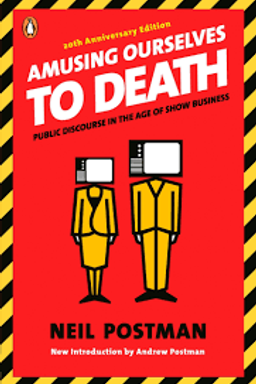
When was the last time you turned on the TV or scrolled through your phone and found yourself entertained but not enlightened? In Amusing Ourselves to Death, cultural critic Neil Postman argues that modern media, especially television, has transformed serious public discourse—from politics and religion to education and journalism—into mere entertainment. He contends that our society’s obsession with amusement has quietly eroded our capacity for reason, dialogue, and democratic thought.
Postman’s main argument builds on the powerful comparison between George Orwell’s 1984 and Aldous Huxley’s Brave New World. Orwell warned of tyranny through pain and censorship; Huxley predicted a society enslaved by pleasure and distraction. According to Postman, the latter vision has come true. We are not censored by oppressive regimes but lulled into complacency by dazzling screens and entertaining diversions. In this new age, information is abundant but meaning is scarce. We are living, quite literally, in Huxley’s world.
The Shift from the Word to the Image
Postman traces the deep roots of this transformation. Centuries ago, print was the central medium of thought—it rewarded logic, patience, and reasoned argumentation. The written word demanded active engagement. Reading and writing cultivated critical thinking because they required you to pause, reflect, and connect ideas across time.
But the rise of visual media changed everything. The invention of the telegraph, photograph, and eventually television shifted communication from ideas to images, from linear reasoning to instant snapshots of sensation. The telegraph brought context-free information—facts moving faster than understanding. The camera replaced abstraction with spectacle. And television united these technologies to create a medium that prizes entertainment over analysis. As Postman puts it, “no matter what is depicted or from what point of view, the overarching presumption is that it is there for our amusement and pleasure.”
Media as a Philosophy of Reality
Postman’s brilliance lies in showing how media is not just a tool but a metaphor—a way we make sense of reality. Different forms of communication carry different assumptions about truth and intelligence. In a print culture, truth is something logical and verifiable through language. In an image-based culture, truth becomes what appears credible, beautiful, or entertaining. This shift in epistemology—our very definition of what counts as knowledge—transforms how we think and talk about everything. Television teaches us to value emotional resonance over reason, appearance over substance, and celebrity over competence.
For example, political discourse now mirrors commercial advertising. Instead of debating policy ideas, candidates “sell” their personalities as products in 30-second TV spots. Viewers choose leaders based on charm and camera appeal rather than principles or arguments. Similarly, news anchors smile through tragedies and end reports with the cheerful transition “Now... this,” a phrase Postman calls the ultimate symbol of cultural incoherence—a sign that context no longer matters, only the next fleeting story.
The Huxleyan Trap
Postman insists that the dangerous power of entertainment lies in its subtlety. Unlike Orwell’s nightmares of forced censorship, the Huxleyan nightmare requires no coercion. People eagerly consume the distractions that pacify them. “Who is prepared to take arms against a sea of amusements?” he asks rhetorically. Pleasure, not pain, becomes the mechanism of control. The decline of reason happens not through oppression but through laughter.
Technology, Postman warns, is not neutral. It carries with it an entire ideology—a way of life and thought embedded in its design. Every communication medium reshapes culture: the printing press created a rational society; television creates a fragmented, trivial, and performative one. In this world, religion becomes show business, education becomes entertainment, and news becomes spectacle. Postman’s critique isn’t about rejecting technology altogether—it’s about recognizing how our tools shape our worldview, often without our consent.
Why This Matters Today
Though published in 1985, Postman’s warnings feel prophetic today. His insights apply even more to the age of social media and smartphones. Platforms like TikTok, YouTube, and Instagram amplify television’s logic—they compress complexity into short clips, prioritize visual stimulation, and transform personal identity into branded performance. The medium isn’t just the message—it is the worldview.
Postman urges you to pause and ask: What does your media environment teach you to value? If television cultivates amusement, what kind of citizens will result? If the internet rewards immediacy, what happens to patience and thoughtfulness? His core thesis is simple yet profound: we become what we behold. To preserve our culture and democracy, we must understand that technology always comes with ideology. Awareness—not rejection—is the cure.
In this summary, you will explore how media shapes knowledge, how American public discourse devolved into show business, and how institutions—from schools to religion to politics—were redefined by the logic of entertainment. You’ll also learn how Postman differentiates between Orwell’s tyranny by fear and Huxley’s tyranny by pleasure, and why education may be our last line of defense against cultural triviality. Ultimately, Postman challenges you not just to think about what media says, but how it says it—and what kind of people we become in listening to its endless show.