
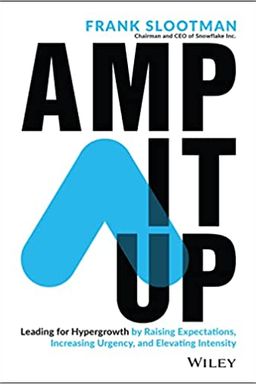
Amp It Up cover

Amp It Up

by Frank Slootman

Amp It Up reveals transformative leadership principles vital for achieving unmatched enterprise growth. Discover how to avoid common pitfalls, align teams with pivotal goals, and cultivate a culture of urgency, enabling your organization to thrive without drastic overhauls.

Amp It Up: Raising Standards, Speed, and Focus

Have you ever felt your organization—or even your own career—drifting into a slow rhythm of “good enough”? In Amp It Up: Leading for Hypergrowth by Raising Expectations, Increasing Urgency, and Elevating Intensity, veteran CEO Frank Slootman argues that every company and leader possesses untapped potential that can be released without expensive restructures, consultants, or lengthy overhauls. You simply need to amp up your standards, urgency, and focus.

Drawing on his experience at three billion-dollar success stories—Data Domain, ServiceNow, and Snowflake—Slootman contends that transformative change begins not with external advice but with internal energy. Instead of hoping for innovation to arrive, you act decisively to raise expectations, align your people, and move faster. His philosophy is a call to arms for leaders who want to drive hypergrowth and break organizational complacency. The magic, he insists, lies in intensity—the kind that tightens focus and ignites performance.

The Core Argument: Leadership Is Energy

Slootman’s central thesis is that great leadership is primarily about injecting energy, urgency, and alignment into a system that’s gotten too comfortable. When he joined Snowflake, he saw a technically brilliant company drowning in mediocrity—too many priorities, too little focus. Within months, he transitioned the business model to pay-for-usage, slashed redundant teams, and pushed performance metrics company-wide. Results exploded, culminating in one of the largest software IPOs in history. His message: it’s not talent or luck but an unrelenting increase in standards and pace that creates breakthrough results.

He compares this to Vince Lombardi’s transformation of the Green Bay Packers: same players, new leadership intensity. Organizations, like sports teams, don’t just need strategy—they need velocity. It’s your job as a leader to set that tone, even if it means discomfort. In fact, Slootman often says, “Get comfortable being uncomfortable.” Leadership isn’t about consensus; it’s about movement.

The Five Steps of Amping Up

Slootman distills his method into five interconnected actions:

  • Raise your standards: Replace “good enough” with “insanely great.” Ask if you’re thrilled by your output. If not, redo it.
  • Align your people and culture: Get everyone rowing in the same direction; remove misaligned incentives and passengers who merely coast.
  • Sharpen your focus: Quit multitasking. Prioritize brutally and keep only what truly moves the mission forward.
  • Pick up the pace: Compress timelines. Demand results in days, not weeks. Create organizational urgency.
  • Transform your strategy: Once execution excellence exists, widen your aperture to new opportunities and rethink the business model before disruption hits.

You begin with high standards and end with strategic scale. This rhythm of tightening standards and expanding ambition forms the heartbeat of the book.

Why This Matters

In a work world often paralyzed by bureaucracy and meetings, Slootman’s doctrine sounds like an adrenaline shot. He warns that even great companies drift toward complacency over time—lowering expectations under the guise of pragmatism. Growth stalls not from bad ideas but from lost intensity. “The moment you have many priorities,” he writes, “you have none.” That’s why “amping up” is both a management skill and a cultural philosophy. You must challenge your own pace, push talent harder, and refuse to let mediocrity set in.

The book isn’t mere theory: each principle is tested in battle—from EMC’s acquisition wars to ServiceNow’s cloud revolution to Snowflake’s billion-dollar explosion. Slootman’s story from teenage toilet cleaner in Holland to hypergrowth CEO mirrors his credo—discipline, focus, and refusal to settle. His journey reminds you that leadership is earned through struggle, not comfort.

“Leadership really matters,” Slootman writes. “The only way to change trajectory is to engulf your organization with energy, step up the tempo, and raise expectations starting right now.”

Across all chapters, Amp It Up urges leaders to reject incrementalism and instead cultivate urgency, execution, and clarity. It’s a playbook for those who want to lead at the highest level—not through charm, but through relentless drive. If you're the kind of person who feels there's more potential in your team, your company, and yourself, this book gives you the blueprint to turn velocity into victory.


Raise Your Standards Relentlessly

Frank Slootman begins his transformation philosophy with one simple command: Raise your standards. He argues that most organizations settle for “okay” outcomes because people chase completion instead of excellence. The challenge isn't more work—it’s better work. He models this on Steve Jobs, who famously demanded products that were not just good but “insanely great.” Jobs rejected mediocrity even in the smallest design detail, and Slootman adopts that same mindset for leadership.

Fight the Drift Toward ‘Good Enough’

Slootman cautions that companies drift naturally toward lethargy. Without intervention, standards regress until “good enough” becomes acceptable. When evaluating work, he asks employees: “Are you thrilled with it?” If their answer is anything less than passionate excitement, it’s not ready. That question reframes excellence as a feeling—enthusiasm, pride, conviction—rather than a checklist. When everyone works to astonish themselves, momentum multiplies.

He insists that leaders must make this visceral. In meetings, don’t merely critique; set expectations that feel uncomfortable. People will rise to demanding standards if leaders communicate them relentlessly. At Snowflake, that meant rejecting lukewarm product ideas until engineers were bursting with enthusiasm. At ServiceNow, it meant upgrading the entire user experience from industrial-grade to consumer-grade—a monumental shift that crystallized the brand’s new era.

Energy Flows From Standards

Raising standards isn’t punitive—it’s energizing. High expectations create engagement because people want to matter. When employees sense they’re pushing toward greatness, they invest more effort, creativity, and pride. Slootman calls this “engulfing the organization with energy.”

“Raising the bar is energizing by itself,” he notes. “Don’t let malaise set in—bust it up.”

This emotional dimension parallels research in performance psychology (for instance, in Atomic Habits by James Clear): success breeds excitement, and excitement breeds further success. Holding a high bar acts as a motivational loop. It’s not simply tactical but cultural—people internalize achievement as part of identity.

When Raising the Bar Hurts

Of course, higher standards unsettle many employees. Mediocre performers may resist, labeling new expectations as unrealistic. Slootman’s answer: either rise to the occasion or get off the bus. No organization can thrive on passengers. In his model, leadership compassion does not mean avoiding pressure—it means helping people stretch to their potential. If that pressure reveals unfit players, he acts decisively. He maintains that conviction—hard but fair—is the hallmark of amped-up leadership.

(In contrast, Jim Collins’s Good to Great recommends “getting the right people on the bus and the wrong off”—Slootman operationalizes that idea through relentless elevation of expectations. The bar itself sorts talent.)

Your Takeaway

To implement this in your own work, stop asking “Is it done?” and start asking “Is it thrilling?” Make excellence a nonnegotiable cultural value. Set standards that make people stretch, involve passion in evaluation, and refuse mediocrity disguised as pragmatism. According to Slootman, excellence isn’t a finish line—it’s a lifestyle. It’s how organizations ignite extraordinary results without waiting for external miracles. Once you raise the bar, every part of your operation—from incentives to culture—starts to hum at a higher frequency.


Align People and Culture

To scale momentum, you must align your people and culture. Slootman argues that misalignment—conflicting incentives, vague objectives, or siloed departments—is the silent killer of organizational energy. When everyone rows in different directions, your power dissipates. Alignment starts with clarity: one mission, shared incentives, and a consistent culture that codifies high performance.

Destroy Conflicting Incentives

At Snowflake, he inherited a company confused about its business model—sales reps were rewarded for bookings under a SaaS structure, even though true revenue came from consumption. The result: people oversold contracts while ignoring usage. Slootman transitioned the company to a consumption model, aligning rewards directly with the customer’s success. Once everyone’s bonuses reflected consumption metrics, motivation and clarity exploded. “Consumption became our middle name,” he writes.

He also abolished management by objectives (MBOs), which made employees act as isolated entrepreneurs chasing personal goals. That fragmented culture blocked flexibility. True alignment means shared accountability, not contract negotiation within departments. “MBO causes every man for himself,” he warns.

Drivers, Not Passengers

Cultural alignment depends on people with drive. Slootman divides staff into “drivers” and “passengers.” Drivers move things forward, take ownership, and inject urgency. Passengers merely ride along. His hiring mantra, inspired by an old Volkswagen ad—“Drivers wanted”—became a rallying cry at Data Domain and ServiceNow. Passenger-heavy organizations drown in polite stagnation; driver-heavy ones surge ahead. Identifying and retaining drivers across all levels ensures cultural coherence and pace.

Culture as a Performance Engine

A strong culture multiplies performance. At Data Domain, Slootman codified cultural values under the acronym RECIPE—Respect, Excellence, Customer, Integrity, Performance, and Execution. Unlike poster-only cultures, RECIPE lived through consequence. People who violated respect or failed integrity were removed quickly, sending signals that culture was real policy, not propaganda. Leaders modeled customer obsession and execution intensity daily.

“Culture results from consequences, good and bad, and from the lack of consequences,” Slootman warns. “People learn from outcomes, not posters.”

Protecting the Culture

Even great cultures face outbreaks of bad behavior. When Snowflake’s sales culture grew toxic, Slootman swiftly dismissed executives who had ignored company values—proving culture enforcement wasn’t negotiable. He distinguishes between fixable issues (skill gaps) and unforgivable ones (ethical or interpersonal misconduct). People who treat colleagues badly tear the organizational fabric. Protecting culture, therefore, ranks above short-term performance. “We’ll work with underperformers who share our values,” he writes, “but we never tolerate those who violate them.”

Your Takeaway

Alignment isn't bureaucracy—it’s battle readiness. Define your mission clearly, structure incentives to reinforce it, hire drivers, and enforce culture through consequence. When everyone understands the mission and shares responsibility for outcomes, speed and execution become automatic. That’s when urgency turns into unity.


Sharpen Focus Before Acting

Most leaders confuse activity with progress. Slootman declares that an unfocused organization spreads itself “a mile wide and an inch deep.” You must sharpen focus before chasing solutions. The discipline of prioritization, he says, transforms sluggish organizations into agile ones. True productivity is subtraction—doing fewer things better.

Prioritize Ruthlessly

At ServiceNow, he often asked executives: “If you could only do one thing this year, what would it be?” Most struggled to answer because they preferred lists of ten priorities—comfortable but directionless. He insists that “priority” should ideally be singular. Trying to move in five directions guarantees stagnation. In one example, he nudged ServiceNow’s chief product officer to identify a single defining initiative. The result: a strategic overhaul of the user experience from drab IT layouts to consumer-grade design. That singular focus reshaped the company’s future.

Analysis Before Solutions

Slootman likens too-fast decision making to doctors prescribing treatment without diagnosis. In business, teams rush into “solution mode” without analyzing the real problem. He recalls meetings at Snowflake where executives proposed endless initiatives to boost data cloud adoption—with little analysis. By slowing the conversation to diagnose root causes, he uncovered “data gravity”—the idea that demand concentrates around specific sectors. Sharpening analytical focus saved time, money, and energy.

“Let’s try a rifle shot instead of a scatter gun,” he told his team—reminding leaders that precision trumps proliferation.

Clarity Creates Speed

Paradoxically, slowing down for analysis speeds everything later. Vagueness breeds confusion; clarity creates alignment. Once priorities crystallize at the top, they cascade accurately down the line. Otherwise, distortion grows with each layer. Good leadership continuously distills complexity into essence: what truly matters now? When focus sharpens, execution accelerates.

Your Takeaway

Make analysis your weapon. Before launching new projects, isolate one mission-critical problem. Ask fewer, sharper questions: What matters most? What happens if we don’t do this? Remove noise and force clarity. By mastering focus, you convert confusion into confidence—and velocity naturally follows.


Pick Up the Pace

One of Slootman’s most electrifying ideas is about speed. He insists that urgency beats bureaucracy, and time is not your friend. “In a troubled organization, there’s no rush,” he observes—but there should be. Leaders set the tempo, and the rhythm they create spreads across the company. Every email, meeting, and decision becomes an opportunity to accelerate.

Compress Time

If someone tells him they’ll respond in a week, he asks, “Why not tomorrow?” That subtle correction reshapes mentality. At Snowflake, shortening response cycles invigorated teams overnight. Patience, he argues, may be a virtue in life but often a flaw in business—it signals a lack of leadership drive. Urgency fuels innovation, while delay breeds decay. You don’t need reckless speed; you need disciplined intensity.

Good Performers Crave Energy

High achievers thrive in energetic cultures. They want pressure, fast decisions, and visible momentum. Without pace, your top talent leaves. Slootman compares sluggish companies to bureaucratic institutions—like the California DMV, where the team “doesn’t start moving until 4:00 p.m. because quitting time is 4:30.” To prevent stagnation, use every interaction to amplify urgency. A leader’s impatience can be a cultural asset.

“Once the cadence changes, everyone moves quicker. Suddenly, new energy and urgency are everywhere.”

Speed and Execution

In startups and scale-ups alike, velocity multiplies results. When Slootman ramped up ServiceNow’s sales hiring pace, the company doubled revenue within a year. At Data Domain, accelerating product upgrades (“larger and faster”) became their mantra, and revenue exploded quarter by quarter. Each acceleration compounds the next—a dynamic that McKinsey later validated in its study “Grow Fast or Die Slow.” The fastest-growers outperformed rivals fivefold.

Your Takeaway

Speed transforms morale, competitiveness, and valuation. If your team moves slowly, it’s not strategy—it’s culture. Tighten response times, remove unnecessary waits, and push progress at every turn. In Slootman’s world, pace is leadership’s purest expression of intent: it shows you care enough to move mountains quickly.


Execution Is King

Strategy books fill shelves, but Slootman says execution is rarer—and more valuable. You can dream about innovation, but dreams die without disciplined follow-through. At all three of his companies, big ideas only became billion-dollar realities when leaders mastered execution fundamentals. His mantra: “No strategy is better than its execution.”

Execution as a Teachable Competency

Execution deserves the same systematic training as sales. At Snowflake, he created a career path from entry-level reps to elite majors accounts—turning performance into a learnable ladder. Yet most startups offer little managerial education; founders rush headlong into chaos. The result is the “five-year-old soccer game” effect—everyone chasing the ball, no one playing position. Execution means structure, rhythm, and accountability.

Strategy vs. Execution Problems

When teams fail, leaders often misdiagnose. Instead of fixing execution gaps, they change strategy prematurely. Slootman insists you evaluate execution first: are we running plays effectively? Only once execution is proven can strategic issues be assessed. At Data Domain and ServiceNow, competitors underestimated execution and paid the price. EMC and BMC tried acquisitions or dismissive denial—moves born from poor self-analysis. Slootman’s disciplined execution let his companies outpace industry titans.

“Great execution can make a moderately successful strategy go a long way,” he reminds us. “Poor execution will fail even the most brilliant strategy.”

Reject Consultant Dependency

Big corporations hire consultants like McKinsey to write pretty reports—but Slootman jokes, “They borrow your watch, tell you what time it is, and keep the watch.” True operators live and breathe their strategies because they own results. He recommends merging the roles of strategist and operator: as CEO, you must also be Chief Strategy Officer. Separating thinking from doing creates misaligned incentives. Only those who execute should design strategy—they know what’s real.

(Comparison: Peter Drucker discussed “management by objectives”; Slootman dismantles it, showing why delegated planning kills execution rigor.)

Your Takeaway

Before chasing flashy ideas, master execution. Create clear processes, reward accountability, eliminate excuses, and fuse strategy with action. Learn to operate like a coach—not a commentator. Execution is the battlefield where leadership earns credibility. In an amped-up company, everyone plays position, runs their route, and wins through disciplined precision.


Transform Strategy Before You’re Forced To

Every high-performer eventually faces the same paradox: today’s winning strategy becomes tomorrow’s trap. In the later chapters, Slootman describes how to transform strategy before it boxes you in. From Data Domain’s disk revolution to ServiceNow’s workplace workflow dominance to Snowflake’s leap into the Data Cloud, the lesson is consistent—reinvent yourself while you’re still winning.

Anticipate the Shift

At Data Domain, success rested on replacing tape backups with disks. But that triumph created a ceiling. To sustain growth, the company needed new markets—yet it hesitated until larger rivals forced its hand. EMC’s acquisition sealed its fate, proving Slootman’s advice: if you don’t transform your strategy early, someone else will do it for you. “Lay new track before the train catches up,” he warns.

Open the Aperture

ServiceNow avoided that mistake by broadening its lens early. What began as IT helpdesk software became an enterprise workflow platform applicable across HR, security, and customer service. Slootman noticed customers adapting the product far beyond its original intent—a signal to expand deliberately. He dubbed this strategy “opening the aperture.” By reframing the business from tools to platform, ServiceNow captured a hundred-billion-dollar market. Audacity replaced incrementalism.

Swing for the Fences

At Snowflake, he pushed transformation even further—launching the “Data Cloud” to supersede data warehousing. The company evolved to host data marketplaces and programmable apps, unlocking exponential value. It wasn’t just a pivot; it was a reframing of the industry itself. Snowflake went from niche database vendor to unified cloud data ecosystem, setting a new category standard.

“If you wait until the need for change becomes obvious,” he cautions, “it’s already too late.”

Your Takeaway

Strategy transformation demands courage and timing. Never grow complacent behind temporary success. Expand your aperture while momentum is strong. Question whether your current definitions of market and customer still fit the future. In Slootman’s framework, innovation isn’t disruption—it’s survival. The faster you evolve, the longer you dominate.

Dig Deeper

Get personalized prompts to apply these lessons to your life and deepen your understanding.

Go Deeper

Get the Full Experience

Download Insight Books for AI-powered reflections, quizzes, and more.