
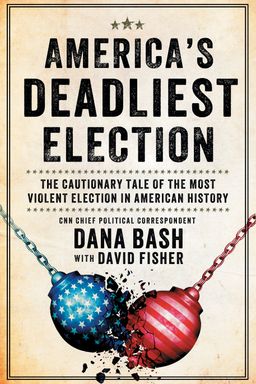
America's Deadliest Election cover

America's Deadliest Election

by Dana Bash With David Fisher

The CNN chief political correspondent considers the election of 1872 and draws parallels to today’s politics.

Power, Race, and Fragile Democracy

How can you watch a democracy unravel in slow motion? In this Reconstruction chronicle set largely in New Orleans, the book argues that elections fail not only when ballots are stolen or guns fire, but when power-holders turn rules, revenues, and rifles into partisan weapons. The core claim is stark: once institutions lose perceived neutrality—amid a revolutionary shift in race, money, and federal authority—politics becomes an existential fight, and losers reach for force.

You follow Louisiana, 1872–1877, as a case study in systemic breakdown. Political entrepreneurs such as Henry Clay Warmoth design electoral machinery to entrench control; rivals answer by starving the state through tax resistance; paramilitaries like the White League drill in public and launch coups; and federal courts narrow Washington’s ability to protect freedpeople. By the end, a national bargain (the Hayes–Tilden resolution) trades the presidency for the retreat of Reconstruction, cementing a regional counterrevolution. (Note: The book’s arc mirrors broader studies of democratic erosion—see Steven Levitsky and Daniel Ziblatt’s emphasis on norm-breaking and institutional capture.)

A city that concentrates national tensions

New Orleans is not just a backdrop; it is a pressure cooker. In 1872 it’s a cosmopolitan port powering Mississippi Valley trade and an impoverished, debt-strapped capital with four paved streets and open sewage. You see opera houses, masked balls, and elite families alongside freedmen communities and Creole networks—French and English speakers, Catholics and Protestants. That density of identities and ambitions turns every fight over customs posts, court appointments, and police commands into a high-stakes contest for livelihoods.

The shock that frames Reconstruction’s urgency comes earlier: the Mechanics Institute massacre of 1866, where a mob led by Mayor John T. Monroe murders Black delegates and allies at a constitutional convention. The lesson lands: rights on paper mean little without force to protect them. That insight haunts everything that follows.

Machine politics meets military occupation

Under General Philip Sheridan in the Fifth Military District, federal occupation fuses Washington and local politics. Ambitious northerners like Henry Warmoth arrive with opportunism and Union credentials. Warmoth, elected governor in 1868 at just twenty-six, builds a patronage machine: he creates new parishes, appoints allies, and claims the right to command sheriffs and police. He forms a five-hundred-man Metropolitan Police—largely Black Union veterans—whose black-and-red uniforms symbolize a new order and, to his enemies, an occupying force in local guise.

Warmoth’s masterstroke is electoral engineering. He pressures the legislature to empower supervisors of voters, commissioners at the polls, and a five-man Returning Board (including the governor) with sweeping authority to throw out “tainted” returns. By building the referee, he shapes who wins, as much as how people vote. (In modern terms, you’d call this procedural capture.)

From fraud mechanics to factional fractures

The book shows how registration and polling logistics become choke points. In Black-majority parishes, offices “run out” of forms, doors stay locked, and polls move miles away; on election day, roads bristle with guns, boxes disappear, and tallies shrink—Mooringsport records 310 Republican voters but only 18 votes for Republicans. Affidavits and counter-affidavits pile up, each side building paper fortresses of legitimacy.

At the same time, Republicans splinter. Warmoth’s “Liberal” wing clashes with the federally anchored Custom House faction (Stephen Packard, William Kellogg, and James Casey—President Grant’s brother-in-law). Oscar Dunn’s death creates an opening; Warmoth maneuvers P. B. S. Pinchback into the lieutenant governorship amid bribery accusations. The party becomes a battlefield of committees, conventions, and press wars, leaving Democrats a clear lane to exploit chaos.

Dual governments, street battles, and federal lines

In 1872–73, three competing Returning Boards (Warmoth’s original, the Herron replacements, and Warmoth’s De Feriet Board) produce rival “winners.” The House impeaches Warmoth, the Senate seats Pinchback (the first Black governor in U.S. history), and McEnery declares himself governor. Two legislatures function at once. McEnery’s lieutenants plan a coup; Superintendent Algernon Badger’s Metropolitans answer with a 12‑pound Napoleon cannon in the French Quarter. Federal troops arrive; Kellogg’s claim survives because Washington recognizes it.

But violence now sits inside politics. Democrats weaponize a tax strike to starve Kellogg’s government; Republicans harden the Metropolitans into a brigade. Meanwhile, paramilitaries emerge openly: the White League recruits thousands, drills in ballrooms, and seizes courthouses. In Colfax (Grant Parish), a contested sheriff’s seat descends into massacre of Black defenders; in court, United States v. Cruikshank narrows federal power to punish private racial terror. By 1874, the White League mounts an urban coup at Liberty Place, briefly toppling New Orleans’s government until federal troops restore Kellogg.

A national crisis and the long aftermath

The 1876 presidential contest takes the Louisiana playbook national: rival returns, partisan Returning Boards, and an improvised Electoral Commission. Justice Joseph Bradley—who earlier helped undo Colfax convictions—casts the deciding 8–7 votes that award Rutherford B. Hayes the presidency. Behind the scenes, a bargain (often called the Wormley House deal) trades acceptance of Hayes for troop withdrawal and “home rule.” Federal shields drop; Francis Nicholls consolidates power in Louisiana; Jim Crow follows in law and practice. The experiment in multiracial democracy retreats for generations.

Core throughline

When procedural levers (Returning Boards), fiscal lifelines (taxes), and armed force (police, militias, paramilitaries) become partisan tools—and courts narrow federal protection—democracy’s “how” collapses, and the “who” is decided by whoever holds the street.


New Orleans: Pressure Cooker Politics

To grasp why Louisiana spins into violence, you need to stand in New Orleans circa 1872. It’s a port moving nearly half of U.S. cotton and a city with four paved streets; it’s opera season and open sewage; it’s Creole elites, Black Union veterans, and immigrant dockworkers hustling under the same miasmic heat. You feel the postwar contradiction: prosperity’s possibility strapped to a state drowning in debt—and that contradiction turns every office, contract, and customs post into a survival fight.

The city’s cultural layering magnifies political friction. French and English speakers, Catholics and Protestants, Creoles of color and freedmen assemble overlapping loyalties and rival patronage webs. You don’t get clean party blocs; you get clans, clubs, and committees—exactly the networks that can mobilize bodies fast when ballots don’t settle disputes.

From massacre to mandate for force

The Mechanics Institute massacre on July 30, 1866, is the city’s brutal prelude. Mayor John T. Monroe’s ex‑Confederate mob attacks Black delegates at a reconvened constitutional convention. The floor dries “caked in blood.” From Washington’s vantage, the message is unmistakable: civil rights require armed protection. From freedmen’s vantage, self-defense is no abstraction; it’s survival.

This memory conditions Reconstruction politics. When you later see Black veterans in Metropolitan Police uniforms, understand how both sides perceive them: to Republicans, a shield for lawful governance; to Democrats, a partisan army in city livery.

Occupation and opportunity

Louisiana sits in the Fifth Military District under General Philip Sheridan. Federal oversight refracts every local decision through national stakes. That pipeline draws in northern strivers—none bigger than Henry Clay Warmoth, a 22‑year‑old Union officer who arrives with charm, audacity, and connections. He spots a state where legal gray zones create opportunity: appoint during Senate recesses, multiply parishes to multiply posts, and turn law enforcement into a governor’s instrument.

New Orleans, with its Custom House and federal payrolls, adds another power center. James Casey (Grant’s brother‑in‑law), William Kellogg, and Stephen Packard anchor a faction the governor can’t dismiss. You get instant factional crosswinds: state patronage versus federal patronage, each with cash, guns, and newspapers.

Economics as political fuel

A debt-burdened state needs revenue; a port city needs customs control. Recovery, bonds, rail subsidies, levee work—these become spoils. When the Picayune rails about taxes or the Times charges illegitimacy, they aren’t only opining; they’re protecting investor interests, advertiser relationships, and party patrons. You can map headlines to ledgers.

That’s why “who counts votes” isn’t abstract in New Orleans. The man who appoints registrars decides which stevedore gets work, which judge hears bond disputes, which contractor receives levee money. The city’s economy transmits political shocks into daily life fast.

The street as a constitutional stage

Urban geography matters. Narrow streets, balconies, and three‑story sightlines turn Canal and Royal into ready-made theaters for force. When Superintendent Algernon Badger rolls a 12‑pound Napoleon into the French Quarter during the March 4 clashes, you feel how easily a precinct fight becomes a civil war tableau. Later, during the Battle of Liberty Place, barricades rise from tramcars and tile crates; rifles on rooftops turn the levee into a firing line. Urban space multiplies the power of organized minorities (a lesson echoed in later urban uprisings worldwide).

Even symbolism is urban. The White League summons men to the Henry Clay statue, seizes the State House and armory, and parades captured artillery. New Orleans supplies the icons—Cabildo, Custom House, Canal Street—that transform factional will into spectacle and, briefly, regime change.

Why the city drives the state

The book insists you treat New Orleans as a force multiplier. Newspapers there frame national narratives; federal commanders stage interventions there; Returning Boards convene in its halls. Events in remote parishes—Colfax, Coushatta—depend on whether New Orleans sends troops, validates returns, or prints their story above the fold. When the city tilts, the state follows.

Actionable lens

To read any contested democracy, start with its biggest city: map economic chokepoints, media nodes, and coercive hubs. That’s where rules become outcomes.


Warmoth And Republican Fracture

If you want a masterclass in converting institutions into personal power, you study Henry Clay Warmoth. He arrives a young Union colonel and, by 1868, occupies the governor’s office. He moves quickly, seeing that appointment powers and election rules are levers, not paperwork. He creates eight new parishes, seeds them with allies, and asserts authority over sheriffs, constables, and militia. Patronage ceases to be abstract; it becomes a governor’s daily engine.

Warmoth also builds muscle. The Metropolitan Police—about five hundred strong, many Black Union veterans in black-and-red uniforms—function as both public safety and private guard. He claims the right to deploy them statewide when “necessary,” blurring police, militia, and party. His critics hear an autocrat; his supporters see stability against terror. (Note: The pattern echoes big-city machines like Tammany—centralize appointments, control the streets, reward the press.)

Election law as architecture of control

Warmoth pushes statutes that place the governor’s allies at every election chokepoint: supervisors of voters, commissioners at each box, and, most potent, the Returning Board—five members, including the governor, with power to discard results for fraud or violence. You don’t need to stuff every box if you can judge every box. That logic, perfectly legal on paper, detonates once violence and fraud become universal claims.

He then manages optics. Newspapers publishing official notices get paid handsomely—especially the New Orleans Republican, where he holds shares. When critics charge graft, Warmoth shrugs with a modern-sounding defense: everyone in politics gets theirs; he just got his more efficiently. The plausible deniability works until it doesn’t.

The Custom House counter-power

New Orleans’ Custom House creates a rival sun. Stephen Packard, William Kellogg, and James Casey (Grant’s brother‑in‑law) command federal appointments and paychecks. Warmoth can’t fire federal marshals or customs men; he can’t shut off that money spigot. The party fissures into his “Liberal” wing versus the Custom House Republicans. The 1870 convention clash makes the split theatrical: Warmoth, once locked out, returns on crutches for a showman’s scene; the dissidents set up at the Custom House, he convenes at Turner Hall. Two conventions, two committees, one shattered coalition.

Then contingency deepens the rift. Lieutenant Governor Oscar Dunn dies; Warmoth maneuvers P. B. S. Pinchback into the seat amid bribery charges, enraging rivals and galvanizing Black Republicans who had aligned with Dunn. The fight stops being just about policy; it’s about who commands the pipeline of jobs, votes, and the Returning Board’s pen.

From party war to constitutional crisis

The 1872 election reveals the cost of fracture. Three Returning Boards—Warmoth’s original, the Herron-appointed replacements, and Warmoth’s De Feriet Board—each issue “official” results. The House impeaches Warmoth; the Senate seats Pinchback as acting governor. Kellogg claims the governorship with federal blessing; John McEnery claims it with rural backing. Two executives, two legislatures, one capital city—all insisting on legality.

Warmoth’s story becomes the cautionary pivot: by mastering levers, he taught everyone else where they were. Once rivals learn to pull the same levers, legitimacy fragments. The party that freed slaves and won the war can’t agree on a speaker’s gavel, let alone a governor’s seal—and Democrats, watching from the wings, step into the breach with organization and guns.

Personal ambition, structural lessons

You could fault Warmoth’s ego or applaud his state-building; the book urges a structural read. Institutions that concentrate discretion (appointments, election certification, police command) are efficient in calm times and catastrophic in contested ones. Factional incentives then push each bloc to clone a rival institution—rival committees, rival Returning Boards, rival legislatures—until the constitution becomes a hall of mirrors.

Leadership takeaway

The more you personalize authority to win today, the more you teach tomorrow’s enemies exactly how to unmake you.


Elections As Weapons

If you think fraud is a single trick, Louisiana disabuses you. The book inventories a toolbox that converts voting into partisan warfare: choke registration, menace roads, game ballots, kidnap boxes, and, if necessary, let a board of “referees” decide the score after the game. Each method alone warps outcomes; together they nullify the idea that ballots measure will.

Registration becomes the first filter. Supervisors set hours and locations and weaponize inconvenience: offices “run out” of forms; doors stay locked; Plaquemines sites sit thirty‑five miles from Black communities; a back door opens only for whites. You see the contemporary rhyme—ID hurdles, precinct closures, line-length manipulation—because the logic never changes: turnout shrinks when the process wastes your time or endangers you.

Election day as battlespace

On the day itself, violence shifts from rumor to roadblock. Polls close early or move to sheds and islands. Armed men loiter on paths to the booth; two Republicans in Livingston are shot trying to vote; Black ministers urge congregants to stay home. The tactic isn’t random terror; it’s targeted suppression to shave Republican tallies and set up plausible disputes for the count.

Then comes the box. Supervisors “sleep with” ballots, disappear overnight, return with miraculous flips. At Mooringsport, 310 Republicans line up; just eighteen Republican votes appear. Counterfeit tickets omit or misspell candidates, voiding ballots on technicalities; folded “packets” let ballots separate during transport to simulate more votes after the fact. Every mechanical step becomes a vulnerability.

Paper wars and the Returning Board

After the physical contest comes the narrative contest. Affidavits stack up by the thousands—Republicans swear denial and intimidation; Democrats swear forgery and perjury. Facts matter less than which pile of paper a recognized authority blesses. That authority is the Returning Board, Warmoth’s engineered lever, empowered to throw out precincts “tainted” by violence or fraud. In a landscape saturated with both, discretion equals decision.

Three different Returning Boards later—Warmoth’s original, Herron’s replacements, and Warmoth’s De Feriet Board—you have three “true” results. The lesson bites: when final certification is discretionary, every upstream dispute becomes a reason to litigate outcomes downstream. If there is no neutral last umpire, the game doesn’t end; it moves to the streets.

From technique to strategy

The Democrats’ answer to stacked rules is not only counter-fraud; it’s counter-sovereignty. They stage tax resistance to deny the winner the money to govern, and they organize paramilitaries to enforce “local” outcomes. Republicans answer by hardening enforcement—converting the Metropolitans into a state brigade—and by appealing to federal recognition. The struggle ceases to be about who got more votes last Tuesday and becomes who will command police this Thursday.

You learn a contemporary rule of thumb: fraud is seldom one trick; it’s a system. Eliminate one tactic and pressure re-routes through another—administrative closures, ballot design, chain of custody, certification discretion. Only holistic safeguards—a clean registration regime, secure logistics, independent certification—can keep elections as measurement rather than maneuver.

Modern parallel

If you control who registers, where they vote, how boxes travel, and who certifies, you don’t need to change minds; you just shape who counts.


Legitimacy Unravels In Public

Once Louisiana’s certification process fractures, legitimacy itself goes to war. In 1872–73, three Returning Boards—Warmoth’s original board, the Herron replacements aligned with Kellogg, and Warmoth’s De Feriet Board—issue rival results. The state House impeaches Warmoth; the Senate seats P. B. S. Pinchback as acting governor. William Kellogg and John McEnery claim the governorship simultaneously. New Orleans hosts duplicate legislatures a few blocks apart. Government, once a singular noun, becomes plural.

The practical consequences are immediate. Who collects taxes? Which judge’s order binds sheriffs? Which police chief commands the night shift? Citizens face ordinary crises under extraordinary ambiguity: if you pay taxes to the “wrong” collector, have you paid at all? If the man with the badge answers to a rival governor, is he a cop or a partisan?

Federal recognition as the pivot

President Grant’s telegrams and Judge Durell’s rulings—recognizing the Lynch/Durell-backed legislature—don’t solve the politics; they freeze the battlefield. Washington’s recognition acts like oxygen to Kellogg’s claim and vacuum to McEnery’s. In the absence of a neutral state umpire, the federal executive becomes the decider by default. That is stabilizing in the hour and destabilizing in the long run, because every loser will now litigate the presidency rather than the precinct.

McEnery’s camp shifts from paper to plans. With Warmoth’s encouragement, Confederate Colonel Fred Ogden outlines a coup: seize police stations, capture the Cabildo armory, and occupy the State House. Spies leak the scheme; Superintendent Algernon Badger braces the Metropolitans. On March 4, attackers overrun the Seventh Precinct and then target the Third Precinct in the French Quarter.

When bullets replace motions

Snipers open from balconies; the Metropolitans wheel out a 12‑pound Napoleon. Grapeshot roars down Chartres; bullets punch shop windows by Jackson Square. Casualties are modest—a pair killed, fewer than twenty wounded—but the psychological blast is enormous. Union infantry appear; arrests follow; Kellogg’s forces retake positions. The city has seen what constitutional breakdown sounds like.

After the skirmish, each side normalizes force. McEnery’s bloc organizes tax resistance to starve Kellogg of cash. Kellogg’s legislature converts the Metropolitans into the Metropolitan Brigade, a state-level standing force. The grammar of politics changes: motion, injunction, and subpoena yield ground to muster roll, requisition, and barricade.

Tax strikes as counter-sovereignty

The tax strike isn’t just refusal; it is a theory of government: we deny your sovereignty by denying your revenue. The Times-Picayune refuses $2,150 until the eve of auction; a storekeeper, Edward Booth, resists, is arrested, pays “ransom,” and parades in triumph. Kellogg’s camp stiffens penalties and tries seizures; enforcement proves combustible and uneven. Meanwhile, garbage collections stall, courts slow, teachers go unpaid. Pain, once fiscal policy, becomes political theater.

You witness the choreography of dual power: rival legislatures, rival sheriffs, rival budgets—each backed by their own newspapers, guns, and telegraphs. The constitution has rules for who wins elections; it has fewer for what to do when two men arrive with oaths and seals. In that vacuum, the side with federal recognition and the side with rural muscle trade blows until a national reckoning imposes an end.

Governance lesson

If you can’t agree on who collects the taxes or commands the police, you don’t have a constitutional crisis—you have two constitutions.


Colfax To Cruikshank

Colfax, in Grant Parish, is where contested offices tip into atrocity. After a disputed local election, Fusionist sheriff Christopher Columbus Nash refuses to yield courthouse keys. Black militia leader William Ward—a popular Union veteran and Warmoth appointee—rallies freedmen. Republicans enter the courthouse to swear in officers; shots are alleged; rumors of lynching Ward circulate. Both sides mobilize with purpose, not accident.

On April 13, Nash advances with roughly 165 armed men and warrants. Ward’s defenders dig shallow breastworks, wield shotguns, and improvise artillery. They face wagon-mounted deck guns and Spencer and Sharps rifles. A river detachment outflanks them. Amid the fight, the courthouse roof catches fire—accounts diverge on whether a captive, Pinckney Chambers, set it or combustibles did. Defenders fleeing the flames are cut down at doorways and in ditches; others surrender and are shot later in the woods. Bodies—at least sixty-five at first count, perhaps far more—burn or sink by the river. Survivors like Levi Nelson and Alabama Mitchell describe executions at close range.

Competing stories, national shock

Democratic papers call the Republicans usurpers; Republican papers name it massacre. President Grant labels it “bloodthirsty and barbaric.” The event electrifies Washington because it crystallizes a Reconstruction dilemma: if state courts won’t or can’t punish racially motivated mass murder, can the federal government?

U.S. Attorney James Roswell Beckwith brings indictments under the Enforcement Act of 1870, designed to target conspiracies depriving citizens of rights. With Treasury agent John J. Hoffman’s help, nearly one hundred men are charged—not for murder per se, but for violating rights of assembly, bearing arms, and equal protection. A federal jury convicts seventeen on some counts—a rare triumph for Reconstruction enforcement.

Justice Bradley and the Supreme Court narrow the field

On retrial, Justice Joseph Bradley, riding circuit, rules the indictments defective. He says the federal government can’t reach private wrongs unless the state is the actor or a specific federal right is at issue. The case heads to the Supreme Court as United States v. Cruikshank. Chief Justice Morrison Waite writes the opinion reversing convictions and anchoring a doctrine: the Fourteenth Amendment restrains states, not private individuals; federal power protects you when the state injures you, not when your neighbor does (absent specific federal guarantees).

That formalism has devastating bite. If a state refuses to prosecute white mobs, federal prosecutors cannot easily step in. Democratic editors cheer “reserved rights of the States”; Governor William Pitt Kellogg groans that, henceforth, “no white man could be punished for killing a Negro.” The ruling shrinks Washington’s reach just as paramilitaries scale up.

From case law to countryside

Cruikshank doesn’t create the White League, but it licenses its confidence. When federal threat recedes, rural elites calculate that intimidation will carry elections and policy. Local prosecutors, juries, and judges—steeped in planter networks—become final arbiters by default. The national headline fades; the local signal blares: organize, arm, expel Republicans, and expect impunity.

The book treats Colfax as anatomy and omen: you watch a specific chain—contested office, mobilization, siege, massacre—and then see law’s retreat make repetition more likely. The pipeline from courthouse corridor to Supreme Court syllabus transforms Reconstruction from a policy era into a jurisprudential narrowing that lasts a century. (Note: Later rulings—The Civil Rights Cases, Plessy—will extend this state-action logic and harden Jim Crow.)

Legal takeaway

If rights depend on state action for enforcement, hostile or apathetic states can nullify those rights in practice without changing a word of the Constitution.


The White League’s Counterrevolution

Think of the White League as Reconstruction’s public-facing paramilitary. Unlike the clandestine Klan, its companies drill in ballrooms, picnic in fields, and advertise in newspapers. Founders and boosters—Robert Marr, E. John Ellis, John McEnery—link ex‑Confederates, conservative Democrats, Knights of the White Camelia, and local elites. The mission is plain: replace Republican rule with white-dominated governance, by intimidation when ballots fail.

Their tactics scale across parishes. In Natchitoches, hundreds force Republican officials to resign. In St. Martinville, Alcibiades DeBlanc blocks Metropolitans with a 600‑man militia, then returns to New Orleans greeted as a hero and granted bail. In Coushatta, they arrest Republican officials, compel resignations, and execute or lynch them during a staged “removal.” The point isn’t only to remove a few men; it’s to teach a lesson to every Black voter and Republican organizer: the state won’t protect you.

Guns, smuggling, and narrative

Weapons are plentiful. Postwar markets flood Louisiana with cheap Belgian and Prussian rifles; crates labeled “Machinery” and “Dry Goods” pour through the port. The Metropolitans seize loads at Olivier’s Gun Shop and intercept 264 muskets and ammunition on the steamer Mississippi, but dispersal is fast and networks are dense. When Governor Kellogg confiscates arms in the name of order, the League turns it into rallying cry: they’re taking your guns.

Legal nuance—Louisiana’s 1868 constitution ties gun rights to a “well-regulated Militia”; Warmoth’s 1870 tax chills pistol carry; concealed carry limits date to 1813—doesn’t matter at mass scale. The narrative does. The Second Amendment, simplified, becomes recruitment poster and street password. (Modern echo: weapon regulation is easiest to debate as rights; hardest to enforce amid distrust.)

Battle of Liberty Place: urban coup playbook

On September 14, 1874, months of preparation crest. The League prints a call to arms at the Henry Clay statue on Canal Street. Barricades go up from tramcars and tile crates; countersigns circulate; riflemen take rooftops and levee positions. Badger orders the Metropolitans and militia to clear the street with two 12‑pounders and a Gatling. The defenders meet concealed fire; Badger takes three bullets; casualties mount—about twenty-one White Leaguers and eleven defenders killed.

The League captures the arsenal, distributes roughly 5,000 arms, and installs Davidson B. Penn as acting governor. They parade captured artillery—politics as theater with shrapnel. The coup holds briefly until President Grant orders General Emory in with 5,000 troops. Federal commanders refuse recognition; the insurgents melt away without a protracted siege. Tactically temporary, Liberty Place is psychologically durable: it proves to rural whites that organized force can flip a city, if only for a day.

Why public paramilitaries matter

Operating in the open gives the League protective coloration—newspapers, clubs, civic ceremonies. It blurs lines between party and militia, between citizen guard and insurgent. Federal suppression now requires not just arrests but a willingness to target networks embedded in “respectable” society. After Cruikshank, that willingness fades.

The League’s success is not only in bodies assembled but in institutions seized—courthouses, armories, telegraph lines—and in rituals performed—parades, proclamations, oaths. That choreography converts fear into power and power into policy: obstruct taxes, intimidate registrars, and dictate local appointments. By 1876, the method scales into statewide leverage over electoral returns.

Strategic insight

Paramilitaries win not only by shooting; they win by making the act of governing feel impossibly costly for their opponents.


1876 And Reconstruction’s End

By 1876, the Louisiana script scales to Washington. Multiple states—Florida, South Carolina, Louisiana, plus one Oregon elector—send rival returns. In Louisiana, a four-member Returning Board, already scarred by years of partisanship and threats, combs through parishes and rejects or modifies results where intimidation or fraud is alleged. Roughly 15,000 votes—13,000 for Samuel Tilden—are thrown out. The Board awards the state to Rutherford B. Hayes; Democrats respond by certifying their own electors for Tilden. The result is a national impasse with no constitutional breaker.

Congress improvises the Electoral Commission: five senators, five representatives, five Supreme Court justices. The intended neutral, Justice David Davis, exits after accepting a Senate seat; Justice Joseph Bradley—who earlier helped unravel the Colfax convictions—steps into the swing seat. Every disputed return falls 8–7 along party lines for Hayes. The law serves as stage; politics writes the script.

The bargain behind the curtain

Even as the Commission votes, negotiators meet—famously at Wormley House—to trade acceptance of Hayes for promises of “home rule,” troop withdrawal, and patronage. The agreement is unwritten but unmistakable. In early March 1877, Hayes takes the oath; in April, federal soldiers board steamers and leave New Orleans. Governor Stephen Packard, the Republican who had clung to federal bayonets, watches power pass to Francis Nicholls. The shield vanishes; Reconstruction ends in practice.

The price surfaces slowly. Without federal enforcement—and with Supreme Court precedents like Cruikshank narrowing Washington’s reach—southern legislatures codify Jim Crow. Louisiana’s 1898 constitution and statutes formalize disenfranchisement through literacy tests, poll taxes, and registration traps. What paramilitaries had compelled and Returning Boards had certified, laws now engrave.

Institutional aftermath and memory

The federal government learns a procedural lesson and passes the Electoral Count Act of 1887 to routinize future disputes. But the moral lesson bites deeper: a presidency can be purchased at the cost of a region’s civil rights. The national appetite for Reconstruction enforcement evaporates, replaced by a rhetoric of sectional healing that leaves Black citizens exposed.

For you, the 1876 crisis fuses the book’s themes. Election mechanics—returning boards, certifications—become the final arena for fights begun in parish courthouses and on Canal Street. Paramilitary “facts on the ground” shape which returns look plausible; federal judges who narrowed criminal enforcement now arbitrate presidential legitimacy. The system treats politics as the solvent for law; law returns the favor by laundering political outcomes.

A closing caution

Democracy doesn’t only require counting votes; it requires losers who accept losing and institutions that losers trust. Louisiana’s 1872–1877 saga shows what happens when neither condition holds: tax strikes sap capacity, guns fill the streets, courts split hairs, and the national center chooses peace over principle. The consequences last nearly a century.

National lesson

When process breaks locally and will falters federally, settlements don’t end conflict; they entrench the side most willing to wield force between elections.

Dig Deeper

Get personalized prompts to apply these lessons to your life and deepen your understanding.

Go Deeper

Get the Full Experience

Download Insight Books for AI-powered reflections, quizzes, and more.