
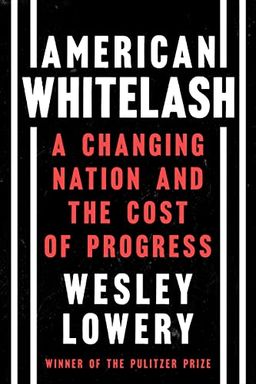
American Whitelash cover

American Whitelash

by Wesley Lowery

The Pulitzer Prize-winning journalist examines a cyclical pattern of violence and backlash against racial progress.

America’s Recurring Whitelash

Have you ever felt a door close just as another opens—like progress is always shadowed by pushback? In American Whitelash, Wesley Lowery argues that the United States is living through a familiar pattern: when the nation takes visible steps toward racial inclusion, a counter-surge of white grievance and violence follows. He contends that Barack Obama’s election didn’t usher in a post-racial era; instead, it catalyzed a renewed period of racial reaction that emboldened white supremacist ideology, normalized conspiratorial rhetoric, and produced deadly violence—from Patchogue to Oak Creek, from Charleston to Charlottesville, and beyond.

Lowery’s claim is both historical and urgent: the American story is a tug-of-war, not a straight line to justice. Progress (Reconstruction; civil rights; Black Lives Matter) is routinely met by Redemption, a backlash that defends the existing racial order (think Jim Crow or the Klan’s 1920s revival). He shows how this dynamic reappeared after 2008, tracing how mainstream media and politics laundered ideas long nurtured on hate forums, and how that rhetoric traveled—by algorithm, talk radio, and cable news—into behaviors that left real people dead.

The Book’s Core Claim

Lowery contends that you can’t understand Obama-to-Trump America by economics alone. Demographic anxiety, media-fueled moral panics, and a revived belief in white victimhood converged to form a potent “whitelash” (Van Jones’s term on election night 2016)—a surge of white grievance against a changing country. He maps how leaders and outlets—Lou Dobbs on CNN and later Fox, talk radio figures like Rush Limbaugh, politicians such as Arizona’s Joe Arpaio, and national voices who mainstreamed “birtherism”—translated fear of immigration, Muslims, and Black protest into a political lingua franca. That vocabulary, in turn, made white supremacist narratives (like “replacement theory”) feel plausible to millions.

What You’ll Learn

First, you’ll see the pattern across American history: when inclusive change arrives, violent redemption movements rise (echoing scholars like Carol Anderson in White Rage and Peniel Joseph on the “Second Reconstruction”). Then, you’ll meet the people inside today’s story: Joselo and Marcelo Lucero on Long Island; Oak Creek’s Sikh community; Susan Bro after Heather Heyer’s killing in Charlottesville; Dorian Johnson in Ferguson; and Richard Collins III’s parents in Maryland. Their names anchor abstractions in lives upended by actions encouraged—if not ordered—by the era’s rhetoric.

Second, you’ll learn how radicalization works. Lowery draws on researchers Robert Futrell and Pete Simi (American Swastika) and former DHS analyst Daryl Johnson to show how white power music scenes, leaderless resistance (Louis Beam’s concept), and online forums (Stormfront; “Alt-Reich: Nation”) convert grievance into mobilization. He details Wade Michael Page’s path from Army discharge to Hammerskin to murderer in Oak Creek, illustrating the mixture of personal fracture, subculture, and ideology that produces violence.

Why This Matters Now

Lowery argues that ignoring this pattern has real costs. In 2009, analyst Daryl Johnson warned DHS about a coming surge of right-wing extremism; political blowback (particularly over a paragraph about veterans’ susceptibility to recruitment) chilled domestic terror analysis for years. During that period, attacks multiplied and rhetoric escalated—culminating in Trump-era policies (the Muslim ban, family separations), public defenses of white nationalists (“very fine people on both sides”), and a violent insurrection on January 6 rooted in conspiratorial grievance. You see how policy blind spots, selective enforcement, and euphemistic coverage let threats metastasize while communities most targeted by violence—Black, Latino, immigrant, Muslim, Sikh, and Jewish—absorb the consequences.

How the Book Is Structured

American Whitelash alternates between narrative reporting and historical framing. It moves case by case—Patchogue (the 2008 murder of Ecuadorian immigrant Marcelo Lucero by teens who called their pastime “beaner hopping”), Oak Creek (Wade Page’s 2012 massacre at the Sikh temple), Overland Park (Frazier Glenn Miller’s 2014 killings at Jewish sites), Charlottesville (the 2017 Unite the Right rally and Heather Heyer’s death), and College Park (the 2017 killing of Richard Collins III)—and pairs each with the wider currents: immigration fights (Sensenbrenner, McCain-Kennedy, and local “quality of life” battles); the 1920s Klan’s template of nativism + moral panic; the media’s role in platforming myths; and the legal/policy gaps in hate crime data.

Key Idea

Whitelash is not a blip; it’s a recurring operating system. When you only count the progress—and not the predictable counter-mobilization—you misunderstand the risk, misallocate resources, and leave vulnerable people exposed.

What This Means for You

If you care about a pluralistic democracy, Lowery’s message is simple: track the backlash as closely as the progress. That means interrogating rhetoric that casts immigrants as “invaders” or frames Black organizing as disorder; demanding accurate hate-crime data; resisting the laundering of extremist frames into mainstream discourse; and investing in prevention—deradicalization, responsible political speech, and community protections—before violence erupts. In other words, don’t just celebrate the opened door. Fortify it against the predictable slam.


The Cycle: Progress, Then Redemption

Lowery urges you to see American racial politics as a series of rope pulls, not mile markers. After breakthroughs—Emancipation and Reconstruction, the mid-20th-century civil rights movement, or the election of a Black president—you get a fierce tug back: Redemption. That backlash restores hierarchies through law, violence, or both. If you expect uninterrupted ascent, this will feel like failure. If you expect whiplash, you’ll prepare differently.

Reconstruction → Redemption (Round One)

Post–Civil War Reconstruction recognized Black humanity in law. Redemption followed: Black Codes, disenfranchisement, lynching, and the rise of terror groups such as the Ku Klux Klan. Historian Peniel Joseph calls this the “white supremacist Redemption,” while Carol Anderson (White Rage) argues that Black advancement is the trigger: “White rage doesn’t have to wear sheets.” It can be zoning laws, school-board budgets, and “law and order” campaigns that reassert who belongs where.

Civil Rights → A New Backlash

The mid-century civil rights movement—voting rights, public accommodations, school desegregation—produced another wave: suburban white flight, “Southern Strategy” politics, and carceral expansion. Lowery maps how this modern Redemption was less about hooded mobs and more about respectable politics and policy: voucher fights, tough-on-crime platforms, and cultural panics that coded race without naming it.

Obama → Whitelash

After 2008, the backlash hit three registers at once:

  • Mainstream populism: Tea Party rallies; voter ID campaigns; birtherism; and the elevation of figures who framed immigrants, Muslims, and Black activists as existential threats.
  • Policy retrenchment: efforts to roll back policing reforms; the Muslim ban; family separations at the border.
  • Violent fringe: an empirically growing share of domestic terror from white supremacists (as FBI director Christopher Wray later testified), normalized by adjacent rhetoric about “invasions” and “replacement.”

History’s Chorus: Immigrants as Targets

The pattern stretches back. In 1885, white miners in Rock Springs, Wyoming, massacred Chinese laborers amid wage fear. In 1891, a New Orleans mob lynched 11 Italian immigrants (then not accepted as “white”); national papers praised the killers. In 1919 Chicago, white mobs attacked Black neighborhoods during the “Red Summer,” punishing Black migration. Each time, new arrivals (or newly visible neighbors) were cast as a threat to jobs, safety, or purity—and the state often looked the other way. (Compare Clint Smith’s How the Word Is Passed on how public memory edits this record.)

Why Seeing the Cycle Changes What You Do

If you lead a city, school, newsroom, or company, expect backlash when inclusion expands and plan accordingly. Build rapid-response infrastructure for targeted communities; anticipate data gaps (hate crimes, extremist threats) and fill them; pressure institutions to call racism by name rather than speak in euphemisms. The goal isn’t cynicism—it’s foresight. Lowery’s point is not that progress is futile, but that durability requires hardening after the win.

Key Idea

Every Reconstruction comes prepackaged with its Redemption. If you design for linear progress, you’ll be surprised. If you design for backlash, you’ll be ready.

(Context: Lowery’s historical framing echoes Ibram X. Kendi’s Stamped from the Beginning, which argues that racist ideas arise to justify self-interested policy—not the other way around. He also builds on Theodore W. Allen’s insight that “whiteness” was invented to fracture class solidarity, and James D. Rice’s account of how race helped resolve colonial Virginia’s tensions after Bacon’s Rebellion.)


Immigration As Backlash Engine

Lowery shows how immigration debates become accelerants for whitelash—turning abstract grievance into mobilization. You see it locally in Suffolk County, Long Island, where anti-immigrant rhetoric saturated talk radio and council meetings—and then a group of white teens set out to “beaner hop,” murdering Marcelo Lucero just days after Obama’s election. You see it nationally when cable news and political campaigns mainstream myths that immigrants depress wages, spread disease, or erode “the suburbs.”

From Policy Fights to Street Violence

In the mid-2000s, Congress debated comprehensive immigration reform (the McCain–Kennedy bill). House Republicans pushed a border-first approach (Rep. Jim Sensenbrenner); the Senate sought legalization pathways. As compromise faltered, media figures like Lou Dobbs (then on CNN) and Bill O’Reilly hammered nightly narratives about “amnesty,” “broken borders,” and even a fake leprosy surge. Talk radio reinforced the sense of invasion (“We’ve now traded liberty for perversity,” Rush Limbaugh said in 2007). On Long Island, local officials warned that immigrant day laborers would ruin property values; anti-immigrant “quality of life” politics surged.

Those talking points weren’t just words. In Patchogue, teens gathered beers and BB guns, then roamed for targets. Earlier in the night, they attacked a Colombian waiter, Hector Sierra, who banged on a stranger’s door to escape. Later, they surrounded Lucero and Angel Loja near the train tracks; Jeff Conroy plunged a knife into Lucero’s chest. Conroy had a swastika tattoo and a “white power” lightning bolt; in court, he denied being racist, a pattern Lowery highlights again and again—violence disowned by the perpetrator’s self-image.

How Extremist Frames Get Laundered

White supremacists have long peddled “replacement theory”—the idea of a deliberate plot (often blamed on Jews) to engineer white extinction via immigration and “race mixing.” Lowery shows how, in the Obama/early-Trump years, mainstream rhetoric functioned as a bridge to that ideology. When prime-time hosts framed immigration as “an invasion,” curious viewers Googled crime stats and landed on sites like the Council of Conservative Citizens, the very page that radicalized Dylann Roof before his massacre in Charleston. (Sociologist Ashley Jardina’s research on “white identity politics” explains how a sense of threatened status primes audiences for these frames.)

Local Gatekeepers, National Outcomes

Lowery profiles Steve Levy, the Democratic Suffolk County executive who became the face of anti-immigrant governance: stricter zoning to break up “overcrowded” immigrant homes, proposals to deputize local police as immigration agents, and constant warnings about suburban decline. Community advocates argue that Levi’s rhetoric validated vigilante impulses. Levy rejects the link—insisting most constituents with “concerns about illegal immigration” weren’t racists—but Lowery juxtaposes the words with the funerals that followed. The lesson for you: rhetoric from “respectable” actors shapes the permission structure for everyone else.

Why This Pattern Persists

Immigration is a perfect vessel for status anxieties. It blends economic fear (job competition), cultural fear (language, religion), and spatial fear (who lives next door). It also offers plausible deniability: you can say you’re “only” concerned about law or services. Lowery urges you to track outcomes, not intent. When the frames in your town halls sound like milder versions of extremist manifestos, the line from podium to pavement is shorter than you think.

Key Idea

Ideas migrate. When message boards say “replacement” and cable says “invasion,” the average listener hears the rhyme—and a few will act on it.

(Comparison: Patrick Radden Keefe’s work on the Troubles shows a similar pipeline from respectable grievance to violent splinter groups; in U.S. context, Kathleen Belew’s Bring the War Home connects white power networks, veterans, and paramilitary organizing across decades.)


How White Radicalization Happens

If you want to prevent violence, you have to understand its on-ramps. Lowery zooms in on the human pathways from grievance to massacre, drawing on fieldwork by Robert Futrell and Pete Simi (American Swastika) and counterterror analyst Daryl Johnson. You meet two faces of the pipeline: Wade Michael Page, who murdered six people at the Sikh Temple of Wisconsin, and Frazier Glenn Miller, a veteran movement leader who killed three people at Jewish sites in Kansas.

The Subculture: Music, Parties, Forums

Futrell and Simi detail how white power music—hardcore punk/metal hybrids, house shows, and festivals—provides identity, belonging, and an interpretive frame. Lyrics scream grievance; gatherings normalize violence as defensive necessity. Page’s biography scripts the pattern: Army discharge after showing up to work drunk; drifting into Southern California’s skinhead scene; a patch in the Hammerskins; romantic breakdown; expulsion for a relationship with a woman of color; isolation; binging white supremacist videos. He sold off belongings, parked his red pickup at a Sikh temple on a Sunday morning, and opened fire. There was no manifesto—just the stew researchers warn about: personal fracture + ideological frame + means.

The Strategy: Leaderless Resistance

Louis Beam’s 1992 “Leaderless Resistance” essay counseled the movement to move from hierarchical groups (easy to infiltrate) to lone actors inspired by shared narratives. In practice, this means you don’t need orders—just a steady diet of rhetoric that tells you the stakes are genocidal. Beam’s vision resonates from Oak Creek to Charleston to El Paso, where killers cited “invasion” or “replacement” to justify their actions.

The Gateways: Mainstream Echoes

Former insider Derek Black explains that movement communicators speak in code: not “white power,” but “silent majority,” “save the suburbs,” and “real victims.” When Patricia McCloskey told the 2020 RNC that Democrats wanted to “abolish the suburbs,” the subtext was racialized fear of marching Black and brown protesters. To a radicalized ear, it’s confirmation that the threat is real and the time to act is now.

The Missed Warnings: Policy Blind Spots

Daryl Johnson’s 2009 DHS report predicted a right-wing resurgence due to economic stress and Obama’s election. Political backlash—especially over a paragraph about veterans’ recruitment—got the report retracted and chilled domestic extremism analysis. Over the next decade, FBI directors would testify that white supremacists posed the most lethal domestic threat. The prevention window narrowed while rhetoric got bolder and platforms rewarded outrage.

What You Can Do

If you’re a civic leader or parent, monitor for convergence: not just angry posts, but a subculture (music or forums), personal crisis, and access to weapons. Support exit work from credible messengers (Christian Picciolini, Shannon Foley Martinez) who stress that hate fills a vacuum of belonging—so alternatives must be relational, not just argumentative. And scrutinize your organization’s language. When you launder frames born in hate spaces, you may not intend harm—but you widen the on-ramp.

Key Idea

Radicalization is DIY now; all it needs is a playlist, a Telegram channel, and a leader’s wink. That’s a systems problem, not just an individual one.

(Context: Compare with J.M. Berger’s research on online extremism and with Kathleen Belew’s argument that the post-Vietnam white power movement organized across groups via shared narratives and paramilitary culture.)


When Government Looks Away

One of Lowery’s most sobering through-lines is policy abdication. The U.S. has repeatedly under-resourced domestic extremism prevention—even after spectacular warnings. That gap, he argues, left communities exposed between 2009 and 2020, as white supremacist plots multiplied while federal attention fixated on foreign terror.

The 2009 DHS Report That Vanished

DHS analyst Daryl Johnson published a memo predicting that economic turmoil + Obama’s election would fuel right-wing radicalization. Conservative media exploded; veterans’ groups objected to a line about recruitment vulnerability; DHS secretary Janet Napolitano apologized and retracted. Reporting later showed DHS’s domestic extremism shop was “eviscerated.” The analytic vacuum persisted as attacks mounted: Oak Creek (2012), Overland Park (2014), Charleston (2015), Charlottesville (2017), Pittsburgh (2018), El Paso (2019), and Buffalo (2022, beyond the book’s core window but consistent with the trend).

A Familiar Hearing, Few Tools

Lowery revisits 1995 Senate hearings after Oklahoma City: law enforcement warned about militias; militia witnesses claimed persecution and peddled conspiracies; senators postured; little changed. Post-9/11, new resources targeted transnational jihadists. Domestic threats remained comparatively under-addressed, complicated by civil liberties concerns (legitimately raised by lawmakers like John Conyers after COINTELPRO’s abuses against Black activists). Lowery doesn’t argue for dragnet surveillance—he argues for proportionate, transparent focus on the threat FBI leaders themselves called the deadliest.

The Rhetoric–Violence Feedback Loop

Presidential language matters. “On many sides” after Charlottesville and “very fine people on both sides” blurred moral lines; “invasion” language about migrants echoed in El Paso’s manifesto. Extremism scholars like Nathan Kalmoe stress that violent words don’t invent hate, but they give unstable actors a permission structure. Lowery juxtaposes that insight with haunting details: Heather Heyer killed as she marched down a Charlottesville street; Susan Bro testifying for better hate-crime reporting because her daughter’s death initially wasn’t counted.

What a Better Posture Looks Like

A healthier approach would: 1) restore domestic terror analytics; 2) harmonize federal/state hate-crime reporting (and fund it); 3) set clear speech norms for officeholders that disavow conspiratorial frames; 4) invest in community protection and deradicalization pipelines; and 5) enforce accountability for political violence. Lowery closes by linking whitelash to January 6, where researchers found many charged rioters lived in areas with declining white populations—demographic anxiety moving from meme to melee.

Key Idea

Threat isn’t just who hates; it’s who acts—and who feels permitted to act. Leaders set that permission.

(Comparison: Cynthia Miller-Idriss’s Hate in the Homeland likewise calls for upstream prevention in schools, gyms, and hobby spaces where radicalization seeds are planted.)


Black Lives Matter: Demand and Backlash

Lowery covered the rise of Black Lives Matter as a reporter; here he re-threads its origin story through the whitelash lens. You watch how public exposure to police killings (filmed on cellphones) birthed a generation of organizers—and how their momentum provoked both reform and retaliatory violence.

From Fruitvale Station to Ferguson

The 2009 killing of Oscar Grant on a Bay Area train platform—filmed by riders—signaled a new era: what Black communities had long reported would now be visible. A string followed: Trayvon Martin (2012); Eric Garner (2014); Michael Brown (2014). Lowery revisits Ferguson through Dorian Johnson, the friend beside Brown that day, whose life unraveled under threats and job loss. You see the human cost of being a witness, and the structural forces that sparked months of protests: aggressive policing, municipal fines, and a prosecutor’s office historically reluctant to charge officers.

Wins and Work: Policy Shifts and New Dilemmas

The movement drove concrete change—body cameras, use-of-force reviews, and national databases (including the FBI’s promised, if still incomplete, effort; Lowery himself co-led the Washington Post’s police shootings database). Progressive prosecutors won across cities. In St. Louis, Kim Gardner embraced alternatives to incarceration. Lowery profiles Shawn Washington, a trucker beaten and jailed after a panicked encounter; Gardner’s decision to drop charges freed him—but the ripple of lost jobs and homelessness showed how repair lags harm.

Backlash on the Street

Backlash didn’t only come from podiums. In Minneapolis in 2015, as protesters demanded answers in Jamar Clark’s killing, four white men approached the encampment, mocked and filmed demonstrators, and one—Allen Scarsella—opened fire, injuring five, including Clark’s cousin Cameron. Scarsella had texted about “dumb n*****s” and posted with Confederate flags. He received 15 years; the pattern was the point: protest meets vigilantism.

Protests, Pandemic, and a Global Reckoning

The 2020 murder of George Floyd ignited the largest protests in U.S. history, with a global echo. Lowery underscores that this crescendo didn’t emerge from nowhere—it stacked on a decade of organizing, data-building, and narrative change. Even then, the familiar countercurrent surfaced: claims of lawlessness; attempts to depict reforms as anti-police extremism; and renewed political emphasis on “order,” a word that historically doubles as a racial sorting device.

Key Idea

BLM is both a demand (end state violence) and a stress test: when multiracial crowds claim public space, who shows up to welcome them—and who shows up with a gun?

(Context: Compare with Keeanga-Yamahtta Taylor’s From #BlackLivesMatter to Black Liberation on movement trajectories and with Elizabeth Hinton’s America on Fire on how protests reflect policy failure over time.)


Charlottesville’s Battle Over Memory

Charlottesville clarifies how public memory shapes present risk. A teenager, Zyahna (Zy) Bryant, asked her city to remove a Robert E. Lee statue and rename its park. That simple act—a young Black girl questioning a Confederate pedestaled downtown—helped trigger one of the most consequential white supremacist mobilizations in modern America.

Statues as Signals

Historian-activist Jalane Schmidt’s walking tour shows what the city chose to glorify: towering fountains for horses; Confederate generals (Lee and Jackson) never domiciled there; “Johnny Reb” relics; and, only recently, a small sidewalk marker for enslaved people sold on those very streets. The message to Black residents approaching the courthouse beneath a Stonewall Jackson statue was unmistakable: justice is racialized space.

From Petition to Tiki Torches

Bryant’s petition spurred a blue-ribbon commission; the city council voted to remove statues; lawsuits ensued. Into that fight stepped Jason Kessler, Richard Spencer, and a network of groups who framed preservation as “free speech.” May 2017’s torch-lit march previewed the summer’s scale; locals organized to drown out a Klan rally in July. On August 11–12, 2017, Unite the Right brought hundreds, disciplined in khakis and polos, to chant “Jews will not replace us.” Virginia officials declared an unlawful assembly, dispersing chaos across downtown. James Alex Fields, 20, weaponized his car and murdered Heather Heyer.

Aftermath and Accountability

President Trump’s “very fine people on both sides” signaled moral equivocation. Susan Bro, Heather’s mother, refused to let her daughter be erased or made into a white savior narrative. She launched a foundation, pushed Congress to fix hate-crime reporting (where Heather’s death initially wasn’t fully counted), and joined Black-led study circles to interrogate her own learning curve. Her eulogy’s power rested in its ordinariness: “They tried to kill my child to shut her up. Guess what—you just magnified her.”

Why Memory Work Is Safety Work

Public symbols choreograph belonging. When cities pedestalize Confederates and minimize enslaved people, they set stage directions for who may rule the square. Lowery’s lesson for you: memory decisions aren’t cosmetic; they attract or repel mobilizations. Removing a statue won’t end racism—but keeping it has a cost. The choice is between which story you authorize and which crowds you embolden.

Key Idea

The fight over a pedestal was never “just history.” It was a dress rehearsal for which future gets to take center stage.

(Comparison: Jelani Cobb and Bryan Stevenson have argued similarly—Stevenson’s Equal Justice Initiative built memorials to lynching victims precisely to rebalance civic memory as a precondition for justice.)


Counting Hate, Changing Law

You can’t fix what you won’t count. Lowery shows how incomplete hate-crime data obscures the scale of violence—and how families and advocates forced change. Two stories anchor the problem: Heather Heyer’s death initially slipping through federal tallies, and the court’s failure to convict Richard Collins III’s killer on a hate-crime charge despite abundant racist context.

Heather Heyer and the Numbers

In the days after Charlottesville, Susan Bro discovered that the FBI’s systems didn’t reliably capture all hate crimes: local reporting is voluntary, definitions vary, and many departments submit zeros by default. She joined coalitions pressing Congress for better standards and funding. Years later, provisions inspired by these campaigns passed in the 2021 COVID-19 Hate Crimes Act, aiming to improve reporting pipelines—an incremental but necessary fix.

A Murder in College Park

In 2017, Sean Urbanski, a white student at the University of Maryland, stabbed Richard Collins III, a newly commissioned Black Army lieutenant, after repeating, “Step left if you know what’s good for you.” Urbanski’s phone contained racist memes; he belonged to the “Alt-Reich: Nation” Facebook group. Prosecutors charged murder and a hate crime. The judge dismissed the hate-crime charge before deliberations, ruling Maryland’s statute required proof Collins was targeted solely because of race—a bar the court found unmet. Urbanski received life with the possibility of parole on the murder count; the hate motive went legally unrecognized.

Fixing the Law

Collins’s parents pressed lawmakers to amend Maryland’s statute to include crimes committed “in whole or in part” due to bias, closing the “solely because of” gap. They succeeded in 2020. The point for you: definitions matter. If laws require an impossible purity of motive, many bias crimes will be invisibilized by design, especially where alcohol, mental illness, or mixed motives are present. Perpetrators don’t live in clean categories; neither should statutes that seek to account for harm.

Measure to Protect

Improved data does more than satisfy spreadsheets. It determines whether resources flow to targeted communities, whether police learn patterns, whether prevention is proactive, and whether victims see their reality reflected. As Bro argued to Congress: “We cannot solve a problem we refuse to recognize.” That’s the practical spine of Lowery’s argument: counting is care.

Key Idea

Data is dignity. When the ledger omits you, the budget and the law will too.

(Context: This mirrors broader measurement fights—e.g., The Washington Post’s police shootings database exists because official systems were incomplete; similarly, Stop AAPI Hate emerged to fill gaps during COVID-19.)


What To Do About Whitelash

Lowery isn’t offering a checklist, but you can extract a strategy for resisting backlash and reducing harm. It spans rhetoric, reporting, prevention, and accountability—and it starts with refusing euphemism. If you lead, write, teach, or parent, here’s how to translate the book’s lessons into practice.

Name the Pattern, Not Just the Moments

Teach whitelash as a recurring pattern (Reconstruction→Redemption; Civil Rights→Backlash; Obama→Whitelash). When you help people expect backlash, they can prepare: maintain organizing capacity after wins; harden targets (houses of worship; community centers); and budget for protection, legal support, and data work in advance.

Starve the Laundering Pipeline

Audit your institution’s language. Don’t adopt frames like “invasion,” “abolish the suburbs,” or “silent majority” that echo extremist narratives, even if they “perform” well online. Journalists: replace false balance with clarity about ideas’ provenance (“This narrative mirrors ‘replacement theory,’ a white supremacist concept”). Politicians: when violence follows your phrasebook, don’t plausibly deny; change the book.

Fix Counting and Law

Push your city/state to adopt standardized hate-crime reporting; fund it; train investigators; and publish disaggregated data. Review your state’s bias-crime statute for “solely because of” language and amend to “in whole or in part,” as Maryland did after Collins’s murder. Support federal improvements like the 2021 law and demand enforcement benchmarks (not just press releases).

Invest Upstream

Deradicalization works best through relationships. Fund credible messengers (e.g., Picciolini, Martinez) and community hubs (faith spaces, gyms, hobby clubs) where recruitment happens. Schools and parents can intervene when three factors converge: grievance + belonging to a radical subculture + access to weapons. This isn’t about surveillance of opinions; it’s about interrupting the slide to violence.

Protect the Targets

Synagogues, gurdwaras, mosques, Black churches, and immigrant-serving nonprofits need security grants, drills, and rapid-text trees. Local police should build relationship-based liaison units—without turning houses of worship into outposts of surveillance. The goal is trust + preparedness, not fear.

Hold Speech to a Standard

Free speech isn’t free of consequence. Demand that leaders renounce conspiratorial frames and condemn political violence unequivocally. Social platforms should enforce policies against dehumanization and coordinated harassment; newsrooms should avoid laundering extremist frames via stenography. As Lowery notes, code words travel; your voice can disrupt the code.

Key Idea

Don’t just celebrate the march forward; build guardrails for the shove back.

(Note: Lowery’s approach complements policy roadmaps from organizations like the Leadership Conference on Civil and Human Rights and scholarship by Cynthia Miller-Idriss on prevention ecosystems.)

Dig Deeper

Get personalized prompts to apply these lessons to your life and deepen your understanding.

Go Deeper

Get the Full Experience

Download Insight Books for AI-powered reflections, quizzes, and more.