
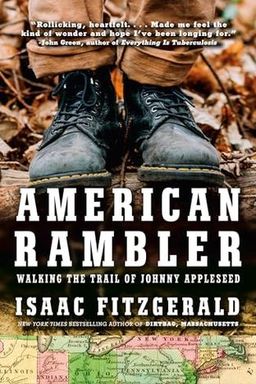
American Rambler cover

American Rambler

by Isaac Fitzgerald

The author of “Dirtbag, Massachusetts” goes on a yearlong journey that follows in the footsteps of the pioneer nurseryman known as Johnny Appleseed.

Making A Life From Messy Beginnings

What do you do with a childhood that taught you love and harm at the same time? In American Rambler, Isaac Fitzgerald argues that you don’t transcend a broken past so much as you befriend it—naming the hurt, honoring the helpers, and choosing the kind of adult you will become. He contends that forgiveness (of others and yourself) is only meaningful when joined to accountability, and that chosen family, honest work, and storytelling can turn chaos into a livable code. To get there, you have to sit with contradiction: faith that comforts and betrays, parents who injure and grow, a body you both loathe and learn to inhabit.

Across a set of propulsive essays, Fitzgerald traces a life that pinballs from Boston soup kitchens and the Catholic Worker to New England woods, from a scholarship boarding school to San Francisco’s legendary biker bar Zeitgeist, from filming BDSM porn at the Armory to smuggling medical supplies with the Free Burma Rangers on the Thai–Burma border. The result isn’t a tidy redemption tale but a field guide to muddling through—especially for anyone raised on mixed messages about masculinity, faith, and worthiness.

What The Book Is Arguing

Fitzgerald’s core claim is that you can build a good life without lying about where you’re from. He keeps returning to three practices: tell the truth about what happened, choose people who choose you, and keep moving (sometimes literally: bicycles, motorcycles, and cross-country bus rides thread the book). He repeatedly reframes classic American scripts—bootstraps, barroom brotherhood, boys-will-be-boys violence—and asks you to notice who gets harmed when those scripts go unchallenged. The throughline is a simple, stubborn ethic he learned first in the Catholic Worker: love the faith, hate the institution; help the person in front of you; and forgive—but only after responsibility is faced.

How The Story Unfolds

You begin in Boston with a book-obsessed kid whose parents meet in divinity school while married to other people. Early years at the Catholic Worker shelter (Haley House) are full of soup lines, tricks with apple-juice "shots," and stacks of novels—until, at eight, a move to rural Massachusetts detonates his world. There are grim scenes: his mother’s late-night confessions (including that she almost aborted him), a confessional booth turned predatory, a father’s controlled violence in a shower. From there, the book follows a jagged climb: stealing cigarettes at a country store, fighting in a teenage "fight club," then a scholarship to boarding school where he learns to code-switch between cinderblock dorms and friends’ penthouses.

Adulthood gets stranger and richer. In San Francisco, a perfect bar (Zeitgeist) becomes church and family; a chef named Jef with one F becomes a brother he’ll later mourn. The Hold Steady soundtrack binds memory and meaning. He shoots porn at Kink.com and learns more about consent than any classroom taught him. He volunteers with the Free Burma Rangers, packing rice sacks of medical supplies, ferrying a missionary eye doctor into an IDP camp, then questioning what it means to be a white American seeking meaning in other people’s wars. He rides a motorcycle blackout-drunk from Santa Cruz and gives the bike away the next morning. He climbs Kilimanjaro with his half-sister and their father on Christmas Day, proof that broken families can still make new rituals.

Why It Matters To You

If you were raised by complicated people—or inside a faith that blessed and betrayed—you’ll recognize the book’s ache and its stubborn joy. Fitzgerald wrestles publicly with the questions many of us try to handle alone: How do you honor the help you received from a church while refusing its cover-ups? How do you confront racism and misogyny in rooms (barbershops, bars) you love? What does accountability look like when the person who hurt you is also someone you still love? His answer isn’t a program; it’s a posture. Keep telling the truth. Keep building chosen family. Keep practicing courage, from speaking up to apologizing to putting down whatever keeps you from living (he quits the motorcycle; he doesn’t quit bars, but he changes how he uses them).

A Line That Lingers

“Love the faith. Hate the institution.” That tension—between tenderness and critique—shapes his relationship with religion, with masculinity, with America itself.

Expect scenes that feel like short films, not sermons. The essays carry you from confessional booths to fight rings behind a friend’s house, from the pink-elephant mural at Zeitgeist to the dusty soccer pitch at Ei Tu Hta camp, from the Kink.com green-room pizza to a barber whipping out a photo of Gavin McInnes’s exposed crotch. But they amount to one invitation: your story—especially the parts you least want to claim—might be the raw material for the life you most want to lead. (Think Mary Karr’s The Liars’ Club mixed with Kiese Laymon’s Heavy, with the communal pulse of Anthony Bourdain’s bar-world pages.)


Family Stories, Faith, And A Break

Fitzgerald opens with a line he’s perfected: “My parents were married when they had me, just to different people.” The quip is both shield and key. You meet his mother, raised on a New England farm by granite-tough parents, and his father, a troublemaking New Bedford kid who became the first in his family to go to college. They meet in divinity school, take "retreats" that are really trysts in the White Mountains, and conceive him on Mount Carrigain despite birth control—a sacred mistake told to a Catholic child as a miracle story.

The early Boston years are scrappy and full of light. The family lives with the Catholic Worker, on Dartmouth Street then Tremont, eventually in John Leary House on Mass Ave. Isaac bikes beside his dad’s runs along the Charles and cons his way into Fenway seats (“my son’s first game”). Haley House regulars teach him street bar tricks with apple-juice "shots," and the apartment overflows with milk crates of books—The Hobbit at five, Coleridge’s albatross haunting his dreams. Storytelling is a second religion; moving trucks are packed with paperbacks first, chairs second.

The Move That Broke The Spell

At eight, everything tilts. His mother moves them to her rural hometown, into a gray drafty house next to his disapproving grandmother’s red farmhouse. The city’s hot noise becomes the woods’ cold silence. A cast-iron stove warms bricks for their beds; a rusted pump freezes in winter. His bus driver, Trudy, is kind in the ways adults can be kind without overstepping—small reassurances when he shows up crying. But loneliness thickens into something else when his mother, grieving and isolated, confides in him like a peer and, during a drive over heat-shimmering asphalt, says she almost aborted him. He stares at the road and wishes for water to swallow the car.

Meanwhile, his father stays in Boston, then has an affair—confirmation, to his mother and her parents, of everything feared. Eventually the father returns, but the house fills with new weather systems: her sadness, his anger. Isaac inherits both and learns, viscerally, that hurt can be handed down like silverware—and that children become vessels for adult secrets. The book marks this era as a hinge: before eight and after. The line isn’t just biographical; it’s a craft move. By naming the break, Fitzgerald gives you a map for your own life’s hinge moments.

Why This Matters To You

If you grew up as a child-friend to a parent, you know the strange pride and lifelong cost. Fitzgerald doesn’t flatten anyone into villain or saint. He shows his mother’s bottoming-out (pills and vodka on a concrete floor; a knife slicing a green Champion sweatshirt as he pulls her arm away), his father’s violence (cold, not hot—hands hammering in a shower, the curtain rod coming down). He also shows tenderness: lightning bugs in a backyard, a grandfather running in a thunderstorm in his underwear, the clarity of the one night his mother considered divorce and he felt giddy relief. The essay argues for complication as a path toward sanity. (Mary Karr charts a similar path in The Liars’ Club, naming harm while staying loyal to complexity.)

Key Reminder

“Do not put off acknowledging your pain. Weeks turn into months into years… those years stack into the structure of your life.”

Fitzgerald’s power is in refusing a single story. Faith and fury, love and damage, shame and humor—all sit at the same table. He’s not asking you to excuse anyone. He’s modeling what it looks like to see the whole picture and let that fuller truth guide how you heal, set boundaries, and—eventually—try to forgive.


Faith, Betrayal, And Real Forgiveness

Few sections are as bracing as Fitzgerald’s reckoning with the Catholic Church. As a boy he practically lived at the Cathedral of the Holy Cross, where his mom worked; he charmed Cardinal Bernard Law by calling him “Blue Jay Law.” He and his half-brother once started a “Half-Brothers Detective Agency” in the rectory until a furious priest shut it down—an anger that, in hindsight, reads like a frightened warning during the era of shuffling predatory priests from parish to parish. Years later, the Boston Globe’s Spotlight investigation broke; Cardinal Law appeared on the cover of Newsweek; Fitzgerald learned that the parish priest he’d served beside as an altar boy had past accusations. The betrayal was institutional, not abstract.

At twelve, in a confessional booth, a priest goaded him for lurid details about a sexual encounter with an older teen, asking, “What did her hair smell like?” Fitzgerald fled the church steps to his parents—who, at that moment in their lives, were getting better while he was getting worse. He didn’t tell them then. Years later, when his mom asked, after watching Spotlight, whether anything had happened to him, he told the literal truth (no one touched him) and the more complicated silence (he still can’t name what happened in that booth). The point isn’t purity of memory; it’s the cost of being forced to carry the Church’s failure alone.

Forgiveness, Not Forgetting

Fitzgerald distinguishes real forgiveness from the institution’s weaponized version. Real forgiveness requires responsibility; it’s a first step, not an eraser. He’s grateful for what Catholicism gave him—communal song, a set time each week to say thanks and sorry, an imagination shaped by saints (Saint Jude, patron of lost causes, tattooed on his arm). He still prays, even as a nonbeliever. But he won’t call nothing something. He argues that the Church’s cover-up turned victims into bearers of fault: if you tell, you break hearts; if you stay quiet, you carry it forever. (Compare to Tara Westover’s Educated on how institutions can gaslight memory; or to James Martin, SJ, on distinguishing faith in God from allegiance to a flawed church.)

Holding On To What Helps

A Christmas Mass at Glastonbury Abbey, sunlight through triangular windows, a Benedictine simplicity untethered from Vatican grandeur—this is the faith he can live with. Brother Daniel, a Catholic Worker friend from decades before, offers a hug in the parking lot. His parents remain faithful Catholics and devoted educators; Fitzgerald loves that about them even as his own faith left the building at fourteen with the revelation he didn’t have to attend Sunday service anymore. His tattoos become his catechism, a way to keep faith with suffering, humor, and second chances—“Life mistakes are my copilot.”

Working Definition

Forgiveness = acknowledging harm + making peace with the past’s fixity + moving forward differently. Anything less is abdication, not absolution.

If you’re disentangling what you still love about a tradition from what you can’t accept, this essay gives you a vocabulary. You can light a candle and name the abusers. You can keep the saints and toss the secrecy. You can go on Christmas Eve and spend more time walking among the pines afterward, if that’s where you now meet whatever you call God.


Hungry Body, Hungry Heart

Body image in American Rambler isn’t a subplot; it’s a constant thrum. At eight, in a Stuarts discount store, his mother slaps his belly—“If you weren’t getting so fat, I wouldn’t have to buy you new clothes.” That single scene hums through decades: the off-brand Chef Boyardee, the secret cereal bowls with extra sugar, the loneliness that tastes like comfort. Later, as a teen, weight melts off on a diet of running, cigarettes, dip, and snorted Ritalin or Adderall. The shift doesn’t heal his mirror. A Friendly’s waitress named Jennifer invites him to a house party; he loses his virginity; a hockey jock at boarding school shouts, “Way to not be so fat, Fitzgerald!” Praise lands like a slap. He starts to learn: desire can be a funhouse mirror when you can’t bear your own reflection.

Sex becomes a trick—a way to borrow other people’s liking for a body he can’t like. After, he always puts on his shirt first. In San Francisco, a photographer friend, Mikael Kennedy, captures him at twenty-three: bleached hair, a jawline he couldn’t see then, a rib cage (too visible). Years later, the photo still shocks. It’s proof that your past body—like your past story—can be radically different from the one you carried in your head.

Learning Enough

Fitzgerald doesn’t land on a tidy self-love creed. He aims for something saner: sufficiency. His weight continues to fluctuate; age slows metabolism; winter coats in New York add pounds. There’s no magic number. The achievement is smaller and sturdier: he no longer scrambles for a T-shirt after sex; a mirror sometimes reflects a person, not a project. He refuses to spend the rest of his life loathing himself. (Kiese Laymon’s Heavy is a powerful companion here: another son of the South and of a brilliant, complicated mother writing toward a kinder relationship with his body.)

Why It Matters To You

If your body story started with shame delivered by people you loved, this chapter offers two lifelines. First, the feeling isn’t proof—it’s a weather system that can be named and worked with. Second, chasing approval through bodies (yours or someone else’s) doesn’t make the weather change. Fitzgerald’s pragmatic peace—the willingness to stop throwing away years on self-hatred while still caring for the body he’s got—is a stance you can practice today, no ideal-weight milestone required.

Reframing Win

“There will be no perfect body… I’m learning to be okay with that. That’s my exit.”

Self-respect here isn’t a TED Talk; it’s daily, sometimes shaky practice—a few less hateful minutes in the mirror, a shirt left on the floor a little longer, a meal chosen for joy not punishment. It’s a kind of forgiveness you can actually do: not excusing the slap in the store but declining to keep slapping yourself.


Boys, Violence, And Brotherhood

In 1999, Fight Club hit a precise cohort of American boys at the exact wrong/right moment. Fitzgerald and his friends—fifteen, sixteen, rural and poor—watched it twice in a row, then started their own in Connor’s house, a tumbledown sanctuary run by a loving, neglectful mom who worked, drank, and went to bed early. The fights begin as one-hits in the kitchen and migrate to a quarry. Shirts come off for most; Fitzgerald keeps his on. There’s blood and cheers and a code (no winners, just the guy who falls and the guy who doesn’t). Connor emerges as a quiet leader—the kid caring for everyone while holding the center of an Ewok-village home.

The essay is funny and tender without romanticizing teenage violence. A punch sends stars across his vision; a frozen burrito becomes an ice pack; a blood vessel bursts in a friend’s eye and the fights end. The boys graduate into the next American storylines: most of the Mikes enlist; Connor eventually leads troops for a living. In their yearbook handout, Connor sprinkles unattributed Fight Club quotes (“It’s only after we’ve lost everything that we’re free to do anything”)—a teenage gospel of wreckage.

What The Fighting Gave And Took

Fitzgerald is blunt: they already knew other kinds of violence—shove-you-into-lockers bullies, parents’ slaps, pill bottles rolling on concrete. The club offered control and contact. It also offered intimacy, however warped—boys touching boys, learning one another’s limits, caring for each other after. Then there’s the Y2K myth: sitting around a woodstove, they root for apocalypse, for a restart where community and venison and free cigarettes rebuild society. Midnight comes; a TV reporter’s debit card briefly fails; hope. Then: “Whoops! Overdrawn.” The world keeps cycling as before—no cleansing fire, no new fraternal order.

Masculinity You Can Actually Keep

The chapter honors male affection that doesn’t require catastrophe. Connor’s living room is a kind of church—a place to gather without getting hit “in the bad way, the unfair way.” The best parts of their club—cheering one another on, helping each other up, the feral comedy—survive long after fights stop. (Compare to Michael Chabon’s essays on male friendship, or to bell hooks on love as a verb that men can practice.) Fitzgerald’s adult corollary is gentle: you don’t need a split lip to belong. You can trade the ring for a record, a burner phone for a book, a bar tab for a ride home.

Hard-Won Clarity

Teenage violence can feel like agency. What you’re often craving is tenderness and a witness—things you can have without blood.

If you were a boy trying to punch your way into mattering, this chapter gives you permission to keep the brotherhood and ditch the bruises.


Escape, Education, And Class Codes

After smashing a math book into a kid who called him “tubby,” a web of women at school—librarians, secretaries (including a classmate’s grieving mom), teachers—slide him a brochure: a boarding school that sometimes scholarships local kids “in trouble but with promise.” The application lands; the letter arrives: a free ride. He sits in a house finally quiet and learns that change is possible. Then the reality check: he shows up with no sheets, no jacket, no tie. His roommate, a blond Cape Cod patrician named Jon Ritzman, lends him both and—crucially—ties the knot. He walks to town to buy a tie, a jacket, and, at Cumberland Farms, applies for a job, careful to hide that he’s a student. When the dorm parent nixes outside work, the school pays him for odd jobs. Fitzgerald learns two systems at once: the deadpan, button-down rules of the wealthy and the hustle that keeps you fed.

The school is a paradox: fluorescent, cinderblock, institutional—and also the safest home he’s had. Everyone plays freshman football because that’s what you do; a friend breaks his arm and is told to “suck it up.” Varsity hockey guys teach Isaac to skate backward. Inhale/Exhale: He learns to love learning, and learns that rich kids do drugs too—only with prescriptions and less fear. His school ID becomes his pill crusher for "Diet Coke" (Ritalin/Adderall), and by senior year he’s snorting north of 100 mg a day. He’s bilingual in class markers: draws a salary washing sushi trays and wears a borrowed blazer to a doctor’s private plane to Nantucket. He visits New York penthouses (throw a rock, it’d break the Met’s glass roof) and then brings those friends home for the River Rat canoe race, drunk donuts and e-brake turns on backroads, a brawl to defend a theater kid who later turns out to have assaulted a girl. Class codes cut both ways.

Switching Without Losing Yourself

Fitzgerald perfects the art of being “delightfully working class”—telling stories that don’t freak out rich parents while not turning on his own friends. He learns when to ask questions and when to shut up, how to be a light guest, when to smooth over an insult. At the same time, he keeps his anchor: he loves Connor’s fridge as much as a prime rib at House of Prime Rib (a later San Francisco ritual). In college in D.C., he works two to three jobs, protests the Iraq War (black bloc; a chair through a Starbucks window), and graduates drunk but present, organizing impromptu family photos for classmates. He’s proud of the work ethic, not the myth of arriving fully self-made.

What You Can Take

Class translation is less costume, more conscience. You can learn wealth’s grammar without absorbing its entitlement; you can keep your home tongue without weaponizing it into brittle pride. Fitzgerald’s model is concrete: get a job, be a good guest, don’t posture, notice who’s invisible, leave a big tip, pay it forward. (See also Jesmyn Ward’s Men We Reaped on the toll of mobility and return.)

Quiet Practice

Gratitude as muscle, not performance: be generous both directions—to the people who brought you up and the ones who opened their doors.

If you’ve ever felt like a “townie who crossed over,” this chapter shows you how to hold both halves without tearing yourself in two.


Bars, Music, And Chosen Family

San Francisco’s Zeitgeist—a biker bar with a beer garden and pink elephants—becomes Fitzgerald’s church. He lives on McCoppin, literally on the block. He learns its history from Todd (“Happy Todd”), the crankiest bartender in town, who mourns original owner Hans Grahlmann, a queer legend who renamed the Rainbow Cattle Company “Zeitgeist” in the AIDS years to keep the doors open. When Isaac offers to “keep an eye” on a homeless man nursing a beer, Todd snaps: “Oh, fuck you. That man’s just trying to stay dry. Much more likely some young jammer like you can’t handle his booze.” Lesson received: this bar loves hard and sees clearer than your savior complex.

Work there and you learn a code. Smile less (oddly, more tips). Wear fewer button-ups. Run glassware tower after tower. Clap out a couple having sex in the photo booth. Apply frozen burritos to a bloodied bouncer’s head; get him to a hospital; “leave him alone” when he says the guy is just “a fucked-up old man.” The holiday economy is communal—Thanksgiving birds, Christmas pinball, “Papa Noël” skateboarding bar to bar dropping gifts. A night at House of Prime Rib with Churchill and Elizabeth (bartenders who save cash in a mattress to buy their own bar) is a sacrament: remember why you do the job; treat others as you want to be treated; tip big to make someone’s night.

The Soundtrack That Saves

The Hold Steady arrives like scripture. Separation Sunday plays while he stages a mop-bucket “accident” to justify workman’s-comp dental coverage after drunkenly face-planting in a stolen skiff; later, at the Fillmore, he presses to the stage to shoot 700 blurry photos for his friend Jef with one F, the grill-master-writer who introduced him to Craig Finn and Lifter Puller. Years on, Jef staggers past his office—day drunk, asking him to hit a bar; Isaac keeps talking on the phone. On July 4, they find Jef dead in his room. Grief drives him East. But he keeps visiting the wall of photos at Zeitgeist, a barroom cemetery, and plays a Lifter Puller track for his friend. Music and memory become a way to keep loving.

Why Bars Work (And When They Don’t)

For Fitzgerald, bars are safety in a world where home and church weren’t. They’re rule-sets you can count on: pay tab, tip, sit. A portal out of the world and a net under a fall—because he knows how to tend bar anywhere if life goes sideways. But the book doesn’t romanticize oblivion. He names the regret of not hanging up the phone for Jef. He also names why he still drinks: he’s older now; hangovers last; therapy offers an alternative path to feeling. Zeitgeist doesn’t fix him; it hosts his attempts at healing.

A Bar’s Best Gift

Chosen family. People who teach you, razz you, call you out, and keep a seat for you when you come home.

If bars have been your refuge, this chapter will feel like being scooped back onto a worn stool, handed a cold pint, and reminded you’re not alone.


Sex, Consent, And Agency

At the Armory in San Francisco—a brick castle that once hosted National Guard drills and later housed Kink.com—Fitzgerald finds himself on the other side of the camera. Friends like Lorelei Lee (writer, performer) and director Tomcat usher him in. Princess Donna runs a van shoot; the cameraman tumbles over the front seat; a muscular man barks lines; Isaac, untested, is told he can “watch, touch, talk” (no recent STD panel). He puts tentative hands around Donna’s neck on her cue. When she says “Cut,” everything stops: hands up, step away, “Need anything? Water? Towel?” For a man who grew up in a faith that never taught him healthy sexual language, porn becomes consent school.

Backstage is ordinary: pizza in robes, showers, sat phones of another kind in the basement, jokes while the next setup lights. The Armory’s lower level holds Mission Creek running under San Francisco; the upper floors hold a wrestling ring for Ultimate Surrender and sets for Bound Gods and Hardcore Gangbangs. The people—Lorelei and Tomcat (they’ll later marry), Donna negotiating locations with tattoo shop owners—become another chosen family. For a short season (roughly a dozen shoots), it’s honest work, quick cash ($300 a “pop”), and a sex education he wishes school had provided: negotiations up front; clear boundaries; immediate, unquestioned stops. (See also Stoya’s essays or Tristan Taormino’s The Ultimate Guide to Kink for similar inside-out consent frameworks.)

What He Keeps

Fitzgerald doesn’t glorify porn or pretend its industry isn’t fraught. Kink faces headwinds; Peter Acworth sells the Armory; the neighborhood gentrifies. But the lessons stick. He learns to talk about sex—awkwardly first, then plainly—with partners. He sees how communities stigmatized by the “moral” mainstream can be the most ethical in practice. He understands that consent isn’t a one-time yes; it’s an ongoing choreography backed by power-sharing. When he writes later about confronting casual misogyny and racism at barbershops, you can hear the Armory’s echo: people deserve better rooms.

A Queer Gift To Straight Men

The chapter argues implicitly that straight men can learn a saner masculinity from queer spaces: humor without humiliation, desire without coercion, community without domination. “If society protected, respected, listened to, and learned from sex workers,” he writes, “sex education might actually stand a chance of being useful.” That’s not a slogan; it’s a practice you can adopt tonight: ask, listen, stop, check in, and build the room you want to share.

Consent In One Line

A partner’s “Cut!” means: stop completely, hands visible, step back, and don’t make it about you.

If you’ve been looking for a practical, de-shamed way to talk about sex—especially as a man raised on silence, jokes, or conquest—this essay hands you a script and a better imagination.


Risk, Service, And Moral Ambiguity

Two stories bookend Fitzgerald’s reckoning with risk. In Santa Cruz, he rides a motorcycle down the 101, drinks through sunset, blacks out, and wakes the next morning in his leathers, his helmet placed by the door, the bike perfectly parked outside. The perfection terrifies him. He pictures a school bus swerving to avoid his body. He gives the motorcycle away that day. The other story: he travels to Thailand to volunteer with the Free Burma Rangers (FBR), a Christian relief group led by ex–Green Beret Dave Eubank, to smuggle medical supplies to internally displaced people across the Thai–Burma border. He stuffs rice sacks with gauze and nets, sews them shut with plastic binding, and drives a snorkel-exhaust diesel truck past checkpoints (“Preacher or teacher?” “Teacher”).

He ferries Dr. Bob, an eye doctor from Anchorage, to the Ei Tu Hta camp on the Salween River. A soccer match thunders at the center of camp; he lures kids to screenings with camera tricks and yellow finger puppets; Dr. Bob prescribes reading glasses and promises to return with Rx pairs. Isaac talks with a teenager in a green dress about skiing and hamburgers, gifts him aviator shades, receives a hand-painted Karen flag pendant. On the boat back, they pass Burmese soldiers bathing in the river: he feels a spike of hatred and wants to scream at them. Peter, the Karen leader, says, “They are children… brainwashed to hate.” In Shan State, an officer asks if he’s CIA; a soldier with a tiger tattoo offers jumping jacks; a mine explodes under a pack of wild dogs. He sleeps in a hammock strung between two trucks and doesn’t pick up a gun.

The Hard Question

Why is he there? Friends ask pointedly: there is work to do at home. He answers honestly: it felt good to help; he learned things; he also wanted a reason to live. Later he admits the mix includes “white-boy adventure tourism.” He holds both truths: his driving and packing mattered; his presence was also part of a fraught pattern of Westerners seeking meaning in others’ crises. He quotes the starfish parable—saving one still matters—then complicates it: people aren’t starfish; real help is slower, more accountable, and requires staying with ambiguity. (Read alongside Anand Gopal’s reporting from Syria or Teju Cole’s critique of the White Savior Industrial Complex.)

A Risk Ethic You Can Use

Fitzgerald’s ethic shifts from thrill to responsibility. Risk is fine if what’s at stake is you; not if you’re externalizing the cost. He quits the blackout rides. He keeps showing up for service at scales he can answer for—bars, books, family, friends—and he tells on himself when he gets it wrong. He doesn’t lie about the buzz of border crossings or the joy of lantern-lit New Year skies over Chiang Mai. He also doesn’t mistake feeling useful for being just. That’s grown-up risk.

Compass Point

When in doubt, choose the action whose consequences you’re willing to carry all the way home.

This chapter is a manual for anyone pulled toward work "out there." Go if invited; learn fast; center locals; interrogate your motives; and make sure the risks you take aren’t being paid by someone else’s body.


Speaking Up, Not Just Fitting In

Late in the book, a barber flips through his phone and shows Fitzgerald a photo of Gavin McInnes’s dick. They have the same haircut. It’s a comic-horror epiphany: how easily you can be mistaken for the very men you oppose. Fitzgerald inventories past silences—barbers who normalized hitting women, dudes who wrapped racism in “just jokes,” rooms that invited his complicity. He names what kept him quiet: politeness as pathology, honed in a home where speaking up got you hurt. Then he chooses differently. He dissects hipster racism (Vice’s DOs & DON’Ts, where he once glued in McInnes’s cutout crotch) and the Proud Boys’ faux-comedy bait-and-switch. Cool curdles; jokes reveal their core. Growth, he insists, means admitting the guy you were and refusing to be him again.

Elsewhere, he says yes to family. He climbs Kilimanjaro with his half-sister and their father on Christmas. His marathon-running sister gets altitude sickness; their guide Habibu shines a light in her face and says “Polé, polé” (slowly, slowly). They summit at sunrise; then they go back down—seven days up, two days down. Back in New York, he pivots East for good: a nephew’s “Heartbeat” text, holidays run by siblings, grandparents stepping up where once they faltered. Forgiveness isn’t a speech; it’s sitting in a dim basement while your mom worries about a missing molar, hearing her say, “It’s your dad that knocked it out,” and staying. It’s telling the truth on the page and then trying, one more time, to have the hard conversation in person.

From Accommodation To Action

The closing move is small and radical: commit to uncomfortable conversations. Confront the racist uncle and the barber. Risk a scene. Use the safety your body grants you (white, straight, cis, tattooed) to pull more people into better rooms. Growth is cumulative talk: the ones others had with you, and the ones you now owe forward. (Compare to Ijeoma Oluo’s So You Want to Talk About Race for scripts, or to Austin Channing Brown on the cost of niceness.)

What You Can Do Tomorrow

Audit your silences. Practice a line that interrupts with dignity (“Hey—that’s not funny. Here’s why.”). Choose family rituals you can stand behind. Visit the bar wall where your dead are pictured. Tip big. Say sorry. Ask your parents the questions you’ve been avoiding, even if the answers hurt. Remember Habibu’s cadence: polé, polé. You don’t summit in a day. You do keep climbing.

Final Note

“I haven’t forgiven them yet, but I try. I try. I try.” Trying, here, is not avoidance. It’s the daily labor of becoming the kind of man who speaks, stays, and repairs.

If you’ve ever worried that who you are might be confused for what you oppose, this chapter hands you the tools to make the difference visible: your voice, your people, your choices.

Dig Deeper

Get personalized prompts to apply these lessons to your life and deepen your understanding.

Go Deeper

Get the Full Experience

Download Insight Books for AI-powered reflections, quizzes, and more.