
Idea 1
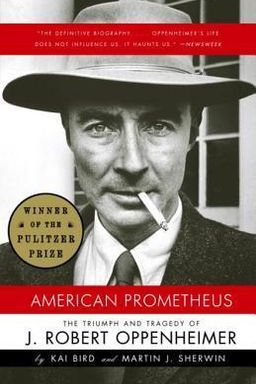
The Moral and Intellectual Arc of J. Robert Oppenheimer
How does a man of immense intellect become both architect of world-changing discovery and victim of his own era’s fear? The life of J. Robert Oppenheimer, as rendered across these parts, traces the moral arc of a scientist whose curiosity and conscience collided with twentieth-century politics. The book presents Oppenheimer as a symbol of transformation—from sheltered prodigy to wartime leader, from public hero to political exile, and finally to moral philosopher. You see that his journey is not simply scientific; it is a meditation on knowledge, responsibility, and character under pressure.
Roots in Ethical Culture and Intellectual Formation
Oppenheimer’s early life gives you the blueprint for his later paradoxes. Raised in New York among art and intellect, he absorbs Felix Adler’s Ethical Culture creed—“Deed, not Creed”—which prizes public responsibility and compassion over dogma. His father Julius models curiosity, his mother Ella demands aesthetic perfection, and those dual influences produce a mind both refined and restless. The young Robert collects minerals, reads poetry, and struggles with identity as a secular Jew in an assimilating elite. These tensions will later inform his fascination with moral universality and civic action in science.
Education, Crisis, and Transformation
Through Harvard and Cambridge you watch his brilliance collide with fragility. At Harvard he devours chemistry, literature, and philosophy, dazzling peers but remaining isolated. The Cambridge incident—the poisoned apple legend—exposes the pressure of perfectionism and the psychological strain that shadows him. Yet the Corsica interlude, where he reads Proust and discovers renewal, marks a turning point: despair yields maturity; theory replaces experiment; emotion becomes discipline. This combination of introspection and intellect prepares him for Göttingen, where under Max Born’s mentorship he becomes one of quantum mechanics’ synthesizers, producing the Born–Oppenheimer approximation that cements his technical legacy.
Teaching, Community, and Charisma
At Berkeley he emerges as the magnetic teacher who turns seminars into laboratories of imagination. His “nim-nim” mannerisms and intellectual force create a cult of apprentices—the “nim nim boys.” Here you see character crystallize as communal genius: Oppenheimer shapes American theoretical physics not by solitary calculation but by conversation. His Room 219 sessions produce Serber, Morrison, Bethe, and a culture of collaboration that mirrors Ethical Culture’s moral collectivism. Oppie’s contrast with Ernest Lawrence’s industrial “big science” foreshadows the coming balance between human-scale theory and vast technological enterprise.
Politics and the Popular Front
In the 1930s he moves from private study to public sympathy. Influenced by Jean Tatlock and the Spanish Civil War’s ethical urgency, he donates to relief groups, signs petitions, and joins the Teachers’ Union. The record is ambiguous—was he a Communist? Evidence shows him as a fellow traveler engaged with humanitarian causes, not disciplined by Party structure. This ambiguity later becomes weaponized, but in context it reflects conscience, not conspiracy.
War Work and Leadership
War transforms the scholar into a leader. The fission discoveries of 1939 draw him into coordination with Vannevar Bush’s S–1 committee and ultimately the Manhattan Project. His ability to synthesize ideas and manage egos leads Leslie Groves to choose him for Los Alamos. There he invents the modern research institution: cross-disciplinary, intellectually open yet militarily secret. His humane leadership—persuading Groves to preserve civilian freedom inside barbed wire—creates productivity and morale. His crucial managerial gamble on plutonium implosion demonstrates both scientific audacity and organizational brilliance, culminating at Trinity in July 1945, where triumph meets dread.
Moral Reckoning and Postwar Vision
Trinity’s flash divides his life. He quotes the Bhagavad-Gita’s line, “Now I am become Death, the destroyer of worlds,” capturing the union of knowledge and mortality. After Hiroshima, he advises restraint and pursues international control, collaborating on the Acheson–Lilienthal Report inspired by Niels Bohr’s dream of an “open world.” When Bernard Baruch distorts that plan at the UN, optimism collapses. Oppenheimer later chairs the General Advisory Committee and argues against the hydrogen bomb—calling it technically dubious and morally catastrophic. That position spawns enmity with Edward Teller and political hawks, setting up the Cold War’s moral collision between realism and conscience.
Fall, Surveillance, and Exile
The Chevalier affair and prior associations resurface in the McCarthy era. Lewis Strauss and William Borden weaponize FBI files, creating the infamous 1954 hearing where procedural imbalance—not espionage—decides guilt. Oppenheimer loses his clearance, branded “loyal but risky.” The fallout shrinks his public reach but expands his symbolic stature: he becomes emblem of science under suspicion. Surveillance continues; devices track him even during St. John retreats where he and Kitty seek refuge among palms and friends like the Jadans. You glimpse him as human again—reciting poetry, explaining constellations—revealing moral endurance beyond politics.
Late Years, Voice, and Legacy
After the trial, Oppenheimer redefines influence privately. At Princeton’s Institute for Advanced Study he fosters interdisciplinary thought, mentoring minds like Freeman Dyson and John Nash, and building a library whose light becomes metaphor for inquiry. His public works—The Open Mind and the Harvard lectures—argue for humility and transparency in democratic life. Family suffering, especially Toni’s 1977 suicide, shows the hidden costs of public vilification. Yet redemption arrives symbolically: the Fermi Award from Lyndon Johnson in 1963, Kipphardt’s play, and international mourning cast him as tragic sage. His ashes at Hawksnest Bay complete the circle—from atomic fire to elemental peace.
Central insight
Oppenheimer’s life shows you that intellect without moral imagination endangers humanity, and moral imagination without institutional protection becomes vulnerable to fear. His story teaches that both knowledge and conscience demand courage—public, private, and historical.
(Contextually, you can read this as complement to biographies of scientists and thinkers like Bohr, Fermi, or Einstein, where genius and ethics intertwine. Oppenheimer’s lessons echo today whenever technological mastery exceeds moral confidence.)