
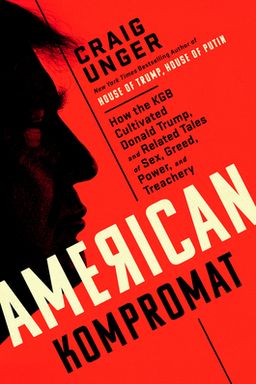
American Kompromat cover

American Kompromat

by Craig Unger

American Kompromat unveils the shadowy connections between Donald Trump, the KGB, Jeffrey Epstein, and the Catholic sect Opus Dei. This gripping account reveals how political manipulation, espionage, and hidden agendas influenced Trump''s presidency and America''s global standing.

Power, Influence, and the Hidden Hands Behind Modern Authoritarianism

What if the course of American democracy had been shaped not just by voters and elected officials, but by hidden networks—foreign and domestic—that saw the presidency as the ultimate prize? The book argues precisely that: behind the spectacle of elections and political theater lies a shadowy ecosystem of influence. It weaves a gripping, investigative narrative connecting Cold War espionage, religious authoritarianism, and personal ambition, suggesting that these forces converged to shape not only Donald Trump’s rise but also the evolution of power in the United States itself.

The author contends that starting in the late 1970s and early 1980s, the KGB identified and cultivated Trump—not as a spy or ideological agent, but as a “useful idiot,” someone whose vanity and ambition could be gently manipulated for Russian interests. Over decades, the machinery of soft influence—including business favors, flattery, and strategic partnerships—helped align Trump’s ambitions with Moscow’s goals. Later, Trump’s presidency reflected patterns disturbingly similar to those employed by authoritarian states: information control, degradation of institutions, and the merging of religious conservatism with executive power.

The Structure of Hidden Power

This story isn’t just about one man but about the architecture of influence itself. The book shows how the KGB first reached into American life through cultural and business channels during the Cold War. Companies like Joy-Lud Electronics—run by Soviet émigrés—became gateways for contact. Figures like Semyon Kislin acted as “spotter agents,” identifying promising personalities in America who could be courted. In Trump, Kislin found someone both ambitious and pliable—a developer seeking prestige and willing to make shady deals if it meant advancing his empire.

Fast forward, and the idea that manipulation comes not through overt violence but through psychology becomes central. The KGB’s classic method wasn’t necessarily to recruit spies but to study personalities. They exploited traits like ego and envy to create unconscious agents of influence. Trump’s craving for adulation, his sensitivity to praise, and his identification with “strong men” played perfectly into that psychological profile.

Religious and Ideological Capture

Parallel to this Cold War story runs another narrative: the infiltration of politics by authoritarian religious movements like Opus Dei. While the group’s origins were Catholic and spiritual, the author portrays its evolution into a political weapon with a clear mission—to reshape governments into theocratic systems ruled by moral and hierarchical obedience. The American judiciary became its key target, with alliances formed through organizations like the Federalist Society. By influencing the law, Opus Dei and its allies could gradually dismantle secular liberal frameworks under the banner of “moral renewal.”

Trump’s later judicial appointments, especially the tilt of the Supreme Court, mark what the author suggests is the success of that long game. Combined with figures like Attorney General William Barr—whose constitutional philosophy grants immense executive power—the presidency began to resemble the form of control familiar in authoritarian regimes, where law bends to personal will and ideology replaces accountability.

Kompromat and the Economy of Secrets

No system of power consolidation would be complete without the strategic use of secrets. The book situates Jeffrey Epstein within this ecosystem, describing his coercive network as more than a personal scandal—it was an open-source system of blackmail, a massive kompromat operation that could be valuable to anyone seeking leverage over global elites. That the trove of alleged tapes and photographs disappeared—and that individuals with Russian intelligence ties may have had access—only deepens the sense that control through exposure has become a new political currency.

This layer of control mirrors intelligence playbooks from both East and West: create environments of moral compromise, record everything, then selectively release or threaten to release as needed. It’s power through paranoia. The implication? Whether or not Trump was ever directly blackmailed, the risk of exposure could itself have been enough to keep him aligned with interests beyond his own.

The Bigger Story: Authoritarian Convergence

At its heart, the book suggests that the Trump era was no accident, but the result of multiple authoritarian threads converging over decades: the KGB’s psychological cultivation, the religious right’s long march through American institutions, and the moral corrosion of power structures where loyalty outweighed truth. Figures like Vladimir Putin and William Barr may appear ideologically different, but they share a common logic—centralized control, disdain for pluralism, and the elevation of “order” over liberty.

For readers, the underlying question becomes personal: how do you recognize influence when it doesn’t look like force? How do institutions, friendships, and beliefs become the soft levers of manipulation? This book’s unsettling answer is that manipulation isn’t always external or coercive—it’s often embraced by those who find in power the reflection of their own desires. And so, you are left to face the tension between freedom and the seductive comfort of certainty—a dilemma that lies at the core of every democracy’s fragility.


The KGB’s First Contact with Trump

The story begins quietly, in the late 1970s, inside a modest Manhattan electronics store called Joy-Lud Electronics. To an average passerby, it was simply a place to purchase imported televisions. But for Soviet officials in New York, it was a nexus of convenience—and covert operations. Joy-Lud was run by Soviet émigrés who, under KGB pressure, doubled as informants, providing intelligence and identifying potential recruits. One of those émigrés, Semyon Kislin, would become the bridge between the KGB and Donald Trump.

Trump was, at the time, ascending quickly in the New York real estate scene. His projects combined spectacle and ambition in ways that naturally drew attention. When he purchased hundreds of television sets from Joy-Lud on unusually favorable terms to furnish his Grand Hyatt renovation, it was more than just a business transaction: it marked the opening of a channel. Kislin informed his handlers in Moscow, and just like that, the KGB had an official contact point.

Spotting, Flattering, and Grooming

According to former KGB agent Yuri Shvets, this was standard operating procedure. Spotter agents like Kislin were trained to identify individuals with influence and exploitable weaknesses. Trump’s vanity, ambition, and admiration for powerful men made him an ideal subject. The KGB didn’t recruit through ideology alone—they recruited through ego. Flattery was their most potent tool, one they wielded like art. When Trump was later invited to Moscow in 1987 to discuss a Trump Tower project, it wasn’t primarily about real estate—it was about grooming.

Like many who encountered Soviet diplomacy, Trump was seduced by pageantry. KGB teams likely flattered his “vision,” exaggerated his political potential, and mirrored his ambitions back to him. Upon his return, his public statements echoed Soviet narratives, calling for the U.S. to withdraw from certain defense commitments—positions celebrated within KGB circles as evidence of a successful cultivation.

The Useful Idiot Paradigm

The book emphasizes that Trump wasn’t a formal agent but a “useful idiot,” a term used in intelligence for those manipulated without direct knowledge. They act in self-interest while unwittingly serving foreign agendas. It’s a subtle yet devastating concept—one that reshapes the idea of patriotism. Trump’s craving for validation became a geopolitical asset in itself.

That idea—that ego can be weaponized—echoes throughout modern politics. It’s not just about Trump. Many leaders and public figures, when caught between power and principle, can become mirrors for the interests of others. The brilliance of the KGB operation, as the author frames it, lay not in control but in suggestion—a whisper that made a man believe the thoughts were his own.


The Web of the Russian Mafia and Money Laundering

As Soviet power waned in the 1970s and ’80s, a new kind of empire rose in its place: the Russian Mafia. Made up largely of ex-intelligence agents and former Communist elites, these criminal groups sought new channels for influence and wealth. In Trump, they found a willing partner. His luxury real estate empire provided the perfect front for laundering capital from post-Soviet networks desperate to park money abroad.

Trump’s sale of condos to these groups wasn’t merely a business decision—it became a geopolitical transaction. Apartments in Trump buildings were bought and sold through shell companies linked to Russian oligarchs and mobsters, transforming real estate into the clean front for dirty money. For Trump, it was profit without regulation. For the mobs, it was legitimacy cloaked in gold-plated architecture.

A Symbiosis of Power

The author paints this as a symbiotic relationship: Trump’s brand offered prestige, while the Mafia provided capital. Neither side cared much about legality—what mattered was the image of success. Yet beneath the sheen of marble floors and crystal chandeliers lay billions of dollars of illicit wealth flowing seamlessly between Moscow, New York, and the Caribbean.

It’s here the author introduces a profound insight: money laundering isn’t merely financial; it’s ideological laundering too. As criminal networks integrated with business elites, corruption became rebranded as capitalism, and greed as patriotism. By selling access and legitimacy, Trump effectively merged organized crime with mainstream finance—setting the stage for political capture disguised as enterprise.


Jeffrey Epstein and the Economy of Blackmail

Jeffrey Epstein’s story has been told countless times as one of moral depravity and abuse. But in this book, it’s reframed as an extension of political manipulation: a high-stakes network built to accumulate kompromat—material that could destroy reputations and thus command obedience. Epstein’s connections stretched across continents and included CEOs, heads of state, and celebrities. His private island, Little Saint James, became not just a playground of debauchery, but a private intelligence hub where power, sex, and secrecy converged.

According to the text, Epstein recorded many of his “guests”—some unwittingly—in compromising acts. The implication is chilling: that there exists, or once existed, an archive of personal humiliations capable of shaping political will on a global level. This collection of kompromat, if it fell into the hands of a state actor like Russia’s FSB, would represent the ultimate tool of influence: invisible, untraceable, and devastating.

Trump’s Entanglement

Among the many names in Epstein’s infamous address book was Donald Trump’s, circled by Epstein’s house manager as noteworthy. While there is no proof that Trump participated in Epstein’s crimes, their friendship was genuine and public. The author explores claims that Epstein kept photographs of Trump with young women—details that, though unconfirmed, gain significance in the broader pattern of blackmail and control weaved throughout the book.

The Epstein chapter serves as a metaphor for an era where secrets are currency. In politics, as in personal life, power gravitates to those who control information. The suggestion is that orbital figures like Epstein are not anomalies but essential cogs in the machinery of authoritarianism—private operatives trading human weakness as leverage across borders.


Opus Dei and the Judicial Capture of America

If the KGB represents the foreign infiltration of power, Opus Dei stands for the domestic equivalent—a religious network quietly embedding itself into the American legal system. Founded in Spain under the dictatorship of Francisco Franco, Opus Dei blended piety with politics. Its founder, Josemaría Escrivá, believed society could only function when guided by divine hierarchy. In practice, this meant obedience to authority and rejection of liberal pluralism.

When Opus Dei turned its eyes toward Washington, its strategy was subtle but deliberate: infiltrate the courts. Court appointments last decades, outliving elections and political shifts. By steering the judiciary rightward through alliances with organizations like the Federalist Society, Opus Dei found a way to roll back cultural liberalism piece by piece—especially on issues like abortion, LGBTQ rights, and the separation of church and state.

The Federalist Alliance

Trump’s presidency offered the perfect vehicle for this agenda. His appointments of Supreme Court justices—many affiliated with the Federalist Society—cemented a philosophical shift grounded in religious conservatism. The book argues that behind this alliance is not just political convenience, but ideological synergy: both Trump and Opus Dei envision power centralized in a single, unquestioned authority.

Through judges, clerks, and policy advisors, Opus Dei’s influence flows not through elections but through interpretation—transforming the Constitution from a shield of rights into a tool of control. It’s not overt domination but a patient, theological colonization of democracy from within.


William Barr and the Theology of the Unitary Executive

William Barr, Trump’s attorney general, believed in a doctrine known as the ‘unitary executive’—the idea that all executive power resides wholly in the president, nearly unchecked by Congress or the courts. This belief, while rooted in constitutional interpretation, carries authoritarian implications. In Barr’s hands, it became theological, merging conservative Catholic concepts of divine hierarchy with political structure: one leader, one vision, absolute obedience.

Barr’s decisions during the Trump administration—defending the firing of FBI Director James Comey, misrepresenting the Mueller Report, and granting himself authority over the declassification of intelligence—are presented here as practical outgrowths of that ideology. The goal wasn’t simply to protect Trump but to reshape the presidency itself into something beyond accountability.

Religion Meets Power

The author suggests Barr’s religious worldview dovetailed with Opus Dei’s authoritarian theology. Both see moral decay as requiring strong paternal correction. Both distrust pluralism. In this light, Barr’s role becomes not just political but almost pastoral—guiding the president as a kind of anointed ruler. The merging of faith and executive power, the book warns, threatens to transmute democracy into a theocracy, justified not by law but by divine order.


Trump’s Presidency as an Extension of Russian Interests

By the time Trump assumed office, the threads of Russian influence were already decades old. His public sympathy for Vladimir Putin, his rejection of traditional alliances like NATO, and his peculiar leniency toward Russian aggression are presented not as coincidences, but as culmination. Whether through manipulation, admiration, or hidden leverage, the net effect was the same: policies and decisions that aligned consistently with Moscow’s strategic interests.

From changing the Republican platform to weaken support for Ukraine, to withdrawing U.S. troops from Syria and destabilizing NATO, Trump’s foreign policy systematically served to erode Western unity. The author points to reports that the White House disregarded intelligence briefings about Russian bounties on American soldiers, as further evidence of a habitual blind spot: an unwillingness—or inability—to act against Putin’s agenda.

The Asset Theory

Calling Trump a Russian ‘asset’ doesn’t imply formal espionage, but functional alignment. In intelligence work, the distinction between agent and asset is critical: the former works knowingly, the latter acts out of self-interest. Trump’s flattery toward Putin, his attacks on U.S. intelligence agencies, and his dismantling of alliances all functionally advanced Kremlin objectives, whatever his conscious intent.

The legacy of this relationship, the book suggests, is not simply geopolitical—it’s psychological. Authoritarian regimes thrive because they understand human frailty better than democracies do. They weaponize ego. They trade in identity and insecurity. And in Trump, they found the most sympathetic mirror of their own method: rule by spectacle, faith in personal strength, and contempt for constraint.

Dig Deeper

Get personalized prompts to apply these lessons to your life and deepen your understanding.

Go Deeper

Get the Full Experience

Download Insight Books for AI-powered reflections, quizzes, and more.