
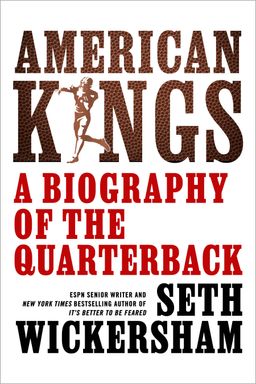
American Kings cover

American Kings

by Seth Wickersham

A senior writer at ESPN characterizes the phases of a professional football quarterback’s career.

The Quarterback: America’s Mirror

The Quarterback: America’s Mirror

Why does the quarterback feel bigger than sport? This book argues that the quarterback is the position where American ideas about leadership, risk, identity, money, and myth converge. The forward pass arrives in the Progressive Era—an age of reinvention—and quarterbacks become national proxies: part general, part model citizen, part celebrity. Johnny Unitas’s poise in the 1958 NFL Championship Game defined composure for a TV nation; Joe Namath’s glamour and guarantee made Broadway showmanship a football virtue; John Elway’s Denver saga linked a city’s ambition to a single arm. To understand the quarterback, you have to read the game as culture, not just tactics.

Why the role matters beyond the field

When you watch a quarterback, the moments before the snap and at release compress time and meaning. Those instants turn technique into ritual and individual poise into a shared myth. The quarterback is a civic figure whose success reorganizes attention, money, and identity around teams and towns. Agents, media, and brands amplify this effect, making a good throw into a cultural story you tell your kids. (Note: this echoes Joan Didion’s idea that we tell ourselves stories in order to live; here, we tell ourselves QB stories in order to belong.)

Family as factory and fortress

Quarterbacks often emerge from families that behave like talent incubators. Jack Elway told his son, “you’re a quarterback,” and selected Granada Hills to fit that identity. The Manning network—Archie, Cooper, Peyton, Eli—built a private pedagogy that shelters prospects while transferring hard-won knowledge (voice memos on footwork; controlled recruiting for Arch). Other models are rawer: Charlie Hurley’s ride-home gauntlet tried to pre-inoculate his son Colin against public criticism. Family systems can be protective cocoons or pressure chambers—and usually they’re both.

The QB industrial complex

Modern quarterbacking runs on a parallel economy of private coaches, combines, and scripted showcases. Tom House tweaks a non-throwing hand and changes a career arc; Will Hewlett scripts Pro Days that turn workouts into market narratives; Elite 11 confers status in twenty-minute windows. Families invest tens of thousands into access and training that may or may not predict Sundays. The lesson isn’t to avoid the circuit; it’s to distinguish development that transfers to games from theater that only performs well under a tent.

Mind speed, decision craft, and measurement

Elite quarterback play is mostly cognitive: perception speed, search efficiency, tracking, impulse control, and improvisation define who survives the chaos. Rich Gannon’s driver’s-license analogy—reps expand your peripheral vision—explains why the game slows for veterans. Peyton Manning used anticipation to simplify decisions; Sean Payton’s “negative-play percentage” (sacks + fumbles + INTs per attempt) offers a practical filter. New tools like the S2 test try to quantify processing, but experience remains the best teacher.

Race, gatekeeping, and alternate routes

Black quarterbacks like James “Shack” Harris and Warren Moon had to create alternate pathways when institutions closed doors. Harris’s blindfolded decision at Bernstein Park sent him to a hostile NFL, where he became a barrier-breaker and later an executive. Moon took the CFL detour, won five Grey Cups, and returned with leverage—but still faced threats and taunts. Their stories aren’t just history; they reveal how structure, not only talent, shapes who gets to lead.

Money, leverage, and control

Quarterback careers are negotiations over power: draft leverage, rookie wage caps, franchise tags, NIL deals, and owner rules about equity all define the game beyond the playbook. John Elway used the threat of baseball to escape the Colts; Moon used stardom from Canada; Carl Williams weighs whether draft position or freedom serves Caleb Williams best. Teams respond with policies that restrain player leverage. Understanding these dynamics helps you see why some stars feel trapped despite wealth.

Identity, pressure, and coping

The quarterback identity can consume a life. Andrew Luck “understood myself best as a quarterback,” and when injuries threatened that self, he turned to therapy and ultimately chose family and presence over the role. Alex Smith’s catastrophic injury exposed how public validation shifts only when pain becomes visible. Faith (Patrick Mahomes, Kirk Cousins) and therapy (Warren Moon, Steve Young) are two architectures that help quarterbacks metabolize pressure and keep performing.

After the final snap

Retirement is not a finish line but a void that demands reinvention. John Elway described it like being in a washing machine; Joe Namath sought recovery and a second act after public struggles; Steve Young bridged to venture capital and broadcasting. The best transitions combine humility, honest help, and new purpose. If your identity and calendar orbit a single arena, plan early for the next one.

Central thesis

The quarterback is both a position and a story engine—shaping culture, family systems, markets, and personal identities—and the winners are those who master not just reads and releases, but narrative, leverage, and selfhood.


Myth, Media, and Market-Making

Myth, Media, and Market-Making

The quarterback myth doesn’t emerge by accident; it’s built by plays, broadcasts, and business models. The forward pass’s rise synced with an American appetite for risk and reinvention. In 1958, Johnny Unitas orchestrated the “Greatest Game Ever Played,” a televised epic that taught a nation how leadership should look under stress: calm eyes, measured cadence, a perfectly timed throw. That performance moved the quarterback from athlete to archetype.

From guarantee to glamour

Joe Namath’s Super Bowl III guarantee reframed quarterbacking as performance art. It wasn’t just a win; it was permission to be theatrical—fur coats, nightlife, the audacity of public risk. In New York, Namath fused Madison Avenue and AFL swagger; in Denver, John Elway fused frontier stoicism with urban ambition. Cities project themselves onto quarterbacks, and quarterbacks project a usable story back to the city.

Amplifiers: magazines, TV, and agents

Sports Illustrated covers, primetime games, and postgame interviews industrialized QB mythmaking. Agents learned to package quarterbacks as civic assets. Leigh Steinberg, for example, built clients into community leaders and endorsement magnets. With every camera, a well-executed drive turns into character evidence—proof a city can believe in itself. (Note: this mirrors how Hollywood studios once managed star personas.)

Commercializing the crown

Frank Vuono’s Quarterback Club consolidated star power—Elway, Marino, Moon, Young—into a cartel that captured individual apparel revenue outside union channels. The position didn’t just become marketable; it became a market mover. That logic lives on in NIL collectives, social followings, and curated Pro Days—proof that quarterbacks can monetize attention at a premium, often above teammates.

Modern branding and its backlash

Today, branding extends into families. Carl Williams shapes Caleb’s public posture and evaluates team fits, sometimes stoking friction (e.g., criticizing a hire in Chicago). Teams now scout entourages as much as elbows. Branding can open doors, but it can also spook decision-makers who fear destabilization. The line between advocacy and overreach is thin and moves with results.

Myth’s cost: performance plus persona

The same megaphone that elevates also suffocates. Elway’s training-camp scrutiny, the Mannings’ dynastic expectations, and NIL-era celebrity for prospects like Caleb Williams prove quarterbacks perform a persona as much as a playbook. When form and story diverge, the public often punishes the human for failing the myth.

How to use this

If you lead in any public arena, manage the story around your performance. Curate exposure, align your values with your city or company, and ensure that the narrative you invite is one you can sustain. The book rewards you with a simple heuristic: make your best moments legible to the biggest audiences, and build systems that protect you from the appetite that visibility creates.

Key idea

Quarterbacking is performance plus presentation; the myth grows where execution meets spectacle, and brands and media turn that intersection into durable power.


Fathers, Families, and Formation

Fathers, Families, and Formation

Quarterbacks are rarely solo projects. The book shows that families act as architects, coaches, brand managers, and bodyguards—often before a kid throws a varsity pass. Jack Elway pulled his car over and told John, “you’re a quarterback,” then targeted Granada Hills for its scheme. That one conversation became a life arc. Archie Manning, with Cooper, Peyton, and Eli, designed a multi-decade factory: private coaching, national relationships, and a recruitment strategy for Arch that limited noise and maximized control.

Private pedagogy and family tech transfer

In Manning-world, Peyton’s voice memos to Eli become a repository of footwork and audibles—a family GitHub for quarterbacking. Coaches like Nelson Stewart integrate into the family network, enforcing continuity between high school and college expectations. The ethos is clear: preparation beats panic; details become doctrine (“Don’t let anyone touch your arm”). This is playercraft as a household culture.

Different father archetypes, different risks

Charlie Hurley represents the hard-edged model—pre-blunting public criticism with harsher private standards, sometimes straying into public outbursts. Drake Maye’s family shows sibling competition as fuel. Carl Williams turns fatherhood into a negotiations office for Caleb, evaluating front offices and protecting leverage. Each model creates opportunity and hazard: more access and toughness, but potentially entitlement or brittle coping if autonomy lags.

Benefits and blind spots

Family systems create repetition, feedback, and emotional cover. They can also produce hypersensitivity to scrutiny or belief in invincibility (a factor in Colin Hurley’s late-night crash). Privilege matters: the Mannings can control exposure in ways other families cannot. The insight isn’t to copy their resources; it’s to adopt their principles—clarity of role, intentional gatekeeping, and a long arc that prioritizes development over viral moments.

A playbook for mentors and parents

If you mentor talent, build ecosystems, not just workouts. Create protected time for practice, limit performative exposure, and recruit honest feedback. Encourage independent decision-making early so authority can be shared, not imposed. Find trusted non-family mentors who can counterbalance your biases and offer a reality check when emotions run hot.

Autonomy as the endgame

The best family systems phase out control as the player matures. You want a quarterback who can self-regulate in chaos, not one who looks to the sideline for permission. That’s the deeper lesson the book delivers: parenting in quarterback families is player development plus identity development; the result should be a resilient adult, not just a decorated prospect.

Guiding principle

Treat the household like a high-trust team: clear roles, demanding standards, and room for voice. Without autonomy and outside mentors, support can harden into a cage.


The QB Industrial Complex

The QB Industrial Complex

Quarterback development is now a marketplace. Private coaches promise mechanical refinement and cognitive shortcuts; showcases promise exposure; agents translate workouts into narratives teams will fund. Tom House tweaks Tom Brady’s mechanics (even the non-throwing hand) and reframes arm care. Will Hewlett writes Pro Day scripts that choreograph throws by difficulty and angle so scouts see what they expect to see. Tom Gormely and other trainers stack movement, yoga, and recovery into year-round calendars.

Pro Day as theater and test

At a scripted Pro Day, the ball and the story travel together. Caleb Williams’s preparation—mobility sequences, off-platform throws, carefully curated routes—turns an audition into a narrative of effortless control. These events reduce a career’s complexity into a digestible highlight reel designed for decision-makers with limited time and appetite for uncertainty. The goal isn’t surprise; it’s confirmation.

The showcase circuit and its limits

Elite 11, the Combine, and private workouts are imperfect filters. Patrick Mahomes didn’t make Elite 11 finals, yet he remade the sport. Short windows and artificial drills can overweight aesthetics and underweight in-game transfer. Still, they matter because gatekeepers act on them. Parents and players chase these stages because everyone else does—a classic coordination problem where opting out feels like self-sabotage.

Economics and risk

This ecosystem is expensive: two-day evaluations, recurring clinics, travel, and content creation. Families invest for scholarships and draft slots, but predictive value is low. The book’s sober message: buy development, not just display. Ask every drill, “Does this transfer to a collapsing pocket on third-and-eight?” If it doesn’t, it’s marketing, not mastery.

Practical heuristics

Favor coaches who teach reads, protections, and decision rules you can apply on Friday nights and Sundays. Value competitive reps over perfect-air throws. Use small-sided games and chaos drills to train search efficiency and impulse control. And insist your Pro Day script showcases what your offense will actually ask you to do, not just social-media throws.

Inside the pitch

“Gotta check all the boxes,” Will Hewlett says—translation: Pro Day is paperwork made physical. Don’t let compliance overshadow competence.

If you’re navigating this world, build long-term relationships with honest evaluators, keep receipts on real in-game improvements, and treat every showcase as one data point in a broader development story you control.


Mind, Processing, and Decision Craft

Mind, Processing, and Decision Craft

The best quarterbacks win with their eyes and nervous systems. At Elite 11, counselors broke the craft into nine trainable skills: perception speed, search efficiency, tracking, visual learning, instinctive learning, decision complexity, impulse control, motor control in chaos, and improvisation. This framework shifts your focus from arm talent to cognition: how fast you see, how well you filter, and whether you can suppress a bad impulse under duress.

Reps that slow the game

Rich Gannon’s driver’s-license analogy is a vivid map: at first you see only the car ahead; later, you read traffic, mirrors, and crosswalks. More reps build peripheral awareness, shrink panic, and expand option sets. It’s why late bloomers often surge—experience stitches film study to muscle memory until chaos feels navigable.

Anticipation versus acceleration

Peyton Manning exemplified anticipation: he simplified the field with pre-snap diagnostics so his post-snap world got small. Steve Young recognized the same trick after games with Peyton—greats use the mind to make time, not just muscles to beat it. Improvisation then becomes an extension of preparation: when the plan collapses, pattern recognition fills the gap.

Measuring the invisible

Teams try to quantify cognition. The S2 test promises to map processing; Sean Payton’s negative-play metric (sacks + fumbles + INTs per attempt) offers a pragmatic proxy for decision hygiene. These tools are helpful, not determinative. They fail in small samples and can miss contextual factors (protection, scheme, opponent). Use them as filters, not verdicts.

Training that transfers

To build these skills, train perception under pressure. Use chaotic target drills where a coach shouts last-second reads. Practice full-field progressions with a play clock and a moving platform to simulate broken pockets. Track your “time-to-throw with correct read” and “negative-play rate” in practice; make improvement visible.

The improvisation paradox

Improvisation looks like magic, but it’s mostly memory. You can’t reliably create off-script until you’ve seen enough pictures for your brain to interpolate a solution. It’s why backyard drills matter—scramble rules, receiver landmarks, and defender leverage all become precomputed building blocks.

Coach’s rule

Minimize negative plays before you chase splash plays. A quarterback who consistently avoids sacks, fumbles, and interceptions is already tilting the field.

In short, build a brain that buys you time. The book gives you a practical blueprint: measure what matters, practice the hard parts on purpose, and let experience make the game feel slow.


Race, Gatekeeping, and Alternate Paths

Race, Gatekeeping, and Alternate Paths

The book insists you confront how race shaped—and still shapes—who gets to be a quarterback. James “Shack” Harris stands at a literal and symbolic crossroads: in Bernstein Park, he blindfolds himself and throws at a tree to decide if he’ll join the NFL after the draft. He hits the tree and goes, becoming the first Black quarterback to start a season opener and win a playoff game, even as teams hide him in YMCA housing and fans send threats.

Warren Moon’s detour and leverage

Warren Moon couldn’t get a fair NFL shot, so he dominated the CFL—five Grey Cups—then returned with leverage and numbers that discredited the “can’t lead a pass-first offense” trope. Leigh Steinberg helped translate Moon’s proof into contracts and cultural legitimacy. And still, Moon absorbed racist venom, a reminder that excellence doesn’t always erase prejudice—it sometimes provokes it.

Institutional responses and role reshaping

Colleges and pros sometimes reassign Black quarterbacks to other positions (Marlin Briscoe to receiver) or slow-walk opportunity. Over time, success stories—Doug Williams’s Super Bowl MVP, Moon’s Hall of Fame induction—expand the map of the possible. Representation in front offices (Harris later as an executive) matters; gatekeepers who have lived the detours are more likely to widen doors for others.

Why this history matters now

Modern fans see Patrick Mahomes and assume the struggle is over. The book urges caution: biases persist in evaluation, marketing, and patience for early mistakes. Alternate proving grounds (transfers, spring leagues, CFL) still function as leverage points for those outside default pipelines. Context—coach, owner, scheme—shapes career arcs as much as talent.

Applying the lesson

If you run a program or company, audit your pathways. Are there alternate on-ramps for talent the default system overlooks? Do your evaluators share backgrounds with the people they scout, or do they carry untested assumptions? Build evidence-based processes and diversify decision rooms to reduce structural error.

Throughline

Race in quarterbacking is not just about who can throw; it’s about who is trusted to lead. Alternate paths created leverage, but they also reveal where the default path was blocked.


Money, Leverage, and Control

Money, Leverage, and Control

Quarterback economics are a tug-of-war between talent and institutions. The draft grants teams control; the rookie wage scale and franchise tag cap early earnings and delay freedom. Players and agents search for workarounds—alternative leagues, NIL, public leverage—while owners close loopholes (e.g., voting to prohibit equity stakes for players). The battleground isn’t just salary; it’s agency.

Draft leverage as a weapon

John Elway threatened baseball to avoid the Colts in 1983, forcing a trade that reshaped Denver. Warren Moon used the CFL to reenter the NFL with leverage. These are blueprints: create credible alternatives, mobilize public pressure, and align with agents who can orchestrate complex moves. Teams hate this because it works.

The rookie wage ceiling’s ripple effects

The wage scale saves teams money but also encourages risky behavior: overdrafting, under-supporting, and fast-tracking verdicts on rookies. Families watch a career’s most fragile years capped and controlled, then judged as if context doesn’t matter. Carl Williams’s frustration on behalf of Caleb—musing about going undrafted to pick a fit—stems from this structural bind.

NIL and the modern bargaining chip

NIL money tilts leverage back toward prospects. Staying in college becomes a viable counter to a bad NFL fit. Fathers like Carl Williams wield public commentary and private demands to influence landing spots. Teams respond by vetting family dynamics and tightening control elsewhere. The chess match never stops.

How to negotiate your arc

Treat your career as a multi-stage game. Build a brand beyond salary (community ties, endorsements, post-career plans) in the Steinberg mold. Use data to argue for early support (offensive line investment, scheme fit), and be willing to delay gratification for a better fit. The richest outcome is often the one that maximizes early competence, not early cash.

Leverage logic

“I’d prefer Caleb go undrafted,” Carl Williams says, “so he can pick his team.” In a system that prizes control, choosing fit over status can be the ultimate power move.

In short, the quarterback who understands contracts, optics, and alternatives—alongside reads and releases—plays a bigger, more winnable game.


Identity, Coping, and Life After

Identity, Coping, and Life After

Becoming “the quarterback” can crowd out every other identity. Andrew Luck admitted, “I understood myself best as a quarterback.” When injury attacked that identity, his ability to be a partner and father faltered until therapy helped him step back and ultimately retire for presence and health. The book’s most intimate scenes show you a person wrestling not with coverages, but with selfhood.

Pain, visibility, and validation

Alex Smith’s leg was shattered by Kareem Jackson and J.J. Watt; infection almost killed him. Before surgery, criticism was common; after surgery, teammates and fans saw his pain and reframed his courage. It’s a grim truth: sometimes you have to be visibly broken to be believed. That insight explains part of the quarterback’s emotional isolation.

Faith and therapy as scaffolding

Patrick Mahomes prays at the goalpost and talks about glorifying God; Kirk Cousins keeps anchoring symbols close. Faith turns the field into a platform, not a proving ground. Therapy plays a parallel role for Warren Moon and Steve Young; Bill Walsh warned Young about being “over-accountable,” and Stephen Covey gave him frameworks to distribute responsibility. These structures metabolize pressure into sustainable effort.

Retirement’s washing machine

John Elway describes retirement as entering a washing machine—no schedule, no structure, noise replaced by a hum. Joe Namath’s public struggles led to rehab and a quieter life. Steve Young diversified into venture capital and TV while keeping a tether to the game. The pattern is clear: without a plan, the void wins; with purpose and help, a second act can be rich.

A playbook for you

If your role consumes you, build other roles before you need them. Create simple rituals at home, schedule time where your title has no power, and appoint a small circle—spouse, therapist, mentor—to interpret wins and losses. Practice saying “no” to the apparatus that tries to make your life frictionless; frictions are how you stay human.

Enduring lesson

The quarterback role gives power and structure, then threatens to become a prison. Freedom comes from widening your identity before the cheering stops.

Dig Deeper

Get personalized prompts to apply these lessons to your life and deepen your understanding.

Go Deeper

Get the Full Experience

Download Insight Books for AI-powered reflections, quizzes, and more.