
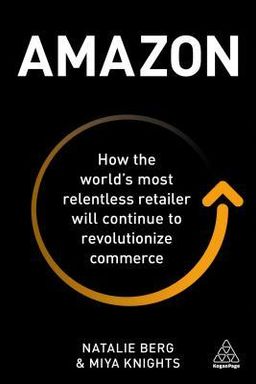
Amazon cover

Amazon

by Natalie Berg & Miya Knights

Amazon explores the rise of the world''s most disruptive retailer, detailing its strategies for dominance and innovation. Learn how Amazon revolutionizes commerce and what strategies other businesses can adopt to stay competitive in today''s market.

Amazon’s Engine of Relentless Reinvention

How does one company shape global expectations about speed, convenience and innovation? The story of Amazon is ultimately the story of a company that redefined what it means to be customer‑centric. The book argues that Amazon’s success stems from a coherent system — a flywheel — of interconnected businesses powered by technology, data and a cultural obsession with removing friction. Every product launch, acquisition and logistic experiment feeds the same loop: lower prices, better service, more customers, more sellers, and reinvestment in speed and innovation.

Amazon’s strategy isn’t about chasing quarterly profits but building an infinite game: a structure that compounds over time. By combining cheap capital, investor patience and systems thinking, the company scaled from online bookseller to a platform touching nearly every consumer habit — shopping, entertainment, cloud computing and, most recently, grocery. To understand the company’s dominance, you must grasp how all the parts — Marketplace, Prime, AWS, logistics, AI — interlock.

The Flywheel Logic

The core metaphor of the flywheel, borrowed from Jim Collins, perfectly captures Amazon’s approach. Every improvement reinforces another part: lower prices attract more shoppers; more shoppers attract more third‑party sellers; sellers expand assortment, boosting convenience and traffic; that volume lowers cost per unit, allowing for more price cuts. Over decades, this system creates compounding advantage. Brad Stone’s The Everything Store noted that there’s no single breakthrough — just thousands of micro‑improvements relentlessly pushing the wheel.

Amazon’s genius is in how it translates this abstract concept into operational systems: Marketplace offloads inventory risk while expanding selection; Prime turns customers into loyal subscribers who spend and shop more; and AWS supplies both the financial oxygen and technical foundation that make the others sustainable. Each division feeds another in a closed‑loop growth cycle.

From Pure‑Play to Platform

Initially an online retailer, Amazon evolved into a platform company that integrates logistics, media, and cloud services. Its shift from pure e‑commerce to clicks‑and‑mortar demonstrates a deeper strategic insight: physical stores aren’t relics but nodes in a larger network optimizing the last mile. Acquisitions like Whole Foods provided distribution density and credibility in perishable goods while serving as micro‑hubs for one‑hour Prime deliveries. Experiments like Amazon Go or Books are less about retail square footage and more about testing technology — computer vision, checkout‑free models and dynamic pricing — that can scale elsewhere.

This hybrid model blurs the lines between online and offline. You see the same principle in Amazon Lockers, partnerships with Kohl’s for returns, and its grocery ambitions. Each move refines the logistics backbone while enriching the customer ecosystem—a template now emulated by countless smaller retailers transitioning to O2O (online‑to‑offline) service models.

Customer Obsession and the Elimination of Friction

At the cultural core lies customer obsession, one of Amazon’s first Leadership Principles. The company constantly asks what irritates you as a shopper—slow delivery, hidden fees, cumbersome checkouts—and then designs to erase those pain points. 1‑Click shortened checkout, Prime collapsed delivery uncertainty, and Alexa moved the purchase decision closer to mere speech. Every time Amazon reduces effort, conversion and loyalty rise. Bezos called this working backwards: start from the desired customer press release and build the system to make it real.

The transition from 1‑Click to zero‑click commerce (via Dash, subscription replenishment, and smart devices) pushes toward an invisible interface future. The less you think about shopping, the more habitual it becomes. For Amazon, friction removal isn’t a UX tweak—it’s competitive defense. Every second saved at checkout and every failed delivery eliminated increases switching cost and deepens dependence.

Technology as Architecture, Not Accessory

Many retailers treat technology as cost; Amazon treats it as product. AWS, which began as internal infrastructure, turned into a global computing business powering Netflix, NASA and startups worldwide. That same infrastructure fuels rapid innovation in retail via analytics, AI recommendations and automation. The culture that writes six‑page narrative memos and measures success by customer outcomes, not internal politics, is what allows experiments like Prime Now to launch in 111 days or Alexa to redefine home interfaces.

Amazon’s investments in robotics and AI extend that architecture from the cloud to warehouses, predicting demand before orders are placed and optimizing delivery routes dynamically. These systems, from anticipatory shipping patents to Kiva robots, translate data into operational scalability. They also become moats: the more orders flow through, the smarter the system, and the harder it becomes for rivals to match its precision or cost efficiency.

Beyond Retail: Building the Modern Consumer Economy

Each new line of business—Prime Video, Alexa devices, private labels, physical stores—serves the same purpose: fortify the flywheel. Prime locks in spending through perks and entertainment, shifting customer behavior away from price sensitivity. Private labels give Amazon better margins and control over search results. Alexa and voice‑commerce ensure that Amazon remains the default choice even when you no longer see a screen. Grocery brings habitual frequency. The outcomes ripple across whole sectors, sparking what headlines call the retail apocalypse but which the authors explain is better described as retail transformation.

Where others fear automation or store closures, Amazon redefines those events as stages of evolution. The winners, the authors insist, will be those who focus on WACD — What Amazon Can’t Do: authentic experiences, community and human connection. For everyone else — from department stores to niche brands — survival means integrating digital convenience with experiential depth.

The Risks of Scale

With power comes scrutiny. The book closes by showing that even Amazon’s systems aren’t invincible. Regulatory threats (as highlighted by Lina Khan’s “Amazon’s Antitrust Paradox”) and competition from tech alliances form growing headwinds. The tensions in vertical integration — serving as both platform and competitor — raise fairness debates. Yet, paradoxically, these pressures reinforce Amazon’s discipline: more transparency, faster innovation, and relentless reinvestment in systems that keep the flywheel spinning.

In short, Amazon isn’t just an online retailer or even a technology conglomerate—it’s the architecture of modern consumption. To study Amazon is to study how technology, logistics, psychology and design converge into a single idea: remove every obstacle between intent and satisfaction, then repeat it at scale. That’s how the flywheel keeps turning—and how modern retail keeps changing with it.


The Flywheel in Motion

The flywheel is Amazon’s strategic operating system. Every decision—pricing, logistics, investment—feeds a self‑reinforcing cycle. The simplicity hides extraordinary discipline: start with the customer, move outward to sellers, and let growth fund itself. This model turns volume into power.

Core Mechanics

At its heart, the flywheel depends on velocity. Lower prices and reliable service attract customers. Those customers attract sellers, expanding assortment and convenience. The resulting scale reduces unit costs, enabling reinvestment into technology and faster shipping. It’s the same virtuous cycle Jim Collins described in Good to Great, operationalized at internet speed.

Marketplace, launched to leverage external sellers, exemplifies that multiplication effect: by 2017, third‑party seller services exceeded $32 billion in revenue. AWS funds the entire retail expansion. Prime locks customers into the loop. The ecosystem is designed so that even new ventures—hardware like Kindle and Echo, or content like Prime Video—assume roles as spokes feeding momentum.

Infinite Game Thinking

Amazon views growth as a long‑term compound interest game, not a yearly race. By prioritizing cash flow over profit and reinvesting heavily, it buys patience. Investors fund an infinite horizon in exchange for predictable customer expansion. This “cheap capital plus patience” formula is nearly impossible for traditional retailers shackled by quarterly pressure. It allows operations like AWS to subsidize retail initiatives such as Prime Now or grocery delivery for years before meaningful margins appear.

When you evaluate any Amazon project, the internal question is consistent: how does it accelerate the flywheel? Does it increase selection, reduce cost, or raise customer delight? If yes, it scales. If not, it dies. This ruthless coherence explains the company’s resilience when others perceive chaos.

Why Competitors Struggle

Most companies treat separate profit centers—media, logistics, retail—as silos. Amazon treats them as one data ecosystem. That integration lets it optimize network effects across Prime frequency, AWS margin and marketplace diversity. For a competitor, any single‑function challenge fails because they’re attacking a subsystem rather than the engine itself. The book reminds you that Amazon doesn’t need to win in all categories; it only needs to keep the flywheel spinning faster than anyone else can catch up.

For you as a retailer or strategist, the lesson is structural: build feedback loops that convert today’s users into tomorrow’s advocates and partners. Think systemically, not transactionally. Amazon’s edge isn’t size—it’s dynamic self‑amplification.


Prime and the Loyalty Revolution

Amazon Prime transformed subscription commerce into the cornerstone of modern loyalty. It’s not a shipping perk—it’s a psychological shift that makes shopping an effortless daily reflex. You pay for certainty and convenience, and that subtle inversion—removing delivery friction—drives record engagement.

From Delivery Promise to Ecosystem

Since 2005, Prime expanded from two‑day shipping to a full lifestyle bundle: video, music, reading, Twitch, grocery perks and exclusive deals. Each layer adds stickiness. Members spend roughly five times more than non‑members and show over 90% retention. Prime converts customers into subscribers who think less about price and more about experience.

Integrating Prime with physical stores illustrates its future logic. At Whole Foods, members receive special prices and one‑hour delivery capability. Amazon Books built a precedent by aligning in‑store prices with online Prime rates. The omnichannel future of Prime transforms every touchpoint—screen, speaker, or store—into a single membership lens.

Monetizing Habit

Prime’s power lies in behavioral economics. Prepaying for benefits changes perception: once you’ve paid the fee, you rationalize every purchase as maximizing value. This creates what analysts call the “Prime effect”: increased frequency, impulse comfort, and reduced churn. It also creates mass data advantages for Amazon, which tailors promotions and negotiates better terms with carriers.

Prime’s evolution now includes tiering (student or subsidized plans), and its price increases reveal pricing elasticity born of extreme loyalty. The app, content and payment ecosystem generate recurring revenue far beyond retail margins, demonstrating how convenience can be monetized as emotion—trust and inertia in action.

For competitors, replicating Prime isn’t about copying a price tag but about building holistic value networks that reduce friction across multiple customer needs. Amazon showed that loyalty is earned not through coupons but through time and predictability.


Technology First, Retail Second

Amazon is a technology company disguised as a retailer. That reordering of identity explains its capacity to reinvent markets before rivals can respond. The same infrastructure that powers AWS and Alexa also informs how every retail feature is built, tested and scaled.

Engineering as Strategy

AWS originated as an in‑house tool to solve computing bottlenecks. When externalized, it became the world’s leading cloud service, contributing more than half of Amazon’s operating income by mid‑2010s. This internal‑to‑external loop—turning capability into product—repeats across Amazon’s history: 1‑Click checkout, Fulfillment by Amazon, Alexa skills and voice infrastructure. Every innovation starts as a solution to internal friction and scales into an ecosystem advantage.

The company’s leadership principles institutionalize that logic: Customer Obsession ensures empathy drives design, while Invent and Simplify ensures progress is continuous. Six‑page memos and the “working backwards” press release method embed analytical clarity before code is written. That’s how products like Prime Now emerged fully formed within four months.

Hard to Copy

Most retailers apply technology tactically (POS systems, web storefronts). Amazon treats it as architecture—an economic and creative engine. This mindset allows subsidization: profits from AWS or advertising finance retail experiments. It also gives global scalability: once a feature works in Seattle, it scales worldwide through AWS’s standardized infrastructure. Traditional firms, bound to legacy IT and quarterly ROI, simply can’t iterate at that pace.

For you, the lesson is conceptual: technology isn’t a department; it’s the product. In an AI‑driven market, your capacity to measure, automate and adapt becomes your most defensible moat. Amazon demonstrates that scale doesn’t hinder speed when culture and data are aligned.

The outcome is a digital organism—one that learns, codifies and redeploys insight faster than traditional competitors. Understanding Amazon’s engineering DNA is understanding twenty‑first‑century competitiveness itself.


Frictionless Commerce and the Power of Design

Every friction you experience during shopping—unexpected shipping costs, confusing returns, slow checkout—is an opportunity Amazon exploits. The company’s design philosophy can be summarized as: remove effort, reward immediacy, repeat purchase. This principle drives both interface design and operational architecture.

From Click to No‑Click

The 1‑Click patent revolutionized digital checkout by storing addresses and payment details, cutting cart abandonment and converting transient interest into sale. The next step—“zero‑click”—manifested in Dash Buttons, auto‑replenishment, and Alexa ordering. Each innovation compresses decision time until buying becomes subconscious behavior. (Baymard Institute’s research that 70% of carts are abandoned elsewhere explains why friction reduction is worth billions.)

Prime extends that by unbundling shipping anxiety. When delivery becomes predictable and pre‑paid, shoppers no longer hesitate. Amazon uses those psychological levers not only to close sales but to make its platform the default mental channel for consumption.

Seller and Payment Integration

Fulfillment by Amazon (FBA) allows third‑party sellers to deliver Prime‑eligible speed without owning warehouses. Pay with Amazon exports trusted credentials to external merchants. These tools standardize friction removal across the ecosystem, increasing network dependence and reliability.

Omnichannel Implications

With Prime Now hubs, lockers and hybrid retail sites, Amazon now removes not only digital friction but physical inconvenience. Checkout‑free experiences like Amazon Go make physical stores proof points for a frictionless vision that merges software with real estate. In doing so, Amazon sets a new threshold for all commerce: customers now expect immediacy as a default, not a luxury.

For your own business, the blueprint is clear: identify friction, automate it away, and package the benefit as membership or default convenience. Amazon shows that frictionless design is both user experience and strategy.


AI, Voice, and Predictive Retail

Artificial intelligence and voice form the next frontier of Amazon’s dominance. Behind every recommendation and delivery lies predictive computation. Machine learning not only personalizes your browsing but powers robotics, logistics and the new voice‑based interface led by Alexa.

Recommendation and Personalization Systems

McKinsey estimates that roughly 35% of Amazon purchases stem from recommendations. That’s not guesswork—it’s the outcome of deep‑learning frameworks like DSSTNE (open‑sourced in 2016) that model your preferences in real time. These algorithms balance your history, current trends and strategic stock priorities to increase cross‑sell efficiency. They represent the software embodiment of the flywheel: more data improves relevance, which boosts usage and, in turn, generates more data.

AI in Operations

Amazon extends AI into forecasting and fulfillment. The company’s “anticipatory shipping” concept stages inventory near likely buyers even before orders occur. Kiva robots move shelving pods autonomously, shortening human walk time and increasing throughput. Predictive algorithms optimize which warehouse handles each order to balance cost and speed. The result is an invisible mesh of intelligence that delivers faster, cheaper and more accurately than manual systems ever could.

Voice and the New Interface

Alexa pushes the boundary from screen‑based commerce to ambient intelligence. The Echo devices integrate shopping directly into conversation: instead of typing, you speak. While adoption for direct purchases remains limited, voice drives ecosystem lock‑in. Users who own Echo spend significantly more overall and depend on Amazon’s branded defaults. Voice recognition also caps discoverability—only one or two results—tilting market visibility toward Amazon’s own items and Prime‑eligible goods.

For you, AI and voice signify more than convenience. They point to retail’s shift toward predictive, automatic and context‑aware systems. Competing effectively means treating data not as by‑product but as fuel: you must design content, inventory and customer touchpoints for algorithms that now mediate the act of buying.


Retail Transformation and the Human Edge

While Amazon scales automation, physical retail undergoes reinvention. The so‑called retail apocalypse is actually structural pruning: too much undifferentiated space meeting a more experience‑driven generation. What remains are agile, connected, and experiential formats that deliver what Amazon cannot—community, immediacy and human connection.

From Damage to Renewal

The U.S. once had over 23 square feet of retail per person; much of it generic. Department stores lost half their share since 2000. Yet grocery discounters, curated boutiques and experiential destinations thrive. The authors argue success depends on excelling at WACD – What Amazon Can’t Do. Aldi and Lidl win with focus and efficiency; premium grocers win with freshness and service; experiential stores like Apple or Story win with emotion and discovery. Relevance outweighs footprint.

Experience as Defense

Forward‑looking retailers reimagine stores as social environments. Cafes, workshops, rentals and co‑working spaces increase dwell time and create differentiators. Lego and Apple demonstrate that play and learning transform transaction into participation. Cafeteria culture at Ikea or Wellery wellness zones at Saks show that time spent correlates with loyalty earned. This is the antidote to a world where online purchases require no emotional investment.

Digital Tools in Physical Space

Automation isn’t limited to warehouses. Digital shelf labels, AR try‑ons and mobile wayfinding create real‑time feedback loops in stores. Carrefour’s beacon network or Uniqlo’s AR mirrors let customers navigate and discover easily. The principle mirrors Amazon’s friction elimination, but applied offline. Staff aided by clienteling apps become consultative partners rather than transactional clerks.

Future of Competition

Ultimately, retail’s future splits into two paths: compete on speed using technology, or compete on emotion through service and experience. Both require digital literacy. The book concludes that regulation, consumer expectations and technological saturation will push all players to balance efficiency with humanity. The smart retailers are those who borrow Amazon’s tools but preserve human warmth.

Amazon redefined the rules; the rest of retail must redefine meaning. Survival now depends not on selling everything to everyone, but on selling something meaningful to someone.

Dig Deeper

Get personalized prompts to apply these lessons to your life and deepen your understanding.

Go Deeper

Get the Full Experience

Download Insight Books for AI-powered reflections, quizzes, and more.