
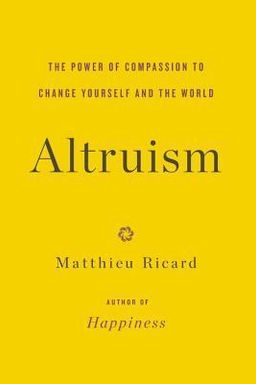
Altruism cover

Altruism

by Matthieu Ricard

Altruism: The Power of Compassion to Change Yourself and the World dives into the human and animal instinct to care for others. Matthieu Ricard explores how altruism, backed by philosophy and science, can transform individuals and societies for the better.

Altruism as the Heart of Human Flourishing

What makes life meaningful isn't wealth or success—it’s your ability to care for others. In Altruism: The Power of Compassion to Change Yourself and the World, Matthieu Ricard argues that altruism is not naïve idealism but the most realistic strategy for human survival and flourishing. He redefines altruism as a motivational state—a wish to promote another being’s welfare for its own sake—rather than a mere behavior or emotional impulse. From neuroscience to global policy, Ricard builds a comprehensive case showing that compassion is not just moral sentiment, but a scientifically trainable force that safeguards happiness, cooperation, and even civilization itself.

The Nature and Trainability of Altruism

Altruism begins as intention. Actions without benevolent motivation may appear kind yet hide self-interest. Ricard, echoing Daniel Batson’s decades of psychological research, distinguishes empathy (feeling another’s pain) from compassion (wishing to alleviate it). He shows that empathic distress leads to burnout, while compassion replenishes energy. Experiments with Tania Singer and Richard Davidson demonstrate that whenever people cultivate compassion—through meditation or daily practice—brain regions linked to joy and affiliation activate rather than those associated with pain. Altruism, then, is measurable and trainable: even short interventions increase helping behavior and emotional resilience.

The Evolutionary and Biological Roots

Ricard draws on Darwin’s neglected concept of sympathy and modern evolutionary theory to show that cooperation and care evolve alongside competition. From Hamilton’s kin selection to Trivers’s reciprocity, biology provides the wiring—parental care, empathy, attachment—that culture amplifies. Bonobos consoling others and toddlers offering help without rewards reveal instinctive sympathy. Cultural evolution, faster than genetic change, stabilizes those instincts through moral norms and institutions. In short, altruism is natural but malleable: societies can either cultivate it through education and example or erode it through narcissism and institutionalized selfishness.

Extending Compassion Universally

You spontaneously favor family and tribe, but Ricard urges deliberate expansion of care beyond those boundaries. Drawing on Buddhist practice, he explains altruistic love (wishing others happiness), compassion (responding to suffering), and impartiality (offering these to all beings). Like the sun that warms all without discrimination, genuine compassion must be impartial yet intelligent, guided by wisdom about what truly removes suffering. Darwin’s insight that sympathy can “extend to all beings” becomes, in Ricard’s work, a concrete psychological practice rather than a vague moral wish.

From Personal Practice to Social Systems

Altruism must scale. Ricard weaves evidence from education, economics, and governance to show how compassion can reshape systems. Early attachment, parental induction (reasoning about harm rather than shaming), and empathy-based curricula nurture prosocial habits. Institutions that reward fairness (as in Ernst Fehr’s “altruistic punishment” games) and emphasize reputation rather than retribution sustain cooperation. At societal level, reducing inequality, promoting voluntary simplicity, and redefining prosperity beyond GDP echo the same insight: when you care for others and for the planet, everyone—including you—benefits.

Ethical and Planetary Stakes

The book culminates by applying altruism to global challenges—the Anthropocene crisis, economic injustice, and mass violence. Ricard calls for extending empathy to future generations, animals, and ecosystems. Industrial meat production, pollution, and corporate denialism exemplify institutionalized selfishness—systems that prioritize short-term gain over collective welfare. Yet evidence from urban green planning (Portland, Stockholm), corporate mutuality models (Mars Inc.), and intergenerational policies shows that altruistic design also works at scale. Practical compassion becomes environmental stewardship, cooperative governance, and responsible consumption.

Core message

Altruism is not a utopian luxury; it is a rational, evidence-based path to surviving and thriving together. You can cultivate it through daily mental training, compassionate institutions, and policies that honor the interdependence of all life.

Ricard’s sweeping synthesis—from infant empathy to intergenerational ethics—invites you to act where science, morality, and practicality converge: in choosing compassion as the engine of both personal joy and collective survival.


The Mind and Biology of Compassion

Ricard bridges psychology, neuroscience, and contemplative science to explain why compassion is the antidote to both personal distress and social breakdown. Empathy lets you feel another’s state; compassion lets you act wisely in response. The difference is biological: empathy activates the brain’s pain circuits, while compassion engages affiliative and reward systems. In real-time fMRI, Ricard himself observed a neural shift from empathic suffering to uplifting warmth when transitioning from empathy to compassion meditation.

Training the Prosocial Brain

Studies with Tania Singer and Helen Weng show measurable changes after even one or two weeks of training: negative affect toward suffering declines, altruistic behavior rises. Brian and emotional patterns once thought fixed reveal remarkable neuroplasticity. Loving-kindness meditation increases cortical thickness (Sara Lazar), positive emotion (Fredrickson), and vagal tone—physiological calm that fosters social connection. Epigenetic studies (Perla Kaliman, Richard Davidson) add that mental states can switch genes associated with inflammation and stress within hours of practice. Your inner life literally reshapes your biology toward care.

Empathy without Burnout

Caregivers often collapse under empathic distress. Ricard offers a practical remedy: let empathy signal need but answer with compassion. That shift turns emotional overload into steady resilience. Training in compassion correlates with increased helping even under anonymity or cost— laboratory confirmations of Batson’s claim that true altruism exists. The science thus dismantles the cynical myth that all helping is selfish, grounding ethics in observable transformation of brain and behavior.

Takeaway

You can train compassion as reliably as strength or memory. Doing so reconfigures neural circuits, gene expression, and emotional habits—making altruism both a biological reality and a practical discipline.

(Parenthetical note: This synthesis mirrors discoveries in positive psychology and contemplative neuroscience showing that empathy alone can wound, but compassion heals both giver and receiver.)


Growing Altruism from Childhood

Compassion begins in infancy. Toddlers as young as eighteen months spontaneously help adults without rewards, while extrinsic incentives often reduce helping—a finding mirrored in adults. Ricard compiles this evidence to argue that human beings are born with prosocial tendencies that must be protected and guided.

Parenting and Moral Development

Longitudinal studies by Tremblay show that aggression peaks early before declining in well-supported environments. The minority of children whose aggression persists typically experience maternal distress, poverty, or absence of nurturing fathers—proof that love and stability shape trajectories. Martin Hoffman’s work on inductive discipline—explaining hurt done and encouraging repair—builds empathy far better than punishment or withdrawal of affection. Jacques Lecomte adds four parental pillars: affection, example, perspective-taking, and real opportunities to help. Guilt-based shame cripples altruism; regret-based reflection strengthens it.

Education That Teaches the Heart

Schools can magnify or mute compassion. Programs like Mary Gordon’s Roots of Empathy or Richard Davidson’s mindfulness training in Madison preschoolers reduce aggression and increase sharing. Cooperative learning (Aronson’s Jigsaw Classroom) diminishes prejudice, while values-based curricula (Neil Hawkes, Oxford) improve academic performance alongside kindness. These are scalable proofs that emotional and ethical intelligence belong at the center of education.

Key Lesson

When adults pair firm boundaries with empathy and model altruism themselves, they activate children’s innate good nature—turning momentary sympathy into lifelong compassion.

(Note: These developmental insights echo the book’s central claim that prevention and care—not punishment—build prosocial individuals and, eventually, cooperative societies.)


Cooperation, Fairness, and Social Design

Altruism flourishes when the social environment rewards fairness and trust. Experiments by Ernst Fehr reveal that people willingly spend resources to punish defectors, preserving group cooperation. Yet cross-cultural variations show that trust and institutions matter—societies with low civic engagement show counterproductive punishment cycles. Ricard integrates Ostrom’s findings on commons governance: clear rules, transparency, and graduated sanctions sustain mutual benefit far better than coercion alone.

The Mechanics of Helping

In everyday life, prosocial behavior follows predictable stages (Latané and Darley). You must notice, interpret, feel responsible, know how, and decide to act. Bystander paralysis and diffusion of responsibility can be reversed by design—clear signals, accountability, and shared values. Cultural data show wide variation: Kenyan children helping universally versus individualist societies where aid is situational. Cultures that celebrate kindness raise helpers; those that glorify competition raise bystanders.

Institutions that Encourage Virtue

From civic engagement (Robert Putnam) to corporate incentives, Ricard argues that systems must align reward with cooperation. Experiments show that when good actors earn reputation rather than mere gain, cooperation endures. Likewise, equality policies and participatory governance translate moral instinct into stable institutions. Fehr’s models, combined with Ostrom’s fieldwork, suggest that moral infrastructure—honor, transparency, trust—is as vital as physical infrastructure.

Applied Moral Economics

Governance that rewards integrity and mutual care converts individual empathy into collective prosperity.

(Parenthetical note: These insights echo Elinor Ostrom’s Nobel-winning demonstrations that community self‑governance often outperforms top‑down control—proof that moral culture, not just law, sustains the commons.)


Facing Ego, Violence, and Institutional Selfishness

For Ricard, the obstacles to compassion are psychological and structural. Egocentrism, amplified by consumer culture and narcissism, narrows your moral circle and fuels discrimination. Experiments like Sherif’s Robbers Cave show how easily group biases arise; cultivating humility and perspective-taking can reverse them. On a societal level, institutionalized selfishness—corporations manipulating truth or pursuing profit despite harm—represents ego writ large.

Dehumanization and Decline of Violence

The same psychology that breeds cruelty also allows its reverse. When groups dehumanize others, atrocities follow. Yet history also shows that moral concern can expand. Statistical studies (Steven Pinker, Peter Brecke) confirm a centuries-long decline in homicide and torture. Enlightenment reforms (Beccaria, Voltaire) illustrate how empathy and reason can institutionalize nonviolence. Modern data link decreasing violence to democracy, education, women’s empowerment, and trade—proof that empathy-driven norms reshape history itself.

Unmasking Harmful Systems

Ricard exposes how industries—tobacco, fossil fuels, pharmaceuticals—manufacture doubt to defend profit. When public information is controlled by vested interests, collective rationality collapses. Altruism here means civic vigilance: demanding transparency, supporting regulation, and protecting science from corruption. The same moral logic applies to industrial farming, where animals are treated as objects; compassion must extend to nonhumans and ecosystems.

Moral Insight

Ego without empathy breeds systems that harm; humility and transparency anchor enduring progress.

(In moral terms, combating cruelty and corruption both demand the same remedy: widening identification with others.)


Altruism for the Planet and Future Generations

Perhaps Ricard’s most urgent claim is temporal: genuine altruism includes those not yet born. The Anthropocene, marked by runaway CO₂ and biodiversity collapse, shows how short-term greed endangers long-term survival. Drawing on Rockström’s planetary boundary framework, Ricard argues that safeguarding a stable biosphere is an ethical obligation akin to protecting life itself.

From Agriculture to Energy: Practical Hope

Examples abound: Yacouba Sawadogo’s re‑greening of the Sahel (six million hectares restored), Navdanya’s seed diversity in India, and Pierre Rabhi’s agroecology in Africa prove that sustainable farming nourishes both people and soil. Systemic fixes—reducing food waste, adopting no‑till farming, and protecting seed diversity—multiply ecological and social benefits. On energy, Jeremy Rifkin’s distributed hydrogen vision and Europe’s renewable pilots show decentralized power as a technical form of altruism: you give back more resilience than you take.

Economy Reimagined

Ricard highlights Bhutan’s Gross National Happiness as a model replacing GDP with holistic well-being that values environmental health and social trust. Complementary corporate models, such as Mars’s “Economics of Mutuality,” prove that profit, people, and planet can reinforce one another. Meanwhile, urban initiatives—from Portland’s tree corridors to Stockholm’s renewable heating—demonstrate policy‑scale empathy.

The Road Ahead

Global governance and civil society must coordinate across levels: personal virtue, local action, and multinational cooperation. NGOs banning landmines or defending rights exemplify altruism institutionalized. Ricard’s call is pragmatic: cultivate compassion locally and express it politically—support transparent science, equitable trade, and preservation of biosphere stability. Only by extending empathy across species and time can humanity sustain itself.

Final Appeal

Preserving the conditions of life is the supreme act of compassion. Each decision—diet, energy, policy, education—can either contract or expand the circle of care.

(Parenthetical note: Ricard’s conclusion merges ethics with sustainability, echoing thinkers from Jonas’s Principle of Responsibility to Singer’s expanding moral circle.)

Dig Deeper

Get personalized prompts to apply these lessons to your life and deepen your understanding.

Go Deeper

Get the Full Experience

Download Insight Books for AI-powered reflections, quizzes, and more.