
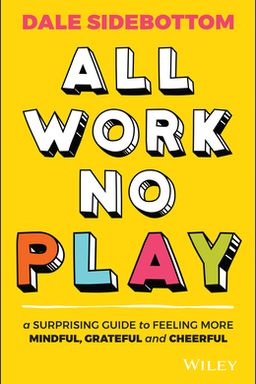
All Work No Play cover

All Work No Play

by Dale Sidebottom

All Work No Play unveils the power of play-based mindfulness to boost happiness and mental well-being. Discover practical tips to reconnect with your inner child, improve relationships, and find joy in everyday life. Embrace a playful mindset to transform your daily routine and create lasting positive change.

Rediscovering Joy Through Play-Based Mindfulness

When was the last time you played—really played—without worrying about productivity or outcomes? In All Work No Play, Dale Sidebottom argues that adulthood has trained us to equate seriousness with success, and in doing so, we've forgotten how to be joyful, present, and fulfilled. The author contends that the secret to mental wellbeing isn't slowing down in stillness, but rather embracing play as an active form of mindfulness.

Sidebottom’s central idea is deceptively simple: play is not just for children; it’s essential for living a balanced, meaningful adult life. Through his personal story of burnout, recovery, and eventual transformation, Dale shows how incorporating play, exercise, gratitude, and giving—his PEGG formula—can transform our mental health, relationships, and overall happiness. Key to his message is “play-based mindfulness,” a concept he originated after realizing that moments of fun and laughter were the only times he felt fully present.

From Burnout to Breakthrough

Growing up in Shepparton, Victoria, Dale lived by a tireless work ethic inherited from his parents. His early years were filled with competition, entrepreneurial ventures, and a relentless drive to succeed. This obsession with productivity led to burnout, divorce, and homelessness by age thirty. In hitting rock bottom, Dale finally recognized what was missing: play, laughter, and gratitude.

Through therapy and self-reflection, Sidebottom began to see that his constant busyness was the antithesis of true mindfulness. While many define mindfulness through calm meditation, Dale discovered his version through activity. He began to schedule “play dates”—time for lighthearted activities like games, sports, and social fun. These playful moments gave him permission to be his authentic self and quiet his racing mind. Over time, this practice evolved into the PEGG routine: Play, Exercise, Gratitude, and Giving, a daily ritual for emotional resilience.

The Science and Soul of Play

Sidebottom’s philosophy is grounded not just in personal experience but in neuroscience and research. He draws on the work of experts like Dr. Stuart Brown, Alison James, and Brian Sutton-Smith, who’ve shown how play develops the brain’s plasticity, fosters creativity, and enhances connection. Studies cited in the book reveal that play triggers the brain’s pleasure pathways, releasing dopamine and endorphins—the same chemicals associated with exercise and altruism.

This science reinforces Dale’s core message: play heals. Whether through simple games like “Rock, Paper, Scissors” in a classroom, adult team-building exercises, or shared laughter at home, play rejuvenates the mind. It builds resilience, deepens relationships, and reminds us of our humanity in a world obsessed with metrics and achievement.

The Daily PEGG and Lifelong Mindfulness

The Daily PEGG ritual became Sidebottom’s cornerstone of transformation. Each day includes four simple elements: play, exercise, gratitude, and giving. He encourages readers to complete all four before clipping an actual peg to their body—a fun physical reminder that they’ve done something joyful and meaningful that day. It might sound silly, but that silliness is deliberate: it breaks the seriousness that often pervades adulthood.

In expanding the concept, Sidebottom emphasizes that mindfulness doesn’t just happen during meditation or solitude. It can occur during laughter, teamwork, or creative challenges. He advocates for “connection before content,” believing that authentic relationships and mental health arise from shared joy, not from rigid professionalism or stoic discipline.

Why This Matters Now

In a post-pandemic world marked by stress, isolation, and digital fatigue, All Work No Play offers a timely antidote. The book speaks to anyone who feels trapped by constant productivity or overwhelmed by expectations. It’s a call to recalibrate how we think about wellbeing—not as a checklist, but as a daily practice of joy. Through the stories of laughter in classrooms, playful team-building in workplaces, and games played on mountain trails, Sidebottom invites readers to reclaim their inner child and cultivate gratitude through lightheartedness.

Ultimately, Dale’s story shows that happiness doesn’t come from doing more—it comes from being fully present in moments of fun, kindness, and connection. The lesson is clear: to live mindfully, you must live playfully. Rediscovering play is not a retreat from responsibility; it’s a return to wholeness. By integrating PEGG into everyday life, you align healing, purpose, and joy—reminding yourself that life is meant to be lived, not managed.


The Hidden Power and Meaning of Play

Play might seem trivial, but Dale Sidebottom—and the experts he interviews—argue that it’s fundamental to human growth, learning, and connection. Play is instinctive, wired into our biology, and essential for keeping us psychologically flexible. Drawing from Professor Alison James and theorists like Brian Sutton-Smith, Sidebottom shows that play acts as a “magic circle”—a protected space where humans experiment, laugh, fail, and evolve without fear of judgment.

Why Play Defies Definition

Defining play is difficult because it exists across a spectrum—from frivolous games to profound artistic or athletic expression. Alison James notes that play isn’t merely leisure; it’s an act of learning and exploration. Through examples of LEGO building, card games, and cubby houses, Sidebottom recalls how childhood play taught him resilience, cooperation, and creativity. Neuroscientific work by Marian Diamond confirms that play enhances brain plasticity, helping develop new neural pathways and adaptive thinking.

Play Across Life Stages

Contrary to popular belief, adults need play as much as children. Play enriches empathy, teamwork, and stress relief. Richard Cheetham MBE reminds us that childhood lasts a lifetime—our instinct to play never disappears; it’s just suppressed by the demands of adulthood. Whether it's Snakes and Ladders with a 101-year-old grandmother or silly group games at professional conferences, play removes barriers of age, language, and culture, creating shared joy and understanding.

The Dark Side and Liberation of Play

Researchers note that play can have a dark side—manipulative “office politics” or cruel jokes—but Sidebottom reframes this by focusing on restorative play that heals and connects. Humor, spontaneity, and curiosity, when practiced non-competitively, lead to emotional intelligence. In military and emergency contexts, play is even used to process trauma and build resilience (a concept also explored by Stuart Brown’s National Institute for Play).

Ultimately, play matters because it teaches us to be fully in the moment. It's how we rehearse problem-solving and empathy in a judgment-free arena. If life feels heavy or transactional, adding play can reset your mental state and reawaken creativity. For Sidebottom, play isn’t just something we do—it’s how we become.


How Play Transforms Mental Health

Play is medicine, Dale Sidebottom insists. Its effects on mental health come from science and lived experience. For Dale, integrating play into his daily routine helped him overcome years of burnout, self-destructive habits, and depression. He pairs his survival story with research from neuroscientists and educators to show that play activates chemical and emotional pathways linked to joy and resilience.

Play as Emotional Therapy

When Sidebottom hit rock bottom at thirty—divorced and homeless—he rediscovered fun through scheduling “play dates.” Simple games with students or moments of laughter during training sessions became lifelines. Over time, these events reset his mental patterns and helped him find gratitude. He learned that joy wasn’t something to achieve; it was something to experience intentionally each day.

Scientific Validation

Neuroscience confirms these effects. As described in Johns Hopkins Magazine’s study “Lighten Up,” dopamine and endorphins flood the brain during play, reducing pain and boosting focus. Play mirrors the healing mechanisms of exercise, meditation, and altruism. It’s a natural antidepressant. Sidebottom compares play deprivation to sleep deprivation: without it, we lose curiosity, empathy, and the ability to connect.

The Daily PEGG’s Mental Reset

This realization led Dale to develop The Daily PEGG. By combining play with exercise, gratitude, and kindness, he created a sustainable mental health ritual that transcends therapy sessions. Each part stimulates different yet complementary aspects of wellbeing: play restores attention, exercise releases energy, gratitude fosters perspective, and giving cultivates compassion. When practiced together, these habits form a mental ecosystem for happiness.

Play doesn’t eliminate hardship—it changes how we perceive it. When you start viewing stress through playfulness instead of fear, challenges become opportunities to connect and grow. As Sidebottom says, the key is to stop being a “human doing” and start being a “human being.”


The Birth and Practice of Play-Based Mindfulness

Traditional mindfulness focuses on quiet stillness, but for high-energy people, that can feel impossible. Dale Sidebottom redefines mindfulness through motion, laughter, and connection. His version—play-based mindfulness—allows you to be fully present by engaging your whole body and mind in fun.

Rethinking Mindfulness

Dr. Craig Daly, one of the book’s collaborators, notes that mindfulness is often misunderstood as escapism or rigidity. In their dialogue, Daly and Sidebottom agree that mindfulness simply means awareness of the moment without judgment. In places like Seoul, Daly witnessed elderly locals practicing playful daily activities—stretching, reading in outdoor cafés, sleeping in hammocks, and playing badminton. These scenes embodied mindful play, physical movement matched with peace and joy.

Flow and Presence

Psychologist Mihaly Csikszentmihalyi’s concept of “flow” underpins this idea: play and mindfulness are both about losing track of time and being immersed in the now. You might find that state in meditation, but you’re just as likely to reach it playing a sport, drawing, or dancing. The difference lies in energy—play-based mindfulness celebrates active engagement rather than passive stillness. It’s about letting go through action.

A Practical Self-Check

Sidebottom offers a short self-assessment: if you’re constantly working, struggling to switch off, or losing sleep to stress, play is your remedy. Simple activities like tossing a ball with a pet or playing cards with friends refocus the mind as effectively as meditation. These play rituals become gateways back to presence.

In essence, play-based mindfulness integrates body, mind, and emotion in one joyful motion, transforming mindfulness from a solemn duty into a celebration. Through it, you learn that being mindful doesn’t mean sitting still—it means being fully alive.


The Universal Language of Play

One of Sidebottom’s most touching insights is that play transcends barriers. Across cultures, ages, and languages, play forges bonds and communicates empathy better than words. His global experiences, from Africa to Peru to Turkey, reveal play as a universal connector.

Play Without Words

In Malawi, Dale joined local children who played soccer using a ball made of trash and plastic bands. They didn’t share a language, but laughter, movement, and teamwork built instant connection. In Egypt, he joined workers playing soccer on the banks of the Nile—a game where an old Coke bottle stood in place of a ball. Similar moments occurred in Turkey and Peru, where playful interactions erased cultural divides entirely.

Creativity Over Technology

These experiences taught Dale that play’s magic lies in its simplicity. The less equipment you have, the more creative you must become. It's not about luxury—it’s about connection. He contrasts this with modern dependency on gadgets, reminding us that true playfulness requires imagination, not technology.

Through games like “Evolution” on the Machu Picchu trail, where travelers from ten countries laughed together making egg and monster sounds, he demonstrates that play unites people through vulnerability. It invites everyone to be silly, inclusive, and human. In a divided world, play offers equality and belonging, making joy the common language.


Play as a Catalyst in Work, Learning, and Relationships

Sidebottom extends the power of play into practical domains—education, teamwork, and professional life. His experiences as a teacher and corporate trainer reveal that play isn’t a distraction from serious work; it’s the foundation of engagement, trust, and creativity.

Play in Education

When Dale taught in London’s toughest classrooms, he discovered that traditional structure without connection failed. His “aha moment” came when he replaced rigid discipline with short bursts of play—like rounds of “Rock, Paper, Scissors.” Through these games, students learned cooperation and listening faster than through lectures. This insight led to his ClassBreak app, providing teachers with playful “connection starter” games to improve engagement worldwide.

Play in Teams and Workplaces

In corporate and sports settings, play enhances collaboration. Sidebottom learned that laughter breaks down hierarchy and fear, replacing them with openness. Richard Cheetham’s studies among coaches confirm that playful interaction boosts creativity and performance. Even an awkward first day at work can be transformed through humor—as Dale showed when he introduced himself by joking about roadworks in his first teaching job, instantly connecting with his colleagues.

Play in Relationships and Families

Play also strengthens romantic and family bonds. Dale’s playful dating—with bowling and “Connect Four”—helped him build a meaningful relationship with his now-wife Bree. As a parent, he uses games to nurture gratitude and empathy at home. In families, he encourages weekly “play dates” to reconnect and heal tension. The core message: play restores joy wherever humans gather, whether in a classroom, workplace, or kitchen.


Living Mindfully Every Day

The final section of Sidebottom’s work shifts from theory to practice, showing how mindfulness becomes a lifelong habit through small rituals. Busy people often treat mindfulness as optional or difficult; Dale reframes it as playful and achievable through his twenty-minute routine anchored in the Jugar Life app.

Morning Wins and Evening Gratitude

The morning begins with three questions: What are you excited about today? What might challenge you? How can you surprise someone with kindness? These prompts, followed by exercise and mindful breathing, set the tone for joy and self-awareness. Evenings close with reflection: What did I learn? What am I grateful for? What playful moment made me smile?

Pairing these small wins with movement and gratitude keeps mindfulness alive. It’s not about perfection—it’s about starting anew each day. When life derails, you reboot by returning to PEGG. Dale reminds readers: “Win the day, win the week.” Through repetition, mindfulness becomes muscle memory powered by play and generosity.

In the end, All Work No Play isn’t just about play; it’s about wholeness. By learning to laugh, give, and pause intentionally, you shape a life filled with gratitude. The goal, Sidebottom writes, is simple: never stop playing, because happiness isn’t passive—it’s practiced.

Dig Deeper

Get personalized prompts to apply these lessons to your life and deepen your understanding.

Go Deeper

Get the Full Experience

Download Insight Books for AI-powered reflections, quizzes, and more.