
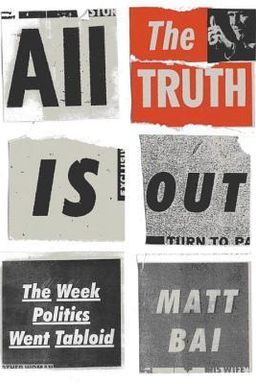
All the Truth Is Out cover

All the Truth Is Out

by Matt Bai

All the Truth Is Out by Matt Bai dives into the 1980s transformation of political journalism, using Gary Hart''s scandal as a lens to explore the lasting shift from policy-driven reporting to a focus on personal lives. This insightful analysis reveals how media scrutiny has redefined political discourse, shaping our understanding of leadership and governance.

The Birth of the Tabloid Age in American Politics

If you want to understand how American politics came to resemble entertainment more than governance, you begin with one week in May 1987. During that week, Gary Hart—a brilliant, charismatic senator and front-runner for the presidency—was undone by a scandal that fused technology, culture, and journalism into a new political reality. The book argues that this crisis wasn’t just about infidelity; it marked the birth of the tabloid age in American political life.

The collision of man, media, and technology

Three forces collided in that moment. Hart, a candidate defined by ideas and strategic vision, stepped into a rapidly changing media ecosystem driven by immediacy and spectacle. The press, shaped by Watergate’s moral triumph and newer technologies like satellite broadcast and fax, sought constant visual drama. Meanwhile, social norms about privacy and morality were shifting: personal conduct had become a proxy for public virtue. Together these forces turned a local stakeout into a national morality play.

In Hart’s words, the system had turned candidates into quarry and journalists into hunters—a diagnosis that perfectly described the “tabloid turn” Bai identifies as a cultural transformation. The Gary Hart scandal becomes a prototype of how politics changed in form and tone, setting the template for every subsequent public exposure from Clinton to Edwards.

The shift in journalistic rules and the fall of gatekeepers

Before this moment, elite newspapers such as The Washington Post or The New York Times still served as gatekeepers. Editors like Ben Bradlee debated whether a rumor merited attention; discretion and proportionality were civic virtues. But once a smaller paper—the Miami Herald—published its expose of Hart’s private life, the old restraint evaporated. From that day on, even the most principled editors faced competitive pressure to follow or risk being sidelined.

The consequence was structural: journalism ceased to be an ecosystem of careful judgment and became a reactive race toward immediacy. Fax machines transmitted local scoops to national networks instantly. Satellite trucks turned remote homes into live sets. Cable shows rewarded confrontation over explanation. The rules of coverage changed from deliberation to acceleration.

Character eclipses policy

Once Hart’s private life became front-page news, the press redefined leadership itself. What once meant competence and vision now meant character—a narrow moral lens often focused on sex and hypocrisy rather than ideas and foresight. Bai traces this new emphasis through later examples: Edwards, Biden, Ted Kennedy, even Clinton. After Hart, voters and editors judged leaders not primarily by their plans but by their perceived moral consistency.

The irony is bitter. Hart’s Strategic Investment Initiative—his plan to redirect defense savings toward education and infrastructure—could have prefigured the next century’s debates on innovation and national renewal. Yet the only enduring image from his campaign is the photograph of “Monkey Business,” a yacht moment that erased decades of intellectual work into a single caption.

Technological acceleration and cultural change

Media technology amplified every new cultural current. The fax age increased the tempo of political life; satellite coverage created 24-hour visibility. Cable shows like Crossfire and The McLaughlin Group rewarded conflict and immediacy. Reporters learned to think visually—helicopters over cabins, live stakeouts, and confrontational interviews. Candidates learned to perform for spectacle or perish under it.

(Note: Bai’s argument echoes Neil Postman’s in Amusing Ourselves to Death: when the medium privileges entertainment, public discourse becomes drama rather than deliberation.)

The generational and psychological divide

Hart’s downfall also reveals a generational rift. The candidate, born in 1936, came from a culture of stoicism and privacy. His pursuers—reporters and consultants shaped by the confessional ethos of the 1960s and 1970s—expected openness and self-disclosure. Hart’s reticence felt suspicious in a media world that equated emotion with authenticity. His refusal to “share” turned reserve into perceived deceit.

That mismatch of psychological norms meant Hart was judged not only for what he did but for how he failed to perform the new ritual of emotional transparency. The generational misunderstanding, magnified by televised inquiry, reveals the deeper shift from policy to personality politics.

The legacy and lesson

This book concludes that Hart’s week redefined the relationship between politics, media, and culture. It created the conditions for permanent scandal—where private life sets political destinies, where speed replaces analysis, and where moral probing becomes spectacle. The aftermath reaches far beyond one man: journalism evolved toward ceaseless revelation, campaigns became exercises in image control, and public conversation grew reactive and moralistic.

The larger meaning

Hart’s downfall wasn’t caused by one mistake or one photograph—it was the first public test of a new system where technology, transparency, and spectacle ruled over deliberation. In that system, leadership became not what you imagine for the future but what others can imagine about your private life on camera.

If you read Bai’s reconstruction closely, you see how this shift reverberates through every campaign since. The week in 1987 didn’t just end one man’s candidacy—it began an era where public life itself became a performance subject to the gaze, the fax, and the lens.


Hart’s Blindspot and the Death of Privacy

Gary Hart’s genius and downfall stem from the same source: his belief that private integrity and public competence could remain separate. Born with Depression-era reserve and shaped by moral stoicism, he sincerely believed that personal life was irrelevant to public leadership. That conviction made him admirable—and obsolete.

The visionary mind

Hart was among the most forward-looking politicians of his generation. He championed ideas of technology-driven growth, energy independence, and global engagement decades before they became mainstream. His strategic plans—such as converting defense savings to investments in education and infrastructure—showed rare comprehension of systemic reform. His “Hart-facts,” as Richard Ben Cramer called them, simplified complexity into actionable insight.

The moral and generational misread

But Hart misread a generational turning point. He came from a time when journalists avoided personal exposure to maintain respect for governance. The cohort pursuing him believed morality required transparency, that confession equaled honesty. Hart’s reticence thus appeared evasive. His refusal to play the confessional game made privacy itself look like guilt.

His declaration that his relationship with Donna Rice was “nobody’s business but mine and my wife’s” embodied a principle quickly rendered obsolete by new expectations. The reaction wasn’t philosophical—it was cultural. By 1987, the press and public demanded access over discretion, intimacy over reserve.

Consequences and lessons

The tragedy of Hart’s blindspot is instructive. A candidate can be intellectually bold but politically illiterate about the norms of visibility. Hart viewed his privacy as a right; his era viewed it as avoidance. And in that misalignment, a campaign collapsed. The Hart episode thus explains how brilliant figures can fail when the rules of attention—not the rules of argument—determine survival.

A universal blindspot

In an era of permanent exposure, Hart’s refusal to perform transparency reads as a timeless caution: it’s not enough to be honest; you must appear honest in the format the culture demands.

Hart’s downfall forced all future candidates to adapt—some by preemptive confession, others by media mastery. The Hart week made privacy itself an act of rebellion and taught every subsequent leader the same grim rule: facts matter less than appearances, and appearances matter endlessly.


The Media Technologies That Reshaped Politics

The Gary Hart moment was technologically possible because the tools of journalism had changed. Bai’s narrative tracks how portable videotape units, satellite uplinks, and fax machines transformed not just speed but purpose: they turned politics into performance. Once reporters could transmit instantly and film anywhere, the incentive structure of coverage shifted from understanding events to producing spectacle.

Television as the new arena

In the world of television news, visuals command truth. Hart’s Red Rocks declaration “Let’s restore integrity” looked cinematic; his yacht photograph looked incriminating. The medium made morality visible and narrative irresistible. Programs like Crossfire and The McLaughlin Group treated politics as theater, rewarding contrarian heat over analytical light.

When newsrooms armed themselves with mobile dishes and live cameras, policy memoranda were no longer the main stories—movement and emotion were. Hart’s cabin in Troublesome Gulch became the stage for helicopters and long lenses; his life became a visual event. Policy could not compete with pictures.

The faxed revolution

At the same time, the humble fax accelerated the rhythm of scandal. The Miami Herald story printed in Denver moments after publication; campaign responses flew back by telecopier. The Hotline, a daily digest of faxed clippings, became an early prototype of online aggregation. Speed was no longer tactical—it was existential.

A precursor to the digital age

Fax transmission mirrored what the Internet would later perfect: instantaneous sharing favoring drama over depth. Bai treats the fax as the hinge between print culture and network culture, a small invention with vast political consequence.

The ethics of acceleration

As speed increased, the ethical frame eroded. Reporters like Tom Fiedler defended aggressive stakeouts as civic duty; editors like Bradlee admitted discretion was no longer practical. The system rewarded whoever published first, not whoever verified best. Journalism’s transformation became a cultural one: truth was what arrived first, not what lasted longest.

This technological evolution culminated in permanent immediacy—the 24/7 cycle you now inhabit. Hart’s week was its prototype: a moment where machinery, morality, and motion fused to create politics as live spectacle.


When Character Became the Campaign

After the Hart episode, “character” became the governing idea of American political journalism. Bai traces a clear lineage: from Watergate’s moral exposure to Carter’s personal rectitude, to Reagan’s evangelical synthesis, and finally to a permanent obsession with private virtue. The country learned to equate moral transparency with leadership—and tabloid scrutiny became the test.

The rise of moral politics

Hart’s scandal taught media and voters to treat sexual behavior as a political litmus test. The definition of “character” narrowed to domestic fidelity and consistency of public image. Bai contrasts prior decades’ forgiveness—Kennedy, Rockefeller—with later mercilessness toward figures like Edwards and Tower. The standard shifted from capacity to righteousness.

The paradox and consequence

This focus paradoxically penalized imagination. Candidates with creative complexity began to avoid public life for fear of moral spectacle. Those who survived—like Bill Clinton—did so by mastering the performative intimacy of televised confession. The emphasis on virtue produced savvy survivors but fewer visionaries.

The Hart effect

Bai calls this enduring legacy the “Hart Effect”—the institutionalization of moral scrutiny as political norm. It reshaped candidate selection, campaign strategy, and the vocabulary of political discourse. Integrity became the slogan; substance became the casualty.

If you look at every campaign since Hart, from Dukakis’s tank photo to Edwards’s downfall, you see this pattern resurface: optics and morality define the conversation, even when policy defines the future. The era of character politics began not with a choice but with a spectacle.


Donna Rice and the Human Cost of Scandal

Donna Rice’s story forms the emotional center of Bai’s reconstruction. Through her, you witness the human damage of tabloid politics—a private citizen turned global symbol in days. The narrative asks you to weigh how quickly reputation can be manufactured, monetized, and yet resisted.

From anonymity to spectacle

Rice, an aspiring actress and former Miss South Carolina, becomes entangled in Hart’s private life through an innocent social event. Within days, she faces televised interrogation, paparazzi at her window, and the publication of personal details she never consented to share. The campaign’s decision to release her name rather than shield her only magnifies the frenzy.

A symbol created by an image

The Monkey Business photograph—Rice on Hart’s lap—emerges weeks after the withdrawal but becomes immortal in memory. It functions as both artifact and distortion, fixing her identity to a single moment that may not reflect truth. Bai uses it to show how visual media defines reputation irreversibly.

Reclaiming dignity

Rice rejects cash offers from tabloids and instead pursues faith and advocacy, eventually leading the organization Enough Is Enough. Her later life demonstrates a form of quiet reclamation—the possibility of rebuilding identity through service rather than spectacle.

Rice’s arc exposes the collateral cost of a culture that treats private people as national moral lessons. In the era defined by Hart’s fall, the least powerful bore the greatest burden—and her refusal to commodify scandal stands as the only act of genuine control left in a system obsessed with exposure.


Exile, Reinvention, and the Enduring Hart Effect

After withdrawal, Hart enters a long exile—a personal and intellectual journey that proves how ideas can outlive scandal even as reputation cannot. His later career, from writing under pseudonyms to co-chairing national commissions, illustrates partial redemption without full restoration.

Personal retreat and reflection

Flying home after the withdrawal, Hart reads Tolstoy and confronts the meaning of ruin. His isolation at Troublesome Gulch and later spiritual encounter with a mountain lion become metaphors for resilience. He continues writing—on democracy, ethics, and reform—but chooses dignity over visible ambition.

Policy recovery and partial redemption

Hart’s intellectual reemergence through the U.S. Commission on National Security/21st Century restores some credibility. His reports predicting domestic terrorism predate 9/11 by years, proving that his visionary talent endured. Yet public memory remains trapped within the Monkey Business frame—the image stronger than the body of work.

A quiet legacy

Hart mentors future leaders, reconnects with Donna Rice, and contributes behind the scenes. His later life answers his own diagnosis: if politics has become hunting, then solitude becomes survival.

The Hart Effect endures as cultural law—the conversion of private life into permanent record. Hart’s story closes with measured reconciliation: the visionary outlives the scandal, but the spectacle outlives the vision. The cost is lasting, and the lesson clear—truth in public life now competes not with lies, but with images.

Dig Deeper

Get personalized prompts to apply these lessons to your life and deepen your understanding.

Go Deeper

Get the Full Experience

Download Insight Books for AI-powered reflections, quizzes, and more.