
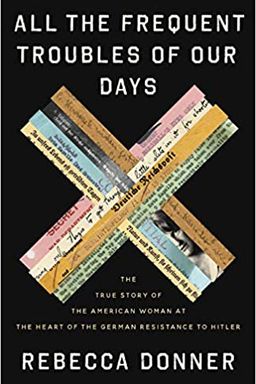
All the Frequent Troubles of Our Days cover

All the Frequent Troubles of Our Days

by Rebecca Donner

All the Frequent Troubles of Our Days unveils the extraordinary courage of Mildred Harnack, an American woman who played a pivotal role in the German resistance against Hitler. Through meticulous research and gripping narratives, this book reveals her unyielding fight for justice and the ultimate sacrifice she made for freedom.

Courage and Conscience in a Totalitarian Age

What does moral courage look like when the state itself becomes criminal? In this narrative of the Harnacks, the Circle, and the Red Orchestra, you watch ordinary intellectuals, artists, and bureaucrats resist Nazism from within the belly of the regime. The book argues that resistance was not born in sudden defiance but in disciplined thought, cultural community, and a stubborn faith in human dignity. It presents the Harnacks as both symbols and strategists—people who turned literature, conversation, and scholarship into instruments of defiance.

Moral and Intellectual Origins

You begin in the early 1930s, when Mildred Harnack, a young American scholar from Wisconsin, arrives in Berlin to teach English and American literature. The city hums with political tension. Mildred, teaching Emerson and Mill, nurtures a moral imagination that becomes, over time, a political one. Her classroom at the Berlin Night School for Adults (BAG) becomes a meeting ground for disillusioned workers and students. There, she connects art and ethics—showing how Whitman’s democratic humanism or Gandhi’s nonviolence can apply under fascism. The lesson is implicit: before rebellion, there must be education.

Her husband, Arvid, an economist from a prestigious German family, mirrors her in intellect but complements her in strategy. Where Mildred builds trust through teaching, Arvid infiltrates the machinery of the Nazi state. When he accepts a post in the Ministry of Economics, he embarks on a double life: outwardly a loyal official, inwardly a conduit of intelligence to both Soviet and American networks. This dual trajectory—of moral persuasion and espionage—forms the heart of the book.

How Culture Became Camouflage

The early resistance used culture as both tool and veil. BAG classrooms, poetry discussions, and songs (“John Brown,” “Clementine”) disguised recruitment. Safe houses like Hasenheide 61 or small walks in the Tiergarten acted as covers for political dialogue. The Circle grew from these cultural roots: workers, artists, and teachers binding around Mildred’s quiet but commanding presence. As the Nazi regime tightened control of speech and press, the Harnacks’ network transformed language itself into subversion.

The book situates their defiance against a state built on propaganda, and thus against Joseph Goebbels’s total control of the narrative. Goebbels’s “People’s Radio” saturates homes with Hitler’s voice, while literary censorship extinguishes dissent. In this environment, the simple act of reading foreign newspapers or translating forbidden texts becomes criminal courage. Resistance is not only about acts of sabotage but about keeping critical thought alive (a parallel to Václav Havel’s “living in truth”).

Networks and Espionage

From their flat at Woyrschstrasse 16, the Harnacks become central nodes linking the intellectual Circle with international actors. They host diplomats like Donald Heath and his family, transforming social dinners into sites of coded information exchange. The Heaths’ son, Don Jr., with his blue knapsack, becomes an informal courier—illustrating how even domestic life becomes operational. Arvid’s infiltration deepens: under code names “Balt” and later “Corsican,” he passes economic intelligence to Soviet handler Alexander Korotkov. His moral conflict grows: to fight evil, he must wear its uniform, even joining the Nazi Party under false loyalty.

The narrative also widens beyond Berlin. Contacts like Harro and Libertas Schulze-Boysen link them to other circles producing leaflets under signatures like AGIS. Others—Cato Bontjes van Beek, Greta Kuckhoff—transform art studios and film stock into printing shops for the underground paper Der innere Front. These cultural interventions ripple outward, asserting moral sovereignty against a state that demands complicity.

Fatal Turns and State Repression

As Nazi counterintelligence matures, the resistance faces fatal vulnerabilities. The Funkabwehr (radio defense) intercepts their transmissions to Moscow. A cipher slip—misused call signs, reused key words, a discovered book—gives Wilhelm Vauck’s cryptanalytic unit everything needed to reconstruct communications. What began as invisible resistance becomes traceable radio patterns. Arrests cascade in 1942, with the Harnacks, Schulze-Boysens, Coppis, and many others swept into Gestapo custody. The machinery of terror, fine-tuned in the Enabling Act and Schutzhaft decrees, performs its lethal ritual: interrogation, coerced confession, trial by Reichskriegsgericht, execution.

Mildred’s execution on February 16, 1943—after Hitler personally overturns her six-year labor sentence—is the moral apex of the story. It underscores the regime’s hatred of intellectual dissent, especially from a foreign-born woman who had dared to teach Germans to think independently. Yet her death also completes her transformation: the teacher of literature becomes the test case of conscience itself.

What Endures

The book closes with a meditation on legacy. Resistance, it shows, is rarely clean or coherent. The Harnacks’ link to Soviet intelligence invites moral ambiguity; the leaflets mix pacifist appeal with propaganda; their friends’ fates show that ideals can fracture under torture. Yet across these fractures runs a luminous thread—the conviction that truth, thought, and courage are acts of freedom even when they fail politically. In that sense, Mildred and Arvid’s story is as much philosophical as historical. It teaches you that ethics is not abstract: it’s a daily craft, practiced in words, friendships, and small, defiant acts even when the world grows dark.


Building an Underground of Ideas

The Harnacks’ movement begins not with bombs or sabotage but with conversation. The Berlin Night School for Adults, where Mildred teaches after losing her university post in 1932, becomes the incubation site. In that cramped classroom, ordinary Berliners read Emerson, Gandhi, and John Stuart Mill—and learn that moral reasoning itself can be a political act. Teaching under fascism, Mildred asks her students to imagine alternatives: What if conscience, not obedience, governed public life?

Recruitment through Culture

You see how this pedagogy turns into clandestine strategy. Books become bait. Lending a collection of Whitman or a Goethe translation invites conversation. Then follow the small tests of trust: a student’s reaction to pro‑Nazi remarks, a willingness to walk a different route home, the comfort of singing labor songs after class. This slow cultivation generates trust where political openness is lethal. The lesson: resistance germinates in culture long before politics matures.

The Circle’s first members—Karl Behrens, Samson Knoll, Greta Lorke—find each other through these classes. When meetings expand, they move into cafés, Tiergarten strolls, and apartments like Hasenheide 61. Each gathering operates under cover of normality: English practice, drama rehearsal, or book club. Yet every poem, quote, and question lays the foundation for eventual coordination.

Safe Patterns and Hidden Messages

As the group develops, secrecy becomes a discipline. Switching meeting locations prevents patterns. Notes travel folded into knapsacks or hidden in recipe books (The Proper Care of Cactus Plants is a favorite decoy). Micro‑leaflets copy texts onto postage‑sized paper; carbon sheets are burned after each run. Such methods blend everyday domestic life with subversion—proof that clandestine work can be profoundly ordinary in outward form.

Balancing Growth and Risk

By 1935, the Circle faces the classic problem of insurgent networks: expand and you gain reach, but also exposure. The Gestapo’s tightening dragnet by 1936 captures hundreds and millions of leaflets. Mildred adjusts by focusing on education and translation, sustaining moral clarity when overt action becomes suicidal. Her strength lies not in volume but in endurance—a model of intellectual resistance that outlasts louder rebellions.


Arvid’s Double Life

While Mildred’s resistance blossoms through teaching, Arvid constructs his behind-the-scenes counterpart. In 1935, he deliberately accepts a post in the Ministry of Economics under Hjalmar Schacht, embedding himself within Nazi bureaucracy to gather intelligence. Outwardly, he blends with the regime—wearing uniform, attending official dinners, and cultivating a calm loyalty that conceals his allegiance. Inwardly, he documents economic mobilization for war and channels it to Moscow and later Washington.

Espionage as Moral Strategy

Early Soviet connections develop through Alexander Hirschfeld and later Korotkov (alias Erdberg). Arvid’s code name, “Balt,” marks him in NKVD records. His choice to accept recruitment illustrates the pragmatic turn from cultural dissent to concrete espionage. He wrestles with a moral paradox: to defeat Nazism, he must impersonate it, becoming in German slang a “Rindersteak Nazi”—brown outside, red within.

At home, this duplicity weighs heavily. Long ministry hours, secret meetings, and periodic despair about compromised allies strain their marriage. Yet both he and Mildred understand the same principle: truth can hide behind masks if the mask serves liberty.

From Economics to Intelligence Networks

You follow Arvid’s transformation from civil servant to rezident—an illegal agent coordinating contacts across industry. He manages sources in the Deutscher Klub and channels memoranda about the Four‑Year Plan, rearmament schedules, and trade data. In late 1941, when Moscow demands direct radio communication, he reluctantly accepts both funds and technical burden, effectively becoming “Corsican.” This willingness to formalize contact crosses his personal red line but ensures ongoing intelligence flow amid Hitler’s invasion of the USSR.

The Ethics of Camouflage

Arvid’s story forces you to ask whether ethical disguise becomes moral compromise. Is it righteous to don a swastika to undermine its wearer? The book doesn’t resolve this; instead, it reveals espionage as tragic necessity. His infiltration yields crucial insights for the Allies yet exposes both himself and Mildred to fatal suspicion once security fractures. The double life achieves its goal only at the cost of life itself.


Allies, Children, and the Web of Trust

The Harnacks’ genius lies in their ability to turn everyday social rituals into circuits of trust. The American embassy community—particularly Donald and Louise Heath—becomes a lifeline. Through embassy luncheons and polite chatter, political intelligence crosses invisible lines. When young Don Heath Jr. begins carrying Mildred’s slips of paper inside a blue knapsack, resistance sheds any illusion of glamour. It becomes a family affair, intimate but perilous.

Child Couriers and Small Acts

Don’s routes across Berlin—Nollendorfplatz to Woyrschstrasse 16—embody operational subtlety. Mildred’s tutoring cover masks the transfer of notes disguised as recipes. His mother times trips and monitors surveillance, knowing that Goebbels’s agent network snakes through apartment buildings. Every detail—train stops memorized, detours through KaDeWe—shows how espionage adapts to domestic reality. Small hands carry large moral weight.

Women, Diplomats, and Intermediaries

Around the Harnacks orbit a constellation of intermediaries. Martha Dodd, daughter of Ambassador William Dodd, enters their social scene as both literary companion and later a Soviet informant. Her recruitment by the NKVD under Yezhov’s purged apparatus exposes the inherent chaos of international intelligence—where love affairs mutate into betrayal. Through Martha, you glimpse the costs of divided loyalties. Soviet purges of agents like Boris Vinogradov and structural paranoia in Moscow cripple the very networks Arvid depends on, foreshadowing fatal isolation.

Trust as Infrastructure

The Harnacks’ operation ultimately is built on interpersonal trust across social and national lines. Their dinners, language lessons, and shared songs transform hospitality into political infrastructure. When surveillance corrodes every public institution, friendship becomes the final form of freedom.


Words as Weapons: Leaflets and Propaganda Wars

The AGIS leaflets and the underground paper Der innere Front demonstrate that ideas could wound militarism as effectively as sabotage. Writers like Libertas Schulze-Boysen and Cato Bontjes van Beek mobilize mimeographs, gelatin pads, and reclaimed film stills to expose Nazi lies. These were campaigns of conscience, crafted from the belief that propaganda must be fought with truth.

AGIS and Moral Rhetoric

Signed “AGIS,” after the Spartan reformer Agis IV, these leaflets denounce Goebbels’s machinery and call for worker sabotage of armaments. Addressed to priests, journalists, and even Nazi officials, they weaponize the intellectual voice. Readers encounter six‑page indictments urging them to rethink obedience. Each copy risks its author’s life; each paragraph is an act of clarity against the fog of terror.

Printing and Distribution

Distribution networks mirror military logistics: stamps purchased singly to avoid trace, copies smuggled through subway kiosks, posters plastered across the Lustgarten at night. Courts later label these crimes of “defeatist agitation.” Yet the networks of culture—students, neighbors, clerks—prove resilient enough to sustain circulation until arrests begin.

Propaganda as Battlefield

By fighting propaganda with alternative media, the Circle contests the foundation of totalitarian control: narrative monopoly. Their actions forecast later movements—the samizdat of Soviet dissidents, the pamphlets of civil rights activists—showing that speech under tyranny remains the most subversive act possible.


Signals and the Fall of the Orchestra

The Red Orchestra—name given by the Gestapo to the interlinked Berlin networks—confronts its undoing through technology. Radios and ciphers, once symbols of unity with Moscow, become vectors of exposure. The tale of these devices reads like tragic inevitability: the very connections meant to empower resistance illuminate it to its hunters.

Anatomy of the Transmissions

Two transmitters, one portable and one mains-powered, serve multiple operators (Hans Coppi, Karl Behrens). They encode messages using a numeric checkerboard and a running-key cipher derived from a French novel—Le Miracle du Professeur Wolmar—with the keyword “Proctor.” When Hans emits the wrong call sign, Funkabwehr pinpoints irregular frequencies. Their intercepts, forwarded to Wilhelm Vauck, eventually reveal patterns that German cryptanalysts exploit.

How the Cipher Broke

A seizure in Brussels uncovers a half-burned code pad and the key book itself. With this, the cipher collapses. The invisible conversation between Berlin and Moscow, which had carried economic reports, resistance summaries, and warnings about German war plans, becomes legible to the enemy. Within weeks, addresses and identities pour into Gestapo files.

Consequences

Arrests ripple across Europe. The Gestapo’s photography albums record faces before executions. The Red Orchestra—so named because “conductors” (radio operators) transmitted to “Moscow Center”—is silenced. Technical fragility becomes metaphor: freedom’s survival depends on discipline and luck as much as on virtue.


Trials, Torture, and Memory

After the cipher break, resistance crumbles under the Gestapo’s procedural terrorism. The arrests of 1942–43 illustrate how fascism converts law into instrument of annihilation. At Prinz-Albrecht-Strasse 8, interrogators orchestrate pain under paper cover. Files, fingerprints, and coerced signatures replace justice with documentation of cruelty.

The Machinery of Repression

Interrogators like Kopkow and Habecker apply both mechanical and psychological torment. Prosecutor Manfred Roeder then scripts “trials” before the Reichskriegsgericht, where defense lawyers cannot speak freely and verdicts require Hitler’s endorsement. Everything—the minutes, photographs, and typed confessions—is curated theater. The regime stages legality to sanitize vengeance.

Final Sentences

In December 1942, Harro and Libertas Schulze-Boysen and several co-defendants are executed. Mildred’s first sentence—six years’ hard labor—is insufficiently harsh for Hitler; he orders retrial and beheading. Arvid’s fate mirrors hers. Their end, though judicially scripted, reverberates beyond Germany: in Allied briefings, in American newspapers, and later in scholarly efforts to reclaim their dignity.

Legacy

Postwar recognition is uneven. Soviet narratives lionize them as communist martyrs; American memory hesitates, unsure how to honor a woman tied to Soviet contact. Yet their significance transcends ideology. They embody the moral line that endures when politics fails: truth spoken quietly, preserved even through death.

Dig Deeper

Get personalized prompts to apply these lessons to your life and deepen your understanding.

Go Deeper

Get the Full Experience

Download Insight Books for AI-powered reflections, quizzes, and more.