
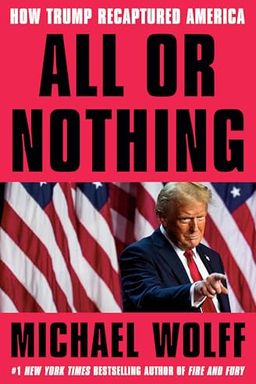
All Or Nothing cover

All Or Nothing

by Michael Wolff

The author of “Fire and Fury” depicts what happened behind the scenes during the 2024 Trump presidential campaign.

Court, Spectacle, and Power After Defeat

How does a defeated president keep governing in everything but law? In this book, Michael Wolff argues that Donald Trump survives—and thrives—by fusing court politics, media production, and legal peril into a single operating system. He builds a personalized court at Mar‑a‑Lago, turns prosecutions into fundraising engines, and treats the courtroom as a campaign stage. If you want to understand his post‑2020 power, you have to stop separating law, media, and politics; in this world, they are the same arena.

Mar‑a‑Lago as the engine of continuity

Wolff’s core frame is simple: picture Mar‑a‑Lago as a substitute White House. Secret Service details, nightly applause lines on the terrace, and a ritual schedule recreate the presidency’s aesthetics. Inside this court, staffers act like aides, members like courtiers, and visitors like petitioners. People who bring Trump pleasing news—Boris Epshteyn, Natalie Harp with her backpack printer, Susie Wiles managing the flow—get proximity and influence. That feedback loop sustains the illusion that the job never ended and shapes decisions you later see onstage and in court.

The court attracts an eclectic cast—Mike Lindell, Sean Hannity, Jon Voight, and would‑be media moguls pitching fantastical ventures. It also draws donors and fixers (Nelson Peltz, Ike Perlmutter, John Paulson) who shuttle between politics and business deals. The result is a self‑validating ecosystem where loyalty is currency and performance is policy. (Note: this resembles classic court histories more than modern party machines; the etiquette of access replaces institutional process.)

Legal strategy equals media strategy

From his first post‑presidency skirmishes, Trump adopts an explicit rule: “Our legal strategy is our media strategy; our media strategy is our legal strategy.” Indictments become content; content becomes cash. He pre‑announces looming charges to seize the framing, then floods friendly platforms with persecution narratives. The payoff is measurable: $22 million after the Mar‑a‑Lago search; $4 million in a day after the first indictment reporting; $34 million in six hours post‑verdict. Lawyers are selected as much for on‑camera bravado (Alina Habba’s courthouse steps) as for in‑court expertise (Todd Blanche’s uneven openings). You watch counsel become cast members, not just legal advisors.

The web of prosecutions and the theater of trial

Wolff maps interlocking legal fronts: Manhattan DA Alvin Bragg’s falsified records case; the federal January 6 probe (Jack Smith); the Miami classified documents case (Judge Aileen Cannon); Georgia’s RICO prosecution (Fani Willis); New York’s civil fraud action (Letitia James before Judge Arthur Engoron); and the E. Jean Carroll civil suits. These cases cross‑pollinate—flipped co‑defendants like Sidney Powell and Kenneth Chesebro ripple outward; one courtroom’s headlines shape another’s schedule. You see delay tactics (presidential immunity claims, gag‑order brinkmanship) pursued as political strategy: push trials past Election Day, and the legal risk becomes electorally negotiable.

At 100 Centre Street, the Manhattan criminal trial reveals the hybrid model: prosecutors (Joshua Steinglass) build a methodical chain—Access Hollywood fallout → catch‑and‑kill with David Pecker → Michael Cohen’s $130,000 to Stormy Daniels → Allen Weisselberg’s reimbursement notes—while Trump stages hallway pressers to convert rulings into rally lines. No courtroom TV? He answers with daily camera scrums and Natalie’s curated clips. The same witnesses who fortify the record (Pecker, Cohen, Stormy, Hope Hicks) also power the nightly news cycle.

Production politics and internal warfare

Campaign production operates like a movie set. Justin Caporale designs shots—motorcades, helicopters, mug‑shot merch—so every legal date becomes a made‑for‑TV moment. Super‑PACs and a billionaire circuit convert outrage into liquidity (and, in tight moments, lifelines like the TMTG SPAC). Meanwhile, inside the tent, infighting and leak wars are constant. Susie Wiles and Chris LaCivita impose discipline, but rivals—Boris Epshteyn, Natalie Harp, Alina Habba, Corey Lewandowski, and outside influencers like Perlmutter—bypass chains of command by appealing directly to the boss’s instincts.

Inflection points and the endgame

A string of shocks reshapes the race: Biden’s debate collapse and the Democrats’ pivot to Kamala Harris; the Butler assassination attempt that recasts Trump as survivor; the Philadelphia debate where moderation frictions and Trump’s misfires change momentum; and a Supreme Court presidential‑immunity ruling that scrambles timelines. The VP choice of JD Vance, a streamlined RNC platform, and Melania’s carefully managed appearances complete the theater. Election Night returns deliver a narrow but real path—and the transition reprises the campaign’s hallmarks: loyalty over hierarchy, spectacle over process, and Boris reemerging as the “new Roy Cohn” while Wiles ascends to chief of staff.

Thesis in one line

To understand Trump after 2020, treat law, media, and politics as one stage—Mar‑a‑Lago is the theater, indictments supply the script, and fundraising counts the applause.

For you, the lesson is broader than one figure. In an attention economy, a leader can replace institutional constraint with spectacle, convert court pressure into cash, and run a campaign that looks less like a policy platform and more like a streaming channel. (Compare to Joan Didion’s portrait of political pageantry or Joan Williams’s analysis of grievance politics; Wolff adds the live‑courtroom feed.) If you track only documents or only rallies, you’ll miss the fusion that powers the whole machine.


Mar‑a‑Lago: A Modern Court

Wolff asks you to see Mar‑a‑Lago not as a club but as a court—a place where ceremony, access, and flattery become instruments of power. After January 20, 2021, Trump scripts a continuous presidency here: Secret Service caravans, terrace ovations, and a retinue that mirrors the West Wing’s rhythms. If you want to predict decisions, don’t look first to policy memos—watch who gets face time on the patio and who rides in the golf cart.

How the court governs reality

The court’s core function is narrative reinforcement. Bring Trump the story he wants—polls showing dominance, donors ready to underwrite legal bonds, clips blaming prosecutors—and you earn proximity. Natalie Harp’s backpack printer symbolizes this architecture: she collects friendly coverage, prints curated headlines, and feeds them into Trump’s daily loop. That curated media diet becomes operational reality. Inside this zone, the 2020 election is still “stolen,” every prosecutor is “political,” and each courtroom setback is actually “election interference.”

This closed circuit attracts a menagerie. You see entertainers (Jon Voight), brand entrepreneurs (Mike Lindell), TV allies (Sean Hannity), and political operatives (Susie Wiles, Justin Caporale). Each contributes to the spectacle that sustains status. The culture is self‑sealing: nightly applause rituals tell Trump the audience loves the show; staff echo lines back; visitors post selfies that certify proximity. In this environment, concession is inconceivable—it would collapse the stage set.

Gatekeepers, courtiers, and rivals

Proximity is policed by gatekeepers. Boris Epshteyn guards the legal entrance, often favoring on‑message lawyers over meticulous ones. Susie Wiles and Chris LaCivita try to impose calendar discipline and strategic boundaries. Justin Caporale directs optics—framing walk‑ons, stewarding camera angles, and turning arraignments into content. Around them orbit would‑be rivals like Corey Lewandowski and outside patrons like Ike Perlmutter, who can tilt access with a whispered critique or well‑placed dinner invite.

Internal disputes play out as leak wars. The Scottsdale bodycam leak that embarrassed Boris, Daily Mail profiles stirring questions about consulting fees, and whispers about budget figures for LaCivita—all operate as weapons. In this court, leaking is not just press management; it is palace intrigue. (Parenthetical note: you can read this like a Versailles chronicle—factional strife subbing for formal audits.)

Donor dinners as command performances

Palm Beach fundraisers and Mar‑a‑Lago dinners double as auditions. Nelson Peltz convenes power tables; John Paulson hosts big‑ticket soirees; Elon Musk’s platform talk hovers in the background. These events accomplish three things: they validate the court’s prestige, they create content (selfies, leaked guest lists), and they provide liquidity when legal costs spike (for example, after Judge Engoron’s nine‑figure fraud ruling). The TMTG SPAC offers a separate lifeline—converting a platform into public‑market value that can be pledged against crises.

How this court shapes governing style

Because access flows through loyalty and theatrics, competence often loses to devotion. Alina Habba earns praise lines for media combat even when courtroom wins are scarce; Todd Blanche, who avoids fireworks, draws ire after flat moments. Wiles and LaCivita thread a needle: they keep the machine moving while insulating operations from courtiers who stoke impulses. Decisions—VP choice shortlists, debate participation, convention platform edits—often reflect who last made the most emotionally resonant pitch, not a long spreadsheet analysis.

Key dynamic

Mar‑a‑Lago is a feedback engine: amplify the preferred story, gain the king’s ear; challenge the story, lose the room.

For you, the takeaway is practical. In personality‑centric systems, the room reshapes the leader as much as the leader shapes the room. If you want to predict where policy or legal posture goes next, chart proximity patterns—who dines at the table, who staffs the motorcade, and whose memes get reposted. In Wolff’s telling, the court isn’t background color; it is the operating system that merges fundraising, messaging, and legal brinkmanship into a single agenda.


Law‑as‑Media Machine

The book’s most explicit claim is doctrinal: “Our legal strategy is our media strategy; our media strategy is our legal strategy.” You don’t watch a traditional defense here; you watch a content pipeline that monetizes risk. Indictment rumors become event programming. Courthouse steps become sets. Court filings become email subject lines. The aim is not just acquittal; it is public resilience—keep the base mobilized and the small‑dollar donors hot.

Tactics that turn law into fuel

First, seize the frame. When Trump pre‑announces an indictment, he converts a news leak into his story. That post begets overnight hits: cable talkers echo it, allies record segments, and email blasts pair outrage with donate buttons. Second, ritualize persecution. Every search, subpoena, or gag order feeds the same line: “election interference.” That turns complex legal facts into a moral binary—us versus them—ideal for fundraising copy. Third, stage the picture. Justin Caporale’s motorcades, hotel backdrops dressed like an Oval Office, and perfectly timed walk‑ins make bad days look cinematic.

The data supports the method: $22 million in the quarter of the Mar‑a‑Lago raid; $4 million in twenty‑four hours after the Bragg indictment reporting; post‑verdict booms cresting into eight‑figure days. Merchandising multiplies the effect—the Atlanta mug shot becomes a brand icon (“NEVER SURRENDER”) across T‑shirts and mugs, transforming humiliation into identity.

Counsel as cast

If media is part of your defense, you don’t just want elite technicians; you want characters who can carry scenes. That’s why Boris Epshteyn, a sentence‑finisher and flattery specialist, survives stumbles; why Alina Habba becomes a star at court microphones; and why Todd Blanche gets crosswise with the boss after cautious courtroom moments. Joe Tacopina exits after the E. Jean Carroll case; Chris Kise burns capital in the New York fraud fight; Cliff Robert is mocked for pace. This is casting logic as much as staffing.

Gag orders become props. Judges like Juan Merchan (Manhattan) and Arthur Engoron (New York civil fraud) impose boundaries; the campaign answers with hallway rants, surrogate blitzes, and Natalie Harp’s repost pipeline. The more the court tightens rules, the more the operation claims speech suppression—and the more donation links ping phones. (Note: compare to legal‑PR hybrids in high‑profile celebrity cases; here the stakes are electoral, not just reputational.)

Why this works—and where it breaks

The formula thrives in a fragmented media landscape. Friendly networks (Fox) amplify his lines; adversarial outlets supply foil and outrage. Social platforms convert micro‑scandals into micro‑donations. For a base primed to distrust institutions, courtroom friction proves the story. Yet the approach has costs. Judges notice attacks. Gag order violations risk contempt. Prosecutors adapt, building cases through documents (Weisselberg’s marginalia) less vulnerable to witness‑credibility warfare. And public theatrics can harden a judge’s posture in rulings.

Tactical core

Transform legal peril into attention; transform attention into money; use the money to survive long enough for political timelines to overtake legal ones.

For you as a voter or strategist, the implication is stark. Fact‑finding now happens in two courts—law and opinion—and verdicts can diverge. A narrow legal loss can coincide with a political win if the base reads it as martyrdom. Conversely, a quiet legal victory without spectacle yields little political payoff. If you analyze modern campaigns, you need to track not only filings and rulings but also the production calendar—when posts go up, which surrogates hit TV, and how fast merch lands in the store. That is the real case calendar in Wolff’s account.


Prosecution Web and Theater

Wolff’s legal map is sprawling: criminal, civil, federal, state—each case a lane that merges into a single superhighway of pressure. The novelty isn’t just the number of dockets; it’s how they interact with politics and with each other. You watch a defendant‑candidate run from arraignment to rally, from deposition to donor dinner, carrying the same grievance story across forums.

The interlocking cases

Start in Manhattan with Alvin Bragg’s falsified business records prosecution, the first criminal case against a former U.S. president. Move to Miami’s “boxes” case in Judge Aileen Cannon’s courtroom, focused on classified documents at Mar‑a‑Lago. Layer on Jack Smith’s January 6 case in D.C., alleging attempts to obstruct the 2020 certification. Add Fani Willis’s Georgia RICO indictment, netting co‑defendants whose decisions (Sidney Powell, Kenneth Chesebro flipping) reverberate across venues. Then watch New York’s civil fraud suit by Letitia James under Judge Arthur Engoron impose a crushing monetary judgment—hundreds of millions—that threatens business oxygen. Include E. Jean Carroll’s civil wins that fold a sexual assault narrative into the file.

These tracks cross. A damaging admission in one courtroom becomes fodder in another. Scheduling fights in D.C. cite noise in Manhattan. Defense motions in Florida point to publicity storms elsewhere. Immunity appeals become a master key—delay January 6, and the Manhattan sentencing window shifts, which alters campaign calculus. Even flips and plea deals carry across narratives—once‑loyal lieutenants become archetypes of betrayal on camera and, potentially, star witnesses on paper.

Manhattan’s show trial—legally narrow, politically vast

At 100 Centre Street, you see the hybrid in high relief. Prosecutors (Joshua Steinglass) proceed like carpenters: build the frame from Access Hollywood panic, add beams with David Pecker’s catch‑and‑kill program, then bolt on Michael Cohen’s $130,000 payment to Stormy Daniels and Allen Weisselberg’s reimbursement notes. Witnesses supply color and credibility: Stormy’s narrative humanizes sleaze; Hope Hicks’s emotional testimony links campaign preservation to crisis management. Documents corroborate memories, blunting defense attacks on character (Cohen’s crimes, Pecker’s tabloid trade).

The defense strategy, fronted by Todd Blanche, is to reduce the cast to unreliable narrators and recast the scheme as routine celebrity damage control. But the prosecution’s felony theory—false records in service of an unlawful campaign aim—turns tawdry into consequential. Without courtroom cameras, the politics plays out in hallways and on phones: one minute of photographs of a heavy‑lidded, motionless defendant; then, outside, a flurry of denunciations about a gag order that “muzzles” a candidate.

Calendar as battleground

Legal timing is political substance here. Appeals on presidential immunity creep upward to the Supreme Court, threatening to kick big trials beyond Election Day. Judges weigh contempt risks against campaign speech claims. Gag orders tighten and loosen in cycles. Each continuance buys time for rallies, message testing, and donor cultivation. If the political clock runs out first, the courtroom’s eventual outcomes land in a different power context.

Interlocking risk

A plea in Georgia can become testimony in D.C.; a contempt flare in Manhattan can shape rulings in Florida. No case is fully siloed because the candidate, the facts, and the cameras are shared.

For you, the lesson is methodological: analyze the web, not a single node. Track who flips, which filings seek delay, what judges signal impatience, and how each headline becomes either a rally crescendo or a donation pitch. Wolff’s contribution isn’t to litigate elements; it’s to show how the law’s slow gears can—through media—spin a perpetual motion machine for politics.


The Inner Cast and Infighting

Wolff’s narrative is really a study of people—who gets to whisper in the candidate’s ear and under what conditions. If you expect the usual hierarchy of campaign and legal teams, you’ll be disoriented. Access in this world flows to those who perform loyalty and feed the narrative. Technical mastery is nice; unflinching affirmation is essential.

The lawyers: performance over prudence

Boris Epshteyn sits at the center as a legal‑political gatekeeper, absorbing blows (and embarrassing leaks) yet surviving because he mirrors the boss’s voice. Todd Blanche, a serious former SDNY prosecutor, struggles when his courtroom restraint doesn’t deliver theatrics. Alina Habba thrives in the spotlight outside, becoming a favorite even as courtroom wins remain elusive. Joe Tacopina’s cautious posture after the E. Jean Carroll loss spells exit; Chris Kise absorbs hits in Engoron’s civil fraud arena; Cliff Robert, representing the sons, gets lampooned for pace.

The pattern is consistent: praise for aggression, punishment for caution. When Blanche can’t produce a fiery opening, Trump blames him. When Habba slashes at microphones, Trump applauds. Counsel are not just advocates; they are characters expected to play to a base that reads vigor as virtue. (Note: this flips the traditional counsel‑client norm, where lawyers curb risky impulses.)

Campaign adults versus court favorites

Susie Wiles and Chris LaCivita, the stabilizers, run the most organized Trump campaign to date—tight schedules, iron discipline, efficient RNC coordination. Yet they constantly fend off rivals who appeal directly to Trump: Natalie Harp (the ever‑present media aide with a printer), Boris (the consigliere), Alina Habba (the combat‑ready face), and Corey Lewandowski (the perennial insurgent). Outside patrons like Ike Perlmutter influence from the wings, nudging personnel and priorities.

Infighting isn’t a side effect; it’s how power moves. Lewandowski’s attempted sweep into HQ, alleged leaks about LaCivita’s receipts ($19–22 million), and the Daily Mail’s profiles are power plays disguised as press. Wiles and LaCivita survive by proving control under fire and by delivering wins—the calendar holds, the rallies fill, the money flows. But no victory is secure; a single flattering phone call can reroute a week’s plan.

Information control as emotional management

Natalie Harp’s letters, curated clippings, and instant prints do more than feed posts; they stabilize Trump’s mood. When he fixates on judges (Merchan, Engoron) or prosecutors (Bragg, James), the inner circle reframes the story as proof of martyrdom. Emotional management becomes strategic management. If you wonder why gag‑order fines are treated like production costs, this is why—the team prices them into the show.

Power rule

In this ecosystem, proximity beats position. The org chart matters less than whoever can text the boss at 1 a.m. with the line he wants to hear.

For you, the analytic move is to track ear‑time, not titles. Who escorts Trump between the elevator and cameras? Whose talking points show up in the next post? Which leak harms which rival? Personnel stories in Wolff’s book aren’t gossip; they are the best leading indicators of upcoming strategic lurches and, sometimes, of legal disasters.


Production Politics: Rallies & Money

Wolff reframes the campaign as an entertainment enterprise that produces moments for continuous consumption. The unit of currency isn’t a policy plank; it’s a clip. Events are sets, indictments are trailers, and rallies are the feature film. If you can dominate the feed, you can dominate the race—even when the legal news is terrible.

How the show is built

Justin Caporale choreographs visuals: motorcades that feel presidential, helicopters overhead, and Manhattan hotel rooms staged as statecraft recesses during arraignments. The team times counter‑programming—rallies during opponent debates—to control the narrative frame. Digital operators push meme warfare: the “lifts” saga to needle Ron DeSantis, chocolate‑boot props, and rapid‑fire clips drawn from Natalie Harp’s curated prints. Each micro‑story keeps the base energized and opponents off‑balance.

Then comes the merchandising masterstroke: the Atlanta mug shot. “NEVER SURRENDER” turns a booking photo into a movement logo. Legal shame converts into cultural capital, then into dollars. The metrics prove it: $34 million in six hours, $53 million in one day after the Manhattan guilty verdict; donors open wallets precisely when prosecutors drop charges or judges issue rulings. Outrage becomes scarcity; scarcity becomes sales.

Amplifiers and foils

Friendly media (Fox) acts as a megaphone; adversarial press (The New York Times, CNN) functions as foil. Trump obsesses over which anchors deliver lines cleanly and which networks must be battled for sport. Celebrity cameos (Hulk Hogan, Kid Rock) add pop resonance; platform figures (Tucker Carlson, Elon Musk) widen reach. Even misfires, like comedian Tony Hinchcliffe’s Puerto Rico quip at Madison Square Garden, feed the cycle—controversy fuels the next wave of content and grievance framing.

Super‑PAC machinery (MAGA Inc., Right for America) and donor circuits translate spectacle into scale. Fundraisers at John Paulson’s and Nelson Peltz’s homes validate the brand and ensure liquidity during legal surges (like Engoron’s judgment). The TMTG SPAC, if it pops, offers access to a capital market beyond campaign law constraints—an emergency valve if bond deadlines loom.

The assassination attempt and heroic framing

The Butler shooting becomes the campaign’s apex image: Trump the survivor, blood‑streaked but defiant. The operation pivots instantly—rally scripts, convention imagery, donor appeals—so the near‑tragedy becomes triumph. Sympathy and awe flood in, and the candidate’s age narrative flips from frailty to fortitude. (Historical echo: leaders from Reagan to Giffords saw approval bumps after surviving attacks; Wolff shows a hyper‑mediated version of that pattern.)

Spectacle logic

You don’t have to win every policy argument if you can own every picture.

For you, the practical insight is blunt: in an attention market, production value is persuasion. If you’re advising opponents, memos and white papers won’t beat a nightly show; you need counter‑spectacle or new distribution that breaks the outrage-to-donation circuit. If you’re a citizen, guarding your attention—deciding which moments deserve your clicks—is a political act.


VP Vance, Convention, Platform

The vice‑presidential choice and the party convention reveal how personnel, donors, and imagery converge. JD Vance’s selection, a thin policy platform, and tightly scripted RNC theatrics show a campaign that prizes alignment and optics over coalition‑balancing checklists. You watch a test of who can persuade Trump most effectively inside the court—and who can make the picture look inevitable on TV.

The vetting process—chaos as method

The list shifts daily: Marco Rubio’s Florida calculus, Doug Burgum’s donor‑friendly competence (pushed by Rupert Murdoch), Bill Hagerty’s reliability, Kristi Noem’s base appeal, and JD Vance’s Peter Thiel‑backed intellectual cred. Susie Wiles tries to keep rails on; outside influencers lobby hard. The decision emerges less from spreadsheets and more from persuasion theater—who turns up with the right mix of loyalty, rhetorical comfort, and donor acceptance.

Vance offers an unusual blend: tech‑adjacent donors in his corner, an author’s sheen (Hillbilly Elegy), and a recent conversion from skeptic to acolyte. Risks come baked in—archival clips to spin, the age contrast that makes Trump look older, and opportunism charges. But the selection tells loyalists and elites alike: the movement can have brains and brawn, with Trump still the headliner.

Convention as coronation—and crisis sandbox

The RNC aims for unity and momentum: polished videos, celebrity walk‑ons, and a platform light on controversy. Last‑minute scrubs remove Project 2025 triggers; Trump personally edits planks in all caps. Melania’s ambivalence forces careful staging—limited appearances, maximum effect (her surprise role at Madison Square Garden later reprises this constraint). Rogue elements (Laura Loomer sightings) and platform edits underscore the tightrope: energize MAGA without spooking swing voters.

Then the Butler shooting reframes everything. The convention pivots to survival and providence; the heroic arc powers prime‑time. The show regains inevitability—less debate about policy, more awe at resilience. If you diagram the week, you’ll see a masterclass in narrative capture after a shock.

Platform minimalism as strategy

Rather than litigate every culture‑war position, the campaign streamlines. A thinner platform limits attack lines and preserves flexibility for the general. It also centralizes message authorship—if Trump writes it (and Vance sells it), there are fewer cross‑pressures from interest groups. (Note: this departs from platform maximalism of earlier GOP conventions and mirrors branding logic—fewer SKUs, stronger shelf impact.)

Convention logic

The goal isn’t policy exposition; it’s image consolidation—bind donors, activists, and swing viewers to a single, heroic storyline.

For you, the VP‑and‑RNC arc shows how modern campaigns manage risk: pick a running mate who complements optics, keep the platform laconic to avoid alienating micro‑audiences, and be ready to re‑script the show within hours when history intervenes. It’s less a convention than a live brand summit—one that previews governing style: centralized message, loyalty first, and a taste for big set pieces.


Turning Points and Endgame

The race hinges on a cascade of jolts that Wolff strings into a cause‑and‑effect chain. One bad debate night, one bullet’s graze, one Supreme Court ruling, one misfired TV performance—each pivot reweights the polls, the money, and the mood. If you only watch averages, you’ll miss the hinge moments where the campaign either captures or loses the story.

Biden collapses, Harris surges

Joe Biden’s debate implosion detonates the Democratic narrative. Within days of the RNC, the party pivots to Kamala Harris. That single media moment resets the map. Trumpworld must recalibrate—opposition research refocuses, messaging pivots to new contrasts, and debate prep assumptions evaporate. For you, it’s proof that one performance can undo months of careful positioning.

Butler shooting and heroic arc

The assassination attempt in Butler, Pennsylvania, flips Trump’s vulnerability into strength. The image—blood, fist, flag—becomes the campaign’s lodestar. Sympathy spikes, critics soften, and the convention narrative condenses to survival. The team moves from defense to triumphalism overnight. It’s the best example of the book’s thesis: control the picture, and you control the interpretation.

Philadelphia debate and narrative slippage

Against Harris in Philadelphia, moderation choices (real‑time fact‑checking disputes) and Trump’s flailing pivots produce a bad night. Backstage, the blame machine revs—ABC broke norms; moderators were biased. Onstage, the misfires give Democrats a second wind. The campaign responds with its standard toolkit—surrogates, friendly hits, reframing—but the moment shows that spectacle can cut both ways; you can lose a news cycle as fast as you win one.

Immunity ruling and the calendar reset

The Supreme Court’s presidential‑immunity ruling reshapes legal horizons. January 6 proceedings slow; Manhattan sentencing windows flex. The defense’s long‑game—delay into and past Election Day—suddenly looks plausible. The campaign translates legalese into messaging (“presidents must be free to act”), while the legal team adjusts filings to exploit the new terrain. Timing, once again, is substance.

In the final sprint, the Madison Square Garden rally aims to reboot momentum, only to birth a controversy (Tony Hinchcliffe’s Puerto Rico remark) that the team must quell and refract into culture‑war positioning. Election Night in Palm Beach is anticlimactic television—sparse, ritualistic—yet consequential; Fabrizio’s numbers show a path that holds. Then the familiar transition patterns reappear: Boris cast as Roy Cohn redux, Wiles tabbed as chief of staff, and a cabinet short list mixing loyalists and provocateurs (Matt Gaetz, Robert F. Kennedy Jr.).

Aftermath lesson

The skills that win the spectacle don’t automatically produce orderly governance; they often carry the chaos into office.

For you, the endgame teaches triage: watch for shocks, ask who controls the first 48 hours of narrative, and remember that the calendar—debates, rulings, rallies—can be as decisive as any single policy position. In Wolff’s story, victory is not closure; it is simply the next stage cue.

Dig Deeper

Get personalized prompts to apply these lessons to your life and deepen your understanding.

Go Deeper

Get the Full Experience

Download Insight Books for AI-powered reflections, quizzes, and more.