
Idea 1
Parenthood and the Rewritten Self
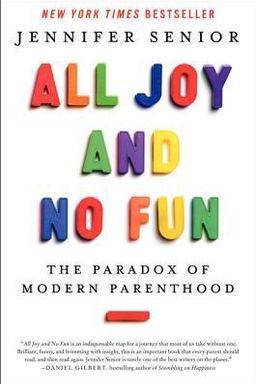
Jennifer Senior’s book explores how becoming a parent transforms not only your routines but your very sense of identity. Parenthood, she argues, is not just an addition to adult life but a complete reordering of autonomy, intimacy, attention, and meaning. You expect disruption, but you rarely anticipate its depth—the way the arrival of a child rewrites how you think about freedom, work, love, and legacy.
Senior builds her argument from lived scenes: kitchens at 3:00 a.m., couples negotiating who gets up with the baby, teens testing limits, and grandparents keeping traditions alive. Across those stories, she tracks the paradox at the core of modern parenting—you choose it freely, yet it constrains you profoundly. The book’s chapters unfold as a progression: from the loss of independence in infancy, through the fragmentation of attention and marital strain, to the competitive middle years and the crises of adolescence, ending with the quieter gifts of joy and meaning.
The Shock of Transition
Senior begins with sociologist Alice Rossi’s insight that there are no welcoming rituals for parenthood—the baby simply arrives, fragile and mysterious, and overnight your autonomous adulthood becomes an interdependent life. This abruptness hits harder in modern times because people often postpone parenting until they’ve spent decades cultivating independence. You remember the freedom to travel or experiment at work; suddenly you are responsible for another life, bound to schedules and emergencies.
Contemporary Amplifiers of Stress
Three developments heighten the strain: the illusion of choice, the intrusion of work, and the revaluation of children themselves. You choose parenthood expecting fulfillment (which makes disappointment sharper), you live with jobs that invade the home via laptops and phones, and you raise children who are no longer economically useful but emotionally priceless, investing more time and energy into fewer offspring. (Viviana Zelizer’s phrase explains that shift perfectly.) These forces make modern parenting both more intentional and more exhausting.
Relationships and Role Change
Marriage absorbs the shock first. Following Arlie Hochschild and John and Carolyn Cowan, Senior shows that the division of household labor remains the most consistent source of anger after childbirth. This imbalance isn’t purely numerical; it’s perceptual. Fathers think they do more than mothers believe they do, and satisfaction depends less on equality than on felt fairness. The arrival of children also shrinks couple-time—from twelve hours a week decades ago to nine or fewer—and transforms sex from a playful connection to an emotional checkpoint. The result is often quiet resentment rather than overt warfare.
Attention Fragmentation and Sleeplessness
Sleep deprivation erodes patience; multitasking destroys focus. Senior links this to Roy Baumeister’s theory of ego depletion: self-control is finite, and nights of fragmented sleep diminish the same resource you need to stay calm with children. Real stories illustrate the toll—Jessie Thompson editing photos past midnight or Angie Holder facing interrupted shifts. You don’t simply lose time; you bleed judgment, empathy, and energy. Understanding this helps couples treat exhaustion as a structural factor, not just character failure.
The Broader Landscape
As children grow, parental anxiety expands in proportion. Middle childhood becomes an arms race of organized enrichment—what sociologist Annette Lareau calls "concerted cultivation." Fewer kids mean more pressure to perfect each one, and safety fears turn play indoors into supervised management. Meanwhile, digital life amplifies social fragmentation. Families rely less on neighbors and more on networks, creating what Robert Putnam would call diminished social capital. Even friendships become scheduled events.
Adolescence and the Mirror Effect
Then adolescence hits, and everything intensifies. Laurence Steinberg’s studies show that adolescents amplify existing household dynamics—the salt in the stew. Their autonomy triggers parental identity crises: midlife reflection, marital projection, fear, and nostalgia. When mixed with digital transparency, parents face new dilemmas: whether to spy online, whether to trust, whether to intervene in behavior they barely understand. Technology makes secrecy accessible but also extends connection—college students still text parents daily, sustaining emotional dependencies long past childhood.
Recovering Meaning
Against this backdrop of fragmentation, Senior ends with redemption. Parenting hurts, but it grants depth: small daily tendernesses, moments of play, philosophical curiosity, and ultimately legacy. C.S. Lewis’s distinction between Need-love and Gift-love reveals how care ripens affection over time, while George Vaillant’s studies show that joy arises through connection, not pleasure. You remember the Cheerios on the counter because narrative memory gilds the hardship. Parents like Sharon Bartlett, facing terminal illness while arranging her grandson’s future, demonstrate parenting’s final promise—duty transformed into enduring meaning.
The whole argument leads to one insight: the happiness of parents is not simple. It’s braided with fatigue, fairness, and longing—but also with purpose, growth, and memory. You don’t parent for fun; you parent for meaning. Senior’s book teaches you how that meaning is earned, reclaimed, and retold through every stage of family life.