
Idea 1
Becoming an AI-Fueled Organization
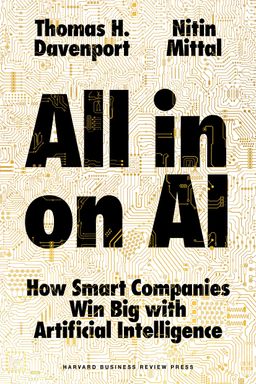
What would it look like if your company didn’t just use artificial intelligence for occasional experiments, but actually ran on it—every decision, every process, every product infused with intelligent systems? In All-in On AI by Thomas H. Davenport and Nitin Mittal, that’s exactly the question asked. The authors argue that the future belongs to organizations that go beyond isolated AI projects to become entirely AI-fueled learning machines, where the blend of human judgment and intelligent algorithms creates radical transformation. They contend that while most companies talk about AI, very few—less than 1%—have gone all the way. But those that do are already redefining competition, value creation, and the way people and machines work together.
You’ll explore what being AI-fueled means in practice: the components that make organizations truly powered by AI, from data and technology to leadership, culture, and ethics. You’ll discover stories of pioneers such as DBS Bank in Singapore, Ping An in China, and Airbus in Europe—traditional companies that transformed their operations by weaving AI into their very DNA. The book argues that being “AI-first” isn’t just strategy anymore; it’s survival. Whether you’re leading a global enterprise or a small firm, the lessons here show what’s required to thrive in the “Age of With,” where humans and intelligent machines actively collaborate.
From Experimentation to Transformation
Many organizations dip their toes into AI through pilot projects or prototypes, but as Davenport and Mittal emphasize, pilots don’t transform businesses. True economic value—and competitive advantage—comes only when models move into full production. AI-fueled companies deploy hundreds of models that reshape business processes, engage customers, and even create new business models. The authors describe how enterprises like Ping An, with massive datasets across insurance, banking, and health care, use machine learning to drive decisions in real time and learn from every transaction. Such organizations don’t just experiment; they evolve continuously, building what the authors call organizational learning machines—firms that learn from both data and human interactions faster than competitors can copy them.
The Human Side of AI Power
A surprising insight that runs through the book is that technology isn’t the hardest part of becoming AI fueled—people are. Leadership, culture, and skill-building determine success far more than algorithms do. The authors highlight leaders like Piyush Gupta, CEO of DBS Bank, who personally drives data transformation and creates incentives for experimentation. His mantra, “ROI too early kills experimentation,” captures the spirit of fearless exploration that fuels innovation. Likewise, companies like Airbus and Unilever retrain thousands of employees to understand data and AI fundamentals, proving that upskilling an entire workforce creates a stronger, smarter organization. The book insists that being AI-fueled means being human-centered, with ethics, trust, and learning embedded in the system.
Strategy Beyond Efficiency
It’s easy to think of AI as primarily about reducing costs and automating processes, but Davenport and Mittal show that the most advanced organizations go far beyond efficiency. They use AI to reinvent strategy itself. Some companies use AI to create entirely new businesses (Loblaw expanding into digital health), others to transform operations (Kroger using data science to redesign grocery experiences), and still others to influence customer behavior (Anthem guiding healthier lifestyles). The transformation isn’t just technical—it’s strategic and philosophical. By turning data into insight and insight into intelligent action, these companies become more adaptive and more creative.
The Learning Machine Mindset
Ultimately, being AI-fueled means becoming a learning machine—a company capable of evolving through feedback loops of data, decisions, and outcomes. DBS Bank’s chatbots, for example, learn from customer interactions to improve satisfaction and efficiency, while Ping An retrains machine learning models continuously to adapt to new markets. This mindset of scalable learning (a concept echoed by MIT’s John Hagel) allows organizations to turn experimentation into everyday operation. The authors conclude that these pioneers aren’t just using tools; they’re redefining what it means to be a company in an era where machines think and humans learn faster together.
For readers, the invitation is clear: Don’t wait for AI to become “standard.” Whether you lead a firm, manage a team, or shape digital strategy, the time to build a culture, strategy, and system that learn intelligently—with and through AI—is now. Because as Davenport and Mittal put it, in the near future, being AI-fueled won’t be about leadership—it will be about survival.