
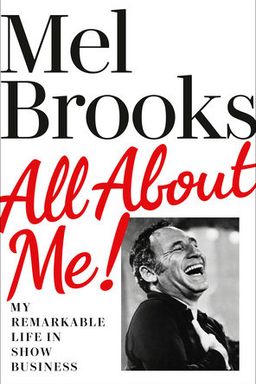
All About Me! cover

All About Me!

by Mel Brooks

All About Me! offers an engaging look at Mel Brooks'' illustrious career in show business. From his comedic roots in Brooklyn to his triumphs on Broadway and Hollywood, Brooks shares entertaining tales and valuable wisdom, revealing the passion and resilience that fueled his legendary journey.

Mel Brooks and the Architecture of Laughter

What does a life devoted to laughter teach you about fear, loss, and survival? Mel Brooks’s memoir unfold as both a personal odyssey and a manual for comic creation—one that turns childhood pain, military discipline, and show-business chaos into enduring art. Across decades, Brooks demonstrates that humor is not escapism but confrontation, a means to understand absurdity and defy despair.

You see a clear narrative arc: from the stoops of Williamsburg to the Catskills, from defusing mines in Europe to writing sketches for Sid Caesar, from breaking taboos in The Producers to orchestrating Broadway spectacle. Each phase adds a tool to Brooks’s comic laboratory—timing, resilience, collaboration, and an appetite for risk. Through these transformations, the book argues that comedy thrives on constraint and catastrophe. The scar becomes the punchline.

Roots: Pain, Protection, and the Neighborhood Stage

Mel’s humor originates in absence: the loss of his father and the chaos of Depression‑era Brooklyn. Jokes offered immunity—“If you make them laugh, you won’t get hit.” Every stoop, candy store, and theatre became a training ground for audience awareness. His mother Kitty’s song fragments and his brothers’ teasing shaped his musical ear and instinct for rhythm. You learn early that Brooks’s artistry stems from emotional scarcity managed by relentless invention.

Apprenticeship: Failure as Teacher

When young Mel shuffles trays in the Borscht Belt, comedy becomes manual labor. The mountains school him in the necessity of bombing: booing crowds, dead air, and recovery. He calls failure “corned beef hash—it stays with you.” This stage refines courage. The job of the tummler—keeping guests alive with laughter—instills his lifelong sense that comedy is nourishment as much as entertainment. These failures later equip him for live television’s brutal pace and film’s public risk.

Discipline and Depth from War

Brooks’s World War II years stretch his understanding of danger and control. As a combat engineer disarming mines in Europe, he learns precision and timing of a different sort. Performing for troops reveals humor’s function as morale and therapy. The same instincts that save lives—attention, adaptation—will later save scenes. His laughter is not denial; it’s an act of defiance against chaos.

From the Writers’ Room to Partnership

Sid Caesar’s writers’ room forms his creative crucible. Imagine forty weeks of live television demanding ninety minutes weekly: it forges a reflexive storyteller. Caesar becomes both patron and sparring partner, teaching him the ethics of humor—don’t go cheap; push to the ultimate punch line. Out of that cauldron comes a lasting friendship with Carl Reiner and the birth of the “2000 Year Old Man,” a comedy rooted in trust between performer and straight man. This collaboration embodies Brooks’s view that the best humor needs friction: one mind provokes, the other anchors.

Risk, Reinvention, and Control

The move from TV to film expands the stakes. The Producers uses outrageous satire—“Springtime for Hitler”—to test whether laughter can exorcise horror. Brooks insists on directing to protect tone and intent, an instinct traceable to the disciplined self-reliance he learned as a soldier and writer. Subsequent works—The Twelve Chairs, Blazing Saddles, and Young Frankenstein—deepen this logic: fearless subjects, formal fidelity, and collaboration as shield. Whether mocking racism or reviving Gothic cinema in luminous black‑and‑white, Brooks fuses respect for form with gleeful anarchy.

Creative Leadership and Legacy

Brooks’s career as producer and mentor (Brooksfilms) reveals a maturing philosophy: use success to shelter others. Projects like The Elephant Man or The Fly prove that credibility from comedy can finance gravitas. Throughout, Brooks remains a craftsman: shaping rhythm in the edit room, cutting two‑hour drafts to 90‑minute symphonies of timing. On stage, The Producers musical demonstrates the full circle—the movie that mocked Broadway becomes Broadway’s biggest hit. What unites all of it is a moral engine: laughter as survival, collaboration as faith, and precision as love.

Core message

If tragedy reveals humanity’s depth, comedy reveals its endurance. Brooks teaches you that every failure, constraint, and absurdity can become creative kindling—provided you keep rewriting, keep performing, and keep laughing at the terror that would silence you otherwise.


From Brooklyn Streets to Catskills Stages

Mel Brooks’s early life demonstrates how environments craft performers. The crowded stoops of Williamsburg substitute for classrooms: every conversation is rehearsal, every wisecrack an experiment. The absence of his father becomes emotional oxygen for humor. Kitty Kaminsky’s insistence on music and resilience turns sorrow into rhythm. You watch a kid transform playground competition into storytelling craft.

Learning Comedy as Survival

For Mel, humor equals safety. On the street, insults fly faster than punches, and the winner is whoever lands the funniest line. This sharpened his timing and empathy—skills later mirrored in the verbal duels of Caesar’s writers’ room. These experiences teach you that environments of scarcity often generate dense creativity: when you can’t buy attention, you earn it with laughter.

Apprentice in the Borscht Belt

The Catskills become Brooks’s first professional lab. As busboy, tummler, and occasional performer, he learns audience chemistry. Tough crowds teach him iteration—testing gags, revising instantly, embracing bombed sets as education. The principle of "embrace failure early" becomes a lifelong rhythm, echoed decades later when editing Young Frankenstein down from disaster to masterpiece after brutal previews.

The takeaway from these formative years is methodological: comedy is an applied science of feedback loops. You throw, you miss, you adjust. Brooks carries this Catskills discipline into every later domain, proof that early workplaces—no matter how menial—can forge creative reflexes stronger than formal schooling.


War, Service, and the Discipline of Danger

When the comedian becomes a combat engineer, comedy acquires gravity. Mel Brooks’s military journey through Fort Sill, the Virginia Military Institute, and finally Europe injects discipline into his art. The army’s regimentation and occasional absurdity mirror a writer’s life: constant rewriting under pressure, long stretches of boredom punctuated by chaos.

Performance Amid Conflict

Brooks discovers that entertaining soldiers is strategic, not ornamental. His shipboard newsletter “My Floating Day” and Special Services shows offer therapy for both performer and audience. Humor stabilizes identity when surroundings threaten to collapse it. Defusing bombs teaches literal patience; quick-fire sketches teach emotional recovery. The same nerve that approaches landmines later enables him to direct actors through volatile comic risk.

Memory as Material

Years later, Brooks channels wartime absurdities into art—the bureaucratic madness of Get Smart, or the moral inversion of The Producers. Military life shapes not patriotism but comic clarity: when life and death are absurdly adjacent, laughter becomes honesty. The soldier’s eye for timing—wait, verify, act—becomes a director’s commandment: set up, hold, punchline.


Television, Collaboration, and the Birth of Modern Sketch

Postwar television transforms Mel Brooks from performer to architect. The Sid Caesar years simulate combat with jokes instead of bullets: deadlines, rivalries, and high-stakes improvisation create a factory of brilliance. Weekly ninety‑minute live broadcasts demand industrial creativity, forging a team ethic that defines American sketch comedy thereafter.

The Writers’ Room as Arena

In that room—filled with Lucille Kallen, Mel Tolkin, Neil Simon, and Woody Allen—Brooks learns collegial ruthlessness. Every idea must survive immediate laughter or be cut. Caesar’s mentorship teaches him expressive precision, turning vulgarity into linguistic gold. The line between work and play vanishes, producing a generation of comics for whom argument equals creation.

Friendship as Creative Engine

With Carl Reiner, Brooks discovers the psychic duet: the 2000‑Year‑Old‑Man segments show how structure and spontaneity feed each other. Reiner’s calm prompts Brooks’s avalanche of invention. The act proves that conversation itself can be art, a jazz of dialogue. It also enshrines a theme running throughout his work: history as improv, survival as punchline.

Television teaches Brooks compressive craft: start with a clear premise, escalate relentlessly, end on a jolt. Those muscles later power his cinematic pacing—from Blazing Saddles’ gunfights to Young Frankenstein’s precision cutaways. In both mediums, the object is the same: earn laughter by respecting intelligence.


Satire on Film: From The Producers to Blazing Saddles

Brooks’s first films transform audacious ideas into controlled lunacy. The Producers turns a scam into moral commentary, daring audiences to laugh at the unthinkable. Its success stems from balance: grotesque premise, meticulous construction. Brooks uses his new authority as writer‑director to guard tone, proving that controversy handled with rhythm can become comic revelation.

Risk and Reinforcement

From The Twelve Chairs’ cultural empathy to Blazing Saddles’ racial satire, Brooks escalates scale and stakes. The western spoof becomes a sociological engine. With Richard Pryor and Gene Wilder shaping dialogue, the film weaponizes absurdity against prejudice. Brooks’s mantra—“First, we laugh”—invites audiences to acknowledge discomfort through humor rather than denial.

Crisis as Catalyst

On‑set chaos, as when Gig Young collapses and Gene Wilder replaces him overnight, turns disaster into discovery. Brooks’s quick rescue redefines the film’s tone. Crisis management becomes creativity’s hidden discipline. Studio censorship—the bean scene, the slurs—tests integrity; Brooks wins by defending honesty over propriety. His refusal to neuter jokes proves that risk defines authenticity.

Across these works, you watch a filmmaker refine the paradox of his career: outrageous content grounded in classical storytelling structure. Brooks’s films achieve universality because they obey craft while breaking taboo. By laughing at power, they protect power’s victims.


Crafting the Perfect Parody: Young Frankenstein and Beyond

Collaboration with Gene Wilder on Young Frankenstein marks Brooks’s technical and emotional peak. Their process models creative partnership: nightly writing sessions, mutual critique, ruthless editing. They rewrite until rhythm and emotion align—proof that disciplined iteration outperforms spontaneous genius.

Respecting Source, Elevating Form

Insisting on black‑and‑white film and vintage lenses, Brooks shows that parody works only when rooted in authentic craft. Emulating James Whale’s originals, he honors cinema history while unveiling fresh emotion. This fidelity transforms imitation into reinvention. Every element—Gerald Hirschfeld’s photography, Peter Boyle’s tender monster, John Morris’s lullaby—merges affection and irony. The editing lessons from his chaotic first cut affirm an enduring principle: comedy lives in timing, not dialogue.

Experimenting with Form

With Silent Movie and later High Anxiety, Brooks stretches homage into formal innovation. Silence becomes musical rhythm; Hitchcockian suspense becomes farce under the master’s blessing. Both experiments confirm that reverence sustains parody. By consulting Hitchcock and integrating classical scoring, Brooks proves that deep study precedes subversion.

These films encapsulate his thesis: comedy is architecture. Construct with precision, decorate with insanity. Whether lampooning horror or suspense, Brooks reveals obsession with cinematic grammar as much as with laughter itself.


Producing Others: Brooksfilms and Creative Stewardship

By the 1980s, Brooks channels his authority into patronage. Brooksfilms becomes a sanctuary for diversity of tone—from Anne Bancroft’s Fatso to David Lynch’s The Elephant Man. To prevent marketing confusion, he omits his comic name from credits, emphasizing that good producing requires humility. The message: credibility earned through comedy can bankroll seriousness if you guard creative autonomy.

Producer as Enabler

Brooks defines producing not as control but as service. He hires managers who stabilize logistics and supports young directors with trust, not micromanagement. With The Elephant Man, this philosophy yields art and accolades; with The Fly, his faith in Cronenberg’s rewrite transforms pulp into tragedy. Solarbabies serves as humility lesson: even visionaries misjudge budgets. Brooks treats both triumph and fiasco as case studies in preparation.

The Ethics of Brand

By compartmentalizing his identity, Brooks models a crucial strategy for any creative polymath: separate the joke from the judgment. The Brooksfilms era cements him as cultural custodian—an advocate for risk across genres. As he says implicitly, producing is comedy’s noblest evolution: learning to laugh, then letting others speak.


Cultural Parody and Enduring Legacy

The late-stage works—Spaceballs, History of the World, Part I, and The Producers on Broadway—demonstrate Brooks’s ability to merge pop culture with self-analysis. His sci‑fi lampoon communicates affection for Star Wars while targeting Hollywood’s merchandising addiction. His historical spoof transforms civilization itself into vaudeville. And his Broadway triumph converts cinematic satire back into live communal joy.

Meta‑Satire and Industry Awareness

By parodying films and business simultaneously, Brooks anticipates modern meta‑humor. Seeking Lucas’s blessing for Spaceballs shows professional ethics; transforming Yoda into Yogurt mocks commercialization while honoring myth. In History of the World, he couples grandeur and vulgarity—the Inquisition as musical spectacle—revealing satire as moral protest disguised as folly.

Full Circle: From Screen to Stage

With The Producers musical, Brooks closes the loop between film, music, and theatre. Writing songs himself, guided by Susan Stroman’s staging and Tom Meehan’s book, he proves that adaptation demands new grammar: lyrics reveal psychology, choreography substitutes for camera cuts. Twelve Tonys later, Brooks demonstrates that reinvention—not repetition—is the hallmark of mastery.

His final legacy is pedagogical: comedic courage paired with technical expertise sustains relevance across media. From Brooklyn kid to Broadway titan, Brooks’s life stands as an argument that laughter, when made with detail and heart, outlives every era it mocks.

Dig Deeper

Get personalized prompts to apply these lessons to your life and deepen your understanding.

Go Deeper

Get the Full Experience

Download Insight Books for AI-powered reflections, quizzes, and more.