
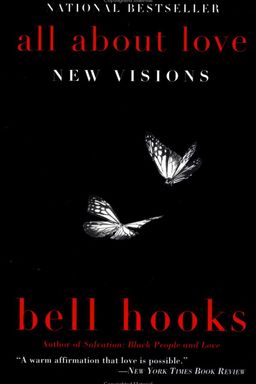
All About Love cover

All About Love

by bell hooks

In ''All About Love,'' bell hooks dissects our flawed perceptions and cultural barriers to love, offering transformative insights. By redefining love as a deliberate action, she provides a roadmap for cultivating genuine, nurturing relationships that challenge societal norms.

The Transformative Power of Love in a Loveless World

Have you ever felt that love, the one force we’re told can heal everything, seems mysteriously absent from daily life? In All About Love: New Visions, bell hooks contends that our culture suffers from a collective lovelessness—a spiritual and emotional deficit that shapes our families, romances, institutions, and politics. For hooks, love is not merely a feeling or desire; it is a deliberate choice and ethical commitment to nurture growth—our own and others’. She argues that reclaiming love as both an emotional and moral practice can radically transform not only individual lives but society itself.

What Hooks Believes About Love

Hooks opens with a striking claim: most of us don’t know what love really is. From childhood onward, we call things love that are actually care, affection, or even domination. Drawing on M. Scott Peck’s definition—“the will to extend oneself for the purpose of nurturing one’s own or another’s spiritual growth”—hooks reframes love from passive sentiment into active will. Love is a verb, a choice that requires attention, discipline, and accountability. Without a shared definition of love, she says, we stay confused, hurt, and disconnected—unable to recognize when love is truly present or when it is being replaced by abuse, control, or apathy.

Why Definition Matters

Much of our difficulty stems from refusing to define love. In a society that equates love with romance or possession, hooks notes, clarity feels dangerous because it exposes how far we’ve strayed. Once love has clear terms—care, commitment, trust, responsibility, knowledge, and respect—it demands accountability. You cannot claim to love while harming. This simple definition pierces the comforting illusions many of us hold: that love and abuse can coexist; that passion excuses cruelty; that being loved by family justifies dysfunction. Hooks insists that confronting those myths is the first necessary act of healing.

Childhood Lessons and Cultural Myths

Our earliest schooling in love often leads us astray. Parents who say “I’m hitting you because I love you” teach confusion that stays with us. Hooks reveals how childhood exposure to manipulation or authoritarian discipline links love to suffering. Children learn that love is conditional, hierarchical, and unsafe. Even adults raised with plenty of care but little emotional honesty grow up equating affection with possession or dependency. Thus each generation passes down a damaged inheritance of love. Hooks argues that to reclaim the true art of loving, we must unlearn these early lessons and replace them with justice, honesty, and mutual respect.

A Love Ethic as Social Healing

Hooks sees love as a revolutionary ethic—a counterforce to domination and greed. Patriarchy, racism, and consumer capitalism, she argues, thrive on fear and separation. By contrast, love calls for connection, interdependency, and respect for life. To live by a love ethic means orienting our relationships, communities, and work around care rather than power. It means valuing honesty, justice, and compassion more than status or wealth. This form of love is inherently political: it heals individuals while challenging the systems that profit from our alienation. (Comparable thinkers like Erich Fromm and Martin Luther King Jr. also viewed love as a democratic, liberating power rather than a private emotion.)

Learning to Practice Love

Throughout the book, hooks combines cultural critique, personal memoir, and spiritual insight to show how real love is learned through practice. She explores honesty as the foundation for authentic connection, commitment as the discipline that sustains it, and forgiveness as the act that renews it. Romantic love becomes less about falling and more about choosing—choosing to nurture growth in oneself and another with awareness and care. She reminds readers that love cannot bloom where fear governs, and our society’s obsession with power keeps love perpetually at risk.

The Stakes: Why Love Matters Now

Hooks warns that without the intentional cultivation of love, individuals and cultures descend into isolation, despair, and violence. The worship of domination and consumption leaves us spiritually starved. Recovering love—whether through community, spirituality, or mutual care—is thus both a personal and collective salvation. Love gives meaning to life, bridges divisions, and frees us from fear. To practice love is the most radical political act we can commit. Hooks’s call is both intimate and universal: to speak love’s name clearly, live it boldly, and let it reshape our world.


Defining Love as Action

Bell hooks insists that love must be understood as a deliberate act rather than as an involuntary feeling. The confusion between affection or cathexis (the emotional investment in another) and true love keeps people stuck in unhealthy relationships. Her guiding definition, borrowed from psychiatrist M. Scott Peck, is that love is “the will to extend oneself for the purpose of nurturing one’s own or another’s spiritual growth.”

Love as a Verb, Not a Noun

You choose to love. This choice doesn’t depend on moods or chemistry but on conscious intention. Hooks emphasizes that redefining love as a verb liberates it from romantic mystery and gives it moral weight. Love becomes something you can practice, measure, and refine—both toward others and toward yourself. In contrast, seeing love as an uncontrollable feeling promotes irresponsibility (“crimes of passion” become excusable).

Ingredients of Real Love

True love combines key ingredients: care, commitment, trust, responsibility, respect, and knowledge. None stands alone; they feed one another. Without trust, care collapses into anxiety. Without respect, commitment turns oppressive. Hooks threads these qualities through stories of family life, showing how partial love—when one ingredient is missing—becomes harmful. Her own upbringing, full of affection mixed with shaming, taught her that care does not equal love.

Accountability in Love

Accepting love as a willful act means accepting responsibility for how you love. You cannot claim love while being cruel, neglectful, or dishonest. This shift forces moral awareness: actions shape feelings, not vice versa. Hooks urges that using the word “love” only when these elements are present cultivates integrity in relationships. It also dismantles the cultural excuse that parents or partners can be abusive yet loving. In her view, love and abuse cannot coexist.

Learning and Teaching Love

Hooks imagines a world where the language of love is taught like any other subject—a collective vocabulary guiding families, schools, and communities. By spreading precise definitions, we counter confusion and begin restoring love’s place in everyday life. This clarity, she says, is the foundation for healing both personal wounds and social divisions. To speak of love as accountable action is to claim it as our shared human work.


Love, Justice, and Childhood Lessons

Hooks draws a direct line between loveless childhoods and adult emotional dysfunction. For her, the family is society’s first school of love—and too often its most damaging one. Both abused and overindulged children are taught false lessons: that love can coexist with cruelty or that it means getting one’s way. These early distortions breed adults who fear intimacy and equate love with control.

Justice as a Prerequisite for Love

Hooks argues that “there can be no love without justice.” The home, she says, often functions as an autocracy where parents hold unchecked power. Children, legally powerless, learn submission instead of mutuality. Until society embraces children’s rights—freedom from abuse, respect for autonomy, fair treatment—families cannot be truly loving. This extends to all oppression: racial, gendered, or class-based hierarchies destroy the possibility of genuine love because they depend on domination.

Unlearning Dysfunction

Hooks recounts her own family story to reveal how affection mingled with humiliation fragmented her sense of being loved. With therapy and reflection, she came to see “dysfunction” not as condemnation but as an opportunity to understand and heal. Just as abused children cling to the idea that those who hurt them loved them, adults rationalize mistreatment. Facing the absence of love is painful but essential—it opens the path to self-recovery and truth.

Creating Loving Families

To raise loving children, adults must replace punishment with guidance, domination with dialogue. Loving discipline teaches boundaries and self-respect through example, not fear. Hooks calls for public education, media representation, and political advocacy that model these values. Families and communities can become sanctuaries of justice rather than training grounds for inequality. In her words, “without justice, there can be no love.”


Honesty as the Heartbeat of Relationship

Love cannot thrive in secrecy or deception. Hooks identifies lying as a major symptom of patriarchal culture, where power is protected through manipulation. Drawing on writers like Sissela Bok and Harriet Lerner, she explains how both men and women learn dishonesty as survival—boys to gain power, girls to please. Yet these lies, large or small, erode trust and make intimacy impossible.

Patriarchy and the Politics of Deception

Men’s lying, Hooks contends, stems from patriarchal privilege—the belief that rules don’t apply to them. Women’s lying, meanwhile, is often a performance of weakness or charm, a survival tactic in male-dominated systems. Both perpetuate inequality and lovelessness. Whether in families, romances, or workplaces, deception maintains control rather than connection. Genuine love demands the courage to tell—and hear—the truth.

Truth-Telling as Liberation

Honesty is not merely moral; it is healing. Hooks recounts her own choice to break silence around family secrets, such as abuse, and how this act of truth-telling restored connection. Keeping secrets, she says, keeps us “sick.” Speaking truth risks discomfort but opens the possibility of real love. The same principle applies socially: a nation built on lies of race, gender, and power cannot love itself.

Cultivating a Culture of Truth

Hooks dreams of a renewal of honesty in both private and public life. In relationships, truth-telling means creating sanctuary where vulnerability is safe. In society, it means resisting propaganda and valuing transparency. Love flourishes only when honesty replaces manipulation as our shared norm. Her challenge to readers is simple but radical: speak truth with care, and let love transform what it reveals.


Self-Love and Commitment

Hooks teaches that self-love is the foundation of all other loving practice. Without it, relationships crumble under unmet needs and insecurity. Yet self-love, she warns, is not narcissism. It is honest self-acceptance, self-responsibility, and integrity—the pillars of healthy esteem. Using Nathaniel Branden’s “six pillars of self-esteem,” hooks shows how living consciously and purposefully builds a self capable of love.

Learning to Accept and Assert

Many adults, especially women, were shamed in childhood for asserting opinions. Hooks recounts that her father punished his daughters for “talking back.” Learning assertiveness, therefore, becomes part of reclaiming voice and self-worth. Commitment to oneself—the will to protect and nurture personal growth—is parallel to loving another. Through affirmations and self-reflection, hooks demonstrates how replacing negative mental patterns with positive declarations awakens courage.

Work, Purpose, and Self-Respect

Self-love extends into how you work and live. Hooks insists that “right livelihood”—doing work that enhances spiritual well-being—sustains love. A culture that makes labor exploitative destroys the soul’s capacity for joy. Even if circumstances limit choices, approaching any task with care and integrity restores dignity and peace. (Similar ideas appear in Buddhist teachings and Parker Palmer’s The Active Life.)

Giving Yourself Unconditional Love

Hooks ends by reminding readers that we can always give ourselves the unconditional love we may crave from others. You cannot expect a lover, friend, or family to offer acceptance you withhold from yourself. By extending care inward, you establish inner stability that allows outward generosity. Self-love becomes a spiritual discipline—not self-indulgence, but the prerequisite to being fully loving.


Spiritual Awakening through Love

Hooks sees spirituality as the ground where love blossoms. She writes that divine love, whether named God, spirit, or soul, is the ultimate source of healing. Modern culture’s worship of money and status, she laments, replaces the divine with consumption. Without spiritual awareness, our society becomes dead to love’s life-giving energy.

Love as Sacred Practice

Drawing on thinkers like Erich Fromm, Thomas Merton, and Martin Luther King Jr., hooks presents love as a sacred duty linking personal growth with social justice. Fromm’s assertion that capitalism and love are incompatible underlies her argument: spiritual life must resist domination and materialism. King’s theology—love as “the key that unlocks the door to ultimate reality”—shows how divine compassion unites individuals and communities.

Rediscovering the Sacred in Daily Life

Spirituality demands action, not theory. Hooks urges you to transform ordinary acts—work, conversation, service—into rituals of reverence. Spiritual practice bridges suffering and joy by turning pain into renewal. Whether through prayer, meditation, or mindful service, these acts remind us that love is an everywhere-present force waiting to be lived. As teacher Jack Kornfield writes (quoted frequently), “the longing for love and the movement of love is underneath all of our activities.”

Faith in Love’s Promise

For hooks, believing in divine love is not blind religion but radical hope. Spiritual awakening counters nihilism and despair. When we remember that “God is love,” we renew our purpose: to serve, create, and connect. Awakening to love is awakening to life itself.


Living by a Love Ethic

Hooks invites readers to build lives and communities grounded in a love ethic—a system of values where care, honesty, and compassion guide every decision. This ethic rejects domination and celebrates equality. Adopting it, she says, would revolutionize politics, economics, and personal relationships.

Love versus Fear

Fear sustains oppression; love dissolves it. Hooks quotes Scripture: “Perfect love casts out fear.” Whether in governmental policy or personal life, fear fosters greed, violence, and separation. Cultivating love courageously means connecting rather than conquering—valuing life over property, compassion over profit. The love ethic begins with this simple but world-altering choice.

Transforming Culture

A love ethic redefines success. Wealth is not evidence of goodness; character and care are. Hooks highlights communities and writers like Wendell Berry and Melody Chavis who embody this ethic through cooperation, generosity, and service. When applied collectively—through media, policy, and everyday interaction—it dissolves racism, sexism, and greed by replacing the logic of domination with shared humanity.

Courage and Conversion

Living by love requires moral courage—a “conversion,” as Cornel West calls it, from nihilism to faith. To embrace a love ethic is to resist cynicism and choose joy. Hooks defines it not as naïve optimism but as disciplined hope, cultivated through daily choices toward truth and compassion. This is her revolution: love as the soul of democracy.


Healing through Redemptive Love

In later chapters, hooks turns toward love’s healing power. Redemptive love, she says, restores wholeness after suffering. Pain marks us but need not define us. By opening the heart to love, you transform wounds into wisdom. Healing is not forgetfulness but renewed vision.

Choosing Healing

Healing begins with the decision to be whole. Hooks cites Toni Cade Bambara’s The Salt Eaters: “Wholeness is no trifling matter—a lot of weight when you are well.” You must choose wellness intentionally, confessing brokenness, and opening yourself to grace. No one can heal you without your willingness to be healed.

Communal and Spiritual Recovery

Healing happens in community. Hooks admires recovery groups like Alcoholics Anonymous, where acceptance and responsibility create transformative love. She blends this communal healing with mystical spirituality—from Buddhist compassion to Christian prayer. Forgiveness and service, she notes, are essential medicines that dissolve shame and reconnect hearts.

Love Redeems

Finally, redemptive love means letting go of fear. “Perfect love casts out fear,” Hooks affirms, returning often to biblical wisdom. Love burns away impurities like fire, freeing soul and society from torment. To be made perfect in love is to find peace beyond suffering—a spiritual rebirth into hope.

Dig Deeper

Get personalized prompts to apply these lessons to your life and deepen your understanding.

Go Deeper

Get the Full Experience

Download Insight Books for AI-powered reflections, quizzes, and more.