
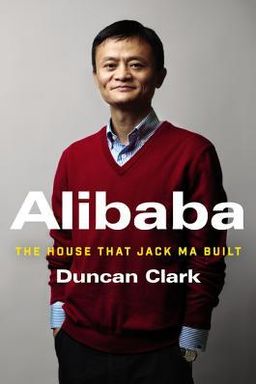
Alibaba cover

Alibaba

by Duncan Clark

Alibaba unveils the captivating rise of Jack Ma and his e-commerce titan, Alibaba. From humble beginnings to global retail dominance, explore the visionary strategies and relentless drive that reshaped the digital landscape and Chinese consumer habits.

Jack Ma and the Rise of Alibaba: The Story of Modern China’s Digital Revolution

What does it take to transform from an English teacher earning $12 a month into the founder of one of the most powerful companies in the world? In Alibaba: The House That Jack Ma Built, Duncan Clark explores how a small apartment start-up in Hangzhou became a digital empire that redefined commerce, finance, and technology not only in China but across the globe. At its heart, this is a story of bold vision, resilience, and the meeting of human passion with historical opportunity.

Clark argues that Alibaba’s success is inseparable from China’s transformation—from a closed socialist economy into a global center of entrepreneurship. He contends that Alibaba did more than sell products online; it built the infrastructure of a new consumer society. Understanding this journey requires exploring both the company's internal DNA and the broader political and cultural tides that shaped it—making the book as much about modern China as about one man or one corporation.

A Folk Hero in the Making

Jack Ma’s story begins not in the boardrooms of Beijing or the Silicon Valley campuses of California, but in the crowded streets of Hangzhou. His struggles—failing his university entrance exam twice, being rejected from dozens of jobs (even KFC)—created a chip on his shoulder and a sense of perseverance that defined his entrepreneurial path. Clark frames this as an almost mythic tale of the ‘outsider’ using charm and narrative to rally others to his vision. Unlike tech geniuses such as Steve Jobs or Mark Zuckerberg, who leaned on science and engineering, Jack relied on charisma, imagination, and language. His early lessons as a teacher and tour guide foreshadowed his talent for inspiring people through words rather than code.

From his first company, a translation agency called Hope, to his exposure to the Internet in Seattle in the mid-1990s, Ma’s obsession with connecting China to the world found its outlet in digital commerce. What began as a curiosity—a search for Chinese beer online—became a revelation: China’s presence on the Internet was nonexistent. This gap sparked his lifelong mission to help small businesses open their doors to the world.

The Entrepreneurial Crucible

Clark reveals how Zhejiang Province, Ma’s home base, incubated an entrepreneurial spirit unique in China. The locals of Wenzhou, Yiwu, and Hangzhou were long accustomed to trade, informal credit, and hustle. These were regions where merchants built their own roads, airports, and factories. This spirit of bottom-up enterprise—often operating in the gray zones of China’s semi-planned economy—became the cultural foundation on which Alibaba was built. When Ma coined the term “iron triangle” to describe the company’s three main pillars—e-commerce, logistics, and finance—he was crystallizing the very ecosystem that Zhejiang’s entrepreneurs had developed over generations.

The book emphasizes how Ma’s emergence was not accidental but the product of a confluence of forces: rapid digitization, government reform, and the aspirations of hundreds of millions of newly urban households. Alibaba’s platforms—Taobao for consumers, Tmall for brands, Alipay for transactions—allowed a country rooted in production (“Made in China”) to evolve into one focused on consumption (“Bought in China”).

The Drama of Conflict and Collaboration

Clark turns Alibaba’s growth saga into an ongoing drama between individual initiative and institutional power. Jack Ma’s battles with foreign giants like eBay, and his tightrope walk with Chinese regulators, reflect the paradoxes of modern China: an economy that champions entrepreneurship but still demands ideological loyalty. His famous advice—‘fall in love with the government, don’t marry it’—illustrates his gift for navigating authority with both deference and independence. When his company went public in 2014 in what became the world’s largest IPO, it seemed that Ma had finally outwitted global finance as well.

But Clark also weaves caution into this triumph. As Alibaba’s influence grew—from data-driven logistics to digital banking—it began to challenge the very state apparatus it once complemented. Investors, competitors, and officials alike questioned whether the ‘House that Jack built’ might one day collapse under its own ambition.

Why It Matters

Reading Clark’s account, you realize that Alibaba’s story is not just about online shopping—it’s about how nations evolve through technology. China’s leap from manufacturing to digital commerce mirrors similar revolutions chronicled in books like Thomas Friedman’s The World Is Flat or Kai-Fu Lee’s AI Superpowers. Yet Clark adds a distinctly human dimension by showing how charisma, storytelling, and moral conviction can become levers of business transformation. For readers, Ma’s journey invites reflection: countries and individuals alike thrive not merely by mastering new tools but by reimagining what those tools make possible.

Across twelve chapters, Clark explores Alibaba’s rise from a modest apartment startup to a global powerhouse; the cultural roots of its resilience; its collisions with Western capitalism and the Communist state; and Jack Ma’s metamorphosis from visionary entrepreneur to unlikely folk hero. The result is both business biography and economic history—an engaging testament to how belief, timing, and a bit of ‘Jack Magic’ can change the fate of a nation.


The Iron Triangle: E-Commerce, Logistics, and Finance

At the heart of Alibaba’s dominance lies what Jack Ma calls the “iron triangle”—a trio of interconnected systems that reinforce each other: e-commerce, logistics, and finance. Duncan Clark shows how this strategic structure transformed not only Alibaba but also the habits of half a billion Chinese consumers.

E-Commerce as an Ecosystem

Alibaba’s consumer platforms, Taobao and Tmall, serve as its foundation. Taobao democratized online stores, allowing millions of small merchants to sell anything from handmade crafts to electronics. Unlike Amazon, Alibaba never owned inventory or warehouses; it created a marketplace of trust through ranking systems and customer feedback. Tmall came later, offering an upscale digital mall where established brands—from Nike to Burberry—sold directly to China’s emerging middle class. Together, they created a digital bazaar that blended the chaos of an open marketplace with the polish of a luxury retail experience.

Logistics: The Backbone of Scale

Clark explains that China’s fragmented infrastructure created both challenge and opportunity. Alibaba’s solution, Cainiao (meaning “rookie”), unified a network of thousands of independent delivery firms—many founded by hustlers from Jack Ma’s home province of Zhejiang—into a nationwide logistics web. Each day, Cainiao ensures that packages generated by Taobao’s millions of merchants arrive on time across China’s sprawling landscape. Couriers on motorbikes, handcarts, and trucks became the invisible army behind China’s e-commerce revolution. By linking data and transport in real time, Alibaba turned logistics into a competitive advantage.

Finance: Building Trust in a Trust-Scarce Society

Perhaps the most disruptive piece of the triangle is Alipay, Alibaba’s digital wallet. Launched to solve one basic problem—how to facilitate safe payments between strangers—it became an engine of financial inclusion. The platform’s escrow system held buyers’ funds until goods were received, establishing confidence in online transactions. Over time, Alipay evolved into Ant Financial, offering microloans, insurance, and investment products to millions who previously lacked access to traditional banking.

In a society where banks served mostly state-owned enterprises, this innovation was revolutionary. As Clark notes, Alipay turned “precautionary savers” into active consumers, unlocking China’s latent spending power. It replaced fear with trust, spreadsheets with smartphones, and bureaucracy with data.

“In other countries, e-commerce is a way to shop; in China, it is a lifestyle.” —Jack Ma

Together, the elements of the iron triangle created what Clark calls Alibaba’s “unbeatable feedback loop.” E-commerce generated data, logistics ensured delivery, and finance powered consumer confidence. Each reinforced the other. In Clark’s view, the triangle is less a business model than a digital blueprint for how modern economies evolve—where seamless integration of trust, speed, and information becomes the currency of growth.


Jack Magic: The Power of Charisma and Culture

Jack Ma is famous for claiming, “I may not be smart, but I have passion.” Clark portrays this passion as contagious energy—what employees dubbed “Jack Magic.” It’s more than charisma; it’s an operating system built on culture, storytelling, and faith in people over machines.

From Teacher to Chief Education Officer

Jack’s background as a teacher deeply shaped Alibaba’s corporate DNA. He referred to himself as the company’s “Chief Education Officer” and taught his teams through proverbs, martial arts metaphors, and fables. Every employee memorized his mantra: “Customers first, employees second, shareholders third.” This reversal of corporate orderlines followed his belief that loyalty and long-term trust, not short-term profits, built resilience.

The ‘Six Vein Spirit Sword’ Philosophy

Alibaba’s internal code of conduct—modeled on a fighting style from Jin Yong’s martial arts novels—is known as the “Six Vein Spirit Sword.” The six veins represent customer obsession, teamwork, embracing change, integrity, passion, and commitment. Employees were evaluated not just on performance but on how well they embodied these traits. Even the company’s headquarters in Hangzhou was designed like a martial arts training ground, complete with bicycles and open courtyards to promote energy and camaraderie.

Storytelling as Leadership

Jack turned speeches into art. He recycled stories of failure—being rejected from KFC, struggling in school, or being kidnapped in America—and made them parables about perseverance. Like Steve Jobs’ “reality distortion field,” his charm erased skepticism. Employees referred to working under him as “living inside a dream.” He cultivated identity and purpose rather than compliance, turning ordinary workers into believers in a national mission: modernizing China through the Internet.

Clark argues that this cultural engine, rooted in humility and humor, gives Alibaba its enduring coherence amid rapid change. Ma’s unique blend of showmanship and sincerity may seem eccentric—a CEO who sings in drag at corporate parties—but it also fulfills something essential in modern China: a narrative that makes capitalism feel authentic, communal, and even heroic.


From Student to Entrepreneur: The Making of Jack Ma

Clark devotes early chapters to Jack’s unconventional path—a story that reveals how persistence can take the place of privilege. Born in 1964 in Hangzhou to poor storytellers, Ma’s youth was shaped by Mao’s Cultural Revolution and China’s isolation. Yet it was exposure to foreigners, not ideology, that transformed him.

Learning English, Learning Perspective

In his teens, Jack learned English by offering free tours to Western visitors in Hangzhou. One family, the Morleys from Australia, became his lifelong mentors—sending him money for school, hosting him abroad, and introducing him to a world beyond China’s propaganda. This exposure to global ideas seeded his lifelong curiosity about communication, culture, and exchange—values that would later form the foundation of Alibaba’s mission to “make the world more open for business.”

Early Ventures and Painful Lessons

Ma’s first company, Hope Translation, struggled. He then launched China Pages, a digital directory that became one of China’s earliest Internet businesses. Lacking capital and cut off by a state-owned partner, he lost control—a humiliation that taught him never to allow outside investors absolute authority over his venture. This lesson became central to Alibaba’s future governance system, where founders retained influence through partnership rights rather than pure ownership.

Encounter with the Internet

During a fateful trip to Seattle in 1995, Ma used the Internet for the first time. Searching for ‘China’ and finding nothing, he sensed opportunity. His dream of connecting Chinese businesses to global markets crystallized. He returned to Hangzhou to build “China Pages” and later Alibaba.com. This blend of ambition and naiveté—believing a provincial schoolteacher could compete with Silicon Valley—became Ma’s defining trait.

By the time Clark reintroduces Ma in 1999, his failures have incubated foresight. He has learned that being underestimated can be his greatest weapon. Alibaba’s future success, Clark shows, is inseparable from these formative experiences—in which adversity served not as an obstacle, but as the training ground for vision.


Battling eBay: Taobao and the Art of Adaptation

Few business rivalries illustrate global miscalculation as vividly as Alibaba versus eBay. Clark recounts this struggle as China’s version of David versus Goliath, where local intuition triumphed over imported arrogance.

The Challenge

In the early 2000s, eBay bought China’s largest auction site, EachNet, and assumed dominance was inevitable. Its American playbook—charging fees, changing interfaces, and centralizing servers overseas—proved disastrous in China’s low-trust, high-context market. EachNet’s sluggish performance and cultural tone-deafness alienated users who valued speed, conversation, and community.

The Taobao Counterattack

In 2003, as the SARS epidemic forced millions to shop from home, Ma secretly launched Taobao. The site was free, chat-driven, and locally attuned. By allowing buyers and sellers to bargain directly through the new instant messenger AliWangwang, Taobao turned online shopping into a social experience. Free listings and a heavy dose of charm—Jack often appeared on television encouraging “dreamers” to open stores—helped Taobao steal 60% of the market within two years.

eBay, blinded by corporate hubris, refused to adapt. It charged fees, hosted its site abroad, and enforced rigid policies from San Jose. Users fled. By 2006, eBay shut down its China operations. Ma’s victory demonstrated that understanding the local consumer often trumps global scale.

Business Lesson

Clark frames Taobao’s rise as a triumph of empathy over efficiency. Ma read not just the data but the emotions of Chinese consumers who feared scams yet craved connection. By transforming trust into a design principle, he outmaneuvered an industry titan. The episode became a masterclass in cultural localization—a warning later heeded by other Western firms like Uber and Airbnb when entering China.


The Yahoo Deal and Global Expansion

In 2005, Jack Ma’s extraordinary gamble redefined Alibaba’s trajectory: he sold 40% of the company to Yahoo for $1 billion—cash that bankrolled Taobao’s growth and crushed eBay for good. But as Clark shows, the partnership also exposed the deep divide between Western capitalism and Chinese pragmatism.

Mutual Misunderstanding

To Yahoo founder Jerry Yang, Alibaba offered a window into China’s digital gold rush. To Jack Ma, Yahoo offered cash, technology, and credibility. Yet Yahoo’s Western structures clashed with Alibaba’s family-like culture. When Yahoo’s local managers tried to impose rules, Ma sidestepped them. Eventually, Alibaba absorbed Yahoo China altogether, leaving the American firm a financial but not operational partner.

The Alipay Firestorm

The partnership nearly collapsed in 2011 when Ma quietly transferred Alipay—by then handling hundreds of billions in transactions—out of Alibaba’s ownership. Ma argued the move was necessary to satisfy Chinese banking laws; Yahoo and fellow investor SoftBank saw it as unilateral betrayal. The resulting scandal wiped billions off Yahoo’s stock. Eventually, a compromise was reached: Alibaba’s investors would receive a cut of future Alipay profits, calming tensions but exposing how fragile corporate governance could be across jurisdictions.

Clark presents this episode not as villainy but as revelation: Ma believed China’s regulatory reality trumped foreign contract law. Business survival, not legal formality, came first. The incident underscored how navigating China’s system requires flexibility bordering on moral ambiguity.

Going Global

With Yahoo’s capital and SoftBank’s backing, Alibaba expanded beyond China—to India, Russia, and later Hollywood. Yet its playbook remained Chinese at heart: build ecosystems, not products; empower customers first, monetize later. Clark suggests this model—focused on infrastructure and inclusion—may offer an alternative vision of globalization rooted in collaboration rather than conquest.


IPO and Icon: Jack Ma’s Global Stage

Alibaba’s 2014 IPO on the New York Stock Exchange raised $25 billion—the largest in history—turning Jack Ma into China’s richest man on his fiftieth birthday. Clark recounts the spectacle as both culmination and irony: a Chinese Internet giant selling shares in America, upstaging the West on its own capitalist stage.

The Showman’s Triumph

The IPO roadshow resembled a world tour, with Ma charming investors from New York to London. His storytelling—peppered with self-deprecating humor and philosophical quotes—won hearts. Investors saw in him not just a business leader but a symbol of China’s creative rise. The ticker symbol, “BABA,” echoed a nursery rhyme but represented an economic juggernaut valued at over $230 billion.

The Aftermath and Accountability

Yet post-IPO, Alibaba faced turbulence: stock volatility, accusations of counterfeit sales on Taobao, and intensified government scrutiny. When China’s regulators publicly condemned the company over fake goods, Alibaba’s stock plunged. Ma’s response—equal parts defiance and diplomacy—reflects the tightrope Chinese entrepreneurs must walk between market ambition and political reality. “Fall in love with the government,” he said, “but don’t marry them.”

Clark’s conclusion is ambivalent. Alibaba’s rise embodies China’s energy, creativity, and contradictions. Its founder’s transformation—from rebel teacher to national icon to cautious statesman—encapsulates the country’s own uneasy march toward modernity. The question lingers: can a company born of disruption survive in a system that fears it?

Dig Deeper

Get personalized prompts to apply these lessons to your life and deepen your understanding.

Go Deeper

Get the Full Experience

Download Insight Books for AI-powered reflections, quizzes, and more.