
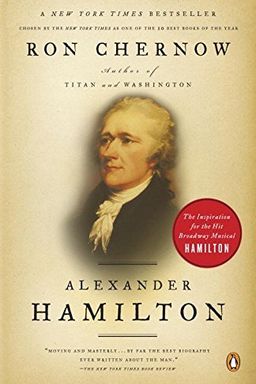
Alexander Hamilton cover

Alexander Hamilton

by Ron Chernow

Alexander Hamilton by Ron Chernow chronicles the extraordinary life of a founding father who transformed American politics and finance. From his tumultuous childhood to his crucial role in drafting the Constitution, Hamilton''s story is one of remarkable intellect and ambition that shaped a nation.

Alexander Hamilton and the Making of Modern America

When you trace Alexander Hamilton's life—from an illegitimate child on a Caribbean island to his fatal duel on the banks of the Hudson—you’re not only following an individual story but the birth of an entire political vision. Hamilton’s journey illustrates how personal adversity, intellect, and restless ambition can create the architecture of a nation. Through war, finance, love, and scandal, he built frameworks—constitutional, fiscal, and cultural—that still shape American life.

From the Caribbean to New York: The Outsider Arrives

Hamilton’s beginnings on Nevis and St. Croix imprinted on him the scars of illegitimacy and poverty. Born to Rachel Faucette and James Hamilton, cast out by inheritance law, he grew up in a “garrison society” scarred by slavery and class hierarchy. Yet from clerking at Beekman & Cruger’s trading house, he trained his mind to see how trade, credit, and administration move wealth. That apprenticeship birthed his fascination with systems—ledgers, logistics, and later, nations. The devastating 1772 hurricane that he eloquently described in print won him benefactors’ support and a scholarship to New York—a literal passage from obscurity to opportunity.

Pamphlets, Polemic, and Revolutionary Conviction

Arriving in New York, Hamilton turned his pen into a weapon. At King’s College, studying Locke and Montesquieu, he learned to fuse moral principle with policy reason. His early pamphlets—“A Full Vindication” and “The Farmer Refuted”—did not merely argue independence; they taught him to wield language as authority. The printing press was his battlefield, his rhetoric its artillery. In public debates and mob uprisings alike, Hamilton already showed his dual conviction: liberty must be defended, but only through disciplined institutions, not popular fury.

War, Leadership, and the Birth of a National Vision

Hamilton the soldier turned administrative genius. As Washington’s aide-de-camp, he mastered paperwork as power—coordinating logistics, commanding intelligence, and learning how authority travels through documents and systems. At Yorktown, his daring assault on Redoubt 10 made him a public hero. From staff tables to battlefield triumphs, he learned that independence required order: a disciplined army and, later, a disciplined government. That experience crystalized his lifelong principle: freedom survives only when organized through law and finance.

From Constitution to Cabinet: Designing a New Order

By the war’s end, Hamilton saw financial chaos as a national illness. His wartime letters to Robert Morris and James Duane proposed national banks, unified taxation, and a fortified union. These ideas matured at the Constitutional Convention, where he helped shape a framework balancing republicanism with energy in government. His essays as Publius in The Federalist Papers turned difficult theory into persuasion, arguing that only a strong fiscal and executive core could make the republic viable. When Washington became president, Hamilton’s Treasury system transformed those ideas into institutions—funded debt, assumption of state liabilities, customs networks, a national bank, and the principle of implied powers.

Innovation, Conflict, and the Partisan Divide

Hamilton’s financial revolution—creation of credit markets, banks, and manufacturing initiatives at Paterson—anchored economic modernization but provoked fears of aristocracy. Jefferson and Madison resisted what they saw as monarchical finance. The result was America’s first party system: Federalists versus Republicans, centralization versus states’ rights. Hamilton’s creative energy, from scrip market interventions to industrial policy, gave birth to both modern capitalism and modern opposition.

Scandal, Alienation, and the Fall

No genius escapes his flaws. The Reynolds affair—blackmail turned public confession—shattered Hamilton’s reputation even as it proved his public honesty. Subsequent conflicts—from the Jay Treaty riots to the Whiskey Rebellion—deepened divisions he had helped define. His later years saw brilliance and bitterness entwined: the Croswell case defending free press, his failed bid to unite religion with politics, and his catastrophic involvement in the 1800 election against Adams and Jefferson.

The Duel and the Legacy

The duel with Aaron Burr in July 1804 is the tragic consummation of a life built on honor and argument. Hamilton’s resolve to waste his fire—his moral protest against violence—met Burr’s deadly precision. His death in Weehawken ended an era, but his ideas endured: fiscal realism, executive energy, and institutional vision as conditions for democratic endurance. Eliza Hamilton’s long widowhood and philanthropy preserved his legacy, reminding you that national memory often rests in private devotion.

Core insight

Hamilton’s life teaches that the strength of a republic comes not from purity of principles alone but from building the machinery—financial, legal, and moral—that makes those principles endure amid disorder.


Origins, Ambition, and the Outsider’s Edge

You can’t understand Hamilton without returning to the Caribbean—where inequality was law and shame institutionalized. His illegitimacy branded him socially inferior, yet it also made him fiercely self-reliant. Observing trade and slavery up close taught him both efficiency and empathy. In Cruger’s countinghouse, Hamilton learned systems thinking: that ledgers can govern empires. The 1772 hurricane letter not only displayed his prose but his implicit belief that intellect could transform fate. That act of writing—turning crisis into opportunity—foreshadows his later habit of converting adversity into architecture, whether in battle plans or fiscal designs.

Self-education as rebellion

Denied status, Hamilton taught himself: he read Euclid, Pope, and commerce manuals until jargon became power. His early experience with slavery inoculated him against moral blindness; his letters condemn the traffic in “human property.” Commerce taught him realism, and realism bred reform: in a world of fragile empires, only systems built on credit and competence survived. This is the seed of his later conviction that economic structure, not charisma, defines liberty.

Reinvention through intellect

By emigrating to New York, Hamilton reinvented himself as merit incarnate. He became not the bastard of Nevis but the scholar of King’s College, an identity forged by his own mind. When he took the Common in 1774 to defend Boston’s patriots, the orphan became orator. The young man who once counted barrels now counted political arguments—transforming numerical precision into rhetorical force. His rise from clerk to “Publius” shows his belief in language as mobility: the written word could make a nation out of fragments.


Revolution, War, and the Discipline of Power

During the Revolution, Hamilton turned ideas into orders. His artillery command proved his methodical nature: supply lists, drills, and discipline came first. Washington recognized in him not a romantic hero but a manager. As aide-de-camp, Hamilton learned leadership through writing—dozens of letters per day that made the army function. These years turned his administrative mind into a national instrument: logistics became nation-building in miniature.

From staff officer to strategist

With Washington, Hamilton absorbed the principle of calculated risk. His counsel to avoid pitched battles and focus on attrition prefigured his later economic strategies: preserve resources, strike decisively, control credit. At Valley Forge, coordinating with von Steuben, Hamilton witnessed how training could turn an amateur militia into an army—a metaphor for his later dream of transforming loose states into a disciplined union. The Yorktown assault sealed his reputation; courage and restraint fused as one.

Moral tests and loyalty

Confronting treason (Arnold and André), faction (the Conway Cabal), and mercy’s limits, Hamilton’s ethics matured. He defended order even when it broke hearts—call it compassionate realism. The execution of André haunted him, showing that justice and honor might conflict. That tension explains his later insistence: institutions must carry moral weight, not passion. The army taught him not just command but the need for centralized energy—a pattern he would later engrave into the Constitution.


Nationhood and the Financial Revolution

After war, Hamilton faced the deeper challenge: how to fund and govern liberty. His letters during the 1780s diagnose America’s illness—an anemic confederation unable to tax or repay debts. The “Continentalist” essays linked credit to sovereignty. In them, Hamilton turned economic analysis into moral vision: fiscal trust as the glue of republican survival. The Annapolis Conference, then the Philadelphia Convention, gave him an arena to argue for union—and he did so with audacity bordering on monarchy. Yet the compromise Constitution still bore his fingerprints: energy, executive direction, and national revenue capacity.

The Federalist persuasion

Through The Federalist Papers, Hamilton transformed dense constitutional theory into accessible political logic. He argued that credit, armies, and laws required a coherent center. His essays on executive power, judiciary independence, and fiscal unity built intellectual scaffolding for modern government. (Note: The same arguments reappear in later jurisprudence, culminating in Marshall’s opinions.) His ability to blend enlightenment philosophy and financial practicality marks him as America’s first technocrat of democracy.

Building the Treasury Machine

Appointed Treasury Secretary in 1789, Hamilton operationalized theory into structure: the Report on Public Credit, the assumptions system, and the creation of customs networks and revenue cutters. Each report was a blueprint for modern bureaucracy. His defense of the national bank through implied powers reshaped constitutional interpretation—establishing precedent for federal flexibility. Even crises like scrip mania and William Duer’s collapse became his classroom for learning market stabilization. The result: fiscal credibility married to administrative intelligence—the foundations of enduring statecraft.


Parties, Press, and the Invention of Opposition

Hamilton’s triumph created its counterforce. His programs united commerce but divided politics. The Republican resistance under Jefferson and Madison became the first organized opposition, rooted in a different image of virtue: small farms over banks, restraint over ambition. Newspapers inflated every ideological difference. Hamilton’s Gazette of the United States sparred with Jefferson’s National Gazette, birthing a polarized media culture recognizable today. Each printed scandal, from elite societies to Maria Reynolds’s letters, fused privacy and politics into one volatile field.

The culture of scandal

The Maria Reynolds affair defined the hazards of early celebrity politics. Hamilton’s 1797 pamphlet confession turned private sin into public theatre—an early example of transparency as damage control. But such honesty cost him trust, especially among allies. The era’s honor culture magnified humiliation; dueling became political punctuation. Meanwhile, Adams’s presidency and the Alien and Sedition Acts deepened fracture, testing Hamilton’s principles about liberty and governance. His own writings—sometimes advocating rigor, sometimes invoking moderation—show a man torn between order and freedom.

Foreign crises as domestic mirrors

During the French Revolution, Hamilton’s neutrality policies exposed fault lines between ideology and pragmatism. His Pacificus essays defended executive power to steer foreign policy; Jefferson’s Helvidius replies demanded congressional dominance. The Genêt and Jay Treaty episodes turned foreign diplomacy into partisan theater, anticipating modern geopolitics where every treaty doubles as a referendum on national identity. The new republic learned that policy abroad often determines unity at home.


Faith, Grief, and Final Exile

Hamilton’s later years mix sorrow and spiritual renewal. His son Philip’s death in a duel shattered him. Friends described a man “utterly overwhelmed” who turned at last toward religion. He annotated William Paley’s View of the Evidences of Christianity, prayed daily, and planned a chapel on his estate. This was not conversion born of politics but conviction born of grief. Faith became his structure of consolation: reason in defense of belief, evidence in service of hope.

Retreat and renewed purpose

At the Grange, Hamilton tried domestic peace—planting trees for each state, mentoring young lawyers, and founding the New-York Evening Post to defend free institutions. Yet pamphlet wars with Jeffersonian editors consumed him; bitterness crept into his pen. His defense of printer Harry Croswell in 1804 reaffirmed his earlier ideals: truth and intent as shields for a free press. Even in exile from power, he fought for principle through argument, not office.

Honor, Duel, and Death

The Burr duel brought philosophy and fate full circle. Hamilton’s decision to waste his shot was meant to reconcile conscience with honor. His death—dignified, reconciled, sacramental—ended the life of America’s most self-made founder. Eliza’s fifty years of widowhood extended his work through orphan charities and educational reform, turning grief into civic grace. Hamilton’s mind built the republic’s skeleton; his family ensured its memory would not decay.

Final insight

Hamilton’s final decade shows that personal tragedy can refine public virtue. Even as politics expelled him, his belief in disciplined liberty and moral courage outlasted every adversary and scandal.

Dig Deeper

Get personalized prompts to apply these lessons to your life and deepen your understanding.

Go Deeper

Get the Full Experience

Download Insight Books for AI-powered reflections, quizzes, and more.