
Idea 1
The Bond That Redefined Intelligence
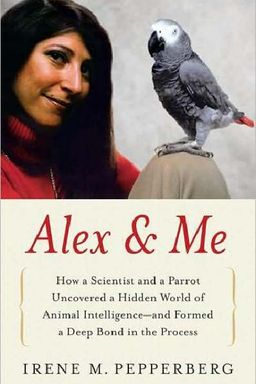
Can love and science ever truly coexist? Can affection for another being help you uncover truths about intelligence itself? Alex & Me by Irene Pepperberg begins with those haunting questions—and answers them through the unforgettable story of a one-pound African Grey parrot named Alex. Over thirty years, Alex and Pepperberg transformed what we think of as a “birdbrain,” demolishing entrenched assumptions that animals are just mimics without understanding.
Pepperberg’s core argument is both scientific and profoundly human: intelligence is not confined to humans or primates, but extends across species through communication, empathy, creativity, and the capacity to grasp abstract ideas. And, she contends, deep connection can be a vehicle for rigorous scientific discovery—emotion doesn’t corrupt science; it can illuminate it. Through the friendship and collaboration between a researcher and a parrot, she reveals the hidden world of animal minds and the shared traits that link us all in one continuum of consciousness.
A Radical Idea, Born of Curiosity
Pepperberg didn’t start out as an animal cognition scientist. Trained in chemistry at MIT and Harvard, she had the audacity to switch fields after discovering research on dolphins and chimps communicating with humans. The field was controversial; most scientists scoffed at the idea that animals could think. She chose to work not with apes, but with a parrot—a species that had speech ability but wasn’t part of the elite mammalian group thought to possess real intelligence. “Birdbrain” was an insult back then; Pepperberg aimed to prove it could be a compliment of the highest kind.
The Experiment in Language and Mind
Pepperberg’s groundbreaking “Model/Rival” approach made learning a social experience. Two trainers interacted while Alex observed, modeling human-like dialogue and rivalry for attention. This method replaced sterile “operant conditioning” boxes with relatable social exchanges. Through it, Alex learned to identify colors, shapes, materials, and numbers—and crucially, to understand what those labels meant. When Alex asked for a grape, he expected a grape, not a banana. When given the wrong item, he protested until he received what he desired. His words carried intention, not mere mimicry.
Pepperberg showed that cognition sprouts from social engagement, much like how children learn language. Her research argued that reference (knowing what a word stands for), functionality (using words for a purpose), and social interaction are universal underpinnings of communication across species.
Scientific Rigor Meets Emotional Truth
Over hundreds of trials, Pepperberg proved that Alex could grasp concepts of “same” and “different,” count objects up to six, identify materials, and later even express a rudimentary concept of zero—as “none.” But beyond data sheets, Pepperberg discovered the nuances of personality and empathy in her avian partner. Alex was bossy, playful, affectionate, and at times mischievous enough to tease his handlers when bored. This blend of rigor and affection set her work apart from the cold reductionism dominating animal research.
When Emotion Opens the Door to Understanding
Pepperberg’s journey wasn’t easy. She struggled against sexism, skepticism, and financial instability across universities. Through relocations—Purdue, Northwestern, Arizona, MIT, Brandeis—she fought to keep her research and Alex together. Their bond deepened into something akin to friendship or kinship. When Alex said, “I’m sorry,” or “You be good. I love you,” it reflected not mere vocal learning but a bridge between worlds.
Why This Story Matters
At its heart, Alex & Me isn’t just about a remarkable parrot; it’s about the shared intelligence and emotional depth that unite all creatures. Pepperberg shows that science and compassion can coexist, and that redefining intelligence reshapes how we treat other beings. Her Wonderful Life moment—realizing through global reaction to Alex’s death that their work had changed countless lives—reveals an ultimate truth: when you listen deeply to others, even a creature with feathers and a small walnut-sized brain can teach you what it means to be fully human.