
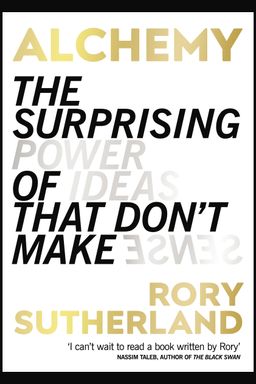
Alchemy cover

Alchemy

by Rory Sutherland

In ''Alchemy,'' Rory Sutherland presents a compelling case for the power of irrational thinking. Drawing from advertising and behavioral psychology, he shows how embracing the illogical can spark creativity and innovation in brands, business, and life.

Alchemy and the Logic of Human Behavior

What if the world runs less on logic and more on meaning? In Alchemy, Rory Sutherland argues that you misunderstand human decision-making when you assume people are rational calculators of preference. In reality, people act through an alternative mental operating system he calls psycho‑logic — a parallel logic grounded in perception, emotion, and social instincts rather than utility maximization. This proposition is both radical and liberating: if meaning drives value, then small changes to context, framing, or symbolism can have massive effects on how people feel and act.

Sutherland’s central message is that you create value by changing how something is perceived, not how it is materially composed. He calls this process alchemy: the art and science of transforming perception into value. By understanding the psycho‑logical rather than the merely logical, you open a new domain of innovation — one where meaning, trust, ritual, and design shape reality as much as engineering.

From Logic to Psycho‑Logic

Traditional logic asks, “What is optimal?” Psycho‑logic asks, “What feels right or restores meaning?” The shift sounds minor but reorders every discipline from marketing to policy. People donate more when the appeal feels personal, not financial (as Ogilvy discovered when emphasizing emotional cues rather than tax rebates). Drivers choose scenic routes over time‑optimal GPS paths because experience, control, and variance matter more than raw efficiency. Red Bull’s success — expensive, unpleasant, but distinctive — epitomizes psycho‑logic at work: oddity and ritual beat reason.

Far from celebrating irrationality, Sutherland’s thesis reframes it as an adaptive feature. In complex, social environments, heuristics and emotions often outperform analysis. Your mental shortcuts — defaults, trust proxies, satisficing — evolved to solve problems that data models cannot anticipate.

Alchemy: Making Meaning Valuable

Alchemy, in Sutherland’s terms, is meaning‑engineering. When you cannot afford or justify changing the physical product, you can change the story around it. Branding, provenance and semantics are alchemical tools. The “Patagonian toothfish” became desirable once renamed “Chilean sea bass.” Frederick the Great made potatoes popular by pretending they were a royal delicacy and posting guards around them. In both cases, no chemical transformation occurred — only a semantic one that altered behavior and value.

Once you realize meanings are liquid, the world becomes fertile ground for creative magic. Even waste or inconvenience can serve economic purpose when they tell the right story. Scarcity, naming, and rituals generate intrinsic satisfaction and strengthen social bonds by signalling commitment or trustworthiness.

Why Rational Models Fail

The institutions that design modern systems — governments, corporations, research bodies — often suppress alchemy because they privilege defensible logic over creative risk. Yet data and economic models miss invisible psychological variables: context, emotion, anticipation, social norms. Market research asks people what they want, but people explain behavior post‑hoc. Statistical averages wash out variance, hiding opportunities found in the outliers.

Sutherland calls this dependence on abstract analytics the “broken binoculars” problem: you see an image that looks clear but lacks depth. The world looks rational, but your instruments filter out the most transformative variables — perception and imagination. Thus, logical obsession breeds mediocrity: you do things that look smart, not things that work.

Psychological Moonshots and Experimentation

Because psycho‑logic operates outside formulaic prediction, experimentation becomes your only reliable compass. Sutherland champions small, low‑risk “psychological moonshots” — interventions that change experience radically at trivial cost. Showing passengers a progress map (Uber), reframing “bus delay” as “transfer to passport control,” or sending a text to reduce waiting anxiety are cheap ways to multiply perceived value without altering infrastructure. The same thinking turned Colombia’s invasive lionfish into a delicacy and Red Bull into a global symbol of energy.

Successful alchemists accept that most ideas sound ridiculous before they prove revolutionary. The market punishes error but rarely rewards imagination. To reclaim creative advantage, you must cultivate tolerance for counterintuitive hypotheses and measure results empirically rather than theoretically justify them in advance.

From Magic to Craft

Far from being mystical, Sutherland’s alchemy is disciplined craft. It relies on understanding the adaptive unconscious, psychophysics and the social mechanisms of trust. It urges you to test absurdity, exploit perception, and rediscover human empathy within systems design. In the process, “being semi‑rational” — balancing data with imagination — becomes a superior business strategy. His message is both ethical and pragmatic: meaning creation isn't manipulation when it genuinely enhances welfare, confidence or enjoyment.

In essence, Alchemy invites you to stop treating humans as machines. You can’t fix complex human challenges with pure rationality — you must embrace the wonderfully irrational logic of meaning. By learning to think alchemically, you discover a universe of hidden levers: stories, symbols and tiny signals that turn ordinary experiences into gold.


The Hidden Operating System of Psycho‑Logic

Sutherland proposes that most choices you make are not analytical at all but governed by a subconscious rulebook that weighs perception, emotion and social fit. This system of psycho‑logic often delivers faster, more adaptive answers than formal reasoning — especially in contexts defined by uncertainty or social nuance.

How Psycho‑Logic Differs from Logic

Where logic pursues optimization, psycho‑logic pursues harmony. People avoid looking foolish, prefer certainty to risk, and interpret experiences symbolically. That’s why a driver will take a longer scenic route or why a consumer trusts a recognizable brand. The human brain evolved for complex social survival, not numerical calculus. In unpredictable environments, a quick heuristic beats a fragile equation.

This insight reshapes traditional decision theory. You act the way evolution rewarded successful cooperation: seeking belonging and reducing anxiety. Rationality, in this deeper sense, means satisfying multiple hidden goals — safety, identity, esteem — that logic rarely models.

Examples of Psycho‑Logic at Work

Ogilvy’s charity experiments showed that a tax incentive decreased donations because it made giving feel transactional. But handmade or personal touches — a nicer envelope or volunteer delivery — increased contributions. Similarly, Red Bull’s off‑beat profile defied logic: a small costly can with an unpleasant taste. Yet the strangeness, expense and audacious claim (“gives you wings”) functioned as a costly signal of potency. Consumers interpreted it as special.

These behaviors reveal that you don’t buy products for what they are; you buy them for what they mean. Psycho‑logic converts the emotional context of choice into tangible economic value — a truth marketers and policymakers can’t afford to ignore.

Practical Use of Psycho‑Logic

To design effectively, start by discovering the “real why.” Don’t trust the explicit reasons people give; use observation, field trials, and naive questioning to uncover unconscious motives. When customers complain about delivery slots, what they crave may be certainty, not punctuality. A simple notification may outperform a complex scheduling system.

Sutherland challenges you to stop thinking like a spreadsheet. Use analytics for verification, not discovery. Creativity and intuition reveal the variables you didn’t know to measure. Psycho‑logic, in his view, isn’t irrational — it’s the forgotten sibling of reason, operating silently but everywhere in your life.


Perception, Psychophysics and Design

Humans don’t respond to reality itself — they respond to their experience of it. Psychophysics, the study of perception, reveals that your senses, expectations and emotions construct the world you act within. Sutherland uses this to explain why trivial design changes can remake subjective experience and economic value.

Expectations Shape Experience

When Cadbury changed the shape of its chocolate pieces, customers swore the taste changed though the recipe was identical. A “low‑fat” label made biscuits taste worse. Both examples show that your brain’s anticipations alter actual sensory outcomes. The Boeing Dreamliner’s improved lighting and air quality reduce jet‑lag not because of physics alone but because they reshape how the journey feels.

Signals that Build Trust and Meaning

Bits convey information, but costliness conveys truth. Lavish packaging, marble bank halls or a doorman work because costly signals show commitment — reassuring both customer and self that quality is real. In evolutionary terms, a signal functions only when it’s hard to fake. For brands and institutions, expense, craftsmanship or ritual build credibility where logic cannot.

Trust also evolves through repetition and reputation: the “shadow of the future.” Acts like waiving minor fees or sending hotel guests a drink are small but powerful cues that a relationship matters more than a transaction.

Designing for Perception

Design based on human psychology — not engineering efficiency — often wins. Google’s sparse home page beat Yahoo’s clutter because it clearly signaled purpose. Sony’s Walkman succeeded after Akio Morita removed the recording function, clarifying its single use. Twitter’s character limit, Spotify’s simplified menus and user‑friendly forms all exploit the same rule: clarity reduces friction and anxiety.

The lesson is simple but profound: you shape behavior by shaping perception. Whether through interface design, packaging or ritual, the way something looks and feels can be more decisive than how it works. Engineers optimize structures; alchemists optimize meanings.


Placebos, Rituals and the Adaptive Unconscious

Many of your body’s and mind’s systems operate automatically — beyond direct conscious control. Sutherland draws on neuroscience and evolutionary psychology to show that symbols, rituals and placebo effects act as credible signals to this adaptive unconscious. You can’t order your immune system to heal, but you can convince it that healing conditions exist.

The Science of Belief

Psychologist Nicholas Humphrey explains that the immune system is expensive to run; it activates more strongly when environmental cues suggest safety and abundance. Treatment rituals, branded packaging and reassuring cost all tell your unconscious, “Help is here.” Trivial external details thus generate real physiological effects — a red pill, a higher price or a clinical ritual can improve medical outcomes. That’s why Sutherland likens packaging and placebo to “design levers for the unconscious.”

Oblique Control: When Willpower Fails

You can’t directly choose to feel courageous or sleepy. But you can manipulate the cues your automatic systems react to — a method Sutherland calls oblique hacking. Military rituals, uniforms, or group chants induce courage by signalling collective strength. Night Nurse rebranded “drowsiness” as a desired feature, converting a side effect into an advantage. By changing framing or context, you make the unconscious cooperate.

In everyday terms: if explicit persuasion fails, adjust the environment. Light levels, music, color and ritual act as interfaces to your inner autopilot. The adaptive unconscious, not reason, is the primary target for influence.

Effort, Cost and Self‑Placebbing

Many apparently wasteful acts — buying luxury goods, applying makeup, building IKEA furniture — serve as self‑reinforcing signals. Jonathan Haidt calls this “self‑placebbing”: you advertise quality to yourself by investing effort or cost. Effort builds meaning; ritual creates belief. Red Bull’s unpleasant taste and price mimic this mechanism: the body reads difficulty as evidence of potency.

Sutherland’s ethical caution is clear: use these insights to design benign placebos that boost confidence or adherence, not manipulative deceptions. When meaning and behavior align, the placebo becomes a tool for genuine improvement — a way to work with, not against, human nature.


Heuristics, Satisficing and the Real Rationality

You rarely face problems with one clear answer. Herbert Simon’s concept of satisficing — settling for a solution that is “good enough” — captures the everyday logic of bounded rationality. Sutherland reframes satisficing and heuristics not as flaws but as adaptive tools that make decision‑making manageable in complex, uncertain contexts.

Why Heuristics Work

In wide‑context decisions — how to travel, who to trust, what to buy — optimization is impossible. Instead, you use simple rules: trust reputable brands, avoid extremes, follow defaults. Captain Sullenberger’s emergency landing on the Hudson River relied on an experiential heuristic (“angle of gaze”) rather than a calculation, illustrating that trained instinct can outperform computation.

Similarly, consumers choose familiar fast‑food chains not for perfection but for predictable adequacy. Defensive decision‑making — picking the socially safe option — also reflects rational pragmatism: minimizing personal blame within system constraints.

The Power of Defaults and Reframing

Thaler and Benartzi’s “Save More Tomorrow” program and automatic pension enrolment prove that inertial psychology shapes outcomes more than incentives. Defaults exploit satisficing: you accept the path of least resistance if it feels trustworthy. Framing reinforces it — turning a £17 bill into “50p a day” converts reluctance into acceptance by reshaping emotional context.

Rory Sutherland’s rule of thumb is to honor heuristics rather than crush them. Logical models describe averages, but individuality and emotion decide reality. Being approximately right using heuristics often beats being precisely wrong using equations.


The Craft of Practical Alchemy

Alchemy culminates in a creative toolkit for transforming perception into real‑world advantage. Its principles intersect design thinking, behavioral science, and storytelling. Practical alchemy means engineering meaning rather than objects, turning small contextual tweaks into large behavioral outcomes.

Experiment and Iterate

Because human behavior resists prediction, the only path to discovery is experimentation. Ogilvy’s behavioral teams run quick, cheap tests rather than prolonged rational planning. A “Continue” button instead of “Register” increased conversions by 45%; offering both mail and phone return options lifted BT’s response rate. These are micro‑level alchemical moves: adjusting symbols and sequence instead of budgets.

Reframe, Don’t Rebuild

When rational improvement is expensive, frame perception differently. Tell passengers a bus “drops you at passport control” rather than “transfers you.” Combine good and bad news to create a trade‑off narrative. Even meaningless transformations can feel significant if they restore agency or identity — the same psychological lever that makes rituals powerful.

Design for Friction and Effort

In a world obsessed with convenience, Sutherland reveals that a bit of friction often increases satisfaction. The cake mix that required “just add an egg” succeeded because participation created ownership. IKEA furniture and complex rituals engage the effort‑value loop, proving that symbolic labor enhances attachment. The right amount of “do‑it‑yourself” is emotional glue.

Practical alchemy is therefore not trickery but empathy applied with imagination. Its motto: small psychological changes can achieve what big rational changes can’t. Test the impossible, respect human weirdness, and you may find gold in cognitive dust.

Dig Deeper

Get personalized prompts to apply these lessons to your life and deepen your understanding.

Go Deeper

Get the Full Experience

Download Insight Books for AI-powered reflections, quizzes, and more.