
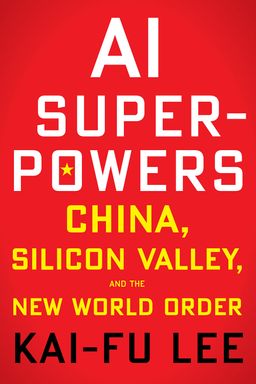
AI Superpowers cover

AI Superpowers

by Kai-Fu Lee

AI Superpowers by Kai-Fu Lee explores the escalating competition between the US and China in the burgeoning AI industry. With a deep dive into technological advances and economic implications, this book offers a compelling look at the future shaped by artificial intelligence. It challenges readers to consider the societal impacts and opportunities of this technological revolution.

The Race to Shape the AI Future

The Race to Shape the AI Future

You live in a moment when artificial intelligence is transforming from futuristic speculation into industrial revolution. In AI Superpowers, Kai-Fu Lee argues that AI is not a single technology but a general purpose force—as transformative as electricity or the steam engine—reshaping economies, geopolitics, and human purpose. He immerses you in two parallel stories: a global competition between China and the United States and a personal awakening about why meaning must accompany innovation.

The engine behind the era

Lee traces modern AI’s acceleration to deep learning—a statistical technique that enables computers to learn patterns from massive labeled data. This breakthrough moved AI from decades of winter into its current renaissance. Deep learning’s strength lies in its narrow power: given enough examples, it can master vision, translation, recommendation, and decision tasks. What it cannot do—general reasoning or empathy—sets the boundary between machine intelligence and human intelligence.

China’s awakening and mobilization

In March 2016, when AlphaGo defeated world champion Lee Sedol and later China’s Ke Jie, China experienced its Sputnik moment. Over 280 million Chinese watched as Ke Jie quietly wept. That emotional spectacle triggered national determination. Within months, Beijing unveiled its AI development plan, promising global leadership by 2030. Local governments built incubators and subsidies; venture investors poured in capital—their share of global AI funding jumped to nearly half worldwide by 2017. What began as a match became a mobilization, unifying policy, entrepreneurship, and data collection.

From copycats to gladiators

Lee calls Chinese entrepreneurs “gladiators.” Many began as copycats, cloning Western apps. Wang Xing copied Friendster and Facebook before founding Meituan, surviving brutal group-buying wars through relentless iteration. Copying became combat training. Fierce competition bred executional excellence. When the deep learning era arrived, these battle-hardened founders were ready to deploy AI into food delivery, transport, and logistics. (Note: In contrast, Silicon Valley’s culture prizes originality, while China’s ecosystem rewards speed and survival.)

An alternate internet as data oilfield

China’s mobile-first, O2O-driven internet ecosystem—anchored by WeChat’s super-app and urban services like Didi and Meituan—provides unmatched real-world data. Lee calls this environment “the Saudi Arabia of data.” Payments, deliveries, shared bikes, and IoT sensors create granular behavioral logs. Combined with government support—thousands of incubators and guiding funds—China’s density of experimentation turns data into national advantage.

Four waves redefining industries

Lee maps AI’s diffusion into four overlapping waves: Internet AI (recommendation engines), Business AI (enterprise optimization), Perception AI (vision and voice interfaces), and Autonomous AI (robots and vehicles). China leads in consumer and perception waves, while the U.S. dominates business applications and autonomous systems. Together they form a layered transformation that will first automate cognition before fully mastering physical interaction.

Economic disruption and inequality

AI functions as a new general purpose technology with sweeping economic impact. Like electricity and ICT, it amplifies productivity but also concentrates wealth. Because AI favors scale, data monopolies form fast—Google, Facebook, and Amazon in the U.S.; Baidu, Alibaba, and Tencent in China. PwC estimated AI could add $15.7 trillion to global GDP by 2030, with most gains flowing to these two superpowers. For developing countries, this dynamic poses an existential threat: the traditional ladder from low-cost manufacturing to prosperity is eroding as intelligent automation replaces both factory and service work.

Work, meaning, and human response

Lee predicts two avenues of job loss: direct one-to-one automation and ground-up industry reinvention by AI-native startups. Algorithms will disrupt cognitive roles first—radiologists, accountants, translators—while robots encroach later on manual labor. Rather than rely solely on universal basic income, he advocates a social investment stipend: payment for socially valuable work such as caregiving, teaching, and community service. This approach restores purpose versus merely distributing cash.

Beyond superintelligence myths

Against sensational headlines predicting AGI imminence, Lee argues current algorithms cannot leap to self-aware machines. Tasks like general reasoning and emotional understanding remain unsolved. True AGI requires breakthroughs in multidomain learning, common-sense reasoning, and ethical alignment. You should not expect humanity to “summon the demon” soon—rather, prepare for decades of practical but narrow deployment that changes work and policy now.

Ethics, policy, and human values

Lee contrasts America’s cautious governance with China’s techno-utilitarian pragmatism. China’s fast experimentation results from tolerance of risk and data collection, while the U.S. prioritizes rights and deliberation. Policy shapes adoption speed. But ultimately, Lee’s personal confrontation with mortality reveals the book’s moral heart: technology can maximize efficiency, not meaning. To build a humane future, you must pair AI’s logic with compassion—letting machines do calculations while humans do care.

Core takeaway

AI Superpowers is ultimately a manifesto: master AI’s mechanics but center its purpose in humanity. The true race is not between nations but between greed and empathy—will you build systems that serve society or ones that merely optimize profit?


Deep Learning and Its Limits

Kai-Fu Lee explains that deep learning turned decades of AI speculation into functioning reality. Neural networks, long dismissed after earlier failures, revived through the convergence of three forces: abundant labeled data, cheap computational power, and renewed techniques to train multiple layers efficiently (championed by Geoffrey Hinton in the mid-2000s). That technical renaissance powered breakthroughs from image recognition to AlphaGo’s mastery of Go.

A shift from discovery to implementation

The author calls our era the “age of implementation.” Earlier AI epochs celebrated rare research insights; now progress depends on engineering scale—applying known architectures to millions of problems. This democratization favors countries with massive data and large engineering talent pools. China, with thousands of skilled programmers and open publication pipelines like arXiv, caught up quickly once algorithms became public knowledge.

Why narrow trumps general for now

Deep learning is potent but narrow. It excels at optimizing within fixed rules—detecting fraud, parsing speech, recognizing faces—but lacks contextual reasoning or creative leaps. Lee stresses you should treat deep learning as an industrial engine, not a brain. Its strength lies in measurable domains; its weakness is flexibility. That contrast makes applied AI simultaneously transformative and contained.

Data versus expertise

Unlike the physics revolution driven by lone geniuses, today’s AI favors distributed tinkering over isolated brilliance. Once algorithms are known, data abundance and execution matter more than theoretical innovation. Microsoft Research Asia and companies like Face++ built China’s research credibility, but what sustained progress was scale—millions of tagged images, billions of transactions, and feedback loops that improve models autonomously.

Hardware and institutional frontiers

AI still depends on physical infrastructure. Nvidia GPUs fueled initial waves, but specialized chips—Cambricon, Horizon Robotics—represent China’s bid for technological sovereignty. Corporate labs like Google DeepMind, with elite talent segregated from academia, may control future paradigm shifts. (Note: Lee warns this secrecy could concentrate innovation power dangerously.) For practitioners, this landscape means success hinges on coupling data access with capable engineering rather than relying on theoretical breakthroughs alone.

Deep learning is the workhorse of current AI—a mix of brute statistical force and elegant mathematical design. Understanding its boundaries helps you plan realistically: great for classification and prediction, not for consciousness or ethics.


China’s Entrepreneurial Evolution

Lee devotes significant attention to how China’s competitive culture forged unique entrepreneurial strengths. Early internet founders thrived in chaos—copying Western models but adapting them obsessively. Wang Xing’s journey from cloning Facebook to building Meituan exemplifies this transformation. The fierce “coliseum” of identical startups forced rapid iteration, tight cost control, and survival by execution rather than originality. That muscle later became crucial for deploying AI at scale.

From imitation to innovation

Copycat competition cultivated operational mastery. Entrepreneurs learned to localize for linguistic, cultural, and payment differences. Jack Ma’s Taobao beat eBay by designing for Chinese buyer habits, not Western logic. Zhou Hongyi’s 3Q War with Tencent revealed aggressive counter-tactics. Such rivalries hardened founders into adaptability experts—a critical trait for implementing AI where agility often beats novelty.

Execution over ideology

Where American founders often chase visionary missions, Chinese gladiators chase survival and speed. Lee argues this pragmatism aligns well with AI’s trial-and-error dynamic. Success depends less on brilliant invention than on tuning models, gathering labeled data, and integrating AI into logistics and daily operations. In the age of implementation, China’s market-driven grit proves as vital as Silicon Valley’s scientific talent.

O2O and super-app dynamics

China’s alternate internet universe expanded these cultural advantages. WeChat’s evolution—from 2011 messaging platform to life remote—merged payments, media, and services under one interface. This “super-app” ecosystem created unprecedented data feedback loops linking online actions to offline behaviors. Bike-sharing networks like Mobike logged tens of millions of rides daily, feeding AI systems with dense, labeled activity streams that Western markets struggle to match.

China’s competitive crucible turned copying into a methodology for mastery. In the deep learning era, that same instinct to test, iterate, and out-execute fuels its AI rise—proof that grit and speed may rival genius.


Policy, Power, and Global Divide

Policy choices define who leads AI adoption. Lee contrasts China’s centralized mobilization with the United States’ decentralized caution. China’s State Council plan and Li Keqiang’s “mass innovation” campaign created direct funding, housing for entrepreneurs, and city-level competition to attract firms. Nanjing alone pledged billions in RMB for AI development. These top-down measures produced scale and urgency the U.S. regulatory climate often lacks.

Techno-utilitarianism versus ethical gradualism

Lee describes China’s posture as pragmatic: deploy first, adjust later. Ethical mistakes are tolerated if the net public benefit rises. In contrast, American policymaking often slows under lobbying and litigation. Autonomous vehicles face union resistance; surveillance policies stumble on privacy battles. This divergence shapes which domains mature fastest: where ethics dominate, rollout lags; where experimentation dominates, adoption accelerates.

Global concentration of wealth

AI’s monopoly tendencies align with geopolitical concentration. Data-rich superpowers—China and the U.S.—will likely capture about 70% of global AI GDP gains by 2030. Developing countries risk technological dependency because automation diminishes their comparative advantage in cheap labor. Lee warns that this new divide could destabilize geopolitical equilibrium and make digital sovereignty a bargaining chip in diplomacy (similar to oil in earlier decades).

Hardware sovereignty and strategic chips

Semiconductors represent another front. Specialized AI processors carry dual commercial and national-security significance. China’s Cambricon and Horizon Robotics embody state-funded efforts to reduce reliance on foreign GPUs. Whoever masters chip design effectively controls algorithmic nations. (Note: This theme echoes economist Dani Rodrik’s warnings about technological dependency cycles.)

In Lee’s framework, policy is not neutral context—it is the throttle. Nations that favor bold experimentation may dominate industrial application even if they lag in theory, reshaping global balance more than algorithms themselves.


Work Disruption and Social Renewal

Automation reshapes work through two pathways: direct substitution and structural reinvention. Lee integrates studies from Oxford, OECD, PwC, and McKinsey, revealing estimates from 9% to nearly 50% of jobs at risk depending on measurement unit—task or occupation. His synthesis clarifies that while not every job disappears, many roles shrink or transform fundamentally.

Algorithms first, robots later

Moravec’s paradox explains this sequence. Cognitive software scales faster than mechanical manipulation. Algorithms can process tax returns or X-rays instantly; physical robots still struggle to fold laundry or navigate cluttered environments. White-collar disruption arrives first because information tasks are digitizable, while manual labor demands dexterity and robustness that robotics achieve slowly.

Ground-up reinvention

Beyond replacing individual workers, new AI-native firms often design business models that eliminate entire job classes. Smart Finance issues loans without officers; Toutiao curates news without editors; F5 Future Store sells products without clerks. Lee estimates such structural innovation could increase displacement another 10% beyond direct automation.

Policy responses and the social investment stipend

Lee critiques universal basic income as insufficient. Cash without community breeds emptiness. His social investment stipend transforms redistribution into purposeful employment: pay citizens to care for elderly parents, teach, mentor, or remediate environments. Funding arises from taxing AI’s winners and reinvesting gains in service-oriented labor. This model rebalances dignity without halting progress.

Prepare for two phases—rapid software automation followed by slower mechanical diffusion—and align education policy accordingly. Future resilience depends on valuing empathy-centric work as economically vital, not auxiliary.


Human-AI Coexistence and Meaning

The final chapters turn intimate. After surviving stage IV lymphoma, Kai-Fu Lee reexamines success through the lens of mortality. His core revelation: technological progress yields prosperity, not purpose. Humans find meaning through care, love, and community—capacities machines cannot replicate.

From productivity to compassion

Lee recounts almost missing his daughter’s birth for a business meeting, later realizing this obsession with impact was hollow. Conversations with Buddhist master Hsing Yun crystallized the principle “maximizing impact is no substitute for love.” The lesson becomes universal: as AI automates decision-making, human value must shift from analysis to empathy.

Designing symbiotic markets

Human-AI coexistence works best when algorithms handle optimization and humans deliver connection. Medical AI may outperform doctors in diagnosis, but compassionate caregivers will remain essential to interpret results and console patients. Similarly, elder-care technologies succeed only when paired with responsive human contact—Lee’s example of senior tablets where the most-used button summoned customer service proves this innate social need.

Meaningful work and impact investing

Lee advocates investing in labor-intensive service ventures—conversation companions, parenting aides, teachers augmented by AI co-tutors. These jobs may not generate unicorn-level returns but can restore communal dignity and emotional health. They embody a practical synthesis of machine efficiency with human ethics.

Let machines be machines, and let humans be human. AI should free time for compassion, not erase it. The true measure of progress is whether society amplifies its capacity to love as much as its capacity to compute.

Dig Deeper

Get personalized prompts to apply these lessons to your life and deepen your understanding.

Go Deeper

Get the Full Experience

Download Insight Books for AI-powered reflections, quizzes, and more.