
Idea 1
The Human Future with AI
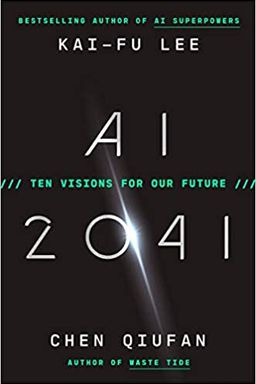
What happens when artificial intelligence saturates every layer of life—education, love, governance, work, and even happiness? In AI 2041, Kai-Fu Lee and Chen Qiufan construct intertwining stories and essays that show you a world transformed by deep learning, robotics, quantum computing, and synthetic economies. They ask not just what AI can do, but what humanity must become when algorithms mediate nearly every decision.
The book’s central argument is that AI will bring both unprecedented plenitude and wrenching disruption. It will automate entire industries, generate wealth through data, and customize daily life to impossible precision. But if left to narrow objectives—maximize profit, reduce risk, optimize engagement—it will corrode fairness, autonomy, and dignity. You, as a citizen and designer of this future, must guide it toward shared prosperity and ethical use.
Four waves and their convergence
Lee’s four waves—Internet, business/finance, perception, and autonomy—anchor this vision. You move first from data-driven commerce (Ganesh Insurance’s AI underwriting) to perception intelligence (Amaka’s deepfake surveillance), and then to full autonomy (Chamal’s semi-robotic driving). Each wave compounds the prior: broad data enables nuanced vision, which enables automated action. By 2041, these waves converge into a near-continuous intelligence layer linking speech, vision, planning, and embodied robotics.
Stories that humanize transformation
Each narrative dramatizes a different facet. Nayana’s story reveals how narrow incentives warp life when insurance AI optimizes health to cut costs. Amaka’s Lagos saga shows deepfake wars destroying visual trust. Golden and Silver Sparrow encounter GPT-style tutors who mold their ethics and creativity. Chen Nan’s post-COVID isolation shows robotics reshaping hospitals and homes. Aiko falls for Hiroshi’s mixed-reality idol and faces questions about grief, identity, and digital immortality.
These grounded experiences illustrate the book’s pattern: technological success always shadows moral tension. Every AI system embodies an objective function that governs behavior. If that objective neglects human values—safety, fairness, compassion—the optimization itself becomes dangerous. As Lee insists, you must design multi-objective systems that encode ethics from the start.
Emerging challenges
From the deep learning economy arises a governance crisis. Foundation models, multimodal generators, and autonomous drones magnify power asymmetries. Governments scramble to draft laws—the EU’s AI Act, Shanghai rules, and an American Blueprint for an AI Bill of Rights—while companies self-regulate (OpenAI, Google DeepMind). Meanwhile, public agitation grows: petitions, moratoria, existential-risk statements from world leaders. The conversation has entered mainstream geopolitics; you are living through the policy birth of AI civilization.
The personal and the planetary
By the late stories, humanity faces quantum threats, autonomous weaponry, and abundance revolutions. Robin’s quantum heist shows why computing power must be treated like nuclear capacity—each exponential leap alters the balance of global security. Keira’s Project Jukurrpa shows how post-scarcity economics demands new moral economies: if goods are free, meaning must come from creativity and contribution. These extremes complete a spectrum—from algorithmic relationships in families to ecological design under plenitude.
The book’s moral thesis
Technology itself is neutral; its values are defined by objectives and governance. AI offers you a mirror of human intention—efficient, relentless, and literal. The stories collectively insist that compassion, equity, and accountability must guide AI’s trajectory. Without them, the same intelligence that enables plenitude may generate stratified misery.
A guide for the reader
Through fourteen interwoven tales, you see how engineers, policymakers, educators, and citizens can intervene. Learn the data foundations behind deep learning; understand computer vision and generative fraud; grasp GPT-style education; examine healthcare automation; debate XR ethics; manage driverless transitions; track quantum and warfare risks; rethink jobs and money; and finally, rebuild happiness and privacy. The book is less prophecy than a moral blueprint for surviving the next twenty years of algorithmic civilization.
If you read closely, Lee and Qiufan give clear advice: embrace innovation, but pair every technical ambition with human oversight. The journey across Nayana, Amaka, Aiko, and Keira’s worlds reveals not what AI might become, but who you must be to coexist with it—ethical, curious, and mission-oriented in protecting human purpose.