
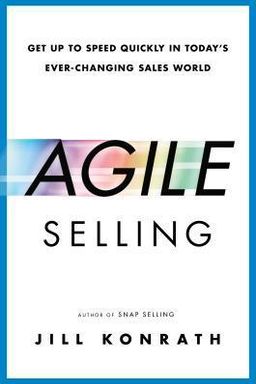
Agile Selling cover

Agile Selling

by Jill Konrath

Agile Selling by Jill Konrath empowers sales professionals to thrive in dynamic markets. Learn to swiftly adapt through agile learning, turn challenges into growth opportunities, and refine your selling skills for unmatched success. Discover practical strategies to outperform in today''s ever-changing sales landscape.

Agile Selling: Thriving Amid Relentless Change

How can you stay ahead when the world around you changes faster than you can learn? That’s the question Agile Selling by Jill Konrath brilliantly tackles. Drawing on her decades of frontline sales experience, Konrath argues that your greatest sales advantage today isn’t your product, your price, or even your company—it’s your ability to learn fast. She calls this essential capability sales agility: the ability to quickly absorb new information, master new skills, and adapt your approach in real time.

Konrath contends that agility has become the ultimate differentiator in a world where buyer behaviors, technologies, and markets shift at lightning speed. You can’t rely on scripts or what worked last year—your buyers have already moved on. But those who cultivate an agile mind-set, combined with rapid learning techniques and disciplined habits, can thrive regardless of turbulence. They don’t just survive change; they leverage it for growth.

Why Agility Matters More Than Ever

Konrath opens by confronting the uncomfortable truth: sales is no longer about pitching—it’s about partnering with highly informed, self-educating buyers. In Chapter 2, she reveals that most prospects research online long before contacting a salesperson. By the time they speak to you, they’ve already decided what they want. Sellers who only talk about products are seen as irrelevant. The only way to stand out, she argues, is to offer insight and value that buyers can’t find online. That requires deep understanding of their world and the ability to learn fast enough to stay ahead.

This evolving environment demands agility: the capacity to adapt quickly to shifting market forces, customer expectations, and even internal corporate changes. Konrath likens agility to a meta-skill—a mindset and toolset that enables you to stay mentally flexible, absorb new knowledge, and pivot your strategies as needed. Like a pro athlete who constantly retrains for peak performance, the agile seller continuously upgrades their own skill set to meet new demands.

The Agile Mind-Set: Adopting an Experimenter’s Mentality

At the core of agility is a new kind of thinking. Konrath describes the agile mind-set as a blend of optimism, resilience, curiosity, and decisiveness. You start by making the pivotal decision—the firm commitment to succeed despite setbacks. Then, rather than treating obstacles as threats, you reframe them as challenges to solve (a concept echoed by Carol Dweck’s growth mind-set research). When you stumble, you reframe failure as fuel for learning; when goals feel unreachable, you shift to “getting better” goals that focus on progress instead of perfection. This chain of mental habits creates emotional resilience—the raw material for agility.

For example, Konrath recalls botching an early Xerox demonstration because she recited her script word for word and forgot the prospect’s name. Embarrassed but committed, she decided to stay and figure it out instead of quitting. That moment, she explains, was pivotal: success became a decision, not a condition. Agile sellers don’t wait for confidence to arrive—they build it through action.

Learning Quickly: The Science of Rapid Mastery

The heart of the book lies in parts 3 and 4, where Konrath unveils practical methods for


Understanding Today’s Buyer

Jill Konrath argues that the most revolutionary change facing salespeople today isn’t technology—it’s the buyer. In Agile Selling, she reveals just how dramatically buyer behavior has evolved. Today’s customers, armed with endless online information, rarely engage a salesperson until they are already deep into their decision-making process. According to her research, buyers are often 60–70% through their journey before contacting a vendor. This means that the traditional role of salespeople as conveyors of information has become obsolete.

Buyers Don’t Need Sellers—They Need Partners

Because prospects can self-educate, they no longer rely on salespeople for product details. Instead, they look for someone who can help them frame problems, understand opportunities, and mitigate risks. That requires sellers who truly understand the buyer’s business context—not only what they sell, but also why their offering matters. Konrath emphasizes mastering the buyer’s world: knowing their goals, metrics, challenges, and what triggers them to change.

Learning to Provide Real Value

Konrath highlights three success factors modern buyers demand: knowledge, relevance, and value. They expect sellers to arrive prepared, bring fresh insight, and speak their business language. The salesperson’s job is to facilitate discovery rather than pitch—the goal is to collaborate on a solution, not push a product. As she notes, only 15% of executives feel that meetings with salespeople meet their expectations. Yet studies (like CEB’s Challenger model) show that those who bring useful insights outperform their peers dramatically.

To meet this new standard, you must transform into a resource rather than a persuader. Konrath urges you to shift your conversations from what you sell to what difference it makes. When you make prospects smarter about their own business, you become indispensable. Sales agility, therefore, begins with empathy, curiosity, and understanding the evolving buyer journey.


The Agile Mind-Set

The mind-set of an agile seller determines everything that follows. In this section, Konrath explores how your beliefs shape your capacity to perform under pressure. She structures the agile mind-set around several key internal disciplines—choice, reframing, goal-setting, and resilience.

Choosing Success

In “Make the Pivotal Decision,” Konrath asserts that success isn’t luck; it’s a deliberate choice to persist when things get tough. She recalls how, at Xerox, she once flubbed a demonstration so badly she wanted to quit. Instead, she committed to learning. That choice to stay ultimately launched her career. The lesson: commitment precedes competence.

Turning Problems into Challenges

Agile sellers reframe stress as stimulation. Neuroscience shows stress releases cortisol, damaging creativity and recall. But reinterpreting problems as puzzles flips your brain from fight-or-flight mode into solution-seeking mode. When Konrath lost key clients, she replaced despair with curiosity—asking “What can I learn?” That question unlocked new strategies and inspired her bestselling book. (This echoes Carol Dweck’s idea that seeking mastery instead of validation breeds growth.)

Redefining Failure and Goals

Konrath borrows from Sara Blakely’s childhood lesson: fail every day. By normalizing mistakes, you free yourself to experiment and learn faster. Likewise, she recommends replacing outcome goals (“make $200K”) with “getting better” goals—small, measurable steps that increase proficiency. Backed by research from Don VandeWalle and Heidi Grant Halvorson, this approach prioritizes skill mastery and sustained motivation. When you focus on improvement, you transform effort into momentum.

Together, these ideas form the foundation of agility—an inner stance that views discomfort as a signal of growth, not danger. Once your thinking changes, accelerated learning naturally follows.


Learning Fast: The Six Rapid Learning Strategies

Konrath draws on neuroscience to explain how to learn at record speed. Selling demands constant upskilling, but most people don’t know how to learn effectively. Her six-step system—chunking, sequencing, connecting, dumping, practicing, and prioritizing—provides a blueprint to master any new domain quickly.

1. Chunk and Sequence

Break complex subjects into digestible units. For a new salesperson, that might include company, products, customers, and processes. Then sequence learning: start with what builds foundational understanding before layering in complexity. Without structure, information becomes noise; with it, learning accelerates.

2. Connect and Dump

Link new ideas to what you already know. Konrath’s client Antonio, overwhelmed by information, regained focus by mapping new knowledge against previous experiences. Dumping means offloading mental clutter—using mind maps, checklists, or cheat sheets to store knowledge externally. This frees your brain to make new connections.

3. Practice and Prioritize

Active repetition transforms knowledge into skill. Role-play sales calls, explain concepts to others, or try “practice safe selling” simulations before meeting real clients. Since multitasking destroys retention, choose one learning goal at a time and attack it with full focus. These techniques form the backbone of Chapter 9–14 and are consistently reinforced through practical exercises.

By mastering how to learn, you develop confidence that you can thrive in any new market, job, or challenge.


Mastering Buyer Knowledge

Once you’ve learned how to learn, the next step is to dig deep into your buyer’s world. Konrath calls this ‘getting situational credibility in 30 days.’ You do that by understanding who makes decisions, what their goals are, and how their buying process unfolds.

Building the Buyer’s Matrix

The Buyer’s Matrix is her signature tool—a chart mapping each decision-maker’s responsibilities, objectives, challenges, and status quo. By filling it out, you not only memorize facts but see patterns across roles and industries. LinkedIn, forums, and customer interviews provide the puzzle pieces that complete this matrix.

From Status Quo to Change

Since most prospects stick with what they know, the status quo is your fiercest competitor. Identifying its weaknesses helps you craft a stronger business case for change. Combining this with trigger event awareness—like new leadership, mergers, or regulations—lets you strike when priorities are shifting. As Konrath writes, ‘Trigger events loosen the grip of the status quo and catalyze change.’

Learning Directly from Buyers

Konrath encourages interviewing recent customers about results achieved. Inside sales rep Sarah, for example, learned from her client Ethan that her company’s software saved $15,000 in labor costs and eliminated backlogs. That insight reframed her pitch around productivity outcomes instead of features—instantly boosting her sales. Real stories like these anchor theoretical knowledge in real-world value.


Accelerating Skill Acquisition

After building foundational knowledge, the agile seller must translate it into behavior. Konrath outlines methods to master selling skills fast by focusing on deliberate practice, feedback, and observation.

Deliberate Practice and Feedback

“Practice Safe Selling” encourages role-plays and simulations before live calls. Sellers often resist this, but it’s the quickest way to ingrain soft skills. Watching recordings or practicing with peers (as Katie did before her big presentation) exposes blind spots and accelerates improvement.

Learning from Others

Konrath recommends ‘picking the upstart’s brain’—those rising stars who cracked the success code recently. They remember what it takes to start from scratch. She also advises observing seasoned pros to understand their intuition, but warns that veterans may skip explaining what’s second nature. The key is curiosity: ask why they made specific choices, not just what they did.

Borrowing Brains

When stuck, she suggests mentally channeling mentors—like her early boss Jim Farrell at Xerox—by asking, “What would [mentor’s name] do?” This reframing unlocks creative thinking and confidence. Hillary Clinton reportedly used this technique, asking herself, “What would Eleanor Roosevelt do?” Borrowing others’ perspectives expands your strategic agility.

These practices fast-track skill mastery because they embed reflection, imitation, and experimentation—the building blocks of expertise.


Success Habits of Agile Sellers

In Part 5, Konrath shifts from techniques to daily habits. Mastery isn’t about occasional bursts of brilliance; it’s about consistent systems that protect time, energy, and focus. Her productivity and mindset chapters translate cognitive science into actionable rituals.

Structure and Focus

Agile sellers control their environment. They purge unqualified leads (purge the pipeline), schedule learning blocks, eliminate distractions, and resist multitasking—since multitasking can drop IQ by 15 points. Tools like Anti-Social or Word’s Focus mode help maintain attention. She emphasizes scheduling email checks and working in 90-minute intense bursts, followed by short breaks to refuel energy.

Building Cognitive Fitness

‘Upgrade your brain’ through sleep, exercise, and focus intervals. When you feel mentally fatigued, take a walk—as Konrath does before important projects. Drawing from research by K. Anders Ericsson, she notes that peak performers alternate intense focus and recovery. Learning agility depends on this rhythm.

Optimizing Attitude and Grit

Purpose fuels persistence. Stories of discouraged reps like Karen and Steve illustrate the transformative power of optimism and noble purpose (echoing Lisa Earle McLeod’s Selling with Noble Purpose). Combined with Angela Duckworth’s grit research, Konrath’s recipe for resilience includes focusing only on what you can control, celebrating small wins, teaching others, and recalibrating over coffee when progress stalls.

Agility, she concludes, is a muscle strengthened through consistent reflection and disciplined self-management. By choosing better habits, you build a life—not just a career—of continuous improvement.


The Ultimate Challenge: Continuing Your Growth

In her conclusion, Jill Konrath reframes the entire book as “Project You”—an ongoing personal development mission. The ultimate challenge is not mastering a sales methodology but transforming yourself into a perpetual learner. Success comes to those who keep experimenting, questioning, and pursuing mastery even after reaching proficiency.

Continuous Curiosity

Konrath warns against complacency—the silent killer of growth. When you start feeling comfortable, curiosity fades and agility weakens. Instead, she advises staying in “testing mode”: ask new questions after every interaction, run controlled experiments, and debrief frequently. Selling, she insists, is an experiment that never ends.

Agility as a Life Skill

Learning agility isn’t confined to sales. It equips you to handle career changes, new technologies, and even personal reinventions. The same mindset that helps you win clients helps you learn languages, lead teams, or start a business. “To be an agile learner,” she writes, “virtually guarantees a prosperous career.”

Ultimately, Agile Selling is both a manual for sales success and a guide to thriving in any domain defined by change. Its message is clear: choose growth over comfort, curiosity over complacency, and action over fear. That’s how you become not just a better seller, but a better learner for life.

Dig Deeper

Get personalized prompts to apply these lessons to your life and deepen your understanding.

Go Deeper

Get the Full Experience

Download Insight Books for AI-powered reflections, quizzes, and more.