
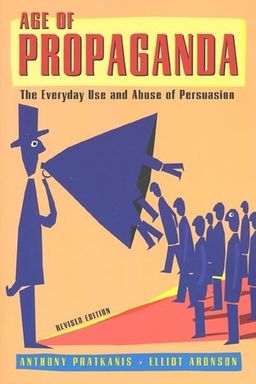
Age of Propaganda cover

Age of Propaganda

by Anthony Pratkanis and Elliot Aronson

Discover the pervasive power of propaganda in ''Age of Propaganda.'' This book reveals the subtle tactics used to manipulate our opinions and decisions daily. Learn to spot propaganda, understand its mechanisms, and arm yourself with the tools to make informed choices.

The Persuasive Society: How Modern Propaganda Shapes You

You live inside a persuasive machine. In their classic work on propaganda and influence, Anthony Pratkanis and Elliot Aronson argue that modern citizens are surrounded by calculated attempts to shape their beliefs, emotions, and decisions—from commercial advertising and public relations to political spectacle and online campaigns. With hundreds of billions spent annually on communication, persuasion is no longer an occasional act; it is a constant environment.

From Rhetoric to Mass Persuasion

Where ancient rhetoricians aimed to train citizens in reasoned debate, the twentieth century industrialized persuasion. Volney Palmer’s 1843 advertising agency ushered in an era of message production. By World War I, George Creel’s Committee on Public Information demonstrated how imagery and slogans could mobilize a nation. These lessons spread globally—from democratic campaigns to totalitarian propaganda machines. The authors call this the postindustrial age of persuasion: organized, scientific, and omnipresent.

The Attention Economy

In a world of message overload, your attention becomes the scarce resource. Advertisers in the United States spend more than $165 billion annually; with just six percent of the world’s population, the country absorbs over half of global advertising. Short, vivid cues compete for your focus—slogans, logos, songs, and emotional triggers designed for memory and repetition. Each ad or soundbite seeks not just attention but consent.

Democracy and the Spectacle Problem

The authors identify a central paradox: democracy requires informed deliberation, yet modern persuasion rewards spectacle and shortcut processing. Television news cycles, thirty-second commercials, and click-based journalism encourage emotional responses rather than thoughtful argument. Audiences learn about scandals and personalities more than about policies—a dynamic seen in coverage of celebrity trials and partisan controversies. The system favors entertainment over reason.

The Civic Challenge

You cannot escape this persuasive landscape—but you can learn to navigate it. Pratkanis and Aronson urge education rather than cynicism: learn how messages frame facts, how repetition builds false familiarity, and how credibility can be manufactured. Recognize emotional appeals and scripting techniques that guide you toward conformity without deliberation. Understanding persuasion is not paranoia—it is civic competence.

Core message

Modern propaganda is not the loudest voice in your life—it is the background noise you stop noticing. Learning its mechanisms is the first step toward reclaiming independent thought and genuine democratic participation.

Throughout the book, the authors combine social psychology findings with vivid real-world examples to show how persuasion operates on multiple levels—cognitive, emotional, social, and institutional. Understanding these mechanisms turns passive exposure into active awareness, restoring your capacity to think freely in a world of engineered influence.


Processing Persuasion: How Your Mind Responds

When someone tries to persuade you, the success of the message depends on how you process it. Social psychologists Petty and Cacioppo describe two primary routes: the central route, which involves logical reflection, and the peripheral route, which relies on shortcuts and cues. Most everyday persuasion targets your peripheral route because it is automatic and efficient.

Central versus Peripheral Route

When you care deeply or feel responsible for a decision, you analyze arguments carefully, forming lasting opinions. When distracted or unmotivated, you rely on appearance, slogans, repetition, and tone. A celebrity endorsement or glossy design sways you more when you are tired or rushed. This explains why product placement and image-heavy ads work even on skeptical viewers.

Mindlessness and Mental Shortcuts

Ellen Langer’s experiments show how even trivial cues can trigger compliance—people let others cut in line because they hear a familiar structure (“because I must…”). You are a cognitive miser; you conserve mental energy through heuristics. Words such as “new,” “natural,” or “scientific” act as decision shortcuts. The same principle governs political messaging, where slogans substitute for reasoning.

How To Resist

  • Pause and ask what thoughts the message evokes. Those thoughts, not the words, drive persuasion.
  • Raise involvement—identify why a topic matters to you so rational processing activates.
  • Check for shortcuts: repetition, attractiveness, familiarity, and slogans often replace substance.

Key principle

Successful persuaders shape your thinking patterns. Once you learn how your mind shortcuts, you can defend against manipulation and promote deliberate reasoning—the essence of civic autonomy.

Understanding how persuasion enters through both thoughtful and automatic processes helps you recognize when you are reasoning versus reacting. In a fast-moving society, slowing your mental responses becomes a radical act of resistance.


Framing, Credibility, and the Construction of Reality

Words, labels, and perceived authority shape how you interpret truth before evidence appears. Pratkanis and Aronson explain how framing, labeling, and manufactured credibility build entire belief systems that feel authentic even when they are engineered.

Labels and Frames

Language defines reality. Terms like “pro-life,” “pro-choice,” “war on drugs,” or “tax relief” trigger assumptions built into cultural frames. Kahneman and Tversky’s framing studies confirm that how choices are worded changes what you prefer; people take risks differently depending on gain or loss framing. This extends to headlines and polls—question wording often predetermines responses.

The Manufacture of Credibility

Authority imagery can make weak arguments seem strong. Early experiments showed identical messages attributed to trusted experts persuaded better. Modern marketing magnifies this—professional spin doctors craft stage-managed authenticity. Nixon’s “spontaneous” phone calls or celebrity endorsements simulate credibility. Even unqualified spokespeople gain persuasive power when represented as experts.

Evaluating Credibility

  • Ask if expertise matches the topic, not public recognition.
  • Check motivation and independence: is there a financial or ideological stake?
  • Be alert to the “against self-interest” effect—sometimes that sincerity is strategic.

Central insight

Frames decide what counts as evidence, and credibility tells you whom to trust. Together they shape not only opinions but the boundaries of public discussion. Reframing and skepticism revive genuine inquiry.

Recognizing how reality is linguistically and symbolically constructed frees you from passively absorbing the narratives designed by professionals. Critical awareness restores your perspective on what’s actually true, not merely what’s plausible or popular.


Emotion, Fear, and Dissonance

Emotion drives persuasion more powerfully than logic. This part of the book unpacks two related principles—fear appeals and cognitive dissonance—and explains why emotional tension, when managed skillfully, can produce profound behavioral change or destructive compliance.

Fear and Relief

Howard Leventhal’s research on fear appeals shows they work only when paired with clear, doable actions. Vague doom triggers paralysis; explicit instructions motivate. Dolinski and Nawrat found a “fear-then-relief” effect—momentary fright removes analytical resistance and makes people more compliant, a principle echoed in many political crises and sales tactics.

Cognitive Dissonance and Rationalization

Leon Festinger’s theory explains why people justify mistakes instead of correcting them. When actions conflict with values, the resulting tension encourages rationalizations. At scale, entire groups justify harmful acts to preserve self-consistency—seen in wartime propaganda and moral disengagement. Fear and dissonance thus serve as tools of mass persuasion.

Ethical and Practical Lessons

  • Fear works when audiences have efficacy and solutions; without them, it breeds denial.
  • Acknowledging discomfort protects moral reflection; rationalizing errors magnifies harm.
  • Evaluate whether emotional appeals serve truth or exploit vulnerability.

Insight

Propaganda manipulates emotion because emotion shortcuts thinking. Reclaiming composure is the psychological act that restores freedom of choice.

Both fear and dissonance remind you that persuasion operates through your need to feel safe and consistent. Understanding those needs lets you separate genuine urgency from manipulative pressure.


Social Influence, Group Identity, and Modeling

Humans learn by observing others and by joining groups. This key idea merges experiments on social learning and Tajfel’s minimal-group paradigm to show how imitation and group identity amplify persuasion far beyond direct messages.

Modeling and Media

Albert Bandura demonstrated that seeing aggressive behavior prompts imitation—the Bobo doll experiment became a cautionary lesson about televised violence. David Phillips connected prizefights and suicide stories to copycat behaviors. Media exposure models what is normal, rewarding, or heroic; and in the absence of personal role models, broadcasts fill that void.

The Granfalloon Effect

Kurt Vonnegut’s term “granfalloon” describes meaningless group identities that still inspire loyalty. Tajfel showed people favor arbitrary ingroups created by coin flips. Advertisers and politicians exploit this instinct by inventing affiliations—fans, demographics, or causes—that drive consumption and conformity. Televangelists and brands alike monetize belonging by converting identity into market share.

Defensive Strategies

  • Diversify your identities; don’t anchor self-worth in one affiliation.
  • Question who benefits from group labels and avatars offered to you.
  • Provide better models—stories of empathy and cooperation counter toxic examples.

Core lesson

We imitate and affiliate before we reason. Persuasion succeeds because social learning feels effortless; resisting it requires mindful choice of what and whom you emulate.

Understanding how groups and media shape norms allows you to choose your influences intentionally—turning automatic conformity into conscious culture building.


Tactics of Compliance and Self-Persuasion

Everyday compliance tactics convert small psychological levers into major behavioral outcomes. The authors outline recurring patterns—commitment escalation, reciprocity, repetition, and self-generation—that explain why you say yes when logic says no.

Commitment and Consistency

Once you make a small commitment, you feel internally bound to stay consistent. Freedman and Fraser's safe-driving study shows how a minor pledge leads to larger compliance, while lowball sales demonstrate escalation traps. National policy—like the Vietnam buildup—mirrors this psychology of successive justifications.

Reciprocity and Contrast Effects

Cialdini’s work reveals that small gifts trigger a powerful urge to repay. Thus, free samples, personal favors, and concessions (door-in-the-face tactics) elicit cooperation. Even a disliked person gains compliance when perceived as generous. Repetition and packaging—familiar slogans, attractive design—foster liking and trust through mere exposure.

Self-Persuasion

When people generate their own reasons, they internalize them. Lewin’s wartime study found that discussing and imagining new behaviors (like serving unpopular foods) doubled adoption rates. Aronson’s later “hypocrisy induction” campaigns for safe sex and conservation leveraged the same principle: lead participants to verbalize values, then show their own contradictions, allowing discomfort to drive improvement.

How to Respond

  • Analyze sequences: small requests often prepare bigger ones.
  • Separate gratitude from obligation when offered favors.
  • Take time—cooling-off periods interrupt automatic consistency.

Essential understanding

Most persuasion succeeds because you help the persuader: you justify, repeat, or extend their message yourself. Recognizing these patterns transforms compliance into choice.

This collection of techniques exposes persuasion’s mechanics in daily life—from sales scripts to social movements—and equips you to slow automatic agreement and think with deliberation.


Information Control and the Myth of Hidden Influence

Not all persuasion is intentional or visible. Some influence results from misinformation, rumor diffusion, and beliefs about unseen manipulation. The book demystifies myths of subliminal seduction while showing how overt repetition and rumors achieve what hidden messages rarely can.

Factoids and Rumors

Media repetition creates believable falsehoods. Norman Mailer coined “factoid” to describe claims existing only because they were printed. Once circulated, such ideas become part of public memory. Elizabeth Loftus’s and Richard Ofshe’s research demonstrates how suggestion reshapes recollection and produces false memories—an effect exploited in politics and advertising alike.

Subliminal Myths vs. Scientific Evidence

Despite cultural panic over hidden messages (“Eat popcorn,” “Drink Coke”), controlled studies find no robust behavioral effect. Real influence occurs through visible repetition and emotional framing, not shadow signals. The media amplify sensational stories and ignore null results, distracting public attention from proven persuasion methods.

Critical Habits

  • Verify sources before repeating claims.
  • Beware emotional vividness—memorable anecdotes rarely equal evidence.
  • Avoid restating false rumors verbatim when correcting them.
  • Focus concern on real persuasion—structured framing, manufactured credibility, and repetition—rather than mythical subliminals.

Key point

Hidden signals are less dangerous than visible manipulations you ignore. The peril of misinformation lies not in secrecy but in familiarity and emotional reinforcement.

In a media-saturated era, vigilance means not chasing invisible conspiracies but developing verification skills and awareness of how ordinary repetition shapes belief.


News as Persuasion and Your Role as Citizen

Propaganda today often wears the costume of journalism. The authors reveal how news outlets select and package information for entertainment value, translating politics and policy into spectacle. Understanding this dynamic restores your ability to distinguish information from distraction.

Selection and Visual Bias

Modern news favors dramatic imagery—the Imelda Marcos shoe photos became shorthand for corruption while erasing complex context. Production deadlines, corporate ownership, and audience metrics drive editors toward visual stories rather than analytical depth. The result: coverage that informs less and excites more.

Corporate and Educational Boundaries

Consolidation of media ownership narrows perspective. Channel One’s in-school broadcasts illustrated how advertising can masquerade as education, producing perfect recall of commercials but weak civic knowledge. When journalism depends on ratings, infotainment replaces substance, undermining deliberation in classrooms and living rooms alike.

Reclaiming Citizenship

  • Seek multiple sources and question framing.
  • Reward depth—not drama—by supporting investigative and public media.
  • Teach media literacy: ask who funds, who benefits, and what’s omitted.

Final reflection

When entertainment values dominate information systems, civic competence declines. But active questioning and diverse media habits can turn spectators back into citizens.

Recognizing news as a persuasion process completes the book’s argument: mass communication constantly tries to shape what you think, remember, and believe. Awareness restores judgment and democratic responsibility.

Dig Deeper

Get personalized prompts to apply these lessons to your life and deepen your understanding.

Go Deeper

Get the Full Experience

Download Insight Books for AI-powered reflections, quizzes, and more.