
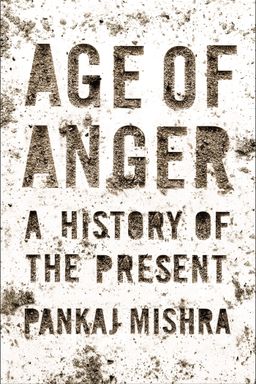
Age of Anger cover

Age of Anger

by Pankaj Mishra

Age of Anger delves into the historical origins of modern discontent, examining Enlightenment philosophies and their unintended consequences. Through a critical lens, Pankaj Mishra exposes how globalization and capitalism have fueled worldwide resentment, urging readers to re-evaluate Western ideologies for a brighter future.

The Age of Anger and the Modern Condition

How do private humiliations become public fury? In The Age of Anger, Pankaj Mishra argues that the emotional climate of modern politics—our rage, resentment, and perpetual hostility—stems from an overlooked psychological condition: ressentiment. He traces how centuries of modernization, inequality, and failed promises of dignity created an age where individuals and groups transform humiliation into violent self-assertion.

Mishra’s thesis connects seemingly disparate events—from D’Annunzio’s seizure of Fiume and fascist spectacles to ISIS propaganda and social media outrage—into a unified diagnosis: modernity’s promise of freedom and prosperity has generated envy, resentment, and imitation. You live in a world where individuals are told they can be anyone, yet find themselves blocked by forces they cannot control. The resulting tension fuels a yearning for revenge framed as moral righteousness.

Modernity’s two faces: Voltaire and Rousseau

To understand modern anger, Mishra begins with the Enlightenment debate between Voltaire and Rousseau. Voltaire celebrates commerce and cosmopolitan progress; Rousseau warns that imitation and envy corrupt the soul. Voltaire’s optimism shaped liberal institutions, while Rousseau’s critique predicted today’s disillusionment. The modern individual, living through comparison and amour propre, feels both free and hollow—an emotional vacuum that demands recognition and meaning.

From intellectual revolutions to political violence

Mishra weaves through centuries of intellectual ferment—German idealism, Romantic nationalism, Marxist development theories, fin‑de‑siècle pessimism—and shows how each transformed longing for dignity into ideological struggle. The forces that built nations and revolutions were not simply rational; they were emotional. Herder and Fichte invented the Volk, Mazzini and Mickiewicz sacralized nationalism, Nietzsche and Sorel sanctified violence. All promised salvation through struggle, turning culture into politics and politics into spectacle.

The mimic men of modernization

Non-Western intellectuals, facing colonial humiliation, imitated Western models while resenting exclusion. Mishra calls them “mimic men”: from Al-e-Ahmad’s Iran to Savarkar’s India, elites borrowed European rhetoric—progress, duty, race, nation—to demand local strength and purity. Top-down modernizers like Atatürk and Nehru tried to impose civilization by decree, but displaced ordinary people. Their imitators later weaponized resentment into violent populism.

Ressentiment and spectacle today

In the twenty-first century, ressentiment has become the grammar of politics. Digital media amplifies vanity and humiliation; populists turn private grievances into collective rage. From Trump’s rallies to Modi’s Hindu nationalism, from Putin’s nostalgic myth-making to the lone‑wolf terrorist’s livestreamed violence, the emotional logic is identical: humiliation seeking recognition through spectacle. As Hannah Arendt warned, modernity breeds a universal irritability.

The book’s moral insight

The ultimate argument of Mishra’s work is moral, not merely political. To cure the age of anger, societies must acknowledge the psychological wounds caused by inequality and exclusion. The liberal dream of individual freedom must be balanced by belonging and dignity. Otherwise, ressentiment will continue to mutate—from fin‑de‑siècle anarchists to modern jihadists, from fascist parades to online mobs—each seeking a violent cure for humiliation. Mishra warns that history’s most dangerous emotions are not ancient instincts but modern creations.

You live, Mishra reminds you, in a time when progress and peace are haunted by envy and imitation. Until societies offer dignity that matches freedom, the rage of ressentiment will remain the sound of our age.


Ressentiment: The Hidden Motor of History

Mishra places ressentiment at the core of his explanation for modern violence. Borrowing from Nietzsche and Max Scheler, he defines it as a bitter fusion of envy and impotence—a moralized hatred toward those perceived as privileged or triumphant. It transforms humiliation into the desire for revenge framed as justice. This is more than emotion; it’s a structure shaping politics, religion, and culture.

How resentment becomes politics

When people feel excluded from modern life’s promises—freedom, wealth, status—they search for dignity by identifying enemies. Mishra traces this logic from nineteenth-century Europe (Boulanger, anti‑immigrant violence, Jim Crow America) to early fascists like D’Annunzio and Mussolini. D’Annunzio’s seizure of Fiume in 1919 transforms humiliation into theatrical redemption: uniformed youth, ecstatic crowds, and chants for purity. This ritualized spectacle reappears in modern populism and jihadist propaganda.

The psychology of ressentiment

Ressentiment clothes envy in moral language—purity, authenticity, honor. It appears virtuous while driven by wounded pride. Mishra connects Arendt’s warning of “mutual hatred” to Rousseau’s notion of amour propre: social comparison breeds inner fragmentation. For Kierkegaard and Dostoyevsky, the self torn between imitation and impotence becomes desperate for absolute acts—violence, sacrifice, or martyrdom—to reclaim meaning.

Cross‑cultural cycles

The same emotional pattern recurs worldwide. Educated but alienated elites in colonized societies feel humiliated mimics—modern in aspiration, marginal in reality. Ideologues like Savarkar or Al‑e‑Ahmad channel that humiliation into nationalist or theocratic politics. Mishra’s insight: the discontent of modern individuals, once spread across nations, makes global rage appear spontaneous though it’s deeply historical.

Why this matters now

You can trace ressentiment in today’s movements: Trump’s anti‑elite rhetoric, Brexit’s nostalgia, Modi’s cultural purity, or ISIS’s heroic self‑image. Each promises restoration through revenge. Mishra concludes: ressentiment is the emotional engine of modernity—an endless feedback loop of humiliation feeding revolt, revolt breeding more humiliation. To understand our politics, you must see the feeling beneath ideology.


Modernity’s Broken Promise

Mishra deconstructs the myth that modernity guaranteed universal progress. After 1989, global intellectuals—from Fukuyama to Zakaria—assumed liberal democracy and free markets had triumphed. Yet the reality was uneven and violent: millions excluded from prosperity, ecosystems collapsing, and communities stripped of meaning. Mishra insists the world’s current anger is the result of this broken promise.

The illusion of inevitability

Reinhold Niebuhr called believers in Western destiny “bland fanatics.” Mishra adds that they forgot the West’s bloody history—imperialism, wars, and racial hierarchies. Globalization’s rhetoric of openness hid deep inequities. When 2008 shattered economic faith and interventions in Iraq and Afghanistan eroded moral credibility, the liberal order exposed its contradictions.

From optimism to backlash

The trust in technocratic progress produced disorientation. Policymakers still invoke democracy and rights, yet their actions breed resentment. Mishra connects this failure to ressentiment: individuals facing insecurity perceive freedom as humiliation. Populism and extremism become easy substitutes for dignity.

The structural lesson

Modernity’s promise failed because it forgot the moral dimension of progress. A purely economic, rational worldview creates disenchanted citizens ripe for demagogues. Mishra’s lesson: genuine reform requires ethical imagination, not just technical policy. Without moral inclusion, globalization produces resentment instead of harmony.


Imitation, Rivalry and the Theater of Violence

A core insight of Mishra’s narrative is that imitation—what René Girard calls mimetic desire—lurks behind much modern conflict. People and nations copy each other’s symbols of success, creating rivalry. From Napoleon’s prestige to today’s terrorist spectacles, the same dynamic repeats: admiration mutates into hatred.

How imitation breeds violence

Commercial societies teach emulation. When this expands into national emulation, rivalry becomes structural. Mishra shows how nineteenth‑century revolutionaries and imperialists borrowed from one another—Lenin taking Taylorism, Zionists reading Wagner, Islamists adopting European organizational styles. Violence, propaganda, and victimhood become transferable techniques.

D’Annunzio to ISIS: performance as politics

D’Annunzio’s Fiume introduced choreographed politics: uniforms, salutes, and mythic spectacle. ISIS adopts the same logic on digital platforms—executions as theatre, martyrdom as podvig (spiritual performance). Mishra stresses that ideology matters less than affect: humiliation seeks stage and audience.

Aesthetics of destruction

Walter Benjamin warned that when politics becomes aestheticized, destruction turns beautiful. Mishra extends this: in the modern media age, violence earns identity. The imitator seeks significance through spectacle, making rivalry the psychological script of history.


From Romanticism to National Fury

Romantic nationalism transformed feelings into politics. Mishra traces its birth from Herder’s celebration of culture and language to Fichte’s moralized vision of the nation and D’Annunzio’s cultic performances. What began as yearning for authenticity became a system of exclusion and revenge.

Poets as prophets

In the nineteenth century, writers were nation‑builders. Mickiewicz imagined Poland as “Christ of nations.” Mazzini turned political aspiration into religion, demanding “Duties to Man.” Literature supplied rituals—martyrdom, sacred history, songs—that turned imagination into solidarity. (Note: similar mechanisms later appear in anti‑colonial and fascist movements.)

Global transformations

These emotional grammars travelled far. In India, Bankim Chandra’s Anandamath and Savarkar’s Hindutva reinterpreted Mazzini’s duty‑based nationalism into religious militancy. In China, Liang Qichao’s Young China echoed Mazzini’s structure of heroic youth. Mishra’s point: nationalism circulated as moral therapy for humiliation.

The legacy today

Modern populisms—from Putin’s myths and Xi’s China Dream to Erdogan’s neo‑Ottomanism—continue this pattern: nationalist pageantry offering dignity in place of justice. Romantic nationalism remains the emotional heart of the age of anger.


Modernization, Mimicry and Moral Backlash

Many non‑Western states pursued top‑down modernization in the twentieth century. Atatürk, Nehru, and the Shah of Iran sought to modernize by decree—changing scripts, calendars, clothing, and education. Mishra shows that while these efforts generated progress, they also provoked deep alienation. The loss of tradition and the humiliation of imitation led to backlash movements demanding moral wholeness.

Westoxification and revolt

Iranian intellectual Jalal Al‑e‑Ahmad called this psychic sickness “Westoxification.” People outside the elite felt like crows imitating partridges—ashamed and displaced. Shariati and Khomeini turned cultural humiliation into revolutionary force, showing how alienation can generate militant restoration.

India’s paradox

Savarkar offers a striking case. Educated in England, admirer of Spencer and Mazzini, he returned home to craft Hindutva—a fusion of fascist ethnonationalism and local resentment. His ideas birthed the RSS and later violent Hindu nationalism. Gandhi’s spiritual counter‑reading of Mazzini—non‑violence and duty without hate—stands as Mishra’s moral alternative.

Lesson for today

Top-down modernization without dignity breeds ressentiment. Whether in Turkey, Iran, or India, borrowed modernity produces mimic men; their backlash writes the next chapter of anger.


Intellectual Genealogies and Dangerous Ideas

Mishra situates intellectuals as crucial intermediaries: they spread ideas that move between liberation and domination. Enlightenment thinkers like Voltaire and Diderot lent legitimacy to despots seeking modern power. Later ideologues—Lenin, Herzl, Hitler, Savarkar—repurposed borrowed doctrines to fit local passions. Ideas rarely travel unchanged; they mutate across cultures.

German roots of development

Germany’s nineteenth‑century philosophers—Hegel, Marx, and their heirs—provided the teleological model of history as “development.” This turned progress into a quasi‑scientific law and justified violent modernization. Combined with cultural insecurity, it birthed the myths of Volk and Kultur, later perverted by Wagner and racial theorists like Chamberlain.

From theory to myth

Anti‑Semitism and fascist identity politics draw from the same intellectual line. Pseudo‑science replaced theology: Jews, minorities, or outsiders were cast as corrupting forces. Herzl’s Zionism, ironically, emerges from this same matrix—a mimic response to exclusion.

Global amplification

By following these genealogies, you see how modern ideologies recycle emotional debts. From Wagnerian myth to Hindutva rhetoric, intellectual history becomes emotional archaeology. Mishra’s warning: the makers of ideas cannot control their consequences.


Propaganda, Martyrdom and Global Terror

From anarchist bombings to jihadist attacks, Mishra demonstrates continuity in how violence communicates meaning. Nineteenth‑century anarchists like Johann Most and groups like the People’s Will viewed terror as spectacle—a deed that proves belief. Their rituals of martyrdom echo in ISIS videos and lone‑wolf uprisings today.

Spectacle as communication

Anarchists used violence to dramatize oppression and provoke reactions. Modern jihadists, operating in a globalized media environment, follow the same logic but scale it up. Al‑Suri’s decentralized strategy and ISIS’s theatrical brutality are the digital heirs of Bakunin’s revolt.

Networks and mimicry

The transnational Ghadar Party in California, inspired by European radicals, foreshadowed global insurgent networks. Mishra calls this “globalization from below”—the circulation of revolutionary affect, not just ideas.

Continuities of emotion

Whether anarchist or Islamist, the emotional structure is identical: humiliation, sacrifice, spectacle, and revenge. Violence becomes both message and identity—a dark version of the modern search for meaning.


The Crisis of the Modern Self

In closing, Mishra brings history back to psychology. The modern individual, shaped by comparison and digital exposure, lives in perpetual self‑surveillance. Rousseau’s amour propre now manifests through social media metrics. This inner fragility links the terrorist and the populist, the online troll and the radical believer.

Humiliation and revenge

Timothy McVeigh and Ramzi Yousef, meeting in prison, recognize shared motives: both crave recognition through violent spectacle. Mishra’s portrayal transforms them into archetypes of the modern condition—seeking visibility, not merely ideology.

Digital amour propre

The internet amplifies envy and moral posturing. Likes and followers become proxies for dignity. Mishra argues that the crisis of liberal institutions—unions, civic associations, meaningful work—leaves citizens emotionally exposed. In this vacuum, demagogues thrive.

Moral restoration

Mishra’s prescription is humble yet profound: heal the emotional foundations of politics. Societies must rebuild recognition and community to prevent ressentiment from mutating into violence. The battle for meaning, not ideology, defines the future of the age of anger.

Dig Deeper

Get personalized prompts to apply these lessons to your life and deepen your understanding.

Go Deeper

Get the Full Experience

Download Insight Books for AI-powered reflections, quizzes, and more.