
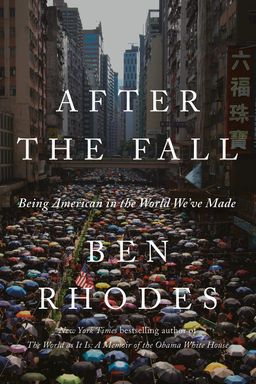
After the Fall cover

After the Fall

by Ben Rhodes

After the Fall examines the unintended consequences of US policies post-Cold War, revealing how they fueled nationalism and authoritarianism worldwide. This insightful analysis provides a hopeful perspective on democracy''s enduring strength despite rising global challenges.

Democracy Under Siege: The Modern Authoritarian Age

Why are democracies around the world faltering at the same time? In After the Fall, Ben Rhodes argues that what you’re witnessing isn’t isolated erosion but the emergence of a global pattern—a portable authoritarian playbook fueled by globalization’s discontents, digital manipulation, and weakened moral authority from the West. From Hungary’s Viktor Orbán to China’s Xi Jinping, from Russia’s Putin to echoes in American politics, Rhodes traces how power concentrates and freedom erodes through clear, repeatable tactics rather than dramatic coups.

You learn that democracy’s crisis begins not with ideology but with structure: who owns information, who controls courts, who directs money. The book blends firsthand political experience (Rhodes served as Obama’s deputy national security advisor) with reportage from Hungary, Russia, China, and the U.S.—revealing how systems built to advance liberal ideals can be inverted to sustain control. The global story is also a deeply personal reckoning: as American influence waned, the moral and institutional gaps widened enough for authoritarian models to thrive. Rhodes wants you to see this not as decline but as a mirror—a chance to rebuild purpose.

The Portable Authoritarian Playbook

Across continents, the same tools achieve control: legal redesigns that entrench ruling parties, media capture that creates echo chambers, economic patronage that buys loyalty, and identity politics that weaponizes fear. Orbán’s Hungary becomes Rhodes’ archetype—showing how electoral victories can become permanent regimes through gerrymandered districts, packed courts, and controlled media. Putin adds disinformation warfare and corruption as statecraft; Xi integrates surveillance technology to make control predictive and total. Each regime adapts tactics to local conditions while following the same underlying script: turn openness into vulnerability, and reform into consolidation.

The chilling brilliance lies in simplicity: autocrats no longer need coups or mass purges. They can hollow out democracy from within. Rhodes calls this the modern authoritarian logic—rule through law rather than by breaking it outright, narrative control instead of censorship, and loyalty purchased through money and fear rather than belief. You, as a citizen, often don’t notice until the rules, media, and economy bend subtly but persistently toward a single center of power.

How the American Century Set the Stage

Rhodes doesn’t let the West off the hook. The forces that made autocracy thrive—hyper-globalization, endless war, and digital deregulation—were largely American exports. In Hungary, privatization bred inequality and resentment. In the Middle East, U.S.-backed regimes used counterterrorism as justification for repression. Online, social media platforms created attention economies optimized for outrage. Each shock—the 9/11 attacks, the financial crash of 2008, and social media’s rise—fractured public faith in democracy’s reliability. As Rhodes puts it, when liberalism ceased delivering prosperity or safety, people sought belonging and certainty elsewhere.

This is the paradox: the same technologies and market systems that once symbolized freedom became tools of control. Facebook algorithms powering the Tea Party mirror Russia’s trolling machinery; Chinese engineers build surveillance grids using U.S.-developed code. Rather than authoritarianism growing from alien soil, Rhodes shows it sprouting in the cracks of the liberal world order itself.

From Budapest to Washington: The Mirror Effect

In his travels, Rhodes sees America reflected in the very systems it once sought to replace. The crony capitalism of Fidesz resembles dark-money networks in U.S. politics after Citizens United. Judicial capture in Hungary mirrors ideological court-stacking at home. State-aligned media in Budapest looks uncomfortably like partisan echo chambers on American airwaves. The point isn’t equivalence but recognition: the playbook works anywhere civic trust fades and money and media are unregulated. By the time an autocrat appears, the system is already tilted in their favor.

You begin to see how global trends converge: Russia wages information war to fracture democracies; China builds a techno-authoritarian model offering prosperity without freedom; the U.S. wrestles with its own democratic backsliding; and smaller countries like Hungary or Egypt serve as proving grounds. The effect is cumulative—the 21st century becoming a race between democratic renewal and autocratic adaptation.

A Story of Decline—And Possible Renewal

Despite the bleakness, Rhodes believes resilience is possible. His portraits of Hungarian activists, Russian reformers like Navalny, Hong Kong’s protesters, and American grassroots organizers show democracy’s survival not in elites but in citizens reclaiming narrative power. Transparency work by Sandor Lederer or media by Szabolcs Panyi represents a new genre of resistance grounded in data and solidarity. Momentum’s anti-Olympic campaign nearly toppled Orbán’s dominance—a reminder that even small victories can reanimate civic faith. Rhodes ultimately asks you to see politics as human work: persistent, local, messy, and moral.

The Core Lesson

The book’s thesis can be summed up simply: democracies die slowly, rebuilt daily, and defended by ordinary people doing unglamorous work. The authoritarian playbook is real—but so is the civic counterplay.

You come away realizing that the new authoritarian age isn’t a foreign threat but a mirror reflecting choices made in your own society—about inequality, surveillance, truth, and moral purpose. Rhodes’ challenge is both diagnostic and practical: understand the mechanisms of control, and you might still turn the ship before the storm closes in.


The Mechanics of Modern Autocracy

Modern autocrats no longer rely on tanks or coups; they use institutions. Rhodes dissects the authoritarian toolkit through Viktor Orbán’s Hungary—an instructive microcosm of how democratic systems can be subverted from within. You see a pattern of legal changes and strategic co-optations that turn open societies into client states managed by networks of loyalists.

Engineering Power Through Law

Orbán’s Fidesz party began by manipulating electoral rules: rewriting the constitution in 2011, redrawing districts, and lowering the legislative seat count to lock in dominance. Judicial independence suffered as retirement ages were lowered and appointments centralized, ensuring favorable rulings. These moves are procedural, not violent—but they freeze political competition much as physical repression once did. Rhodes draws parallels to similar strategies in the United States: gerrymandering, strategic court appointments, and voting restrictions that tilt systems toward incumbents.

Capturing Information and Reality

Controlling information is control of perception. Fidesz-friendly oligarchs bought independent outlets, while state advertising starved dissenting media. Public broadcasters were purged, and pro-government narratives filled the airwaves. Rhodes cites journalist Szabolcs Panyi, who describes independent reporters as “islands in a sea of propaganda.” You recognize this as a global condition: Russia’s RT and troll farms, Fox-style media partisanship, and China’s Great Firewall all enact the same principle—monopoly on narrative equals monopoly on truth.

Crony Capitalism as Political Glue

Orbán’s loyalists receive state contracts and European Union funds, creating a self-reinforcing machine of wealth and power. Lőrinc Mészáros, a former gas fitter turned billionaire, exemplifies how money ties elites to political survival. The analogy extends globally: whether dark-money networks in U.S. politics or Putin’s oligarchic patronage, economic co-option ensures dissent becomes financially suicidal.

Manufacturing Enemies and Emotional Loyalty

Autocrats always need an “other.” In Hungary, Orbán invokes Brussels bureaucrats, migrants, and George Soros as symbols of threat—stirring nationalism and fear to justify control. Rhodes links this to broader right-wing identity politics and conspiracy culture elsewhere: once reality divides into “us vs. them,” rational debate collapses. The authoritarian playbook works because it organizes emotions faster than democracy can organize reason.


The American Origins of Global Authoritarianism

Rhodes argues that twenty-first century autocracy didn’t just rise in opposition to the American-led world—it grew out of its contradictions. Globalization, the War on Terror, and digital capitalism all originated in American choices that reshaped international norms. Understanding these forces helps you see authoritarianism not as a mysterious contagion but as an unintended consequence of modernity itself.

Globalization and the Inequality Trap

In places like Hungary or the American Midwest, free markets brought shiny malls and hollowed communities. Wealth clustered in cities; identity filled the void where opportunity vanished. Organizations such as Sandor Lederer’s K-Monitor documented how privatization and corruption merged. The resulting resentment primed citizens to embrace leaders promising protection from “global elites.” Rhodes links this backlash directly to populist movements—both Orbán’s nationalism and Trump’s America First sentiment drawing from the same dislocated class.

Securitization After 9/11

The “Forever War” transformed fear into policy. Expanded surveillance, detentions, and drone warfare normalized state overreach. Rhodes’s interlocutors like Ching Cheong and Egyptian activist Mohamed Soltan emphasize how regimes worldwide copied this model. When Washington framed human rights as conditional on security, authoritarian states seized moral cover for repression. The People’s Republic of China would later cite “terrorism” to justify camps in Xinjiang; Putin would adopt “anti-extremism” laws to silence opposition. America’s moral authority eroded under its own precedents.

The Digital Amplifier

Social networks, born in Silicon Valley’s laissez-faire ethos, prioritized engagement over truth. Algorithms rewarded outrage and lies, fueling polarization and conspiracy. What began as free expression became infrastructure for manipulation—Russia’s trolls exploited it; Orbán’s media monopolies amplified it; China studied it and chose to contain it entirely. Rhodes calls this the ironic legacy of American innovation: the technology built to connect the world instead accelerated democratic decay.


Russia’s Counterrevolution

In Vladimir Putin’s Russia, you witness how humiliation forged a durable ideology. The post-Soviet collapse created chaos and loss; Putin offered restoration through control. Rhodes presents Russia as a laboratory of cynical governance, where corruption is both method and message.

From Trauma to Doctrine

Putin’s remark after the Beslan school massacre—“The weak are beaten”—captures the tone of his rule. Strength becomes a moral principle; democracy becomes a synonym for weakness. Every policy, from crushing Chechnya to annexing Crimea, flows from this creed. Rhodes shows how nationalism and paranoia merge to justify permanent emergency powers.

Corruption as Governance

Under Putin, graft became the organizing principle of politics. Oligarchs owe their fortunes to loyalty; dissenters like Khodorkovsky or Navalny expose the price of defiance. Media mergers via Gazprom erased critical journalism, turning television into theater. It’s a feedback system: corruption funds control, control protects corruption.

Disinformation at Global Scale

Russia’s innovation is exporting decay. Troll farms and state hackers attack foreign elections not to persuade but to exhaust belief in truth. Rhodes’ account of U.S. election briefings illustrates that Russia’s true target is faith in democratic process itself. Once all sides distrust everything, authoritarian certainty wins by default.

A Destructive Model

Putin doesn’t build an alternative order; he thrives on disorder. His counterrevolution succeeds when others fail to sustain theirs.

Through Russia, Rhodes shows the darker half of the twenty-first century’s political equation: power that feeds on cynicism and exports instability as strategy.


China’s Techno-Authoritarian Alternative

If Russia’s model is destruction, China’s model is design. Rhodes explores how Xi Jinping’s government fuses nationalism, capitalism, and digital control into a coherent alternative to liberal democracy. Rather than collapsing democracies through chaos, China aims to outperform them through efficiency and order.

Building Control Through Growth

From Deng Xiaoping’s market openings to the present, the Chinese Communist Party refined a model of prosperity without pluralism. The lesson of Tiananmen—economic change yes, political reform never—anchors Party strategy. Rhodes describes how foreign dignitaries encounter not ideological lectures but choreographed confidence: gleaming skylines, friendly officials, subtle coercion. Economic success replaces belief as the Party’s claim to legitimacy.

Technology as Social Architecture

Systems like Police Cloud and the Social Credit network turn daily life into a data stream the state can mine for compliance. Maya Wang calls it “behavioral engineering”—using rewards and punishments so individuals police themselves. Xinjiang shows the extreme: mass camps, surveillance checkpoints, algorithmic profiling of Uyghurs. Technology makes repression scalable and invisible, rendering dissent obsolete.

The Chinese Dream’s Global Extension

Xi’s “Chinese Dream” redefines national ambition as geopolitical outreach. The Belt and Road Initiative, Made in China 2025, and digital infrastructure projects embed Chinese standards across continents. Loans and ports replace colonies; algorithms replace armies. Corporations and states align themselves to these incentives, quietly normalizing the idea that development does not require freedom.

Exporting Information Control

China’s Great Firewall has become a global template. Censorship technology, entertainment partnerships, and market leverage now shape speech beyond its borders—from Hollywood edits to NBA controversies. Rhodes warns that this economic self-censorship amounts to soft authoritarianism spreading through capital rather than conquest.

China Builds, Others Bend

Rhodes contrasts China’s constructive control with Russia’s destructive nihilism. The danger lies not in collapse but in imitation.

For you, the lesson is that technology’s neutrality is an illusion. Every design embeds values—collective or coercive—and the future depends on which side governs that code.


Resistance, Renewal, and the American Reckoning

Against this global authoritarian tide, Rhodes finds hope in small acts of civic defiance. From Hungarian activists gathering signatures to Hong Kongers chanting in the rain, resistance emerges less as revolution than as persistence. His vignettes of Momentum, K-Monitor, and the Hungarian Helsinki Committee show that systemic change often starts with data, petitions, and solidarity rather than heroes.

Reclaiming Civic Muscles

Momentum’s campaign to stop Budapest’s Olympic bid proved that citizens could use democratic tools creatively. K-Monitor’s databases and Szabolcs Panyi’s investigations give evidence power. Márta Pardavi’s legal work connects local activism to EU-level oversight. Each initiative demonstrates a replicable skill set: build facts, mobilize people, leverage institutions.

America’s Mirror: Facing Structural Decay

Rhodes turns inward to the U.S., pairing his travels with introspection. The same structural weaknesses—money in politics, partisan media, court politicization—have hollowed American democracy from within. Yet his encounters with ordinary citizens, from protestors to community organizers, suggest that renewal is possible if Americans confront inequality and re-anchor moral purpose in shared dignity rather than dominance. The metaphor of Obama’s “ocean liner” reappears: slow to turn, but still steerable.

Hope as Daily Practice

Rhodes closes on a personal note: lighting a grill, watching his daughter dance, rediscovering what politics is for. Against the spectacle of power, he elevates ordinary meaning. The defense of democracy, he suggests, begins with caring who tells your story and whether you can still tell it yourself. Hope is not sentiment but labor—the daily maintenance of truth, decency, and institutions sturdy enough to outlast their occupants.

The Final Message

If authoritarianism is a system maintained by apathy, democracy is a habit sustained by participation. Every choice—to vote, to speak, to verify—is a small act of reversal.

In the end, Rhodes’ journey is more moral than political. He invites you to resist not just regimes but the cynicism that feeds them—because history doesn’t move on its own; it moves with you.

Dig Deeper

Get personalized prompts to apply these lessons to your life and deepen your understanding.

Go Deeper

Get the Full Experience

Download Insight Books for AI-powered reflections, quizzes, and more.