
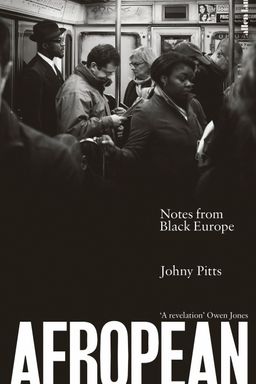
Afropean cover

Afropean

by Johny Pitts

Afropean by Johny Pitts is a compelling travelogue that explores the hidden histories and vibrant cultures of Black communities across Europe. From Paris to Lisbon, Pitts reveals how Afro-Europeans are forging new identities, challenging colonial legacies, and enriching the continent''s multicultural landscape.

Claiming Afropea: Identity, Belonging, and Europe’s Hidden Map

What does it mean to belong to Europe when your skin, heritage, or story seems to contradict its self-image? In Afropean: Notes from Black Europe, Johny Pitts undertakes a journey across the continent — from Sheffield to Lisbon, Stockholm to Moscow — tracing lives that bind Africa and Europe together. His core argument is that Afropean identity is not a fashionable hybrid or aesthetic category but a lived, plural condition. It offers a way of seeing Europe differently: not as a fortress of whiteness, nor as a continent that graciously “includes” minorities, but as a place co-created by them.

Pitts redefines Afropeanism as both an identity and a method. It is the practice of connecting histories, everyday labour, and cultural production across the fault lines of race, class and migration. Through portraits of bus cleaners in Paris, activists in Clichy-sous-Bois, artists in Stockholm, and archivists in Amsterdam, he constructs a map of Europe’s hidden communities—those that power the continent from its basements, train stations and outer estates.

From Glossy Branding to Ground Truth

At first, Pitts imagines the project as sleek: a coffee-table celebration of Black European style. But the journey itself dismantles this fantasy. In Calais, confronted by refugees and cleaners whose labour makes the continent run but leaves them socially invisible, Pitts realises that representation without substance becomes cosmetic multiculturalism. He watches African men scrub Eurostar carriages for passengers who barely notice them—the perfect metaphor for Europe’s economy of visibility.

The shift from branding to reportage is crucial. Afropean, in Pitts’s hands, becomes a lens to see liminality—the condition of being administratively “in” Europe but socially kept “out.” Across Calais, Paris, and Brussels, he encounters people who hold European passports yet live at its psychological borders, a theme that echoes Fanon’s early alienation in Toulon.

Europe’s Two Faces

The book repeatedly contrasts two Europes: postcard Europe and working Europe. In Paris, the romantic myth of “Black expatriate freedom” collides with the banlieues, where racial invisibility meets structural neglect. The glamour of Josephine Baker and James Baldwin sits beside the exclusion faced by Zyed Benna and Bouna Traoré in Clichy‑sous‑Bois. In Stockholm, sleek multicultural surfaces coexist with coded conformity — lagom and jantelagen — that mark anyone who stands out. In Russia, the story turns darker: past solidarity gives way to nationalist hostility. By following these contrasts, Pitts reveals Europe’s tendency to parade diversity while ignoring the social infrastructure that sustains it.

Memory and the Practice of Repair

Each city also holds sites of reclamation. In Amsterdam, The Black Archives gather the forgotten histories of people like Otto and Hermina Huiswoud — Caribbeans who bridged Harlem, Suriname and the Netherlands. In Lisbon’s Cova da Moura, Cape Verdean migrants turn illegal settlements into functioning communities, teaching literacy and producing music that transforms stigma into self-worth. These grassroots archives and collectives operate as both museums and incubators: they document what official Europe refuses to count (echoing Almamy Kanouté’s critique that France’s refusal to track race statistics erases inequality).

Culture as Resistance

Pitts’s journey is scored by sound: Zap Mama’s polyphonies, Sheffield’s pirate radio, Marseille’s hip-hop crews, Berlin’s YAAM collective. Music and cultural practice become low-cost infrastructures of communion. They produce spaces of participation where political language can be rehearsed safely. Yet Pitts also warns that cultural success can be domesticated once markets absorb rebellion—Public Enemy’s Amsterdam gig teaches him that cultural radicalism risks being neutralised by nostalgia if not continually politicised.

From Sheffield to Self-Definition

Pitts’s Sheffield childhood grounds all of this. Firth Park’s multiethnic, working-class mix taught him that Europeanness already includes cross-pollination—Yemeni mentors, Northern Soul DJs, graffiti artists like Fista. But austerity, criminalisation and cultural erasure reveal how fragile those civic bonds are. His return home makes the book full circle: Afropea starts not in exotic exile but in local solidarities forged under neglect.

Through this panoramic journey, Pitts transforms Afropean from a cultural brand into a political practice—one that demands Europe recognise the people who have built and repaired it. The book argues not for romantic syncretism but for accountability. Real belonging is not measured by passports or playlists; it’s measured by how inclusion survives outside the frame of postcards and PR campaigns.

Core message

Afropean identity, Pitts insists, is a way of naming what has always existed but been denied visibility: the everyday lives, loves and labours through which black Europeans claim their continent as home.

You come away seeing that Europe’s future depends on this recognition: inclusion not as ornament, but as structural truth. Afropea is the story of belonging built from the margins—a rebuttal to the idea that Europe was ever pure, and an invitation to imagine it whole.


Invisibility and Everyday Borders

Pitts’s travelogue teaches you that Europe’s borders are not only geographic but social. Everywhere he goes, black workers and migrants occupy the spaces that keep Europe running while remaining unseen. You begin to see visibility and invisibility operating together — your taxi driver, train cleaner or café worker forms part of the European picture yet rarely features in its self-portraits.

In Calais, Pitts’s passport lets him cross checkpoints refugees cannot, yet his body still attracts suspicion from police and civilians. In Paris, Afro‑French youth in Clichy-sous‑Bois are legally French but socially excluded, filmed only when riots erupt. This paradox defines the modern European condition of liminality — being “in” without being accepted.

Visible Work, Hidden Lives

From Eurostar platforms to airport lounges, black visibility is purely functional. Pitts records Senegalese cleaners on high-speed trains, their labour made visible but their personhood erased. The media fuels this split by representing black presence as extremes — glamorous athletes, musicians or criminals — leaving out teachers, shop‑owners and midwives. Mos Def’s warning that black people are shown only as “kings” or “niggers” captures this trap perfectly.

The Liminal Self

Pitts’s own biography exemplifies this. As a mixed‑race Briton from Sheffield, he is legally European but repeatedly reminded that his belonging is conditional. Even being stopped during Remembrance events—while his family’s service is ignored—shows how racial markers override civic ones. His encounters expose the gap between citizenship and social legitimacy, forcing you to see Europe’s invisible walls at street level.

Lesson

Invisibility signals structural failure, not personal misfortune. When a continent cannot recognise the people who clean its trains or teach its children as part of its self-image, citizenship itself loses meaning.

Understanding liminality therefore becomes a political tool: it tells policymakers where belonging frays. Pitts’s fieldwork transforms empathy into method, showing how noticing the invisible can become an act of resistance.


Black Paris and the Myth of Freedom

In Paris, you watch the clash between memory and marketing. “Black Paris,” sold to American visitors as racial sanctuary, becomes a stage where historical prestige coexists with modern exclusion. Ricki Stevenson’s tour introduces Pitts to Josephine Baker, Alexandre Dumas, and the Harlem Hellfighters — luminous figures who built the city’s black legend. Yet just beyond the tourist gaze lies Château Rouge and Barbès, districts of living Afro‑French struggle.

The Expat Illusion

African‑American tourists repeatedly mistook Paris for a color-blind haven, a projection born from U.S. racial fatigue. Pitts reveals how that optimism erases locals; Afro‑French citizens face housing discrimination, unemployment, and police racism. Negritude thinkers like Aimé Cesaire and Senghor had already exposed this tension, celebrating black consciousness while critiquing imperial paternalism. Pitts uses these parallel stories to remind you that freedom abroad often meant exile elsewhere.

Culture as Politics

Through episodes like the Guerlain scandal — a perfumer’s racist remark sparking protests — Pitts charts how a cultural insult triggers political organization. Activists such as Rokhaya Diallo and Rex Kazadi mobilized boycotts, proving that aesthetic and political space are inseparable. The same contradiction shapes Château Rouge: vibrant community markets thrive under watchful policing. Every baguette and hair salon becomes an assertion that black Paris is both presence and protest.

You come away realizing that “black Paris” is not merely jazz nostalgia but a contested geography — a mirror of how Europe commodifies diversity while marginalizing those living its reality.


Republic, Race and the Banlieue

When Pitts moves beyond central Paris into Clichy‑sous‑Bois, theoretical debates about race become concrete. The banlieue is Europe’s architecture of exclusion — tower estates erected with utopian intent that turned into reservoirs of neglect. Their existence exposes a flaw in France’s Republican ideal: defining equality as color‑blindness erases racial disadvantage rather than cures it.

Designing Inequality

Haussmann’s boulevards forced the poor outward; Le Corbusier’s modernism generated concrete high‑rises that aged poorly. What remains are communities such as Clichy, where the 2005 riots testify to decades of exclusion. The deaths of Zyed Benna and Bouna Traoré during a police chase became a national reckoning with invisibility.

Blind Universalism

Activist Almamy Kanouté calls France’s refusal to record racial data a moral blindness. Without metrics, inequality hides behind the rhetoric of indivisibility. Pitts contrasts this with U.S. civil rights models where visibility leads to reform. The difference is telling: statistics can be empowering when combined with moral accountability.

Local Resistance

Grassroots projects and youth committees are the banlieue’s response to official neglect. Leaders like Almamy and Rex Kazadi become civic translators between despair and democratic aspiration. Pitts’s reportage here teaches you that urban space itself can be political — housing estates act as both constraint and incubator for new citizenship.

Clichy‑sous‑Bois stands as a warning to any society that preaches equality while designing segregation into its concrete. Structural color‑blindness, meant to prevent discrimination, becomes another instrument of it.


Archives, Memory and the Work of Repair

In Amsterdam’s Black Archives, Pitts discovers that reclaiming history is an act of politics. Founders Mitchell Esajas, Jessica de Abreu, and Delano Veira salvaged forgotten documents of activists like Otto and Hermina Huiswoud—linking Harlem renaissance debates to Dutch colonial histories. Their work reveals how amnesia maintains inequality: when official institutions neglect racial data, communities must write their own record.

Archiving as Activism

Archivists treat memory as infrastructure. Oral histories, pamphlets and letters become raw materials for education campaigns such as Stop Zwarte Piet. This makes heritage dynamic—something used to mobilize protests and inform new generations. Pitts compares this to Cova da Moura in Lisbon, where informal institutions provide literacy classes and music studios. Both cases prove that documentation and participation are linked.

The Politics of Forgetting

Europe’s bureaucracy often converts racial silence into civic virtue. By refusing to register race, nations claim moral purity while perpetuating erasure. Black Archives projects counter that logic by refusing disappearance. They reveal heritage as a toolkit for policy change — evidence that identity politics can generate practical reforms if grounded in documented experience.

Insight

History must be treated as infrastructure, not ornament. When memory is institutionalized, equality stops being rhetorical and becomes measurable.

Archiving thus emerges as an Afropean strategy: to document presence where states erase it, to rebuild collective memory as civic foundation.


Culture as Bridge and Battleground

Music, art and street creativity thread through Pitts’s travels as living evidence of Afropean coexistence. From Marie Daulne’s Zap Mama in Brussels to Berlin’s YAAM, these scenes prove community can form through rhythm when politics fails. Cultural life becomes Europe’s alternate infrastructure — a set of stages, radios, and markets that knit fragmented populations together.

Creative Synthesis

Zap Mama’s polyphonic blending of African and European traditions demonstrates cultural harmony as active work, not passive mixture. Similarly, Sheffield’s pirate radio nurtures black and white working‑class crossovers through Northern Soul and hip-hop. Pitts notes that culture flows both ways: black creativity energizes the mainstream even as markets commodify it.

Spaces of Resistance

Grassroots venues like YAAM in Berlin transform leisure into community organizing. They show how music scenes can double as safe political forums. Yet Pitts also observes how revolutionary culture turns sterile when unrenewed: Public Enemy’s concert for an aging white audience reminds him that radical art can be archived into nostalgia unless actively politicized.

If Afropean life is to persist, its cultural spaces must be defended — not as exotic entertainment but as laboratories of European democracy. Pitts demonstrates that where institutions fail, rhythm and art survive as bridges across language and origin.


Northern Roots and Everyday Multiculturalism

Firth Park in Sheffield forms Pitts’s emotional and moral compass. His working‑class upbringing among Yemeni, Jamaican and white neighbours shows you that multiculturalism was once ordinary. Local mentorships—like Mohammed teaching him chess and hip‑hop—forge belonging across ethnic lines. This everyday integration, messy but real, underpins Pitts’s belief that Afropean identity is grounded in social practice, not elite policy.

Decline and Disillusion

Gentrification and austerity erode those informal networks. The collapse of youth clubs and pirate stations breaks the channels where cultural mixing once flourished. Pitts juxtaposes this local decay with the Helmstetter family in Münster and Nairobi, whose lives illustrate how official “multiculturalism” hides structural segregation. Their experience exposes privilege as the ability to treat inequality as distant.

The Lesson of Everyday Spaces

Through these stories, you learn that genuine multiculturalism requires everyday proximity—shared schools, housing, friendship, not slogans. Policy can celebrate diversity without repairing its inequities; community life, though small and imperfect, does that repair daily.

Pitts’s Sheffield reminds you that home can be laboratory for future Europe. Protecting local cultural spaces—music rooms, youth centres, small venues—is as politically vital as any speech about inclusion.


Arrival Cities and Marginal Futures

At the edges of Europe—Lisbon’s Cova da Moura and Stockholm’s Rinkeby—Afropean identity becomes architectural. These neighbourhoods, built from necessity, reveal how migrants transform neglect into community. Pitts compares builders in Lisbon reclaiming discarded materials with Swedish immigrants cultivating their own markets in Rinkeby Bazaar. Both illustrate Doug Saunders’s idea of the “arrival city”: the informal zone where integration begins from below rather than above.

Building from the Margins

Cova da Moura’s murals of Amílcar Cabral stand beside literacy programs and studios that sustain Cape Verdean life. Police harassment and gentrification threaten it, yet residents organize moral and economic survival. Rinkeby, by contrast, shows Sweden’s “passive apartheid”—a product of privatized housing and white flight. Yet its bazaar and street culture create a vibrant Afropean public sphere even amid stigma.

Contradictions and Resilience

These arrival cities embody both exclusion and creativity. Their residents inherit tensions—from homeland conflicts to local prejudice—but still build functioning worlds. Pitts frames them as prototypes for Europe’s future: if cities nurture such self‑organizing diversity, migration becomes transformation rather than problem.

The Afropean map ends here, among people who redefine citizenship through repair, improvisation and everyday hustle—the continent’s most authentic inclusion experiment taking place off its postcards.


War, Exile and Europe’s Moral Mirror

Pitts threads the continent’s postcolonial fabric back to its wartime origins through Frantz Fanon and Claude McKay. In Toulon, Fanon’s rejection after serving France becomes the foundational wound of colonial psychology: risk life for a nation that will not let you dance. This betrayal feeds his later argument that liberation requires decolonizing the mind, not just removing occupiers.

In Marseille and the Riviera, Pitts revisits spaces where exiles sought community and dignity. Claude McKay’s Banjo and IAM’s militant rap connect 1920s port life to contemporary activism. Yet the nearby villas of Leopold II and Mobutu illustrate how colonial extraction financed European luxury—beauty and brutality cohabiting the same coastline.

Hospitality and Its Collapse

Russia further complicates this moral mirror. Soviet promises of black equality devolved into post‑1990 xenophobia and violence against African and Central Asian migrants. The transformation from “comrade” to enemy encapsulates how Europe’s political shifts often translate into racial withdrawal. Pitts’s conversation with Sayana and James exposes xenophobia as both systemic frustration and scapegoating.

These vignettes complete his continental diagnosis: Europe’s memory of empire—whether French humanitarianism, British nostalgia, or Russian solidarity—contains embedded hierarchies that resurface under strain. To be “Afropean” is to confront those contradictions without retreat.

By ending his odyssey with Fanon’s insight and Baldwin’s exile, Pitts invites you to measure Europe not by comfort but by conscience. The Afropean project is ultimately an ethical map—a call for recognition stitched through history’s wounds.

Dig Deeper

Get personalized prompts to apply these lessons to your life and deepen your understanding.

Go Deeper

Get the Full Experience

Download Insight Books for AI-powered reflections, quizzes, and more.