
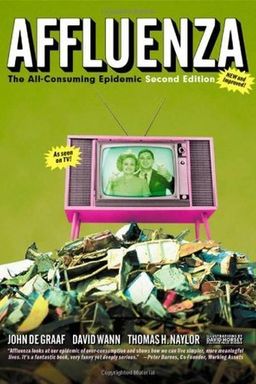
Affluenza cover

Affluenza

by John de Graaf, David Wann and Thomas H Naylor

Affluenza exposes the dangers of our consumption-driven society and offers a roadmap to escape its grip. By understanding our affluence addiction, we can reclaim our happiness, health, and environment. Discover practical strategies for living a simpler, more fulfilling life.

Affluenza: The Social Epidemic of Overconsumption

Why do so many people with comfortable lives feel anxious, overworked, and dissatisfied? In Affluenza, authors John de Graaf, David Wann, and Thomas Naylor argue that modern consumer culture has created a socially transmitted disease—one of overload, debt, anxiety, and waste—driven by the relentless pursuit of more. They treat this syndrome not as personal weakness but as a collective illness infecting families, workplaces, and ecosystems alike.

What Affluenza Is—and Why It Spreads

Affluenza resembles an epidemic: you catch it through exposure to advertising, mass media, and social comparison. Its symptoms—chronic dissatisfaction, overwork, and environmental decay—resemble a fevered attempt to buy happiness. A satirical clinic scene opens the book, in which a doctor tells a wealthy, miserable patient that her suffering is contagious but curable. GDP growth, the authors explain, has long replaced moral and ecological well-being as society’s dominant measure of success.

You see the disease everywhere: malls like the Mall of America or Potomac Mills become pilgrimage sites; Americans spend about 71% of the economy on consumer goods, and the nation stores excess possessions in 2.3 billion square feet of storage space. The message is clear—affluenza is a collective addiction disguised as progress.

A Global Virus with National Symptoms

Because the United States exports its culture through film, media, and brands, the authors call the country a 'carrier.' Fast-fashion trends, fast food, and suburban sprawl replicate globally. Yet the statistics belie well-being: even as GDP rises, the Genuine Progress Indicator (GPI)—which accounts for costs like pollution and lost leisure—has stagnated since the 1970s. This mismatch reveals what Simon Kuznets, GDP’s inventor, warned decades ago: national income is not national welfare.

Core Relationships Behind the Disease

Affluenza thrives where identity and consumption are fused. The book outlines a toxic cycle: desire is manufactured through advertising, satisfied briefly through shopping, and reignited almost immediately by the next marketed want. Social norms amplify it—success is portrayed by property size or brand labels. Meanwhile, time and community erode: people work longer to afford luxuries, defer real rest, and measure life in productivity instead of meaning.

Institutions enable this spiral. Credit systems allow deferred pain, corporations externalize costs, and media structure your sense of normalcy. In effect, all of society sustains the infection because it feeds the short-term highs of spending, even as happiness research shows that beyond a modest threshold, more income no longer improves well-being.

Consequences: Health, Community, and the Planet

The book broadens affluenza’s toll beyond psychological weariness. Overwork triggers stress hormones, leading to heart disease and depression; family contact shrinks while mental illness grows. Communities hollow out as big-box retailers replace local stores, and ecological damage mounts through waste and emissions. Mathis Wackernagel’s ecological footprint data show that if everyone lived like an average American, humanity would need five planets to sustain it.

The economic system rewards churn instead of care, turning finite resources into disposable goods and social interactions into market exchanges. Sociologist Robert Putnam’s 'bowling alone' metaphor—declining civic ties—illustrates what happens when consumerism replaces citizenship.

Diagnosis and Treatment

The authors argue that awareness is the first step toward recovery. Once you see your discomfort and exhaustion as expressions of an economic pathology—not personal failure—you can begin to act differently. You can take a 'bed rest' from consumption through reflection and simplicity, redesign institutions that spread the contagion, and measure progress with metrics that account for human and ecological health.

A Core Lesson

Affluenza is not just an economic critique but a cultural diagnosis. Its cure lies in rebalancing time, sufficiency, and community against the compulsion for growth. By recognizing the social nature of the disease, you open the possibility of collective healing.

The rest of the book unfolds as a treatment protocol: understanding how affluenza operates through addiction, media, institutions, and policy—and then reclaiming health through simplicity, shared ownership, time reform, and reconnection with nature. It’s both a moral awakening and a manual for sustainable living.


The Addiction of More

The authors show that consumption functions like an addiction. You don’t just buy an object—you pursue a rush of novelty, prestige, or comfort. Psychologist Ronald Faber even found that compulsive shoppers experience brain activity similar to drug highs. This cycle—craving, spending, guilt, and renewed craving—is the beating heart of affluenza.

Advertising as the Dealer

Advertisers engineer dissatisfaction. At events like Kid Power '96 at Disney World, marketing executives coached participants on 'softening the parental veto' and exploiting children’s emotions. Pierre Martineau’s claim that 'our economy would collapse if we stopped making people dissatisfied' captures the ethos. By selling fantasy—sex appeal, belonging, success—brands implant emotional dependencies stronger than physical needs.

Product Design for Dependence

Beyond persuasion, manufacturers design obsolescence. Automakers’ yearly model changes and electronics’ software updates make durability unfashionable. The book notes how the iPaq and later smartphones shortened attention spans and life cycles: each innovation promised salvation from boredom but bred more frustration. Planned obsolescence and easy credit tighten the addiction loop, collapsing the distance between want and gratification.

Breaking the Cycle

Breaking the shopping high demands mindfulness—seeing shopping’s emotional triggers. The authors propose honest accounting: tracking purchases, identifying non-necessities, and replacing consumption with time-rich alternatives like volunteering, creativity, or outdoor recreation. Policy can help too—limiting predatory credit and restricting manipulation of children. Recognizing that your desires have been engineered is the first step toward freedom.

Takeaway

Affluenza is both psychological and systemic. Individual sobriety helps, but true detox requires changing how markets manufacture want.

When you substitute emotional connection, creativity, and rest for consumption, you weaken the addictive cycle. The authors suggest that freedom from affluenza begins with reclaiming the ability to define happiness without price tags.


Time Poverty and the Hidden Health Toll

In the wealthiest societies, time has become the scarcest resource. Overwork and material ambition feed each other: you labor longer to buy more but have less time to enjoy what you earn. Juliet Schor’s research found that Americans worked 160 more hours in 1991 than in 1969, and by the late 1990s surpassed Japan in annual hours. The paradox is clear: technological progress expanded productivity but not leisure.

Possession Overload

Physician Richard Swenson coined 'possession overload' to describe how maintaining things devours your schedule: cleaning big houses, repairing cars, managing gadgets. Instead of gaining time, you convert free hours into maintenance chores. Staffan Linder called this the 'harried leisure class'—owning more creates more work.

Health and Happiness Costs

Chronic busyness raises heart risk. Cardiologist Sarah Speck equates prolonged stress with smoking, citing data that skipping vacations increases heart attack risk by 30–50%. The economic price of work stress exceeds $300 billion annually. Yet Americans leave billions in paid vacation unused every year, a cultural badge of honor masking collective burnout.

Policy Lessons

The authors show how society chose consumption over leisure. The Kellogg Company’s 1930s thirty-hour week revealed that shortened hours could maintain output and increase satisfaction, yet postwar America reversed that precedent. You can choose differently—advocating paid leave, shorter workweeks, and valuing time as public wealth. European models show that productivity need not demand exhaustion.

Essential Reframing

Time, not money, is the ultimate measure of affluence. Reducing consumption liberates hours for family, art, and rest—the very experiences that correlate most strongly with real happiness.

In sum, healing affluenza means recalibrating the economy to deliver well-being per hour, not per unit sold. Freeing time is itself a public health intervention.


Children, Media, and Market Values

Children are among the most vulnerable hosts of affluenza. Advertising budgets targeting youth ballooned from $100 million in 1980 to $15 billion in 2004. Kids’ direct spending rose from $4 billion to $35 billion in two decades, while brand recognition begins before age two. The book calls this 'childhood affluenza'—indoctrinating children to equate happiness with logos.

Commercialized Childhood

Deregulation allowed TV–toy tie-ins where programs became marketing pipelines. In classrooms, companies distributed corporate-sponsored lessons: Revlon’s self-esteem curricula, Exxon’s pollution glosses, and Georgia-Pacific’s logging-friendly materials. Ads even adorn school buses. Alex Molnar and Susan Linn warn that this erodes critical thinking and civic duty.

Psychological Fallout

Kids witness about 40,000 commercials per year, while parent–child conversation dwindles. Psychologists David Walsh and Susan Linn documented that heavy ad exposure correlates with anxiety, depression, and narcissism—symptoms of identity tied to consumption. Overscheduled, stressed children exemplify how consumer values creep into family culture: every activity becomes résumé padding rather than joy.

Countermeasures

Parents can reduce exposure—limiting commercial media, emphasizing empathy and cooperation, and supporting public regulation of child-directed advertising. Schools can teach media literacy and resist corporate materials. The larger goal is to raise citizens, not consumers.

A Parental Question

Do you want your child valued for what they own or who they are? Recognizing how the market shapes early identity allows you to protect and guide real growth.

Protecting children from affluenza is both personal and political: it means reclaiming childhood as a space for wonder, creativity, and connection, not corporate branding.


Community, Inequality, and Corporate Control

Affluenza corrodes community. As Wal-Mart and big-box stores overtake Main Streets, local dollars leak to corporate headquarters, civic engagement shrinks, and people retreat into privatized lives. Robert Putnam’s 'bowling alone' metaphor captures this social isolation. Communities morph from relational to transactional spaces.

Economic and Social Hollowing

Local spending has a multiplier effect: money circulates through barbers, grocers, and tradespeople. Chains disrupt that loop. Activists like Al Norman’s 'SprawlBusters' fought to block Wal-Mart stores, documenting how local jobs and cultural life decline post-entry. Meanwhile, affluent citizens withdraw into gated enclaves and private amenities, abandoning public schools, parks, and transportation. Economist Robert Reich calls this 'social secession.'

Resisting the Drift

The cure is relocalization: choose community banks, farmers’ markets, and cooperatives. Alice Waters’ local food advocacy and Organic Valley’s cooperative model exemplify how local ownership restores civic pride and ecological responsibility. Spending locally doubles as social reconstruction.

Community Wisdom

When you rebuild local ties, you immunize your town against the loneliness and volatility that consumer capitalism breeds.

Affluenza’s opposite is connection: a civic culture that values mutual aid, shared spaces, and stewardship. Each neighborhood choice—to buy local, volunteer, or support shared ownership—becomes a vaccine dose.


Nature, Limits, and the Ecological Cure

Affluenza thrives on disconnection from the natural world. When consumption replaces outdoor experience, the planet becomes invisible until crisis strikes. The book widens the lens to planetary limits: we already exceed Earth’s biocapacity by about 30%. If everyone lived at U.S. levels, we’d need five Earths. David Brower’s geological metaphor helps you see the scale—industrial civilization’s entire footprint fits within the final instant of a week-long planetary timeline.

The Costs of Overshoot

Case studies like Alberta’s tar sands and Utah’s Bingham Canyon mine reveal the diminishing returns of extraction—deeper holes, higher costs, greater pollution. Bill McKibben’s 'Do the Math' campaign adds a grim arithmetic: fossil-fuel reserves contain five times the allowable carbon budget to stay below 2°C warming. Financial markets thus bank on ecological collapse.

Reconnecting to Heal

Yet nature itself is antidote. Richard Louv’s concept of 'nature-deficit disorder' explains why children glued to screens suffer stress, obesity, and reduced attention. Studies show that nature time lowers blood pressure and anxiety—sometimes rivaling medication. Programs like 'No Child Left Inside' and hospital garden prescriptions demonstrate policy-level recognition of this medicine.

Practical Actions

You can strengthen this connection: plant native gardens, join restoration projects, or walk daily in local parks. Educators can integrate outdoor curricula; communities can protect open spaces. These steps both restore ecosystems and quiet consumer cravings.

Key Lesson

When you rediscover nature as a source of joy, you need fewer manufactured thrills. Planetary healing begins with attention, not acquisition.

The ecological chapter closes the diagnostic loop: affluenza sickens both people and planet, but the cure—simplicity and reconnection—strengthens both habitats.


Cures: Simplicity, Sharing, and Policy Change

Treating affluenza requires both inner change and systemic redesign. The authors combine moral insight, practical tools, and policy reforms into a holistic recovery program. You start with diagnosis, proceed through personal simplification, and culminate in collective reforms that reward well-being over growth.

Personal Recovery

The 'Affluenza Quiz' helps you self-diagnose attachment to consumption. Then comes 'bed rest': pause consumption, track spending, and apply Vicki Robin and Joe Dominguez’s Your Money or Your Life framework—calculate your real hourly wage and ask if every purchase brings fulfillment. Reaching the 'enough point' on the fulfillment curve reorients life around purpose, not accumulation.

Collective Therapies

Study circles like Cecile Andrews’s voluntary simplicity groups offer communal support. These circles help participants translate reflection into action—tool sharing, local activism, and reduced waste. The Northwest Earth Institute scaled this model to corporations and schools, proving change can spread through face-to-face dialogue. (Sociologists note this mirrors Alcoholics Anonymous in using peer accountability to sustain behavior change.)

Structural Remedies

Systemic healing requires new ownership models—cooperatives, credit unions, and community wind projects like Minwind. The sharing economy encourages access over ownership through car-share, tool libraries, and solar leasing. These designs lower ecological footprints and keep profits local.

Policy Reform and New Metrics

The final prescription is political: reduce work hours to 1,500 annually (the Western European norm), tax pollution and luxury spending instead of labor, and measure Genuine Progress or Gross National Happiness rather than GDP. These changes rebalance incentives toward sufficiency and stewardship. As the book argues, 'you get what you measure'—so measure well-being, not throughput.

Final Thought

Affluenza is curable because it was constructed. Every act of simplification, sharing, or policy advocacy reverses the infection one life and one institution at a time.

The authors close with optimism: by trading 'more stuff' for 'more life,' you not only regain health and joy but also help build a culture resilient enough to flourish within planetary limits.

Dig Deeper

Get personalized prompts to apply these lessons to your life and deepen your understanding.

Go Deeper

Get the Full Experience

Download Insight Books for AI-powered reflections, quizzes, and more.