
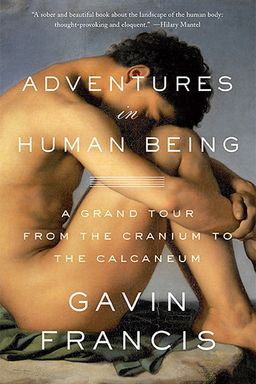
Adventures in Human Being cover

Adventures in Human Being

by Gavin Francis

Adventures in Human Being takes you on a fascinating journey through the human body, blending anatomical insights with cultural reflections. From the brain''s adaptability to the symbolism of the heart''s pulse, Gavin Francis offers a profound exploration of what makes us uniquely human, revealing the intricate connections between our physical selves and cultural identities.

The Human Body as Our Greatest Adventure

What if you could travel to the most mysterious landscape of all—one that you carry within yourself? In Adventures in Human Being, physician and writer Gavin Francis invites you on a journey through the body from head to toe, blending science, medicine, art, and philosophy. He argues that modern medicine, while technical and clinical, still echoes the ancient fascination with the body as a microcosm of the world—a landscape shaped by evolution, culture, and story. Just as maps once helped him decode geography, anatomy atlases became his way of understanding what it means to live, age, suffer, and heal.

Francis’s central claim is that studying and treating the body isn’t about machinery or data alone—it’s about exploring life’s most intimate geography. He sees the doctor’s role as both scientist and storyteller: a mapmaker of human experience who connects the physical with the emotional. Every encounter—whether in the brain, the lungs, or the womb—reveals not only how our organs work but how they shape our sense of self. Throughout the book, Francis blends clinical observation with history and cultural reflection, guiding readers through anatomy as if it were a landscape alive with myth, art, and memory.

Medicine as Exploration

Francis’s fascination began early: as a boy drawn to maps, he dreamt of charting new territories. Medicine, he discovered, was another form of exploration—an inner geography marked by rivers of blood, continental bones, and volcanic hearts. He compares veins to waterways, skin to terrain, and bones to minerals. Like geography, medicine reveals the interdependence of systems and the importance of orientation—where one stands and what one chooses to see. By shifting between patient stories and philosophical meditations, Francis emphasizes that knowing the body is also knowing the human condition.

A Humanistic Lens on Anatomy

While medical textbooks reduce the body to charts and Latin names, Francis turns anatomy into narrative. He shows how every organ has inspired art, myth, and moral reflection. The brain becomes a symbol of consciousness and mystery—Descartes seeking the “seat of the soul.” The face mirrors both expression and vulnerability, while the hands tell stories of creation and harm. In each chapter, Francis restores the sense of wonder that scientific knowledge often overshadows. By weaving literature into medicine—drawing on Homer, Leonardo da Vinci, Borges, and Whitman—he transforms clinical observation into a conversation about meaning.

The Body as a Mirror of Culture

Francis contends that the way we think about our bodies is culturally shaped. Ancient Greeks compared organs to cosmic elements, linking health to harmony. Renaissance artists saw divine geometry in anatomy, while modern science often portrays the body as a repairable machine. Yet, Francis resists the cold detachment of modern medicine. He reminds us that patients are not cases but stories—each with emotional topography and spiritual depth. Culture doesn’t just interpret the body; it inhabits it. From Tibetan medical rituals to Scottish clinics, he shows how healing always involves an act of faith—faith in medicine, in narrative, and in one another.

A Map Through Life, Death, and Wonder

At the heart of Adventures in Human Being is a paradox: the more Francis understands the body anatomically, the more mysterious it becomes. The book begins with the brain—where surgery touches both mind and soul—and moves downward through the lungs, heart, genitals, limbs, and feet. In each, he uncovers both fragility and resilience. A patient with Bell’s palsy reminds him of Leonardo da Vinci’s sketches of facial expression. The rhythms of the heart evoke poetry and music. A kidney transplant becomes an act of sacred gift-giving. A dying woman’s womb cancer becomes a meditation on mortality and compassion. In the end, Francis concludes that medicine is less about conquering illness than about deepening our understanding of what it means to be alive. The body, he writes, is “our most intimate landscape”—not just biology, but geography, story, and soul.


The Brain: Consciousness and the Soul

Francis opens his exploration with the brain, beginning where he first encountered it as a nineteen-year-old medical student, holding the organ that once held a person’s consciousness. It felt, he recalls, like “an algae-covered stone,” slippery and alive with history. This moment captures the awe at the center of his writing: how something so physical could contain thought, memory, and identity. The brain, he soon learns, is both mechanical and enigmatic—a network of neurons wired not just for movement, but for meaning.

Neurosurgery of the Soul

In one vivid story, Francis assists in a brain surgery to relieve epileptic seizures. The patient, “Claire,” must remain awake as the surgeon stimulates regions of her cortex to map where her speech and comprehension live. When the professor discovers the patch that halts her ability to speak, he declares it “eloquent brain.” This phrase, for Francis, is revelatory: our ability to express thought through sound exists on mere millimeters of tissue. The surgery, he realizes, is as much art as science—“neurosurgery of the soul.”

Such moments blur the line between mind and matter. When the surgeon removes the epileptogenic tissue—tossing it casually into a bin—Francis wonders what part of the woman’s self, her history or personality, might have gone with it. This meditation on identity echoes thinkers like Oliver Sacks and Antonio Damasio, who see the brain as the seat of storytelling: the organ through which the self narrates its continuity even as its substance changes.

Seizures, Sanctity, and Psychiatry

Francis widens his lens from the operating theater to psychiatry, tracing the history of how the brain has been seen as both sacred and profane. He recounts the invention of electroconvulsive therapy (ECT), from Paracelsus’s sixteenth-century shock remedies to twentieth-century machines that jolted patients into seizures. The treatment—controversial yet surprisingly effective for severe depression—forces him to confront medicine’s strange duality: healing that depends on controlled trauma. He contrasts early abuses of ECT with modern, sedated practice, where compassion and empathy determine outcomes as much as current and voltage.

In one moving case, he describes an elderly patient, Mr. Edwards, whose psychotic depression makes him believe his body is “rotting from within.” After ECT, Mr. Edwards awakens slowly, asking where he’s been, his despair replaced by calm awareness. This transformation, Francis notes, isn’t simply mechanical—it’s relational. Healing often arises not only from electricity but from human contact. The lesson mirrors Freud’s idea that “all physicians are continually practicing psychotherapy, even when unaware.”

Resacralizing the Brain

Across the two chapters on the brain, Francis urges a restoration of reverence. Ancient Greeks once saw seizures as sacred, evidence of divine touch. Modern neurology stripped away that mystery, leaving a purely clinical gaze. Francis proposes a synthesis: to treat the brain scientifically but honor it spiritually. For him, medicine at its best unites precision with compassion, acknowledging that each neuron carries both data and dreams. Healing, he concludes, begins when science remembers its human soul.


Vision, Faces, and the Human Connection

If the brain is the seat of consciousness, the eyes and face are its messengers. Francis moves from the inner organ to its outward portals—our gaze and expression. He examines how sight, beauty, and facial emotion shape our humanity, combining stories from patients, artists, and philosophers to show that perception is always a dialogue between body and soul.

A Renaissance of Vision

In the eye, Francis sees astronomy turned inward. As a family doctor peering through his ophthalmoscope, he’s struck by how the retina resembles a cosmic sky: veins as galaxies, spots as stars. He recalls how thinkers from Empedocles and Plato to Kepler and Newton sought the nature of light, often experimenting on their own eyes. When Borges, the blind writer of The Library of Babel, lost sight, he turned to imagination as vision’s successor—proof that human perception extends beyond the physiological. “Eyes,” Francis notes, “are our communion with the sun and stars.” (Similarly, John Berger, in Ways of Seeing, described looking as both an act of interpretation and reverence.)

The Expressive Face

Francis transitions to the landscape of the face—“the muscle map of the soul.” Drawing on Leonardo da Vinci and Charles Bell, he shows how art and anatomy intertwined to understand emotion. Da Vinci’s Last Supper captured twelve apostles reacting to betrayal, each facial muscle revealing inner turmoil. Bell’s 19th-century research on facial nerves, later praised by Darwin in The Expression of the Emotions in Man and Animals, revealed that each smile, frown, or grimace is a conversation between physiology and feeling.

The theory becomes personal when Francis meets Emily Parkinson, a patient with Bell’s palsy—a paralysis of one side of the face. As her expressions vanish, she feels socially invisible, her smile “like an ungrammatical sentence.” Through treatment, including steroids and even Botox, she struggles to reclaim her identity. Her final words—“I don’t want to live wearing a mask”—move Francis to reflect on authenticity: we are most alive when emotion and expression align. Later, he notes research confirming Darwin’s intuition: that shaping expressions can influence the feelings behind them.

Seeing and Being Seen

From the grace of cataract surgery to the tragedy of facial paralysis, Francis argues that vision and expression define how we connect. To see someone—truly see them—is to affirm their being. Healing, then, isn’t just biological; it’s recognition. Whether through restoring sight or acknowledging a person’s pain, doctors, like artists, give back the gaze. Francis’s portraits of Borges, Bell, and Emily remind us that medicine at its finest restores our capacity for both seeing and being seen.


Breath, Heart, and the Rhythms of Life

After exploring the head, Francis descends into the chest—the realm of lung and heart, where breath and pulse sustain us. These chapters, both poetic and clinical, trace how air and blood carry not only oxygen but meaning. The lungs speak of spirit; the heart, of emotion. In their rhythms, Francis hears echoes of language, music, and mortality.

The Breath of Life

The lungs, Francis writes, are “the interface between the physical and the spiritual.” Their Greek name, pneuma, means both air and soul. Through stories of patients, he shows how breath connects presence and absence. One man’s smoking-induced cough becomes a meditation on vitality leaking away; another patient’s final breath mirrors the “ebb and flow” of tides. In describing death by suffocation, Francis juxtaposes physiology with pathos—reminding us that even breathing, so automatic, is a privilege. When breath falters, we face what poets and mystics called spiritus—the essence that animates us.

Matters of the Heart

If lungs are the winds, the heart is the drum. Before stethoscopes, doctors pressed ear to chest, hearing directly the whispers of life. Francis revisits this intimate act, finding in the heart’s murmurs not just diagnosis but metaphor. He recounts patients in cardiac crisis—some revived by shock, others gently fading. The medical term for their terror, angor animi, means “anguish of the soul.” In one case, a patient senses death approaching minutes before her pulse fails. For Francis, such premonitions suggest that mind and heartbeat are attuned in mysterious ways.

He also describes poet Robin Robertson’s heart surgery, where circulation through a machine causes mental disorientation (“pump-head”). This blurring between body and mind raises profound questions: can identity survive mechanical interruption? The episode illustrates Francis’s recurring message—that the boundary between flesh and feeling is porous.

The Pulse of Existence

From Whitman’s verses to hospital corridors, Francis finds poetry in circulation. Our lives, he suggests, are sustained not by control but by rhythm—by the alternating systole and diastole of effort and rest, love and loss. Surgeons may replace valves, and machines may mimic the pulse, but they can’t replicate the human heartbeat’s emotional cadence. To listen to a heart is to listen to a life story: one that beats, falters, and tries again.


Healing, Art, and the Stories of the Body

Francis frequently steps back from diagnosis to ask: what does healing really mean? In the chapter on the breast, he contrasts the sterile efficiency of hospitals with the intimate, creative resilience of patients. Medicine, he argues, often repairs the body but neglects the soul. True healing, as seen through artists and patients alike, is a return to belonging—not just to health but to life itself.

Breast and Identity

In recounting a Scottish breast clinic, Francis observes how women’s experiences of cancer reveal cultural tensions around femininity and beauty. Yet he contrasts this clinical detachment with the collaboration between poet Kathleen Jamie and artist Brigid Collins. Their project Frissure transforms Jamie’s surgical scar into art—a map of healing drawn from nature. Through poetry and paint, the wound becomes not mutilation but metamorphosis: “a line that opens voice out of silence.” Francis uses this to argue that healing involves storytelling—turning injury into meaning.

Art as Medicine

Francis aligns this with the Renaissance belief that art and medicine spring from the same impulse: to study form and restore harmony. Just as Leonardo dissected faces to paint souls, Jamie translates trauma into metaphor. In both art and medicine, precision and empathy must coexist. Quoting Jamie, Francis writes that to heal isn’t to escape mortality but “to be released back into it.” Through this lens, even scars are beautiful—they testify to survival.

The Aesthetics of Recovery

By pairing a poet and a surgeon, Francis reframes healing as co-creation. He contrasts the clinic’s sterile pastel walls with the riotous natural imagery of Jamie’s work—flowers, rivers, birds, all metaphors for regeneration. Healing, in his vision, is interdisciplinary: it requires both scalpels and metaphors. Like John Berger before him, Francis calls on doctors to see patients as artists of their own recovery—to witness, not just treat. In doing so, he restores humanity to the clinical gaze.


Gifts and Gratitude: The Spirit of the Kidney

In one of the book’s most moving sections, Francis turns to the kidney—a humble organ that becomes, through transplant, a symbol of interconnection. The kidneys filter our blood, purify life, and remind us that survival depends on exchange. Through stories of donors and recipients, he explores the ethics and poetry of giving flesh to another.

A History of Sacrifice and Science

Francis begins with the evolution of kidney knowledge—from Renaissance anatomists who misconstrued its workings to modern pioneers like Willem Kolff, who built the first dialysis machine from orange-juice tins. Against this backdrop of scientific progress, he situates the intimacy of transplant surgery: the moment when a cold, gray organ, newly implanted, blushes pink with the recipient’s blood. Watching this reanimation, Francis sees not just physiology but resurrection—a secular miracle of renewal.

The Ultimate Gift

Transplantation raises profound moral questions: how do we honor the dead who give life? Francis recounts parents who, after losing their teenage daughter, choose donation as an act of love—her kidneys, liver, and corneas saving others. Through this story, he meditates on generosity that transcends mortality: in giving life, the dead live on. (Echoing Marcel Mauss’s The Gift, Francis suggests that such acts create invisible social bonds.)

He also meets David McDowall, an academic who donates a kidney to a stranger. McDowall calls it a “thanksgiving” for the health services that once saved him—a selfless gesture driven by gratitude, not gain. Francis frames this as a modern echo of ancient sacrifice: a ritual of interdependence reimagined through medicine.

From Sacred Stones to Stem Cells

To illustrate continuity between faith and science, Francis compares Tibetan and Celtic traditions of sacred stones—objects of healing—to modern organ preservation. The kidney’s chemistry and the pilgrim’s faith share a single language: care. He ends with artist Alec Finlay’s memorial for organ donors in Edinburgh, where sculpted stones represent transplanted organs, linking earth, body, and gratitude. In medicine’s most technical corner, Francis thus discovers its spiritual core: giving, receiving, and remembering that our lives are sustained by one another’s grace.


Birth, Death, and the Continuum of Care

Throughout Adventures in Human Being, Francis circles two thresholds: the entry into life and the passage out of it. His chapters on the womb, afterbirth, and dying bodies reveal medicine’s tender paradox—how beginnings and endings mirror each other, each demanding reverence rather than mastery.

The Womb and the Afterbirth

In delivering babies, Francis sees both miracle and routine. He marvels at the placenta’s architecture—its vessels braided “like roots in earth.” Yet he also notes modern culture’s estrangement from nature: placentas once buried or honored are now burned with hospital waste. Drawing on Herodotus’s account of cultural customs, he reminds readers that what one society deems sacred, another discards. Across Tibet, Russia, and China, families have long buried, eaten, or preserved afterbirth as a token of life’s continuity. Francis interprets these rituals as metaphors for connection—the human need to root ourselves in the world that births us.

Thresholds of Death

In counterpoint, he recounts the quiet death of Harriet Stafford, an elderly woman bleeding from womb cancer. The scene—lit by flickering lamplight, her family at the bedside—embodies medicine at its most humane. Francis doesn’t rescue her; he witnesses her dying, easing her pain with morphine and presence. When she exhales her final breath, he notes that her daughter’s sobs echo the first cries of a newborn. The cycle closes: breath in, breath out; arrival and release.

In these chapters, Francis bridges obstetrics and palliative care, suggesting that both demand humility before mystery. Healing doesn’t always mean survival. Sometimes, it means attending to life’s rhythm as it ends.

Continuity of Being

By juxtaposing birth and death, Francis restores medicine to its moral foundation: companionship. Whether cutting the umbilical cord or holding a dying hand, the doctor’s task is not domination but devotion—to witness the full arc of human being. In quoting Walt Whitman’s line, “I bequeath myself to the dirt,” he closes where he began: the body as landscape, endlessly cycling between flesh and earth, always an adventure.


The Doctor as Mapmaker of Humanity

In the epilogue, Francis brings his journey full circle, returning to his Edinburgh clinic. The doctor’s office, he writes, is a crossroads of countless stories—births, deaths, ailments, and recoveries. To map these lives is to chart the body’s geography and the human spirit’s terrain. As both physician and storyteller, he sees medicine not as a science of control but as a discipline of attention.

The Landscape of Care

Francis compares clinical work to cartography. Each day’s patient list is a topography of humanity: arteries of suffering, mountain peaks of resilience, and valleys of grief. His practice, like a small village, unites disparate worlds—students, elders, immigrants, the rich and the poor. Through their bodies he glimpses collective humanity, finding democracy even in death: the city graveyard where “the rich and poor lie side by side.” Here, medicine merges with contemplation. Healing, he realizes, begins in bearing witness to others’ fragility with compassion rather than judgment.

From Geography to Grace

Returning to his childhood love of maps, Francis notes that the human body remains his most rewarding landscape—an atlas of mystery he will never finish charting. For every diagnosis learned, there is a new story to hear. The physician’s work, like exploration, depends on curiosity and humility. In Whitman’s words, we “live by an invisible sun within us”; the doctor’s role is to keep that flame alive.

Medicine as a Moral Art

Francis concludes that medicine’s truest purpose lies in discerning connection—the pulse that links each life to the next. Technology may dominate modern clinics, but the essence remains ancient: to accompany others through their bodily adventures, understanding that in mapping their journeys, we navigate our own. As he walks through the graveyard near his surgery, watching the cycle of leaves, he sees confirmation of everything his travels taught him: that being human is to inhabit both body and story, mortality and wonder. The adventure, he writes, never ends.

Dig Deeper

Get personalized prompts to apply these lessons to your life and deepen your understanding.

Go Deeper

Get the Full Experience

Download Insight Books for AI-powered reflections, quizzes, and more.